Cortisol, Stress and Nutrition: Breaking the Cycle
Chronic stress is eating your nutrients. Every time your cortisol spikes, your body burns magnesium and B vitamins trying to manage the response. Your blood sugar destabilises. Your metabolism shifts toward fat storage. Your sleep worsens, which raises cortisol even higher. It's a cycle that feeds itself, and you can't think your way out of it. You have to feed your way out of it.

By Niall Kiddle, Founder, Organised

Reviewed by Pedro Rodrigues, Agronomist (farming and sourcing only) ·
6 min read · Published · Updated · 3 cited sources
Makers of the Organised Daily blend, a grass-fed beef organ supplement from regenerative UK farms

It's a cycle that feeds itself, and you can't think your way out of it. You have to feed your way out of it.

What cortisol does to your nutrients
Cortisol is your stress hormone. When you're stressed, it spikes. That spike triggers a cascade of metabolic changes designed to give you energy for fight or flight. Your blood glucose rises. Your heart rate increases. Your nervous system fires up.
But sustaining that state requires nutrients. Magnesium is depleted maintaining your neuromuscular system. B vitamins are used in the conversion of glucose to energy and in neurotransmitter synthesis. If you're chronically stressed, you're chronically depleted in these nutrients. The depletion itself makes it harder to manage stress. Stress depletes magnesium. Low magnesium worsens anxiety and tension. Stress makes the problem worse.
Add in the fact that most stressed people skip meals, eat processed food, and sleep badly, and you've got a perfect storm of nutrient depletion. You're running on empty and your body knows it.
The cortisol rhythm matters too. Normally, cortisol peaks in the early morning (that's what wakes you up) and gradually declines through the day, hitting its lowest point around midnight.1 Chronic stress flattens this curve. Your cortisol stays elevated all day and night. Your nervous system never actually switches off. You're perpetually in fight-or-flight mode. No wonder you're exhausted.
You can't meditate your way out of chronic stress if your magnesium is bottomed out. You have to feed the depletion first.
Magnesium and the stress response
Magnesium is responsible for over 300 enzymatic reactions in your body, with the largest concentration in your nervous system.2 When stress hits, magnesium is mobilised to manage the response. It helps your muscles relax. It dampens the amygdala, the fear centre of your brain. It supports GABA production, the calming neurotransmitter. When magnesium is depleted, you stay in a state of hypervigilance. Everything feels threatening. Sleep becomes fractured.
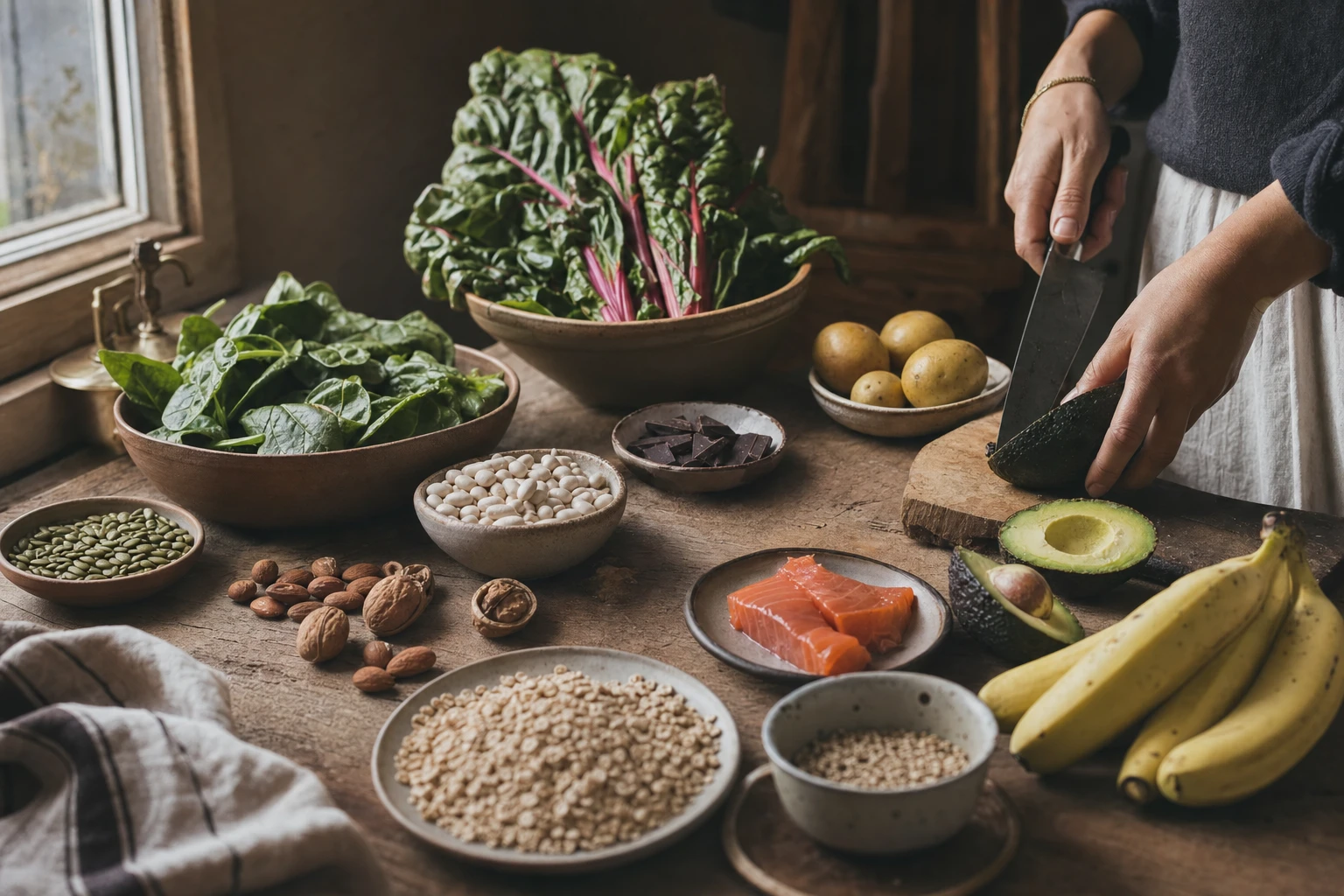
Most people in the modern world are magnesium-deficient. Magnesium is high in leafy greens (which most people don't eat enough of), in nuts and seeds (which most people over-consume in the form of seed oils rather than whole foods), and in mineral-rich water (which is rare in most tap water systems). If you're stressed, you need more magnesium than the average person, and you're likely getting less.
The fastest way to raise magnesium is through food and topical absorption. Leafy green vegetables cooked in broth with butter, pumpkin seeds, almonds, and cacao all provide it. Magnesium baths and sprays are also helpful. Most people experimenting with consistent magnesium intake (food plus topical) notice significant improvements in sleep, anxiety, and tension within two to three weeks.
The source matters. Food magnesium is better absorbed than supplemental forms, but if you're severely depleted, a high-quality magnesium supplement (glycinate is well-absorbed) can accelerate recovery. Magnesium citrate can have a laxative effect, so start low and increase gradually. Aim for around 300 to 400 milligrams daily through food, plus topical magnesium if you're severely depleted.
B vitamins and cortisol
B vitamins are cofactors in literally every metabolic step. When cortisol is chronically high, your B vitamin demand increases dramatically.3 B6 is required for neurotransmitter synthesis and stress hormone metabolism. B12 is required for energy production and nervous system function. Folate is required for DNA synthesis and neurotransmitter production. Pantothenic acid supports adrenal function.
B vitamins are found almost exclusively in animal foods, particularly organ meats. Beef liver is by far the richest source of B vitamins, containing far more than any plant food. If you're stressed and experiencing fatigue, brain fog, or mood changes, B vitamin deficiency is likely contributing. Eat liver weekly, preferably twice weekly. Eggs, red meat, and fish provide them too.
Unlike magnesium, B vitamins are water-soluble and you excrete excess, so supplementation can work if you're severely depleted. But food is better. Liver is non-negotiable if you're under chronic stress.
The B6 to B2 ratio matters too. Stress increases your B6 demand while potentially depleting your stores. A 100-gram serving of beef liver contains about 0.9 milligrams of B6 and 2.6 milligrams of B2. If you're severely stressed, consuming liver twice weekly ensures you're meeting these heightened demands. If supplementing, look for B-complex vitamins that contain all eight B vitamins in balanced ratios.
Get health guides like this, free
Two short reads a week on eating for energy, gut health, skin, sleep and more.
By signing up you agree to receive emails from us. No spam, unsubscribe anytime.
Blood sugar and cortisol
Cortisol raises blood glucose as part of the stress response.1 If you're chronically stressed, your blood glucose stays elevated. Elevated glucose damages your blood vessels and your nervous system. It also triggers insulin resistance, which further dysregulates your blood sugar. Low blood sugar then triggers more cortisol to bring glucose back up. Another cycle.
The fix is consistent, adequate carbohydrate intake. This sounds counterintuitive if you've been told to cut carbs, but chronically stressed bodies need carbohydrate to signal safety to the nervous system. Whole food carbohydrates like white rice, honey, fruit, and root vegetables signal abundance and safety. Your nervous system downshifts from fight-or-flight.
Pair carbohydrates with protein and fat (rice with butter, fruit with eggs, honey with meat) to stabilise blood glucose. Eat regularly. Don't skip breakfast or lunch. Skipping meals keeps cortisol elevated and your nervous system in a state of perceived scarcity.
The timing matters too. If you're under severe stress, eating a small carbohydrate snack with your breakfast (fruit, honey, white rice) can help reset your cortisol rhythm and signal to your nervous system that the threat is over. The effect is subtle but real over weeks and months of consistent practice.
If you're stressed, you need more magnesium, more B vitamins, and more stable blood sugar. Real food provides all three. Restriction makes it worse.



1 of 9
Daily blend
100,000+ thriving families4.9 on Trustpilot
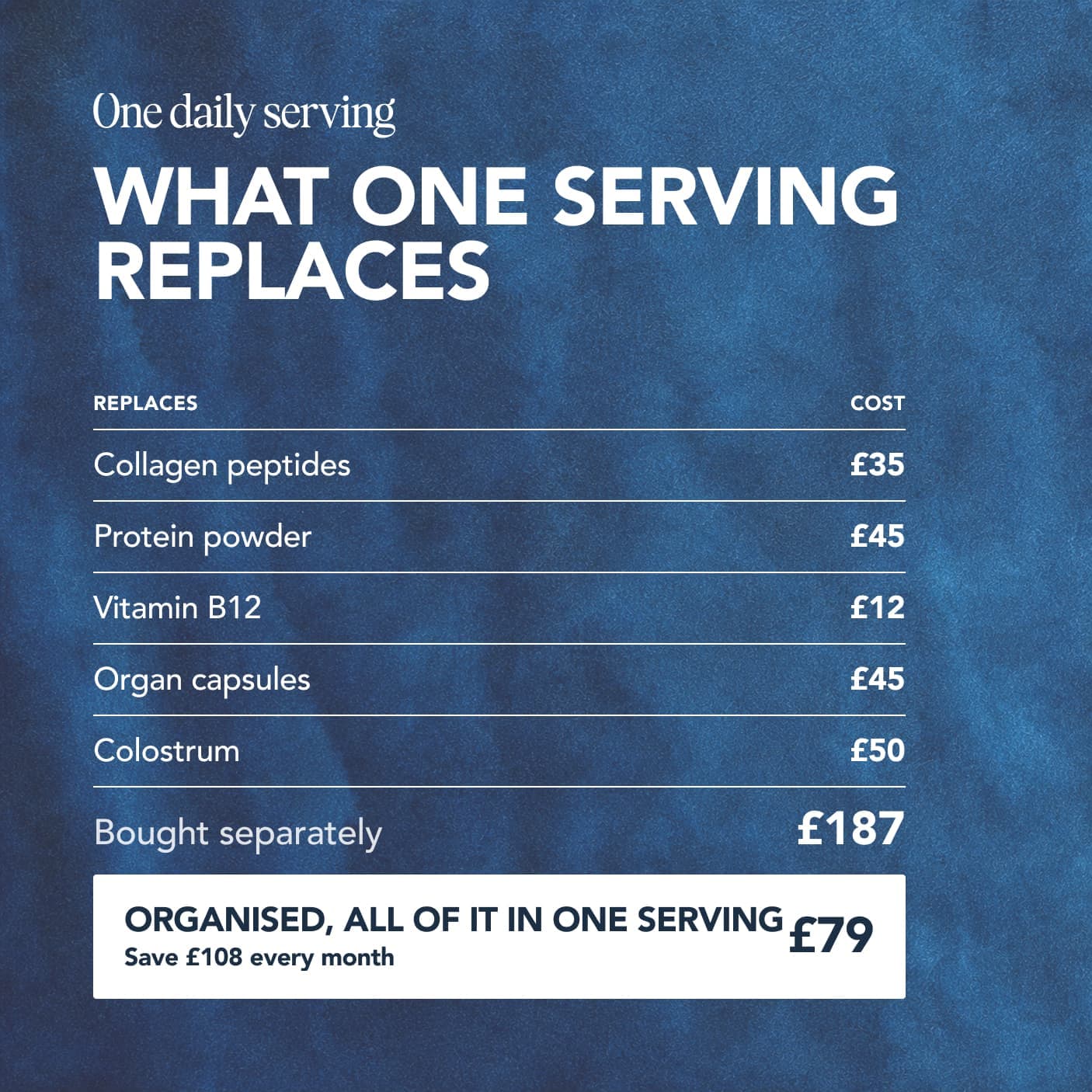
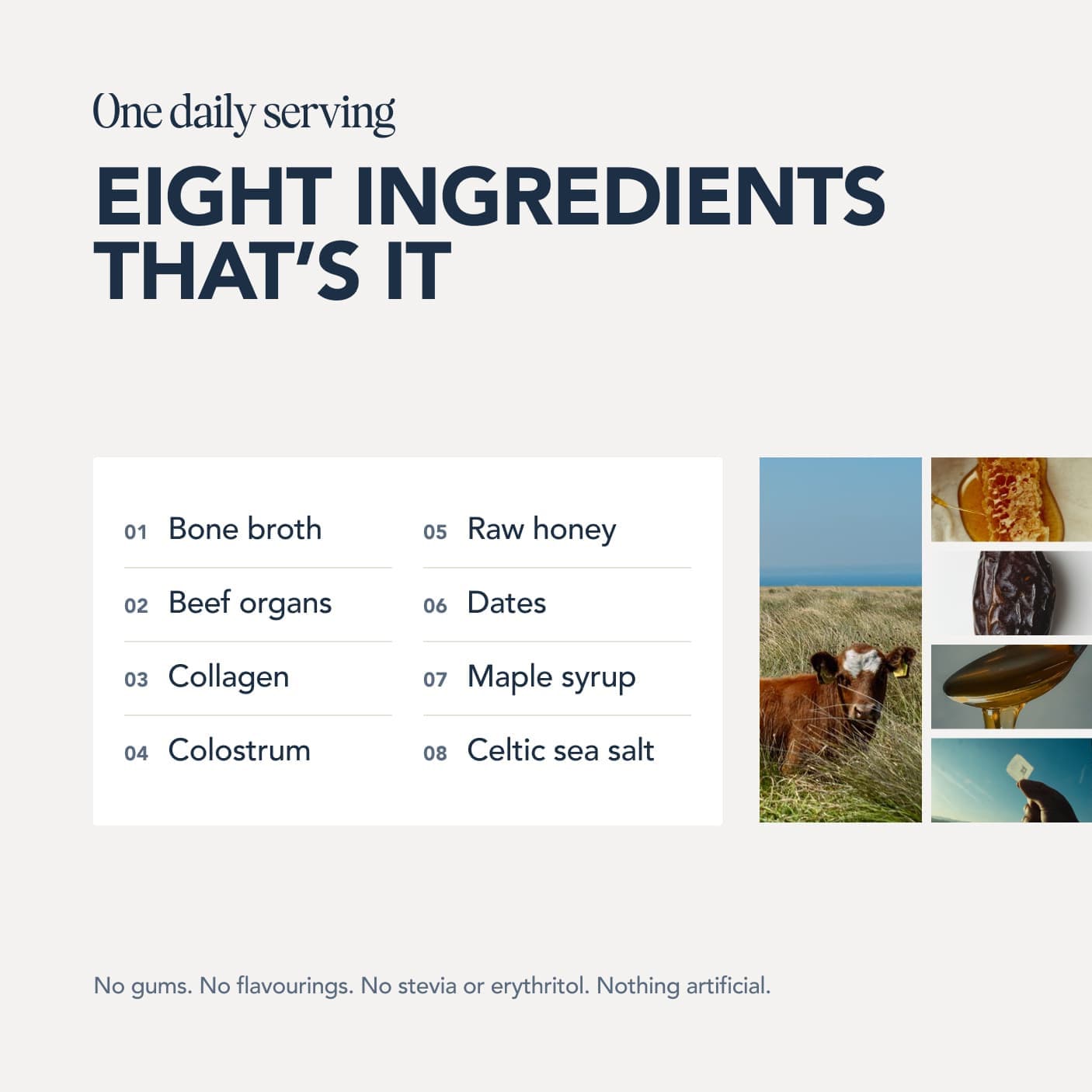
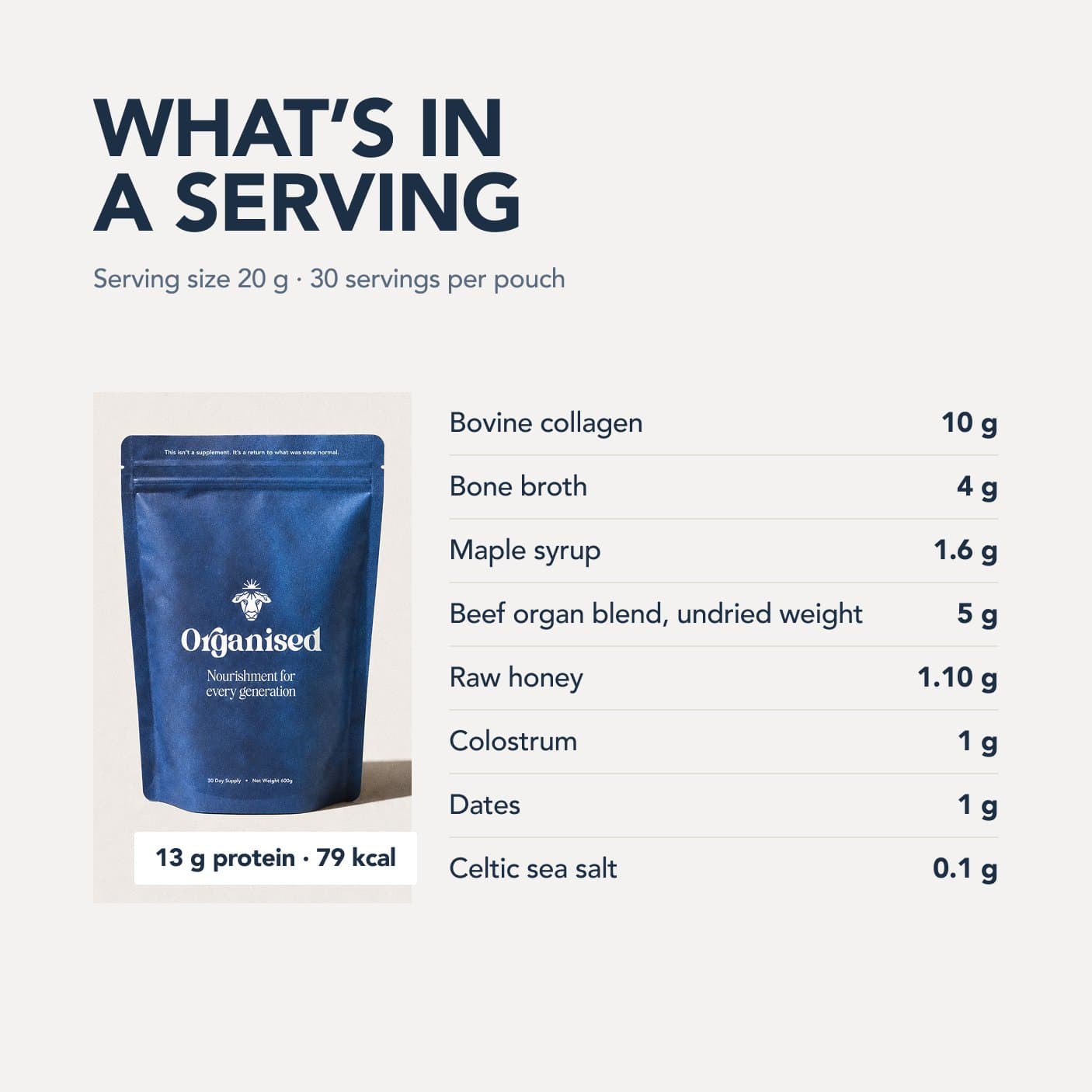
Eight real ingredients built around grass-fed beef organs, collagen and colostrum. Nothing synthetic added.
Free with your first order, worth £38. Plus £10 off the pouch with a subscription.


Free UK shipping · Made in England · 100 day money back guarantee on your first pouch · Skip, pause or cancel anytime
Breaking the cycle
If you're in a chronically stressed state, you need to interrupt the cycle at every point. Stop the external stressor if you can. But whether or not you can, you must address the nutritional component.
Eat liver twice a week. Add leafy greens cooked in broth with butter daily. Add magnesium-rich foods like pumpkin seeds and almonds. Eat eggs regularly. Eat fish. Stop skipping meals. Eat breakfast even if you're not hungry (appetite signals are disrupted by cortisol). Eat regular carbohydrates with each meal. Add sea salt to your food.
Cut seed oils completely. They drive inflammation, which activates the immune system, which raises cortisol. Cut ultra-processed food. Remove stimulants like excess caffeine. Sleep matters because poor sleep raises cortisol the next day. Rest is not laziness. Rest is medicine.
Expect noticeable improvements in anxiety and sleep within two to three weeks of consistent magnesium intake and nutrient-dense food. Real changes in stress resilience take four to eight weeks. You're rebuilding your stress-buffering capacity, which takes time.
This matters enough to be worth doing consistently. Your nervous system has learned to stay in survival mode. Teaching it that safety is possible requires patience and consistency. Feed it well. Sleep well. Rest well. Over time, your baseline cortisol will lower and your resilience will return.

The bottom line
Chronic stress depletes your nutrients, and nutrient depletion worsens stress. You break the cycle by feeding your depletion. Magnesium, B vitamins, stable blood sugar, consistent calories. These aren't supplements. They're foundational nutrition. Your resilience isn't broken. It's starved. Feed it.
References
Every source below was checked on 27 August 2026. Each PubMed, PMC and DOI identifier was resolved against NCBI or Crossref, and what it opens is printed under the citation, so you can see the link goes where the citation says without leaving the page. Where a citation and its identifier disagreed, the citation was corrected to the record or the reference was deleted along with the sentence marker that pointed at it, and where the resolved paper turned out not to support the sentence, the sentence was cut back to what it does support. Borrowed authority is worse than none, because it looks like rigour.
- Thau L, Gandhi J, Sharma S. Physiology, Cortisol. StatPearls [Internet]. Treasure Island (FL): StatPearls Publishing; 2023. https://www.ncbi.nlm.nih.gov/books/NBK538239/
- National Institutes of Health, Office of Dietary Supplements. Magnesium: Fact Sheet for Health Professionals. https://ods.od.nih.gov/factsheets/Magnesium-HealthProfessional/ [accessed May 2026].
- Kennedy DO. B vitamins and the brain: mechanisms, dose and efficacy—a review. Nutrients. 2016;8(2):68. https://pmc.ncbi.nlm.nih.gov/articles/PMC4772032/Checked 27 August 2026: PMC4772032 opens Kennedy DO, B Vitamins and the Brain: Mechanisms, Dose and Efficacy--A Review. Nutrients 2016;8(2):68. PubMed indexes it as: Review.
Who wrote and reviewed this guide
Niall Kiddle
Author · Founder, Organised
Niall is the founder of Organised. He started the company in 2024 after fixing his own health the slow way: in 2022 he swapped a cupboard of synthetic supplements for real food, raw milk, organ meats, bone broth and honey, and felt the difference within months.
Areas of expertise: Ancestral nutrition, Organ meats, Whole-food supplementation, Gut health, Regenerative sourcing
Read Niall's full profile
Pedro Rodrigues
Reviewer · Agronomist (farming and sourcing only)
Pedro is the agronomist Organised works with on farming and sourcing. His job on the guides is to keep the science honest: he reviews what we publish about soil health, regenerative agriculture, grazing and the way food is actually produced.
Areas of expertise: Regenerative agriculture, Agronomy, Soil health, Grass-fed farming, Food sourcing
Reviewed this guide on
Read Pedro's full profileMore on hormones
View all- Hormonal Health Starts in the Kitchen: A Whole Food Guide
- Perimenopause Nutrition: What Changes and What to Eat
- Coming Off the Pill? How to Support Your Body's Transition
- Eating for Each Phase of Your Menstrual Cycle
- How Blood Sugar Instability Wrecks Your Hormones
- How Liver Supports Oestrogen Detoxification
- How Seed Oils Disrupt Your Hormones
- Insulin Resistance: The Silent Metabolic Crisis
- Is Polyester Bad For Hormones? Your Guide To Hormone Safe Clothing
- PCOS and Nutrition: A Whole Food Approach
- Testosterone and Nutrition: What Men Need to Know
- Thyroid Health: The Nutrients Your Thyroid Needs to Function
Browse the guides library
All guidesKeep reading

Health goals
Hormonal Health Starts in the Kitchen: A Whole Food Guide
Your hormones are built from food. Learn the hormonal health nutrition basics that support oestrogen, progesterone, and thyroid, starting in your kitchen.

Health goals
How to Maintain Energy All Day Without Caffeine Dependency
Stop crashing after 3pm. Discover how to fuel sustained energy through the day using mitochondrial nutrition, stable blood sugar, and real food.

Health goals
Why Your Grandparents Ate Better Than You
Explore the nutritional shift since the 1970s. Your grandparents' whole-food diet contained far more nutrient density than modern food. Here's what changed.
Real food, made effortless
Start my daily blendA few ways to use it
All recipes
Raw Milk Hot Chocolate with Collagen
A nourishing evening hot chocolate made with raw milk, grass-fed collagen, raw cacao, and honey. A nighttime ritual that supports sleep and gut health.
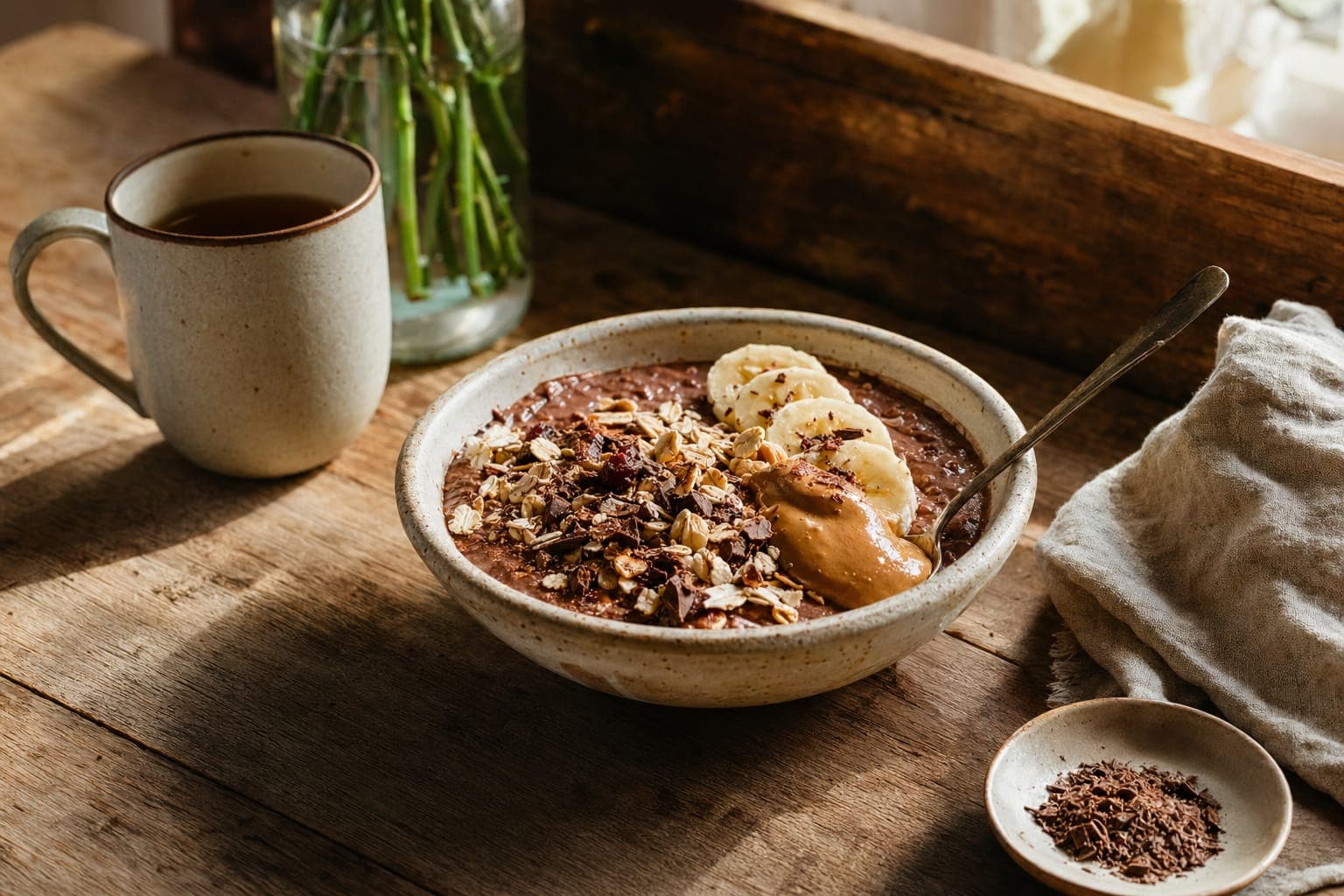
10 Ways to Use Organised That Aren't Just a Shake
Move beyond the basic shake. Discover 10 creative ways to use Organised in smoothie bowls, oats, yoghurt, baking, and more.

Ancestral Breakfast Ideas from Around the World
Traditional breakfast recipes from cultures that got nutrition right. Japanese, Turkish, Scottish, and more. Whole-food breakfast inspiration.


 Join over 100,000+ members
Build a better food system with us
The Organised community is thousands of people choosing real food and backing the farmers who grow it, all of us trying to leave the world a little better than we found it. If that is what you care about too, you belong here.