Endocrine Disruptors in Your Kitchen (And How to Avoid Them)
You eat clean. You avoid processed food. You source quality ingredients. And yet your hormone levels are still off. Your energy is poor. Your metabolism feels sluggish. And you're wondering what you're missing. The answer might not be in what you're eating. It's in what you're storing it in.

By Niall Kiddle, Founder, Organised

Reviewed by Pedro Rodrigues, Agronomist (farming and sourcing only) ·
7 min read · Published · Updated · 4 cited sources
Makers of the Organised Daily blend, a grass-fed beef organ supplement from regenerative UK farms

The answer might not be in what you're eating. It's in what you're storing it in.
What endocrine disruptors actually are
Endocrine disruptors are chemicals that interfere with your hormone system. They're not poisons (though high doses can be). They're substances that mimic hormones, block hormones, or alter hormone metabolism at incredibly low doses.
The problem is that your endocrine system operates at extremely low concentrations. Hormones are measured in picograms (trillionths of a gram). Endocrine disruptors can interfere with hormone signalling at similar concentrations. This means that a small amount of BPA or phthalates can meaningfully disrupt thyroid function, cortisol rhythm, oestrogen signalling, or testosterone production.
Most people think hormone disruption requires intentional poisoning. It doesn't. It requires daily exposure to low doses of disruptors, which is exactly what occurs when you eat food that's been stored in plastic, served on non-stick cookware, or heated in containers with problematic chemicals.
Endocrine disruptors work in tiny doses because hormones work in tiny doses. Your kitchen is a constant low-level exposure to chemicals that are directly interfering with your metabolic and reproductive function.
The research is consistent and troubling. Exposure to BPA during pregnancy alters offspring metabolism and fertility. Phthalate exposure is associated with reduced testosterone and altered sexual development. Non-stick chemicals accumulate in the blood and are linked to metabolic dysfunction. These aren't marginal concerns. They're foundational health issues.
BPA and its cousins
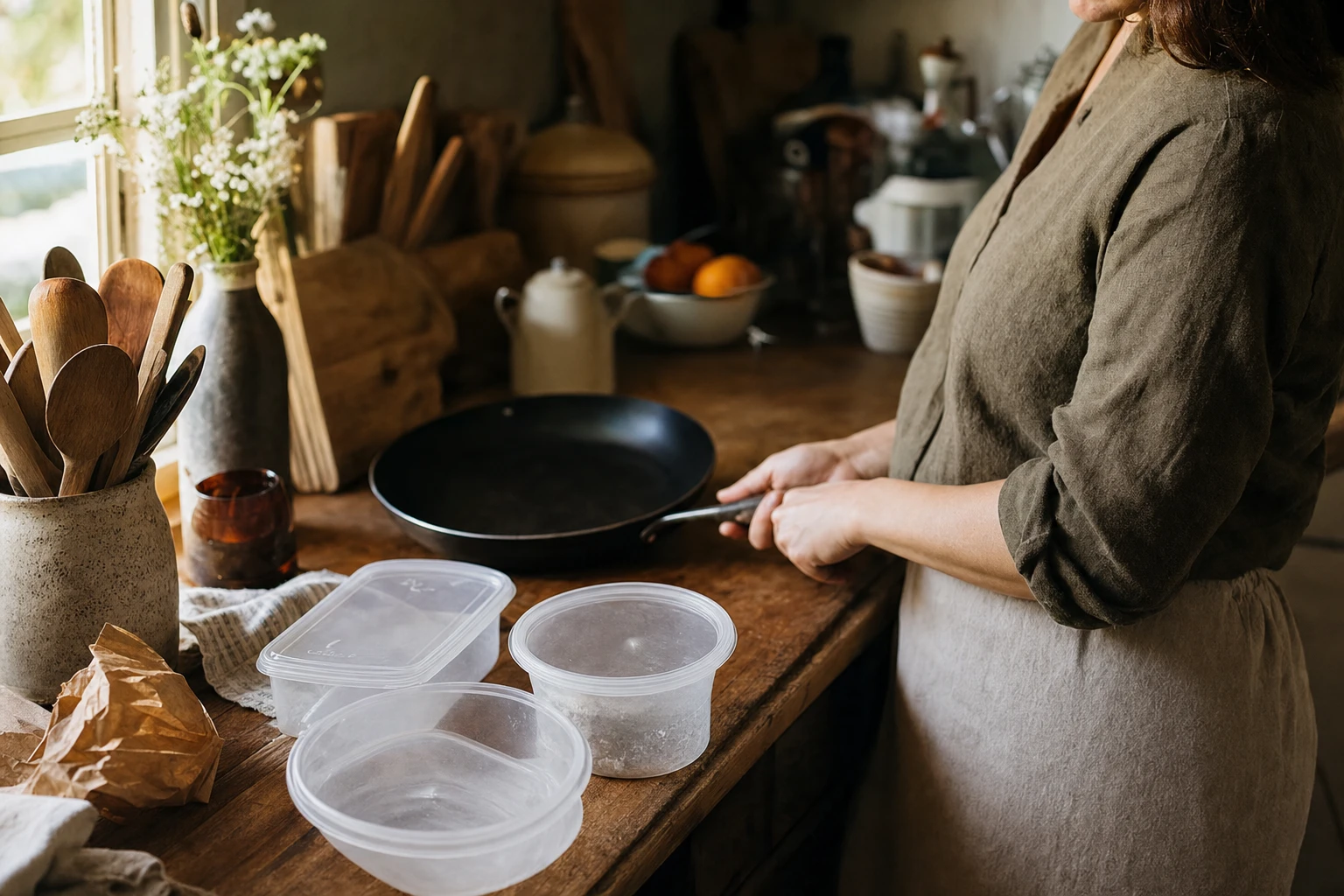
Bisphenol A, or BPA, is a chemical used to harden plastic and coat the inside of metal food cans. It leaches into food and water, particularly when heated or when the plastic is worn. BPA acts as an oestrogen mimic in the body, interfering with oestrogen signalling and disrupting multiple endocrine pathways.1
The scary part: BPA is labelled as "BPA-free" in many products, but the replacement chemicals are often worse. BPS (Bisphenol S) and BPF (Bisphenol F) were created as BPA replacements and are proving to be equally problematic, if not more so. "BPA-free" doesn't mean safe. It means containing different endocrine disruptors.
Sources of BPA: plastic bottles, plastic food storage containers, the linings of canned food and beverages, receipts from shops (thermal paper is coated in BPA), and some dental sealants. Every time you use plastic, you're potentially exposing yourself. Every time you heat food in plastic, you're accelerating the leaching.
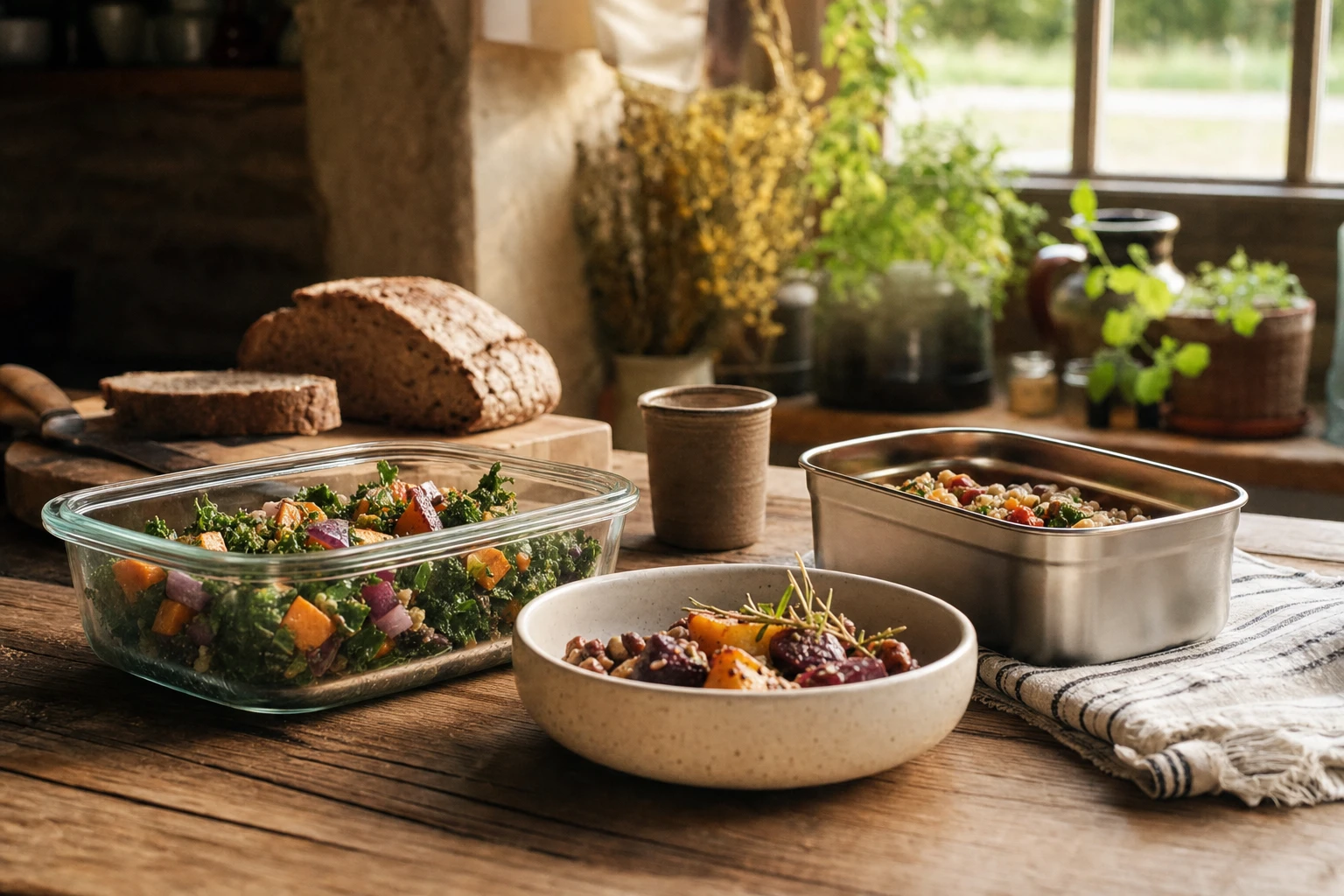
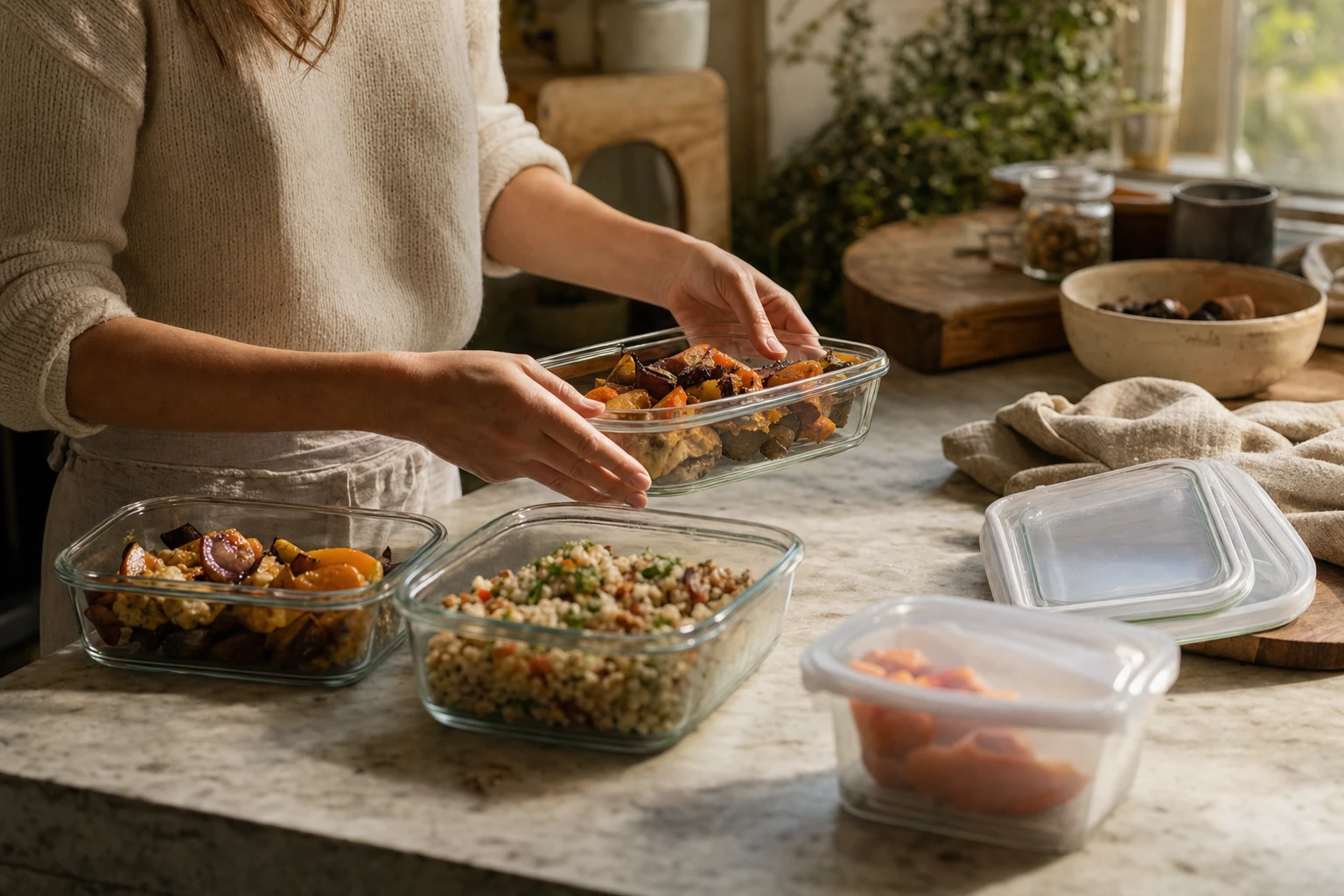
The solution: eliminate plastic food storage entirely. Use glass, stainless steel, or ceramic. Store bone broth and soups in glass containers, not plastic. If you must use plastic temporarily (transit, for example), keep it at room temperature. Never heat food in plastic. Never store hot food in plastic.
Glass and ceramic are your defaults. Plastic is the exception, and only at room temperature. This single swap reduces your BPA exposure by an estimated 50-80 per cent.
For canned foods: select products in glass containers if available, or accept that canned foods will contain some BPA. Bone broth in glass jars, tomatoes in glass, fish in glass. This costs more upfront but is worth the hormone protection.
The non-stick cookware problem
Non-stick cookware (Teflon, PTFE, and newer "forever chemicals") is coated with per- and polyfluoroalkyl substances, PFAS. These chemicals don't break down in the environment or in your body. They accumulate.2
When you cook with non-stick cookware, especially at high heat, PFAS leaches into food. Once ingested, PFAS accumulates in your liver, kidneys, and blood. Research links PFAS exposure to metabolic dysfunction, reduced thyroid function, altered kidney function, and disrupted lipid metabolism.
The problem is pervasive. Non-stick cookware is recommended everywhere. It's convenient. It reduces the need for oil. But the metabolic cost is substantial, particularly for people who cook daily in non-stick pans.
The solution is simpler than it sounds: cast iron, stainless steel, or ceramic cookware. Cast iron seasons naturally and becomes more non-stick with use. Stainless steel and ceramic require slightly more oil but are genuinely inert. Once you've made the swap, you'll never go back to non-stick. The quality of food cooked in cast iron is noticeably superior.
Non-stick cookware is a false convenience. You're trading a few minutes of extra scrubbing for chronic exposure to chemicals that are damaging your metabolism. The trade is not worth it.
Cast iron lasts for decades and improves with age. Stainless steel is nearly indestructible. The upfront cost is higher than non-stick, but amortised over years of use, it's cheaper and dramatically healthier. Quality cast iron or stainless steel is an investment in your endocrine health.

Get health guides like this, free
Two short reads a week on eating for energy, gut health, skin, sleep and more.
By signing up you agree to receive emails from us. No spam, unsubscribe anytime.
Phthalates and food storage
Phthalates are chemicals used to make plastic flexible. They're found in plastic films used to wrap food, in some plastic containers, and in cling film. Like BPA, phthalates are endocrine disruptors.3 They're particularly problematic because they're often not bonded to the plastic, meaning they leach readily into food, especially fatty foods.
Cheese wrapped in plastic film, oils in plastic bottles, fatty meats in plastic packaging: all of these are leaching phthalates into the food. The risk is highest with fatty foods because phthalates are lipophilic (fat-loving) and migrate readily into fat.
Phthalate exposure is associated with reduced sperm quality in men, altered sexual development in children, and metabolic dysfunction broadly. Like other endocrine disruptors, the dose response is non-linear. A small amount might have a larger effect than a larger amount would suggest.
The solution: transfer fatty foods out of plastic immediately. Buy butter, oils, and meat in plastic, but transfer to glass or ceramic containers for storage. Cling film is replaced with glass lids or beeswax wraps (though check beeswax wraps for phthalates too; natural is typically safer).
Fatty foods in plastic are phthalate sponges. Transfer them to glass within hours of purchase. This single swap significantly reduces your phthalate exposure.
The inconvenience is minimal. The health benefit is substantial. Within weeks of eliminating phthalate exposure, many people notice improved energy, clearer skin, and improved mood. These improvements suggest that endocrine function is recovering.
The receipt paper most people ignore
Thermal receipt paper (the paper from credit card terminals, ATMs, and shop tills) is coated with BPA or BPS to create the temperature-sensitive layer that produces the image. Every time you touch a receipt, you're transferring BPA to your skin.4
This seems trivial. But consider: a person who handles cash and cards daily might touch 10-20 receipts. Each receipt contains a moderate amount of BPA. The skin readily absorbs BPA, and cumulative exposure adds up.
The solution is straightforward: decline receipts when possible. If you need a receipt, ask for an emailed version. If you must touch a receipt, wash your hands after. For anyone handling receipts professionally (cashiers, shop workers), the cumulative exposure is genuinely concerning and warrants protective measures.
Receipts are a hidden source of BPA exposure that most people never consider. Declining receipts is an easy win in reducing endocrine disruptor exposure.
Some shops are moving to BPA-free thermal paper. Support those businesses. In the meantime, minimising receipt handling is a practical harm reduction strategy.




1 of 9
Daily blend
100,000+ thriving families4.9 on Trustpilot
Eight real ingredients built around grass-fed beef organs, collagen and colostrum. Nothing synthetic added.
Free with your first order, worth £38. Plus £10 off the pouch with a subscription.
Free UK shipping · Made in England · 100 day money back guarantee on your first pouch · Skip, pause or cancel anytime
Simple practical swaps
You don't need to overhaul your entire kitchen overnight. Start with the highest exposure items:
- Food storage. Replace plastic containers with glass. This is the single biggest source of BPA and phthalate exposure for most people.
- Cookware. Retire non-stick pans. Move to cast iron or stainless steel as they need replacing.
- Water bottles. Use glass or stainless steel, not plastic. If you must use plastic, keep water at room temperature.
- Cling film. Replace with glass lids or beeswax wraps. If you must use cling film, avoid contact with fatty foods.
- Receipts. Decline them or ask for email versions. Wash hands after handling.
- Canned foods. Prioritise glass containers when available. Accept some canned food exposure but don't make it routine.
These aren't extreme swaps. They're returning to the materials humans have used for cooking and food storage for thousands of years. Modern convenience created the problem. Old methods are the solution.
The cost of these changes is higher upfront but amortises quickly. A set of glass storage containers lasts years. Cast iron lasts decades. The endocrine protection is worth far more than the incremental cost.

The bottom line
Endocrine disruptors are not avoidable in the modern world, but they're reducible. The biggest sources are in your kitchen: plastic storage, non-stick cookware, cling film, and thermal receipts. Swap these for glass, cast iron, stainless steel, and beeswax, and you've removed the majority of your exposure.
This is particularly important if you're struggling with thyroid function, metabolic issues, hormonal imbalances, or fertility concerns. Your kitchen might be actively sabotaging your health. Fix the kitchen and the hormonal recovery can begin.
References
Every source below was checked on 27 August 2026. Each PubMed, PMC and DOI identifier was resolved against NCBI or Crossref, and what it opens is printed under the citation, so you can see the link goes where the citation says without leaving the page. Where a citation and its identifier disagreed, the citation was corrected to the record or the reference was deleted along with the sentence marker that pointed at it, and where the resolved paper turned out not to support the sentence, the sentence was cut back to what it does support. Borrowed authority is worse than none, because it looks like rigour.
- National Institute of Environmental Health Sciences. Bisphenol A (BPA). https://www.niehs.nih.gov/health/topics/agents/sya-bpa [accessed May 2026].
- U.S. Centers for Disease Control and Prevention. Per- and Polyfluorinated Substances (PFAS) Factsheet. https://www.cdc.gov/biomonitoring/PFAS_FactSheet.html [accessed May 2026].
- National Institute of Environmental Health Sciences. Endocrine Disruptors. https://www.niehs.nih.gov/health/topics/agents/endocrine [accessed May 2026].
- Hormann AM, Vom Saal FS, Nagel SC, et al. Holding thermal receipt paper and eating food after using hand sanitizer results in high serum bioactive and urine total levels of bisphenol A (BPA). PLoS ONE. https://pmc.ncbi.nlm.nih.gov/articles/PMC4206219/ [accessed May 2026].Checked 27 August 2026: PMC4206219 opens Hormann AM, Vom Saal FS, Nagel SC et al, Holding thermal receipt paper and eating food after using hand sanitizer results in high serum bioactive and urine total levels of bisphenol A (BPA). PLoS One 2014;9(10):e110509.The authors' own declaration, from the record: Competing Interests: The authors have declared that no competing interests exist.
Who wrote and reviewed this guide
Niall Kiddle
Author · Founder, Organised
Niall is the founder of Organised. He started the company in 2024 after fixing his own health the slow way: in 2022 he swapped a cupboard of synthetic supplements for real food, raw milk, organ meats, bone broth and honey, and felt the difference within months.
Areas of expertise: Ancestral nutrition, Organ meats, Whole-food supplementation, Gut health, Regenerative sourcing
Read Niall's full profile
Pedro Rodrigues
Reviewer · Agronomist (farming and sourcing only)
Pedro is the agronomist Organised works with on farming and sourcing. His job on the guides is to keep the science honest: he reviews what we publish about soil health, regenerative agriculture, grazing and the way food is actually produced.
Areas of expertise: Regenerative agriculture, Agronomy, Soil health, Grass-fed farming, Food sourcing
Reviewed this guide on
Read Pedro's full profileBrowse the guides library
All guidesKeep reading

Health goals
Insulin Resistance: The Silent Metabolic Crisis
Insulin resistance develops quietly, but the damage is profound. Here's how it happens and the whole-food strategies that actually work.

Health goals
Acne and Nutrition: What the Latest Research Says
Discover how dairy, processed foods, and nutrient deficiencies trigger acne. Evidence-based diet changes that actually work for clearer skin.

Health goals
Cortisol, Stress and Nutrition: Breaking the Cycle
Ongoing stress and high cortisol can deplete key nutrients. Learn the cortisol and stress nutrition steps that help you restore them and break the cycle.
Real food, made effortless
Start my daily blendA few ways to use it
All recipes
10 Ways to Use Organised That Aren't Just a Shake
Move beyond the basic shake. Discover 10 creative ways to use Organised in smoothie bowls, oats, yoghurt, baking, and more.

Bone Broth from Scratch: A Step-by-Step Guide
Step-by-step guide to making bone broth at home. Stovetop, slow cooker, and Instant Pot methods. Rich in collagen and gut-healing minerals.

How to Make Your Own Gelatine Gummies
A simple recipe for homemade gelatine gummies using grass-fed gelatine, fresh juice, and raw honey. Better than shop-bought, kids love them.


 Join over 100,000+ members
Build a better food system with us
The Organised community is thousands of people choosing real food and backing the farmers who grow it, all of us trying to leave the world a little better than we found it. If that is what you care about too, you belong here.