Postpartum Hair Loss: Why It Happens and How to Recover
Three months after birth, you step out of the shower and the drain is clogged with hair. You run your fingers through your hair and ten strands come away. You panic. This is postpartum telogen effluvium, and if you're a new mother experiencing it, you're not alone. And it's not permanent. Your hair fell out for a reason. Understanding that reason is how you grow it back.
By Niall Kiddle, Founder, Organised

Reviewed by Pedro Rodrigues, Agronomist (farming and sourcing only) ·
6 min read · Published · Updated · 5 cited sources
Makers of the Organised Daily blend, a grass-fed beef organ supplement from regenerative UK farms
This is postpartum telogen effluvium, and if you're a new mother experiencing it, you're not alone. And it's not permanent. Your hair fell out for a reason. Understanding that reason is how you grow it back.

What actually causes postpartum hair loss
During pregnancy, elevated oestrogen keeps your hair in a prolonged growth phase.1 You have thicker, fuller hair than you've ever had. That pregnancy hair glow is real, and it's biochemical. The high oestrogen extends the anagen (growth) phase of hair follicles. More hairs are growing simultaneously. Fewer are shedding. The result is visibly thicker hair that feels extraordinary.
At birth, oestrogen crashes. Violently. Within days, your hormones plummet to pre-pregnancy levels. This hormonal shift signals hair follicles to move from growth phase into resting phase. That's when shedding happens. Three months postpartum is when the shedding peaks, which is why you're noticing it now.1 The timing is predictable and the mechanism is reliable.
But here's the part nobody talks about: that shedding wouldn't be so aggressive if pregnancy hadn't depleted you of iron.
Postpartum hair loss is not inevitable. It's a sign of post-pregnancy nutritional depletion, specifically iron deficiency.
During pregnancy, your blood volume increases 50 percent to supply the growing foetus.2 You're literally losing iron into the womb as your blood expands. If you don't have robust iron stores to begin with, pregnancy depletes them further. This is why pregnant women who start with low ferritin end labour in severe deficiency.
Birth itself causes additional blood loss, meaning iron loss. Women lose on average 500 millilitres of blood during vaginal delivery, 1000 millilitres during caesarean.3 That blood contains iron. Then breastfeeding pulls minerals out of your body to feed your infant. Iron, zinc, copper, selenium all deplete into breast milk. Your body sacrifices your hair for your baby's nutrition. This is biology. Your body is designed to do this. But it only works if you replete nutrients immediately.
The result is severe iron deficiency three to six months postpartum. And iron deficiency makes hair fall out far more aggressively than the hormonal shift alone would cause.
Iron depletion is the core issue
Your thyroid requires iron to convert T4 into T3, the active form that regulates metabolism and hair growth. Without adequate iron, thyroid function tanks immediately. Hair follicles sense the thyroid suppression and enter resting phase prematurely. That's when shedding accelerates catastrophically.
Additionally, iron is essential for the enzyme that builds haemoglobin. Your red blood cell count drops postpartum due to blood loss. Without adequate iron, you can't rebuild those cells. Your red blood cell count stays low, meaning less oxygen delivery to tissues, including hair follicles. Follicles suffocate slowly and fall out.
A simple blood test checking ferritin (stored iron) will show the truth.4 Most postpartum women are severely iron-deficient, ferritin below 15 micrograms per litre. That's not just low. That's depleted. It's the kind of deficiency that causes fatigue, mood swings, brain fog, and massive hair loss.
If you're losing hair postpartum, your ferritin is almost certainly below 20. Your hair is starving for iron.
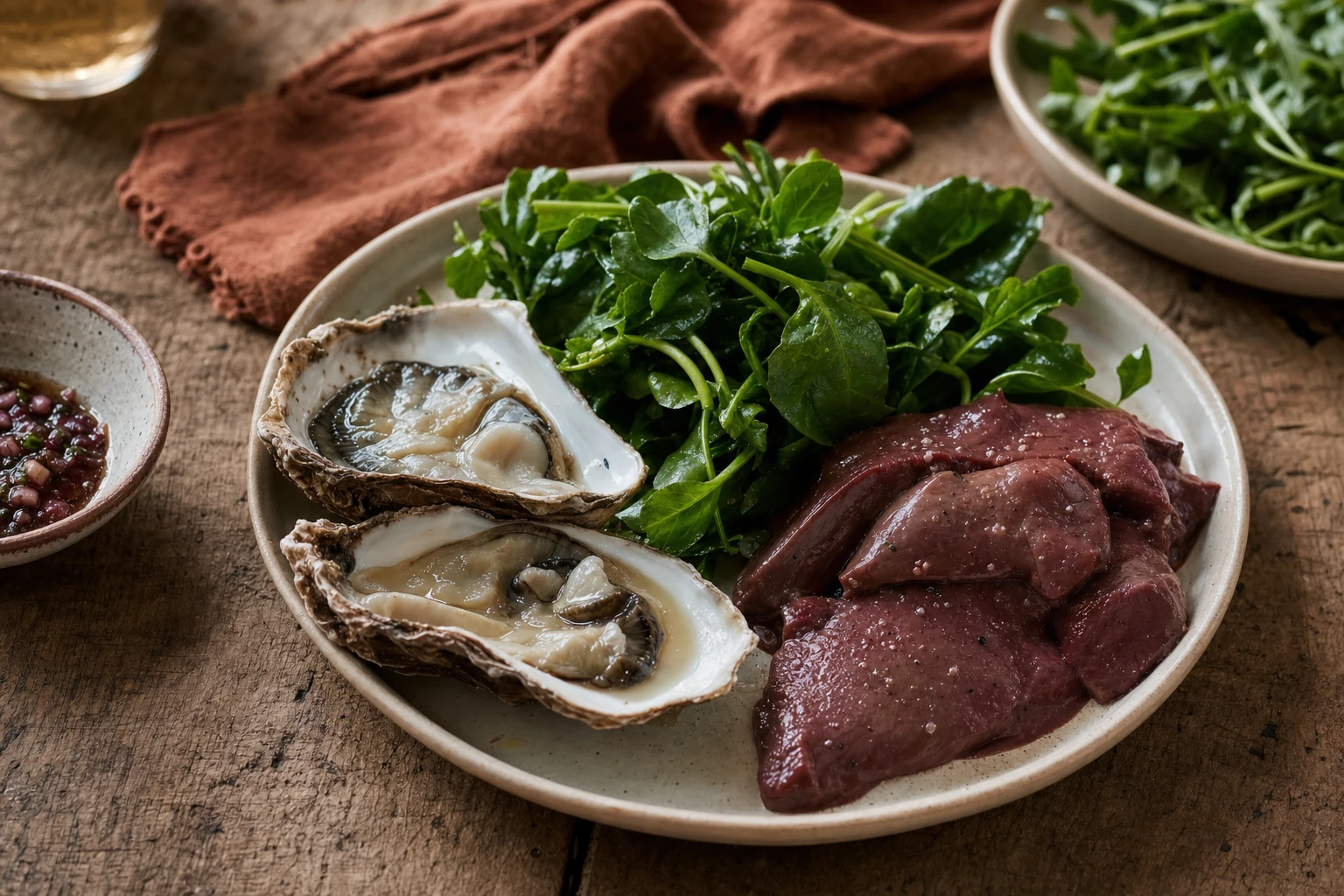
Iron supplementation can help, but here's the critical difference: iron from food is absorbed better than iron from supplements, especially if your digestion is compromised from birth recovery, hormonal shifts, and stress. You need haem iron. Red meat, organ meats, shellfish. These are the iron sources your body will actually absorb and use efficiently.5
Hormonal shifts and recovery
The hormonal crash is temporary. Oestrogen doesn't stay crashed. But recovery is slow. It can take six to twelve months for hormones to fully stabilise, especially if you're breastfeeding. Breastfeeding prolactin suppresses oestrogen recovery. The longer you breastfeed, the longer oestrogen stays low.
Here's what's important to understand: you cannot fight this hormonal shift through supplementation or lifestyle hacks. You can't hack your way to higher oestrogen by taking supplements. But what you can do is ensure your body has the iron and nutrients it needs to tolerate the hormonal shift without shedding excessive hair.
That's why the nutritional intervention is critical right now. Whilst hormones are shifting, feed your hair follicles the iron they need to stay rooted. That's how you minimise shedding and accelerate regrowth when hormones stabilise.
You can't control the hormone shift. You can control whether your hair follicles have the iron they need to survive it.
Stress management also matters enormously. Chronically elevated cortisol from new-mother sleep deprivation literally shifts hair follicles into resting phase independently of iron status. If you can carve out time for rest, for genuine sleep (not just time in bed), for moments of calm, your cortisol drops and hair recovery accelerates.
Get health guides like this, free
Two short reads a week on eating for energy, gut health, skin, sleep and more.
By signing up you agree to receive emails from us. No spam, unsubscribe anytime.
The nutrition plan for regrowth
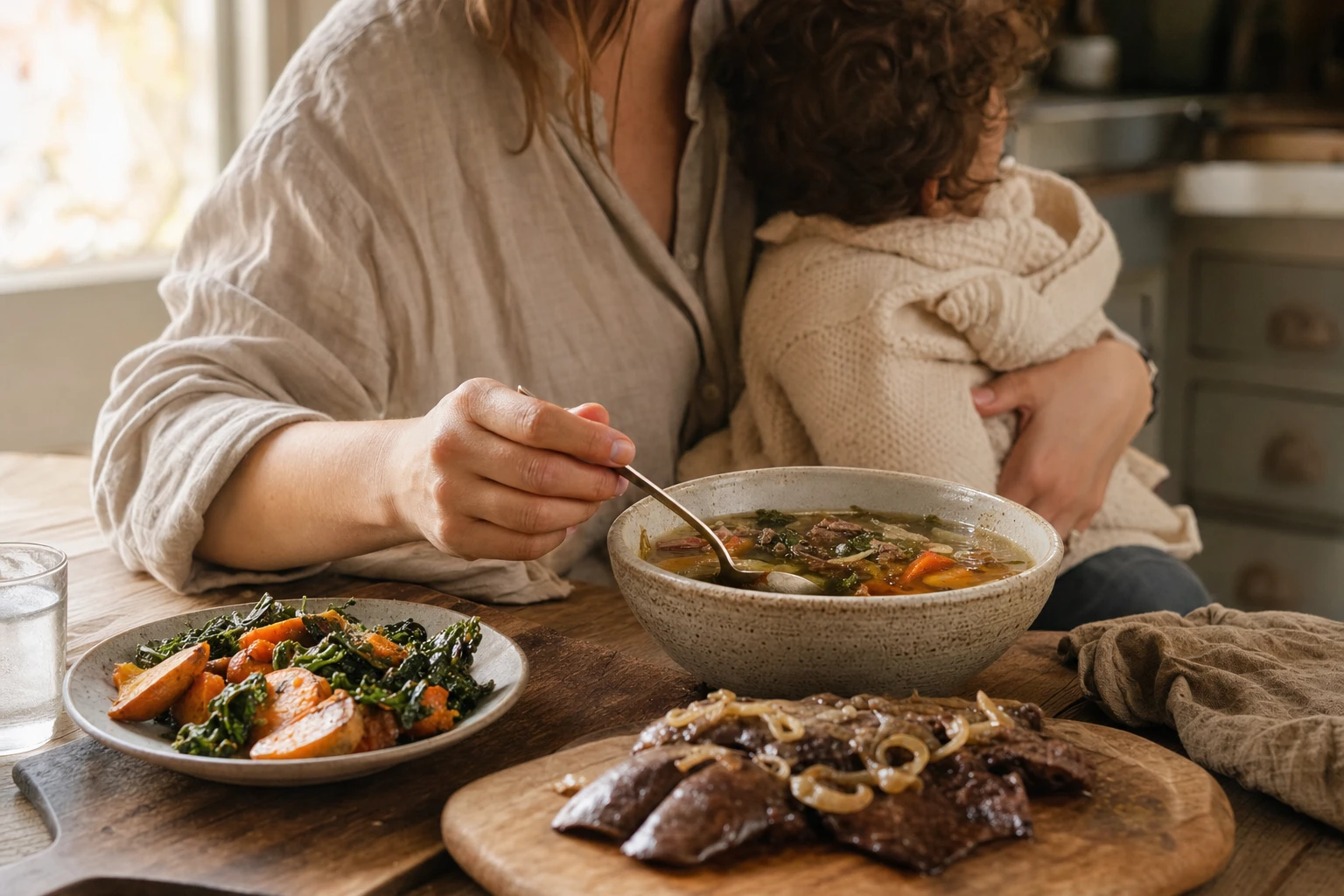
Postpartum nutrition is not optional. This is the time to eat like your hair depends on it. Because it does.
Iron-rich foods should appear at every meal. Beef, particularly organ meats. Liver contains the highest concentration of iron per gram of any food. A 100-gram serving of liver twice weekly is the single most effective intervention for postpartum hair loss. The iron is haem iron, immediately bioavailable.
Oysters and clams deliver iron and zinc. Eggs provide choline, which supports hair growth and liver function. Bone broth made from beef bones delivers collagen, minerals, and gelatin. A mug daily for the next three months changes hair recovery timeline dramatically.
Full-fat dairy, if you tolerate it and aren't breastfeeding, provides fat-soluble vitamins and minerals. But if you're breastfeeding, ensure you're eating enough overall calories and protein to support milk production. Your body will sacrifice your hair before it sacrifices milk production.
Three iron-rich meals daily for three months. That's liver twice weekly, red meat multiple times, oysters when possible, bone broth daily, eggs at breakfast. That's the protocol.
Vitamin C enhances iron absorption substantially. Orange juice, berries, leafy greens alongside iron sources. Avoid coffee and black tea within two hours of iron meals. These reduce iron absorption by up to 50 percent.5
Zinc is also critical. Oysters, beef, pumpkin seeds. Zinc depletion occurs postpartum, particularly if you're breastfeeding. Zinc is lost in breast milk. Replete it aggressively.
Selenium, copper, and iodine are equally important. Organs, shellfish, sea vegetables. These aren't exotic additions. They're the foods that new mothers ate for millennia before formula and supplements existed.
1 of 9
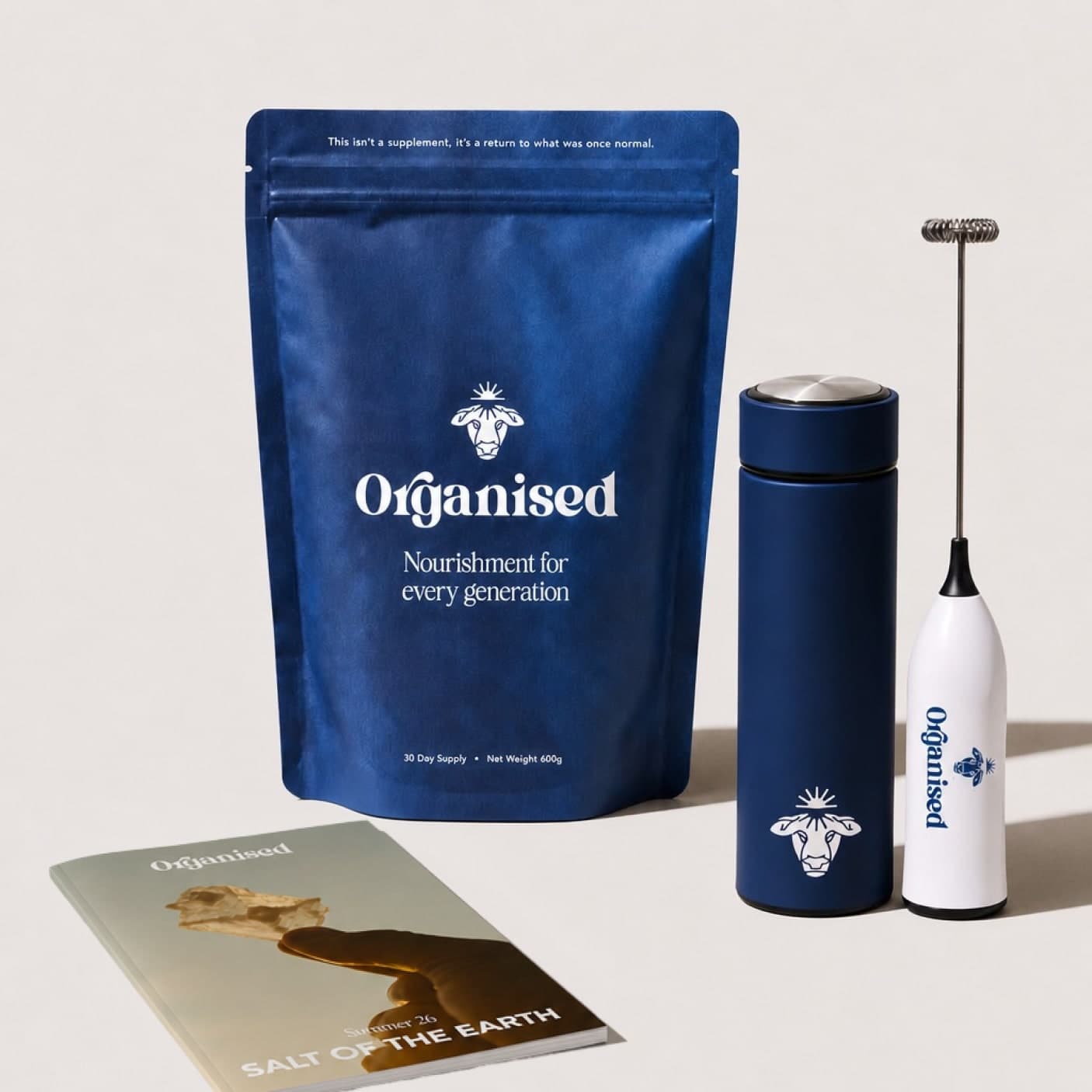
Daily blend
100,000+ thriving families4.9 on Trustpilot
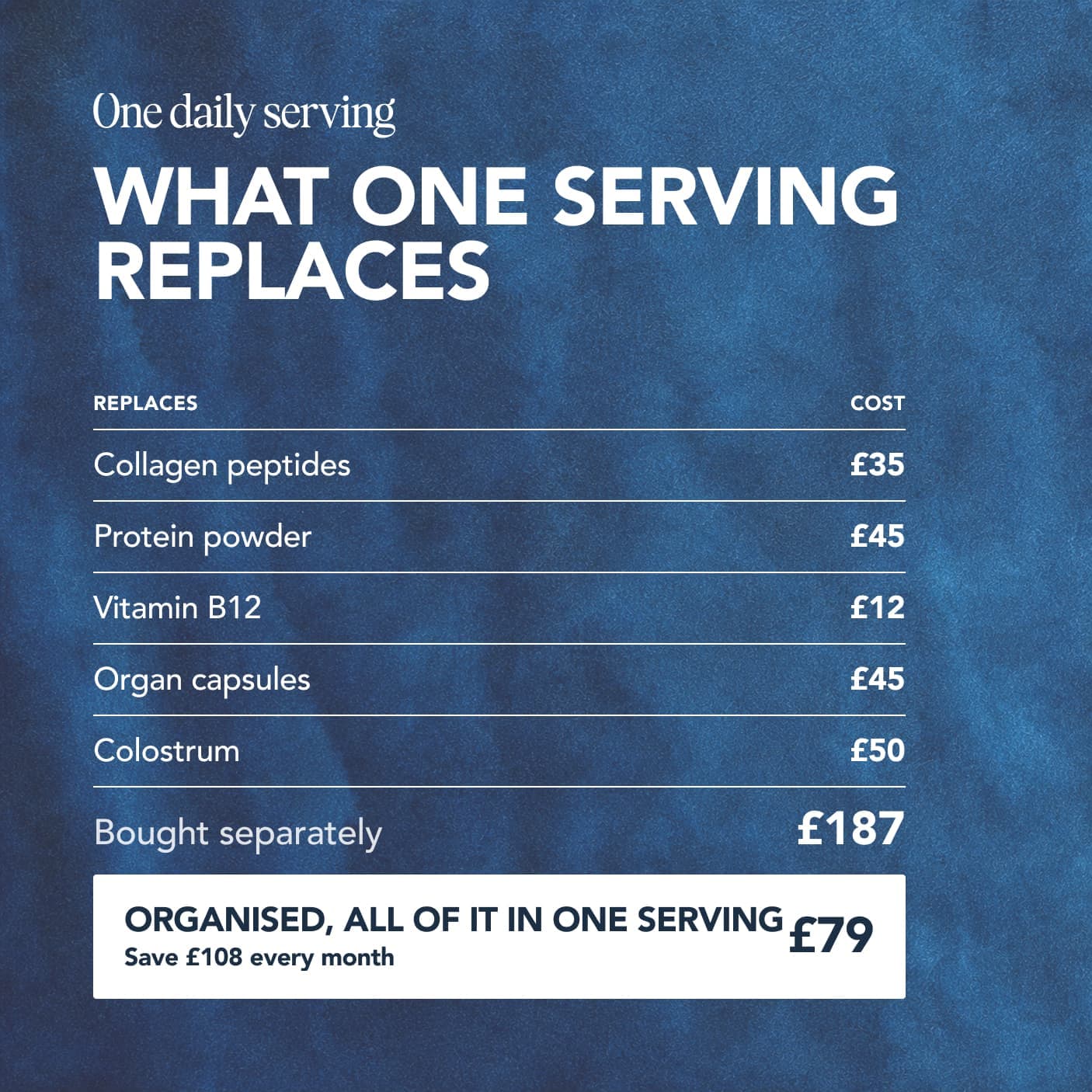
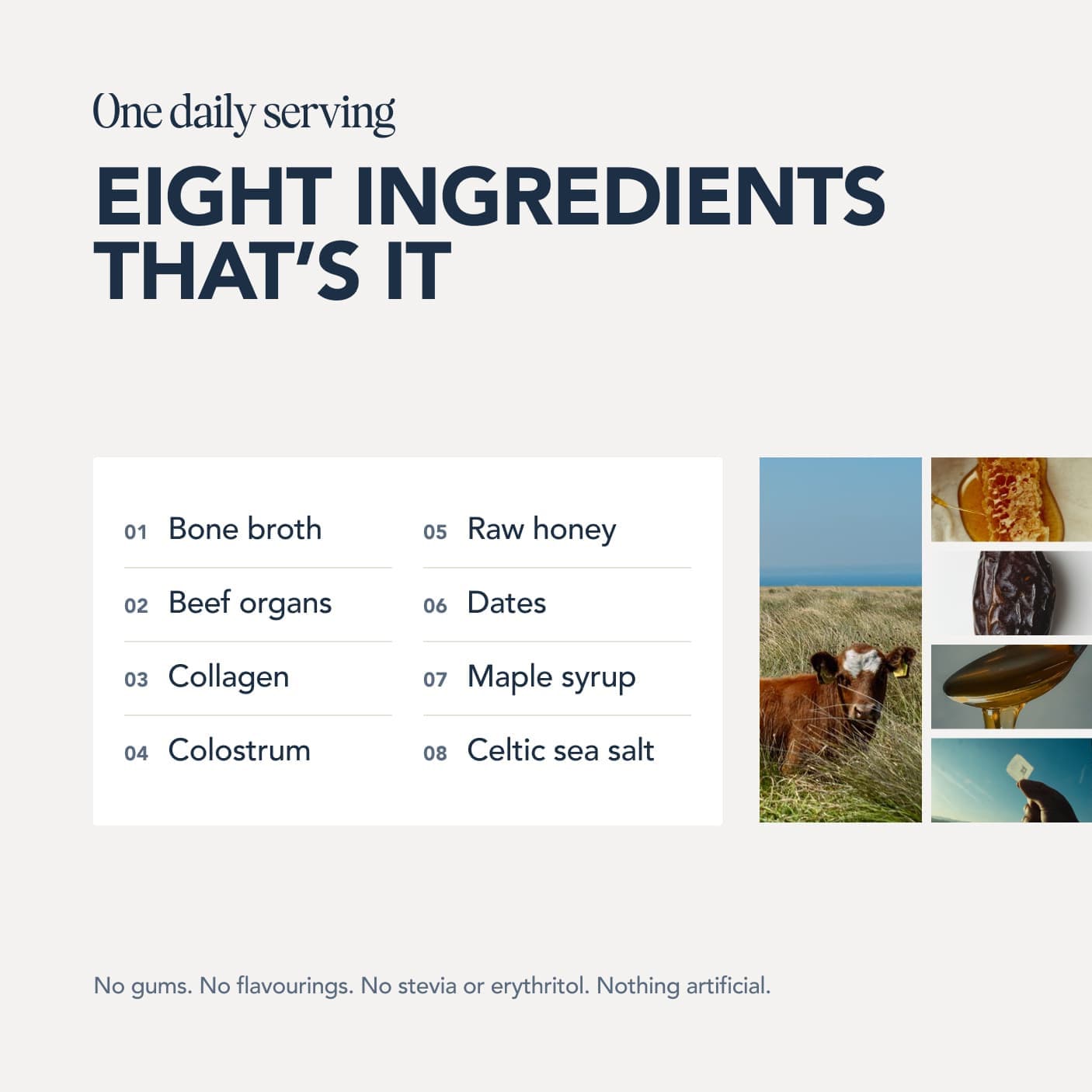
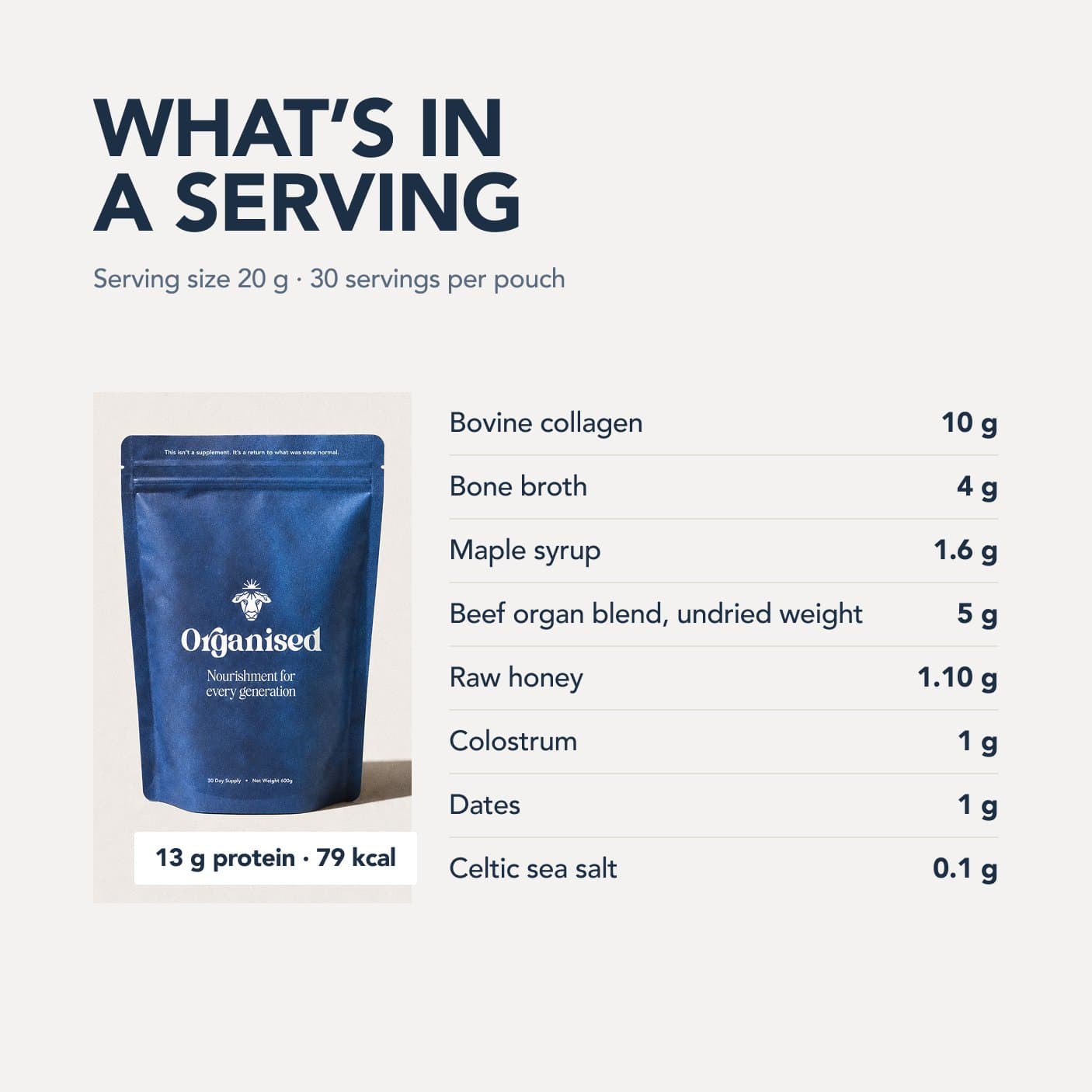
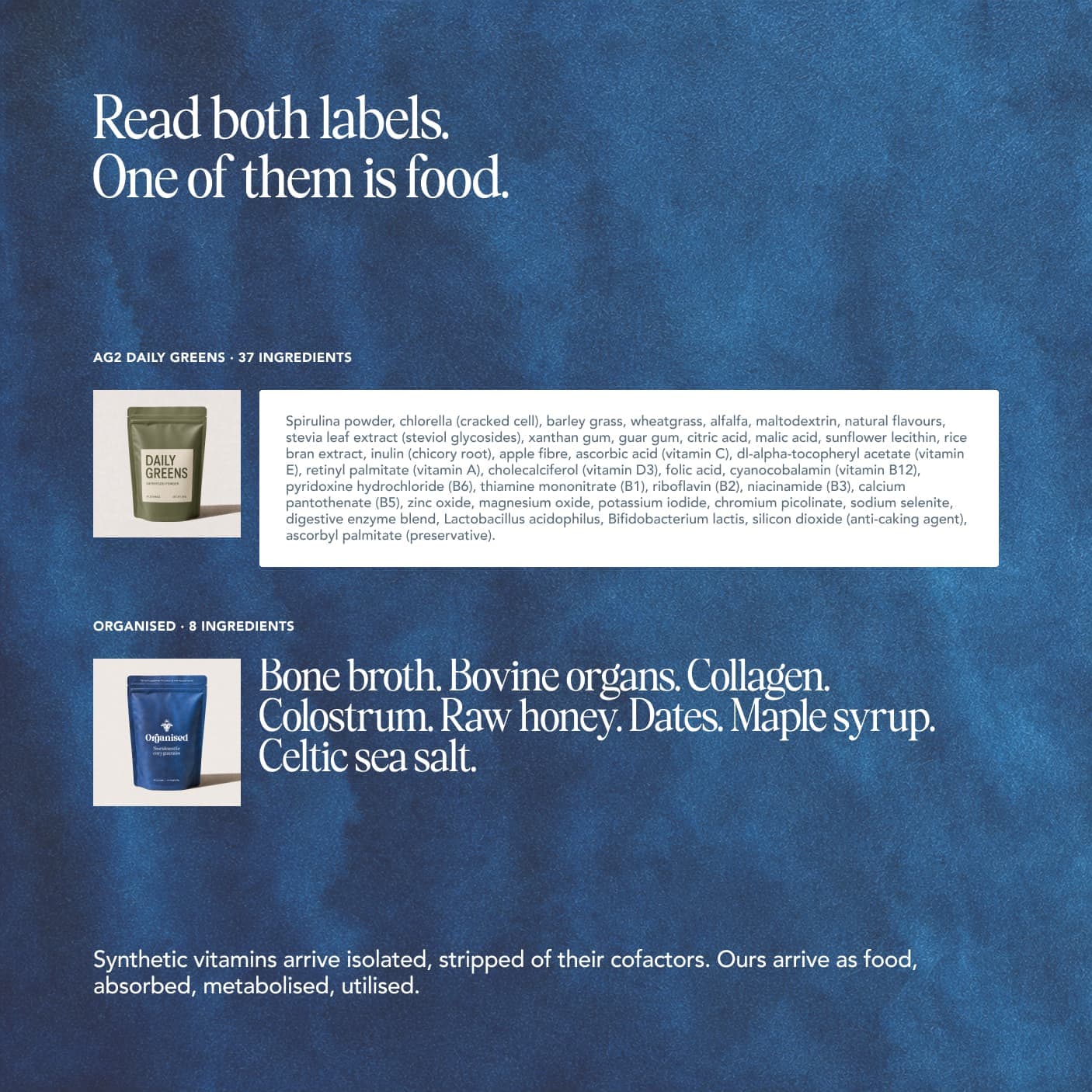
Eight real ingredients built around grass-fed beef organs, collagen and colostrum. Nothing synthetic added.
Free with your first order, worth £38. Plus £10 off the pouch with a subscription.
Free UK shipping · Made in England · 100 day money back guarantee on your first pouch · Skip, pause or cancel anytime
The support system
Hair recovery requires you to be fed. You cannot do this alone on chaos sleep and stress. You need support. If you have family or friends who can cook for you, let them. If you can afford a postpartum doula or meal service, that investment in your health is worth it. Your hair recovery depends on whether you're adequately nourished.
Ask for help specifically: "I need someone to bring me beef and organs." People want to help. Tell them exactly what you need.
The bottom line
Postpartum hair loss is not a cosmetic issue. It's a nutritional signal. Your body is telling you it's depleted, and your hair is the messenger. The good news is it's entirely reversible. Feed yourself iron, minerals, protein, and fat for the next three months. Sleep when you can. Stress less if possible, though new motherhood resists this.
By month six postpartum, if you've been consistent with the nutrition, your ferritin will be restored, your thyroid function will normalise, and your hair will stop falling out. New growth will be visible by month nine. By month twelve, you'll have your pre-pregnancy hair thickness back, maybe better, because you've learned what real nutrition looks like. You're not failing. Your body isn't broken. It's asking for food.
References
Every source below was checked on 27 August 2026. Each PubMed, PMC and DOI identifier was resolved against NCBI or Crossref, and what it opens is printed under the citation, so you can see the link goes where the citation says without leaving the page. Where a citation and its identifier disagreed, the citation was corrected to the record or the reference was deleted along with the sentence marker that pointed at it, and where the resolved paper turned out not to support the sentence, the sentence was cut back to what it does support. Borrowed authority is worse than none, because it looks like rigour.
- Gizlenti S, Ekmekci TR. The changes in the hair cycle during gestation and the postpartum period. J Eur Acad Dermatol Venereol. 2014;28(7):878-81. PMID: 23682615.Checked 27 August 2026: PMID 23682615 opens Gizlenti S, Ekmekci TR, The changes in the hair cycle during gestation and the post-partum period. J Eur Acad Dermatol Venereol 2014;28(7):878-81. PubMed indexes it as: Comparative Study.
- Sanghavi M, Rutherford JD. Cardiovascular physiology of pregnancy. Circulation. 2014;130(12):1003-8. PMID: 25223771.Checked 27 August 2026: PMID 25223771 opens Sanghavi M, Rutherford JD, Cardiovascular physiology of pregnancy. Circulation 2014;130(12):1003-8. PubMed indexes it as: Review.
- National Institute for Health and Care Excellence (NICE). Intrapartum care for women with existing medical conditions or obstetric complications and their babies (NG121).
- Trost LB, Bergfeld WF, Calogeras E. The diagnosis and treatment of iron deficiency and its potential relationship to hair loss. J Am Acad Dermatol. 2006;54(5):824-44. PMID: 16635664.Checked 27 August 2026: PMID 16635664 opens Trost LB, Bergfeld WF, Calogeras E, The diagnosis and treatment of iron deficiency and its potential relationship to hair loss. J Am Acad Dermatol 2006;54(5):824-44. PubMed indexes it as: Review.
- National Institutes of Health, Office of Dietary Supplements. Iron: Fact Sheet for Health Professionals.
Who wrote and reviewed this guide
Niall Kiddle
Author · Founder, Organised
Niall is the founder of Organised. He started the company in 2024 after fixing his own health the slow way: in 2022 he swapped a cupboard of synthetic supplements for real food, raw milk, organ meats, bone broth and honey, and felt the difference within months.
Areas of expertise: Ancestral nutrition, Organ meats, Whole-food supplementation, Gut health, Regenerative sourcing
Read Niall's full profile
Pedro Rodrigues
Reviewer · Agronomist (farming and sourcing only)
Pedro is the agronomist Organised works with on farming and sourcing. His job on the guides is to keep the science honest: he reviews what we publish about soil health, regenerative agriculture, grazing and the way food is actually produced.
Areas of expertise: Regenerative agriculture, Agronomy, Soil health, Grass-fed farming, Food sourcing
Reviewed this guide on
Read Pedro's full profileMore on hair
View all- The Nutritional Root Causes of Hair Loss
- Hair Loss in Men: Nutrition Beyond Finasteride
- How to Stop Hair Shedding with Ancestral Nutrition
- Keratin Supplements Are a Waste of Money. Here's Why.
- Scalp Health: Why It Matters for Hair Growth
- The Best Foods for Thicker, Stronger Hair
- Thinning Hair After 40: What Your Body Is Trying to Tell You
Browse the guides library
All guidesKeep reading

Health goals
Thinning Hair After 40: What Your Body Is Trying to Tell You
Thinning hair over 40 is not inevitable. Learn what your body may be signalling and the nutrition that can support fuller, healthier hair as you age.

Health goals
Type II Collagen and Cartilage: What the Research Shows
Learn what type II collagen does for your cartilage and joints. We cover the research on UC-II, chicken sternum sourcing, and the oral tolerance mechanism.
Health goals
How Seed Oils Disrupt Your Hormones
Seed oils trigger oxidative stress and disrupt hormone production. Here's how to restore hormonal balance through real food.
Real food, made effortless
Start my daily blendA few ways to use it
All recipes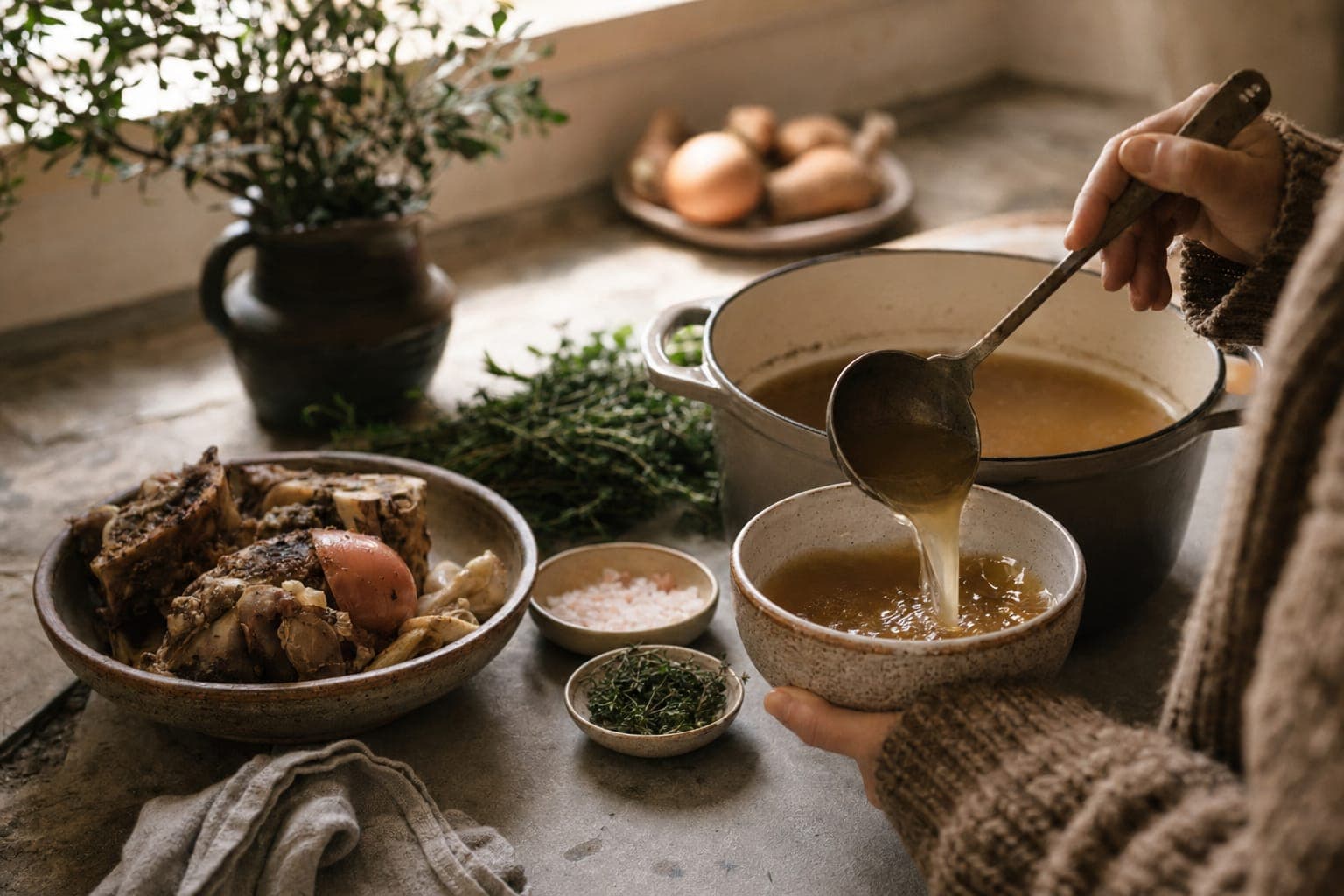
Bone Broth from Scratch: A Step-by-Step Guide
Step-by-step guide to making bone broth at home. Stovetop, slow cooker, and Instant Pot methods. Rich in collagen and gut-healing minerals.

Organised Protein Pancakes: A Weekend Favourite
A high-protein pancake recipe using beef protein, eggs, and raw milk. Cooked in cast iron, naturally sweetened with banana and honey. Real food breakfast.
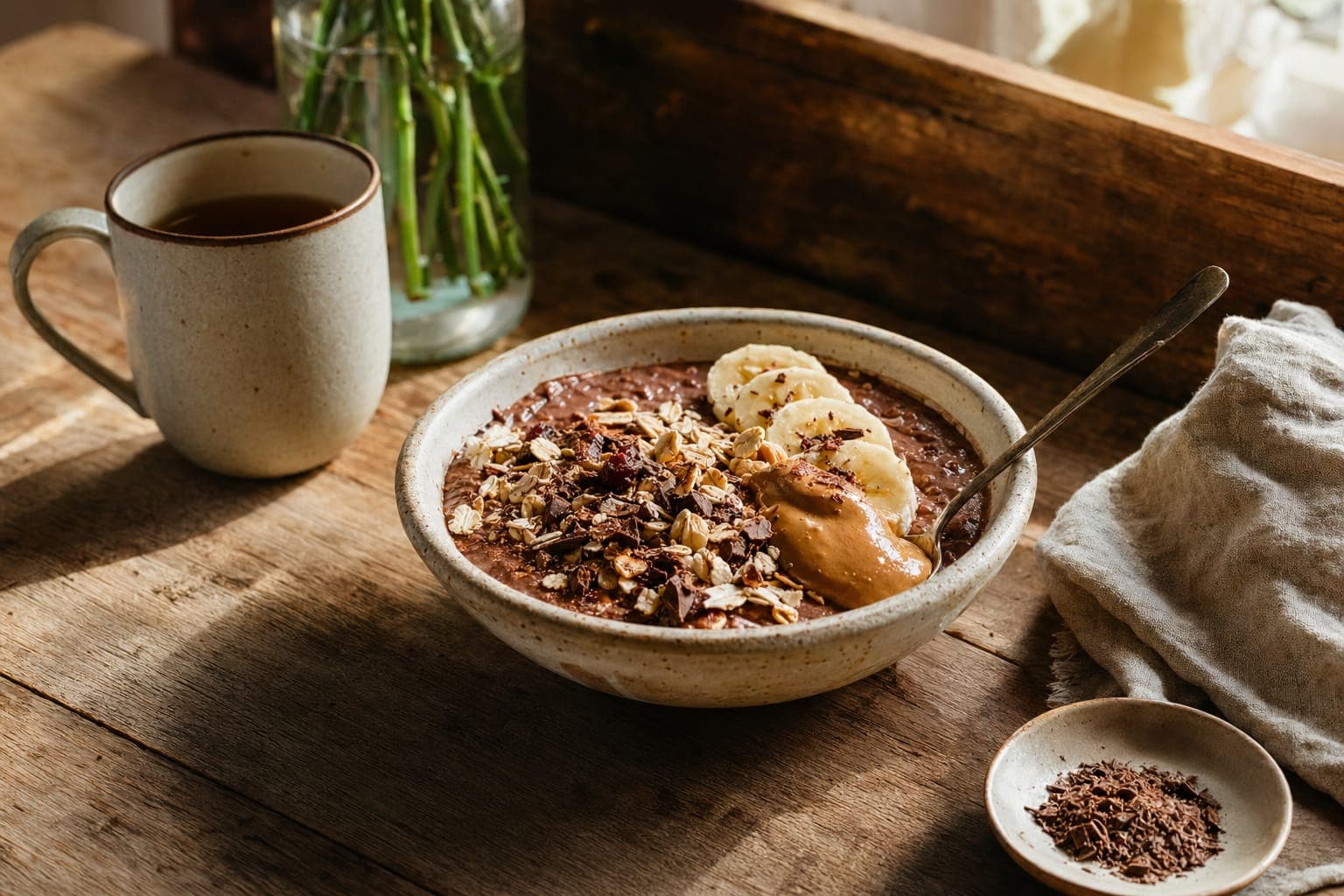
10 Ways to Use Organised That Aren't Just a Shake
Move beyond the basic shake. Discover 10 creative ways to use Organised in smoothie bowls, oats, yoghurt, baking, and more.


 Join over 100,000+ members
Build a better food system with us
The Organised community is thousands of people choosing real food and backing the farmers who grow it, all of us trying to leave the world a little better than we found it. If that is what you care about too, you belong here.