Vitamin D and Immunity: Why Winter Is a Risky Time
November arrives and your immune system goes haywire. You catch everything. That cold that your mate shook off in three days? You've got it for two weeks. The flu bug is devastating. You're tired, your mood drops, and somehow every virus going finds its way to you. There's a reason for that. And it has nothing to do with luck.
By Niall Kiddle, Founder, Organised

Reviewed by Pedro Rodrigues, Agronomist (farming and sourcing only) ·
8 min read · Published · Updated · 5 cited sources
Makers of the Organised Daily blend, a grass-fed beef organ supplement from regenerative UK farms

There's a reason for that. And it has nothing to do with luck.

Why winter is a vitamin D crisis
The reason your immune system crumbles in winter is not because viruses are more aggressive. It's not because you're being careless. It's because vitamin D, the hormone that controls immune function, becomes scarce.
The human immune system evolved in equatorial Africa. Your ancestors lived in intense sunlight year-round. Their skin made vitamin D constantly. When they migrated north to Europe, they adapted. Lighter skin to capture more ultraviolet light. But even with lighter skin, there's a ceiling. In winter, at UK latitudes, your skin simply cannot manufacture vitamin D from sunlight.
From November through March, the sun never reaches the angle needed for vitamin D synthesis.1 You can spend the entire day outside and your skin will make zero vitamin D. Zero. You're running on whatever reserves you built up in summer, and if you spent summer indoors (as many people do, especially in the UK), those reserves are already depleted.
By mid-January, when flu and respiratory viruses are at their peak, the majority of the UK population is profoundly deficient in vitamin D. This is not coincidence. This is mechanistic. Low vitamin D equals a suppressed immune response equals higher infection rates.
Winter immunity isn't about staying warm or washing your hands. It's about vitamin D. If you're deficient, your immune system simply cannot do its job.

The latitude problem in the UK
If you live at latitude 50 degrees north or higher, you're in vitamin D production limbo. London is at 51 degrees. Edinburgh is at 56. The Midlands is at 53. These latitudes are simply too far north for consistent vitamin D synthesis.
Even in summer, UK sunshine doesn't contain the UVB wavelength needed for vitamin D synthesis for much of the day. You'd need to be outside from 10 AM to 3 PM every single day in June, July, and August, with your skin exposed, no sunscreen, and the sun at a high angle. Most people don't do that. Most people either work indoors, apply sunscreen (which blocks UVB), or live covered up.
The result is that the UK population is chronically vitamin D deficient as a rule. In winter, that deficiency deepens into severe insufficiency. This is not a personal failing. This is geography.
How vitamin D actually controls immunity
Vitamin D is not just a vitamin. It's a hormone. It regulates the expression of over 200 genes in the body. One of its primary roles is immune regulation.2
When vitamin D is adequate, your immune system can distinguish between self and non-self, between a real threat and a false alarm. It can mount a proportionate response. When vitamin D is low, immune regulation breaks down. The immune system either over-reacts (autoimmunity) or under-reacts (infections take hold).
Research suggests that vitamin D supports the production of antimicrobial peptides, compounds that directly kill viruses and bacteria.3 When vitamin D is deficient, you lose that layer of defence. You're operating without a critical piece of your first-line immune armour.
Studies have consistently found that people with vitamin D levels below 30 nanograms per millilitre have higher rates of respiratory infections.4 People with levels above 40 have better outcomes. This isn't about taking a supplement and magically never getting ill. It's about your immune system having the tools it needs.
Vitamin D tells your immune cells whether to deploy or stand down. In winter, without it, your immune system is operating blind.

The gut-immune vitamin D connection
Vitamin D also regulates tight junctions in the gut lining. When vitamin D is low, your gut barrier becomes permeable. Bacterial lipopolysaccharides slip through into the bloodstream, triggering chronic inflammation. Your immune system is now busy fighting this inflammation and has less capacity to fight actual pathogens.
This is why winter colds often linger. You're not just fighting the virus. You're fighting the viral infection plus underlying gut permeability plus chronic systemic inflammation. Your immune system is exhausted.
When you restore vitamin D, gut barrier function improves. Inflammation decreases. Your immune system can focus on what matters.
Food sources are not enough
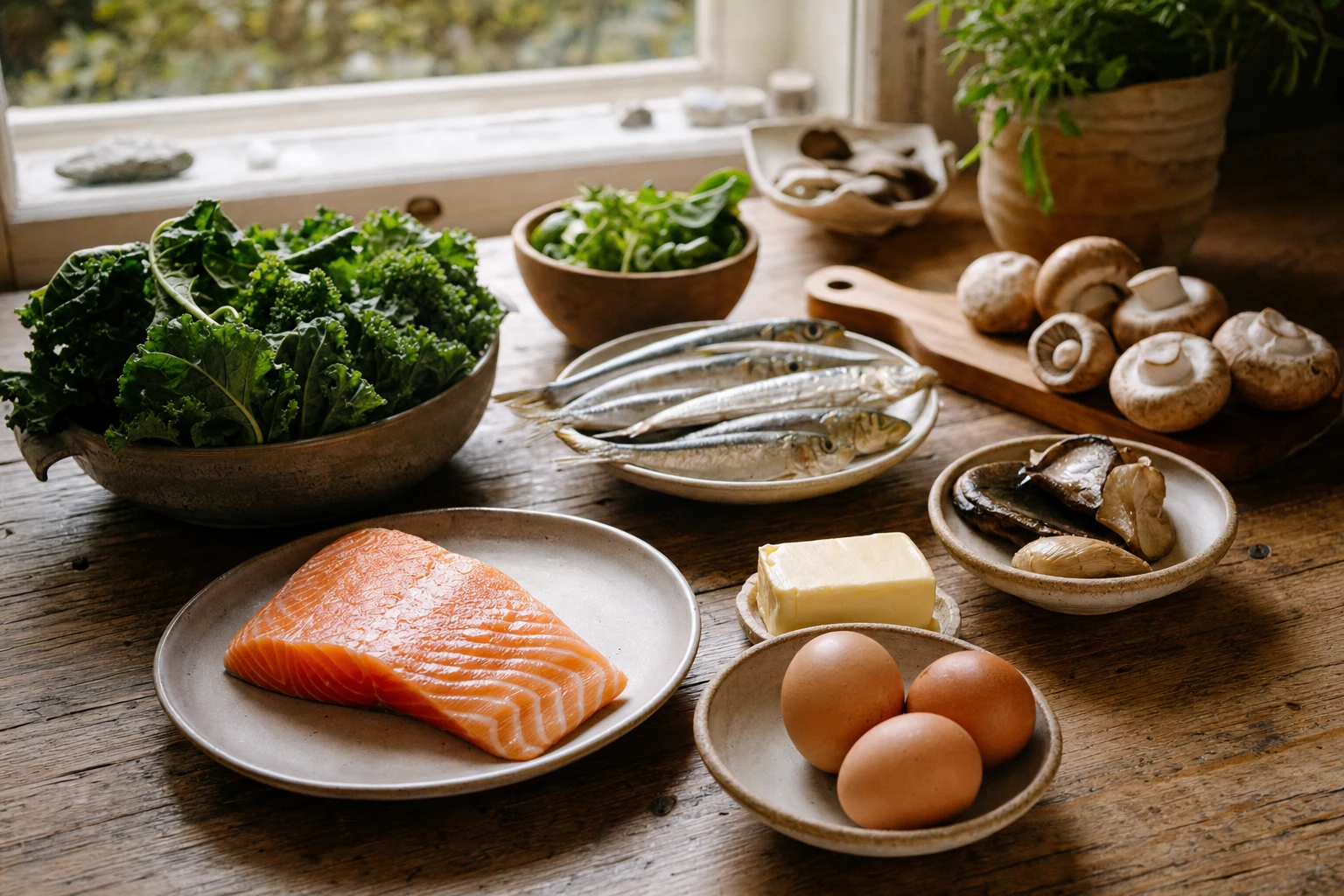
Some people say "just eat more salmon and eggs." Salmon contains around 450 international units of vitamin D per 100 grams. Eggs contain about 35 international units per egg. To reach an optimal level of 40 to 60 nanograms per millilitre from food alone, in the middle of winter, with no sun exposure, you'd need to eat salmon every single day and somehow manufacture 2,000 to 4,000 international units from food.
Liver contains some vitamin D, around 50 international units per 100 grams, but not enough to solve the winter problem.
Food can contribute. It cannot solve. You need supplementation.
Getting your levels right
In summer, if you're outside regularly with exposed skin, you might maintain adequate levels without supplementation. In winter, you need a daily supplement.5
Optimal vitamin D for immune function is somewhere between 40 and 60 nanograms per millilitre. This requires a daily intake of 1,000 to 4,000 international units, depending on your baseline level, your weight, and your genetics.
The safest approach is to get tested. A 25-hydroxyvitamin D test will tell you where you stand. From there, you can dose appropriately. Many people need 2,000 international units daily in winter to maintain adequate levels. Some need more.
Vitamin D comes in two forms: D2 (ergocalciferol) and D3 (cholecalciferol). D3 is more effective. It's derived from lanolin (from sheep's wool) or from lichen (vegan), depending on the product.
Start supplementing vitamin D before winter arrives. Don't wait until you're already ill. Prevention is infinitely easier than trying to catch up once your immune system has crashed.

Get health guides like this, free
Two short reads a week on eating for energy, gut health, skin, sleep and more.
By signing up you agree to receive emails from us. No spam, unsubscribe anytime.
Why winter vitamin D deficiency is inevitable in the UK
The issue is not whether you should supplement vitamin D in winter. The issue is that your body cannot make vitamin D from winter sun in the UK. The sun is too low on the horizon. The UVB rays that trigger vitamin D synthesis do not penetrate the atmosphere at high enough intensity.
The scientific threshold is clear. Your skin requires sun exposure with a UVB index of at least 3 to produce vitamin D. The UK sun barely reaches this threshold in summer, and during winter (October through March), the UVB index is essentially zero. You cannot make vitamin D from UK sun in winter, regardless of how much time you spend outside.
This is not a personal failing. It is a consequence of geography. If you live north of the 37th parallel, which includes all of the UK, supplementing vitamin D in winter is not optional. It is necessary for immune function.
The biological reality is that your ancestors who lived in the UK for millennia experienced seasonal vitamin D fluctuation. They had higher levels in summer and lower levels in winter. Modern humans have reversed this pattern. We spend summer indoors and winter indoors, getting vitamin D deficiency year-round. It is nonsensical.
You cannot make vitamin D from winter sun in the UK. Accept this and supplement accordingly.
Beyond supplementation: Vitamin D from food
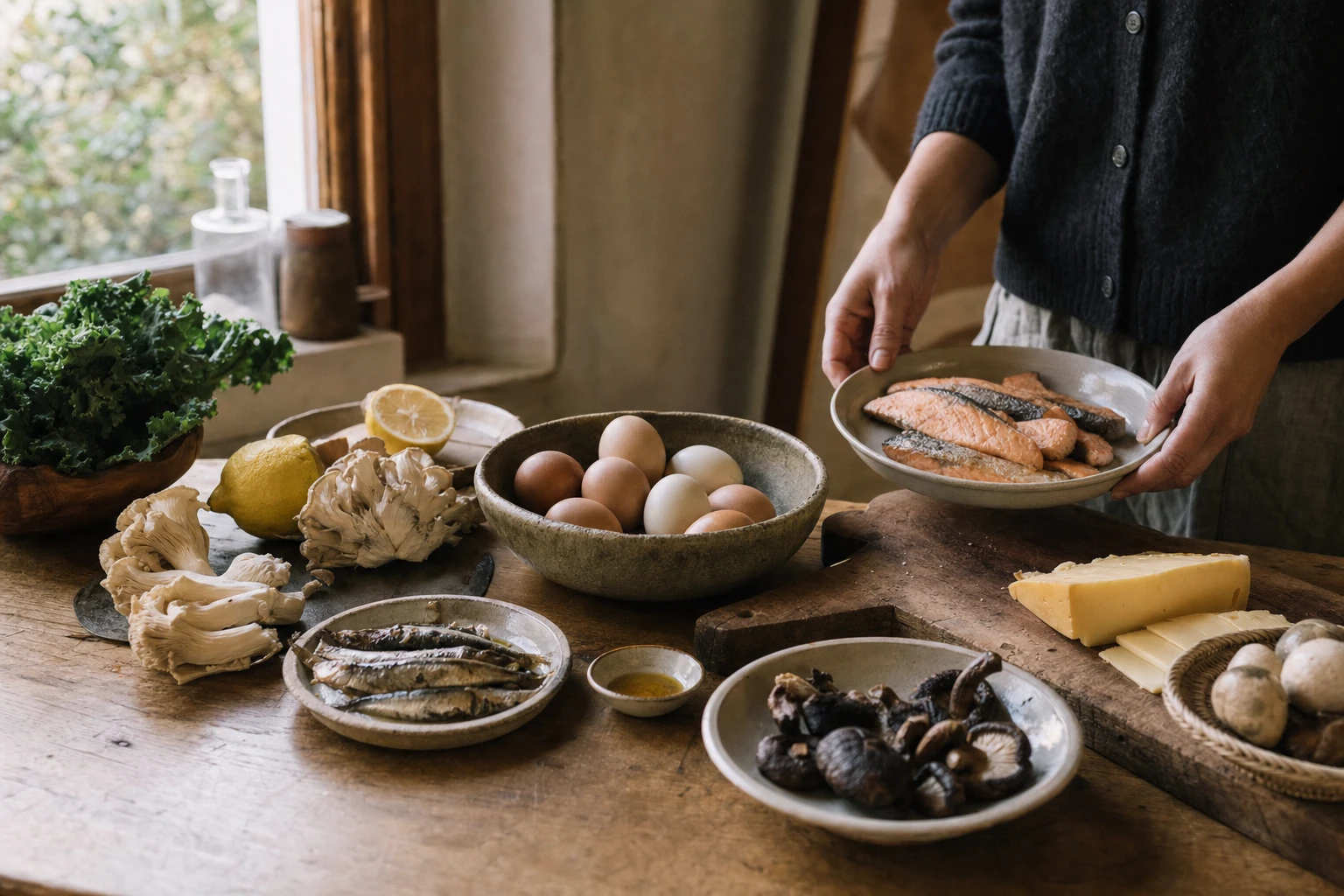
Supplementation is important, but food sources matter too. The richest dietary sources of vitamin D are liver, egg yolks, and fatty fish. A single portion of wild salmon contains 1000 to 2000 IU of vitamin D.2 Beef liver contains 42 IU per 100g. Eggs contain roughly 40 IU per yolk.
These food sources alone will not meet your winter needs (you need roughly 2000 to 4000 IU daily in winter). But they provide a foundation. Eating liver weekly and salmon twice weekly, combined with a vitamin D supplement, is superior to supplementation alone.
The advantage of food-based vitamin D is that it comes with the fat-soluble vitamins (A, E, K2) and minerals that support vitamin D absorption and utilisation. Vitamin D supplementation works better when your overall nutrient status is strong.
Aim for vitamin D from food first (liver and fatty fish), then supplement the remaining gap to reach 2000 to 4000 IU daily in winter.



1 of 9
Daily blend
100,000+ thriving families4.9 on Trustpilot
Eight real ingredients built around grass-fed beef organs, collagen and colostrum. Nothing synthetic added.
Free with your first order, worth £38. Plus £10 off the pouch with a subscription.


Free UK shipping · Made in England · 100 day money back guarantee on your first pouch · Skip, pause or cancel anytime
Testing and appropriate supplementation dosage
The most evidence-based approach is to check your vitamin D levels in early November (before winter supplementation). Aim for a level of 40 to 60 ng/mL (or 100 to 150 nmol/L in the UK).2 If you are below this, supplementation is appropriate.
The standard recommendation is 1000 to 2000 IU daily for adults. Many people need more, especially if they have darker skin (which reduces vitamin D synthesis) or spend minimal time outdoors. Testing allows you to personalise this rather than guessing.
Higher doses (5000 IU daily) are safe for most people and may be necessary if your levels are very low. Vitamin D toxicity is vanishingly rare and requires years of very high supplementation. The risk of being deficient is far greater than the risk of supplementing adequately.
Testing again in February or March allows you to confirm that your supplementation strategy is working. If your levels drop despite supplementation, you may need a higher dose. If your levels are optimal, continue with your current protocol.
Test, supplement appropriately, test again. This removes guessing and ensures your vitamin D support is genuinely protecting your immunity.
The bottom line
Winter immunity is not mysterious. It's biochemistry. Without vitamin D, your immune system loses critical signalling molecules and barrier protection. Supplementation is not optional in the UK during winter. It's a necessity. Start with a test to establish your baseline. Then supplement consistently from November through March. Combined with whole food, sleep, and stress management, adequate vitamin D gives your immune system the foundation it needs to actually do its job.
References
Every source below was checked on 27 August 2026. Each PubMed, PMC and DOI identifier was resolved against NCBI or Crossref, and what it opens is printed under the citation, so you can see the link goes where the citation says without leaving the page. Where a citation and its identifier disagreed, the citation was corrected to the record or the reference was deleted along with the sentence marker that pointed at it, and where the resolved paper turned out not to support the sentence, the sentence was cut back to what it does support. Borrowed authority is worse than none, because it looks like rigour.
- Webb AR et al. Influence of season and latitude on the cutaneous synthesis of vitamin D3. Journal of Clinical Endocrinology & Metabolism, 1988. PMID 2839537.Checked 27 August 2026: PMID 2839537 opens Webb AR, Kline L, Holick MF, Influence of season and latitude on the cutaneous synthesis of vitamin D3: exposure to winter sunlight in Boston and Edmonton will not promote vitamin D3 synthesis in human skin. J Clin Endocrinol Metab 1988;67(2):373-8.
- National Institutes of Health, Office of Dietary Supplements. Vitamin D — Health Professional Fact Sheet.
- Liu PT et al. Toll-like receptor triggering of a vitamin D-mediated human antimicrobial response. Science, 2006. PMID 16497887.Checked 27 August 2026: PMID 16497887 opens Liu PT, Stenger S, Li H et al, Toll-like receptor triggering of a vitamin D-mediated human antimicrobial response. Science 2006;311(5768):1770-3.
- Martineau AR et al. Vitamin D supplementation to prevent acute respiratory tract infections: systematic review and meta-analysis. BMJ, 2017. PMID 28202713.Checked 27 August 2026: PMID 28202713 opens Martineau AR, Jolliffe DA, Hooper RL et al, Vitamin D supplementation to prevent acute respiratory tract infections: systematic review and meta-analysis of individual participant data. BMJ 2017;356:i6583. PubMed indexes it as: Meta-Analysis, Systematic Review.The authors' own declaration, from the record: Competing interests: All authors have completed the ICMJE uniform disclosure form at www.icmje.org/coi_disclosure.pdf and declare financial support for this work from the National Institute for Health Research under its Health Technology Assessment programme. No author has had any financial relationship with any organisations that might have an interest in the submitted work in the previous three years. No author … (abridged; the full declaration is on the record)
- NHS. Vitamin D — NHS guidance.
Who wrote and reviewed this guide
Niall Kiddle
Author · Founder, Organised
Niall is the founder of Organised. He started the company in 2024 after fixing his own health the slow way: in 2022 he swapped a cupboard of synthetic supplements for real food, raw milk, organ meats, bone broth and honey, and felt the difference within months.
Areas of expertise: Ancestral nutrition, Organ meats, Whole-food supplementation, Gut health, Regenerative sourcing
Read Niall's full profile
Pedro Rodrigues
Reviewer · Agronomist (farming and sourcing only)
Pedro is the agronomist Organised works with on farming and sourcing. His job on the guides is to keep the science honest: he reviews what we publish about soil health, regenerative agriculture, grazing and the way food is actually produced.
Areas of expertise: Regenerative agriculture, Agronomy, Soil health, Grass-fed farming, Food sourcing
Reviewed this guide on
Read Pedro's full profileMore on immunity
View allBrowse the guides library
All guidesKeep reading

Health goals
Building Immune Resilience with Whole Food Nutrition
Build lasting immune resilience through whole food nutrition. We explain how vitamin A, zinc, colostrum and gut health work together to support your defences.
Health goals
How to Feed Your Skin from the Inside Out
The complete guide to skin nutrition. Learn which nutrients transform your skin and the specific food sources to eat them from.

Health goals
Why Your Grandparents Ate Better Than You
Explore the nutritional shift since the 1970s. Your grandparents' whole-food diet contained far more nutrient density than modern food. Here's what changed.
Real food, made effortless
Start my daily blendA few ways to use it
All recipes
Gut-Healing Marshmallows with Collagen and Raw Honey
Learn to make gut-healing marshmallows with collagen and raw honey. A shareable treat that sneaks nutrition into every bite. Easy recipe with video tips.

Bone Broth from Scratch: A Step-by-Step Guide
Step-by-step guide to making bone broth at home. Stovetop, slow cooker, and Instant Pot methods. Rich in collagen and gut-healing minerals.
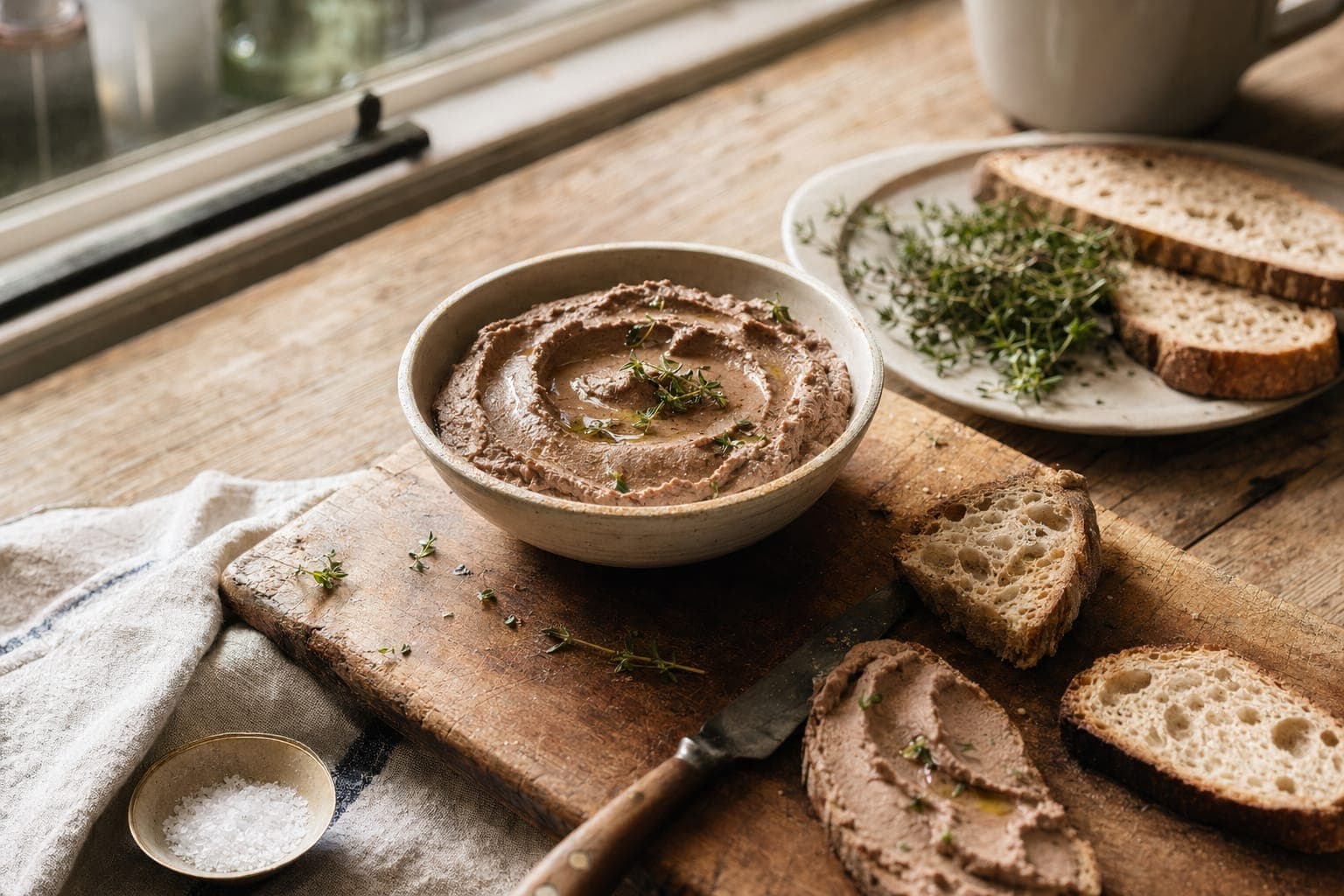
Liver Pate for Beginners: A Gentle Introduction to Organ Meats
Simple liver pate recipe to start eating organ meats. Chicken liver, butter, and herbs. Gentle introduction to nutrient-dense whole foods.


 Join over 100,000+ members
Build a better food system with us
The Organised community is thousands of people choosing real food and backing the farmers who grow it, all of us trying to leave the world a little better than we found it. If that is what you care about too, you belong here.