Why Intermittent Fasting Might Be Tanking Your Energy
Intermittent fasting is sold as a biohack that boosts energy and melts fat. But if you're doing it and you feel worse, sleep worse, and have less energy than before, you're not weak. You're responding normally to a stress your body can't handle.

By Niall Kiddle, Founder, Organised

Reviewed by Pedro Rodrigues, Agronomist (farming and sourcing only) ·
6 min read · Published · Updated · 3 cited sources
Makers of the Organised Daily blend, a grass-fed beef organ supplement from regenerative UK farms

Intermittent fasting works for some people in specific contexts. A generally healthy adult male with stable blood sugar and adequate nutrient status might genuinely tolerate it. But for most people, especially women, people under chronic stress, and anyone with a history of undereating, intermittent fasting is a stressor your body doesn't need. And the damage isn't always obvious until months later.

What intermittent fasting actually does
Intermittent fasting is a simple concept: restrict your eating to a specific window, typically eight hours. Fast for 16 hours. The idea is that fasting depletes glucose stores, forcing your body to burn fat. And in theory, that's true. But in practice, what happens in your body is more complex and potentially counterproductive.
Fasting is a metabolic stressor. Your body doesn't know the difference between choosing to fast and food not being available. It responds the same way: stress hormones rise, hunger hormones rise, and your body begins conserving energy. This is sensible biology when food is actually scarce. It's counterproductive when you're choosing to restrict.
For some people, this is tolerable or even beneficial. For others, it's just another stressor on top of an already stressed system. And the damage isn't always immediately obvious. You might not realise you're suppressing your thyroid, raising cortisol, or creating the foundation for future metabolic problems until months later. By then, the habit is entrenched.
Cortisol and the fasting response
When you fast, cortisol rises. This is normal. Cortisol is your mobilisation hormone. It tells your body to make energy available.1 In the short term, cortisol from fasting is fine. Your body handles it and returns to baseline when you eat.
But if you're already chronically stressed from work, relationships, or sleep deprivation, adding fasting to that stress load doesn't help. Cortisol stays elevated. Your nervous system stays in a heightened state. You feel wired but tired. You sleep poorly. Your body doesn't relax. Over weeks and months, this chronic elevation of cortisol damages your health and metabolism.
For women especially, chronic elevation of cortisol from fasting can suppress progesterone production and shift the oestrogen to progesterone ratio. This affects mood, sleep quality, and appetite regulation. Women often report that intermittent fasting worsens anxiety, disrupts their cycle, and makes sleep worse. These aren't small side effects. These are signs your body is being stressed beyond its tolerance.
If you're fasting whilst stressed, you're not healing. You're compounding the stress. Your body is trying to tell you something.
Thyroid suppression from extended fasting
Extended fasting, especially fasting periods longer than 14 to 16 hours, begins to suppress thyroid hormone output. Your body is trying to conserve energy, so it downregulates thyroid function.2 Thyroid hormone drives metabolism. When it's suppressed, your metabolism is suppressed.
This is particularly problematic for women, who are more sensitive to thyroid suppression than men. Women practising intermittent fasting often develop subclinical hypothyroidism: slow metabolism, fatigue, cold sensitivity, hair loss, and mood disturbance. They might not get diagnosed because thyroid blood tests might appear normal, but they feel genuinely suppressed. The standard TSH test misses a lot of thyroid dysfunction.
The longer you practise intermittent fasting, the more your thyroid adapts downward. You're training your body to run on lower energy. When you stop fasting, your metabolism doesn't immediately recover. It takes weeks or months to upregulate thyroid function again. This is why people often feel worse initially when they stop fasting than they felt whilst doing it.
This is why people often gain weight rapidly when they stop intermittent fasting. It's not that they start eating too much. It's that their metabolism has been suppressed, so they're now eating at a surplus relative to their new, lower baseline. The damage lingers.
The undereating trap
The most insidious problem with intermittent fasting isn't the fasting itself. It's that an eight-hour eating window often forces people to undereat. Your body needs a certain amount of calories. If you're compressing that into eight hours, you might end up eating less than your body needs.
Undereating is energy negative. Your body is not getting the fuel it needs. This shows up as fatigue, brain fog, reduced appetite (because your body downregulates hunger signals when it's undernourished), and poor mood. You're not depressed. You're under-fed. But because you're fasting, you interpret the fatigue as part of the process.
The problem is compounded by the type of person drawn to intermittent fasting. They're often people who've been restricting food, counting calories, or fighting their body's signals for years. Intermittent fasting feels disciplined and controlled. They like it psychologically. But biologically, it's just another form of restriction, and restriction damages metabolism and energy. For someone with a history of disordered eating or chronic restriction, intermittent fasting is contraindicated. It's retraumatising their body.
An eight-hour eating window doesn't magically make food nutrients work better. It often just means you're eating less and calling it health.
Get health guides like this, free
Two short reads a week on eating for energy, gut health, skin, sleep and more.
By signing up you agree to receive emails from us. No spam, unsubscribe anytime.
Who intermittent fasting might actually serve
This isn't to say intermittent fasting never helps anyone. In specific contexts, it can. A generally healthy person with stable blood sugar, no history of undereating, already adequate nutrient status, and moderate baseline stress might benefit from it. The key word is might. And even then, the benefits are often modest and could be achieved through simpler means.
People who report genuine benefits from intermittent fasting usually have one thing in common: they were previously snacking constantly and eating highly processed food. Intermittent fasting forced them to eat fewer processed foods and more whole foods during their eating window. The benefit wasn't from fasting. It was from eating better food.
If that's you, you'd get the same benefit from simply eating better food without fasting. You'd probably feel better, have more energy, and sleep better. And you'd avoid the metabolic stress of the fast itself.



1 of 9
Daily blend
100,000+ thriving families4.9 on Trustpilot
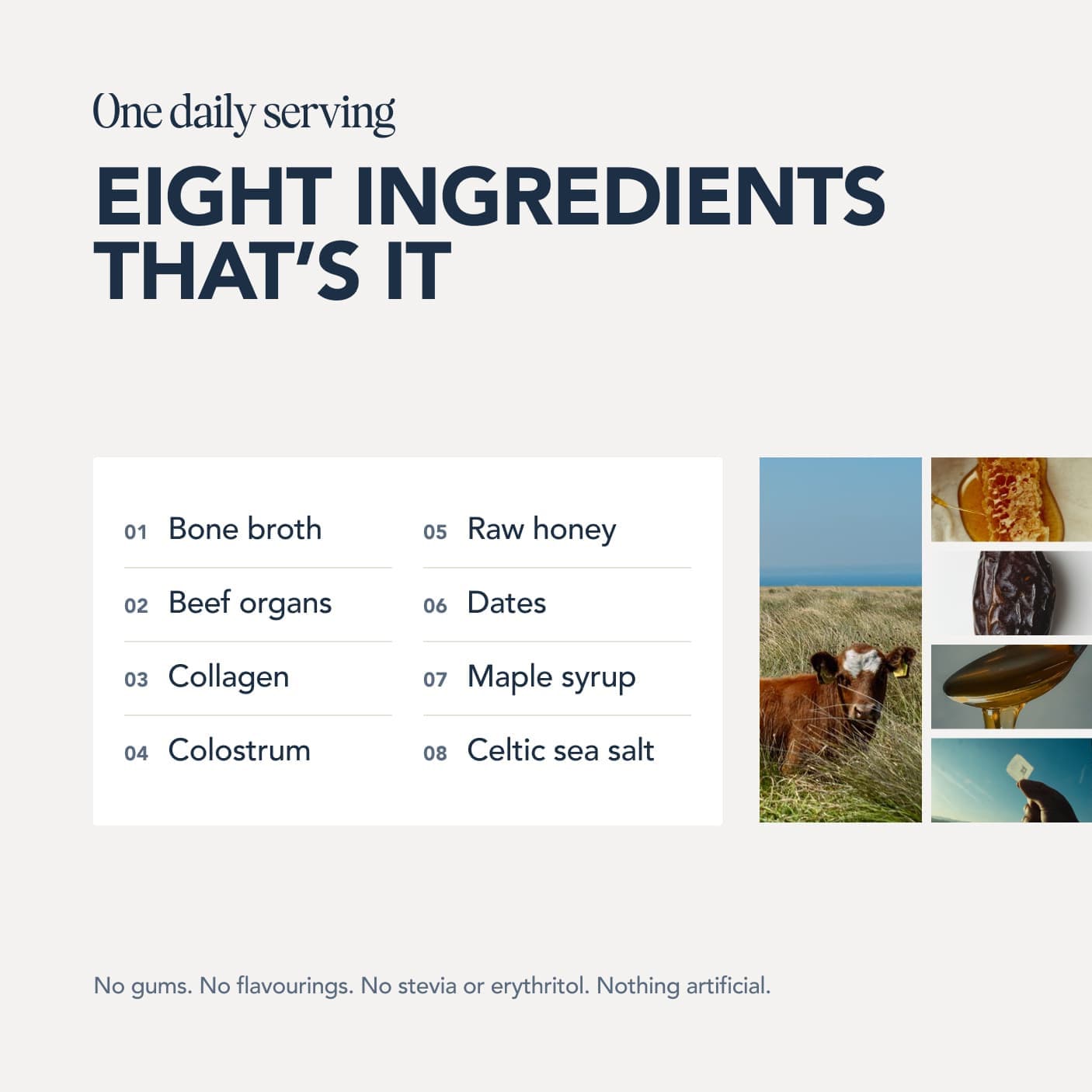
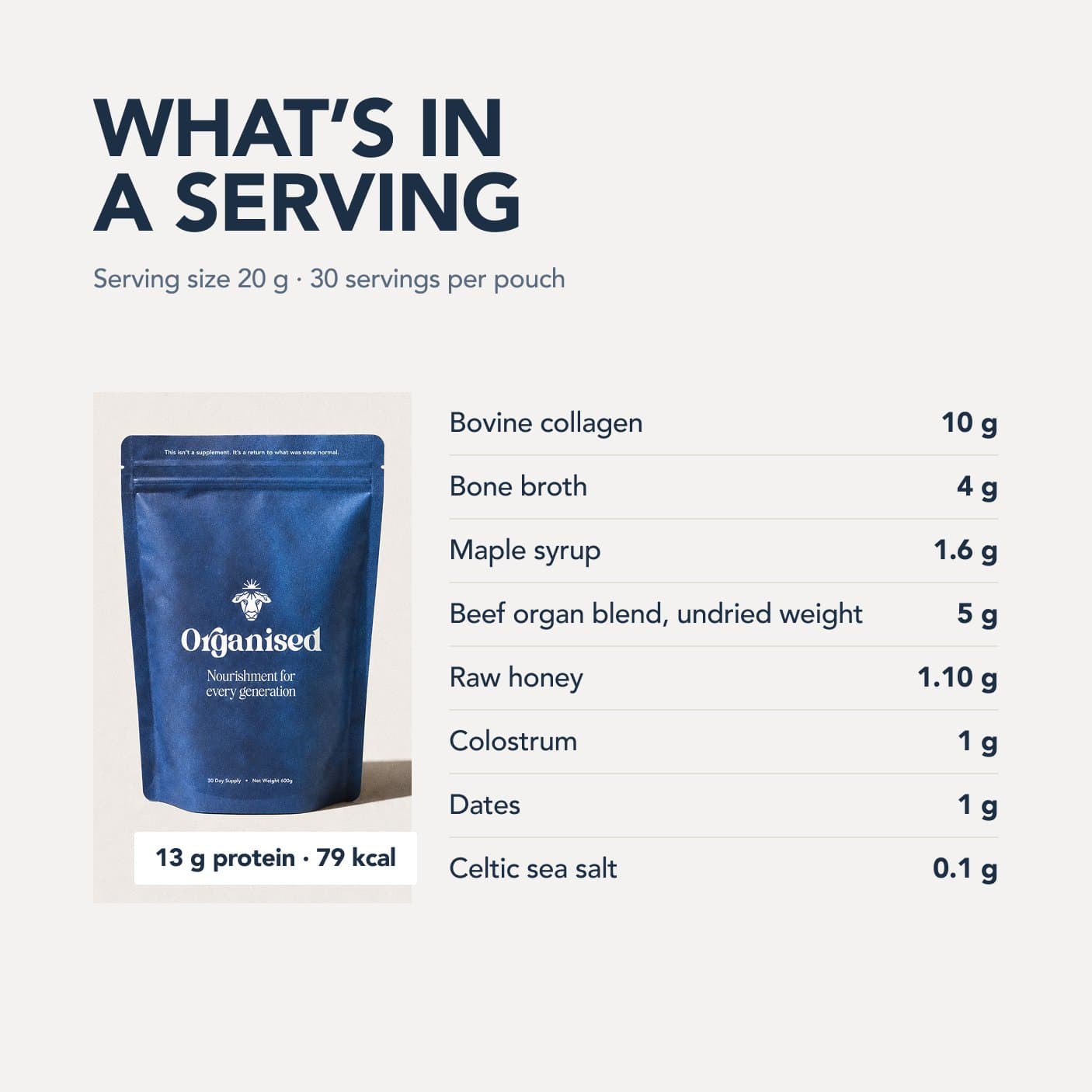
Eight real ingredients built around grass-fed beef organs, collagen and colostrum. Nothing synthetic added.
Free with your first order, worth £38. Plus £10 off the pouch with a subscription.



Free UK shipping · Made in England · 100 day money back guarantee on your first pouch · Skip, pause or cancel anytime
The evidence-based alternative
If you're tired and you're practising intermittent fasting, stop. Your body is telling you something. Eat breakfast. Eat whenever you're hungry. Eat until satisfied. Most people feel dramatically better within days. Energy improves. Sleep improves. Mood improves. That's not placebo. That's your body responding to adequate fuel.
Focus instead on food quality. Eat whole foods. Eat animal foods for nutrient density. Manage stress through movement, sleep, and connection. Support your thyroid through adequate iodine, selenium, and zinc.3 These changes will shift your energy more than any fasting protocol ever could.
If you want to explore eating in a restricted window, do it from a place of abundance, not scarcity. Eat three substantial, nutrient-dense meals in an eight or nine hour window because that works with your schedule, not because you're trying to lose weight through undereating. The difference is subtle but important. One is alignment. One is force.
A simple energy protocol instead
- Eat breakfast within an hour of waking. Protein, fat, and some carbohydrate. This wakes up your metabolism.
- Eat lunch when you're hungry. Another substantial meal. Same macronutrient balance.
- Eat dinner a few hours before bed. This supports sleep quality and overnight repair.
- Eat snacks if you're hungry between meals. Nuts, fruit, cheese, whatever you need.
- Stop eating three to four hours before bed. This improves sleep quality.
This simple pattern supports thyroid function, keeps cortisol reasonable, prevents undereating, and improves energy for most people. No counting. No restriction. Just eating when you're hungry, stopping when you're satisfied, and prioritising food quality.
The bottom line
Intermittent fasting works brilliantly for a small percentage of people in specific contexts. For everyone else, it's usually just another form of restriction that suppresses energy and metabolism. If you're tired, your sleep is disrupted, or your mood is off, intermittent fasting is probably making it worse.
Give yourself permission to eat breakfast. Your energy will improve within days. That's not a coincidence. That's your body getting what it needs.
References
Every source below was checked on 27 August 2026. Each PubMed, PMC and DOI identifier was resolved against NCBI or Crossref, and what it opens is printed under the citation, so you can see the link goes where the citation says without leaving the page. Where a citation and its identifier disagreed, the citation was corrected to the record or the reference was deleted along with the sentence marker that pointed at it, and where the resolved paper turned out not to support the sentence, the sentence was cut back to what it does support. Borrowed authority is worse than none, because it looks like rigour.
- Nakamura Y, Walker BR, Ikuta T. Systematic review and meta-analysis reveals acutely elevated plasma cortisol following fasting but not less severe calorie restriction. Stress. https://pubmed.ncbi.nlm.nih.gov/26586092/ [accessed May 2026].Checked 27 August 2026: PMID 26586092 opens Nakamura Y, Walker BR, Ikuta T, Systematic review and meta-analysis reveals acutely elevated plasma cortisol following fasting but not less severe calorie restriction. Stress 2016;19(2):151-7. PubMed indexes it as: Meta-Analysis, Systematic Review.
- Boelen A, Wiersinga WM, Fliers E. Fasting-induced changes in the hypothalamus-pituitary-thyroid axis. Thyroid. https://pubmed.ncbi.nlm.nih.gov/18225975/ [accessed May 2026].Checked 27 August 2026: PMID 18225975 opens Boelen A, Wiersinga WM, Fliers E, Fasting-induced changes in the hypothalamus-pituitary-thyroid axis. Thyroid 2008;18(2):123-9. PubMed indexes it as: Review.
- National Institutes of Health, Office of Dietary Supplements. Iodine - Health Professional Fact Sheet. https://ods.od.nih.gov/factsheets/Iodine-HealthProfessional/ [accessed May 2026].
Who wrote and reviewed this guide
Niall Kiddle
Author · Founder, Organised
Niall is the founder of Organised. He started the company in 2024 after fixing his own health the slow way: in 2022 he swapped a cupboard of synthetic supplements for real food, raw milk, organ meats, bone broth and honey, and felt the difference within months.
Areas of expertise: Ancestral nutrition, Organ meats, Whole-food supplementation, Gut health, Regenerative sourcing
Read Niall's full profile
Pedro Rodrigues
Reviewer · Agronomist (farming and sourcing only)
Pedro is the agronomist Organised works with on farming and sourcing. His job on the guides is to keep the science honest: he reviews what we publish about soil health, regenerative agriculture, grazing and the way food is actually produced.
Areas of expertise: Regenerative agriculture, Agronomy, Soil health, Grass-fed farming, Food sourcing
Reviewed this guide on
Read Pedro's full profileMore on energy
View all- Why You're Always Tired (And What to Eat About It)
- Adrenal Fatigue: Is It Real and What Can You Do About It?
- Always Tired? What Reddit Says to Eat (and What Actually Works)
- B12 Deficiency: Signs, Causes and the Fastest Way to Fix It
- Chronic Fatigue and Nutrient Deficiency: What Blood Tests to Ask For
- How to Maintain Energy All Day Without Caffeine Dependency
- How Your Thyroid Affects Your Energy Levels
- Iron Deficiency: Why It's So Common and How Organs Can Help
- Metabolism Maxxing: How to Support Your Metabolic Rate with Real Food
- The Desk Worker's Guide to Staying Strong and Energised
- What Does Your Afternoon Slump Actually Mean?
Browse the guides library
All guidesKeep reading

Health goals
Metabolism Maxxing: How to Support Your Metabolic Rate with Real Food
Learn how thyroid support, adequate calories, and nutrient-dense foods naturally increase your metabolic rate without restriction or supplements.

Health goals
Thinning Hair After 40: What Your Body Is Trying to Tell You
Thinning hair over 40 is not inevitable. Learn what your body may be signalling and the nutrition that can support fuller, healthier hair as you age.

Health goals
How Long Should You Prepare Your Body Before Trying to Conceive?
Preconception nutrition matters more than most people realise. A 3 to 6-month prep window allows sperm and egg quality to optimise.
Real food, made effortless
Start my daily blendA few ways to use it
All recipes
Raw Milk Ice Cream with Organised
Make raw milk ice cream at home with Organised for a seasonal, nutrient-dense treat. Three simple flavours to try whenever the craving strikes.

Raw Milk Hot Chocolate with Collagen
A nourishing evening hot chocolate made with raw milk, grass-fed collagen, raw cacao, and honey. A nighttime ritual that supports sleep and gut health.

Matcha Latte Gummies with Collagen and Gelatine
Make visually stunning matcha latte gummies infused with collagen and gelatine. Simple recipe for gut-healing sweets you'll actually want to eat.


 Join over 100,000+ members
Build a better food system with us
The Organised community is thousands of people choosing real food and backing the farmers who grow it, all of us trying to leave the world a little better than we found it. If that is what you care about too, you belong here.