B12 from Organs vs B12 Supplements: Bioavailability Matters
Your brain is slowly starving for B12 and you might not realise it for years. B12 deficiency doesn't announce itself. It whispers. And when it finally becomes obvious, you've already lost ground. The form of B12 you're taking, and the way your body absorbs it, determines whether you're actually fixing the problem or just swallowing expensive urine.

By Niall Kiddle, Founder, Organised

Reviewed by Pedro Rodrigues, Agronomist (farming and sourcing only) ·
7 min read · Published · Updated · 4 cited sources
Makers of the Organised Daily blend, a grass-fed beef organ supplement from regenerative UK farms


Why B12 matters more than you think
B12 is essential for nerve myelin formation, the insulation that wraps around your nerves and allows them to fire properly.1 It's essential for DNA synthesis and cell division. It's essential for homocysteine metabolism, and when homocysteine becomes elevated, cardiovascular and neurological risk increase. It's essential for mood regulation, memory formation, and the maintenance of the hippocampus, the brain's memory centre.
Your body stores B12 in the liver. Unlike many nutrients, you can go a long time running low on B12 before obvious symptoms appear. The stores deplete slowly. The nervous system degrades quietly. And by the time you notice brain fog, fatigue, numbness in your extremities, or memory loss, you may have already suffered irreversible neurological damage.
B12 is found almost exclusively in animal foods.1 This is fact, not philosophy. Plant foods contain bacterial B12 analogues that don't work in human biology. If you're not eating meat, organs, dairy, or eggs regularly, you need B12 support. And the form of that support determines whether it actually works.
The three forms of B12 and which your body actually uses
B12 comes in three active forms inside your body: methylcobalamin, adenosylcobalamin, and cyanocobalamin. Each plays a specific role. Methylcobalamin is used primarily in the nervous system and for homocysteine metabolism. Adenosylcobalamin is used primarily in mitochondrial energy production. Cyanocobalamin is the most common form found in foods, but your body has to convert it to one of the other forms to use it.
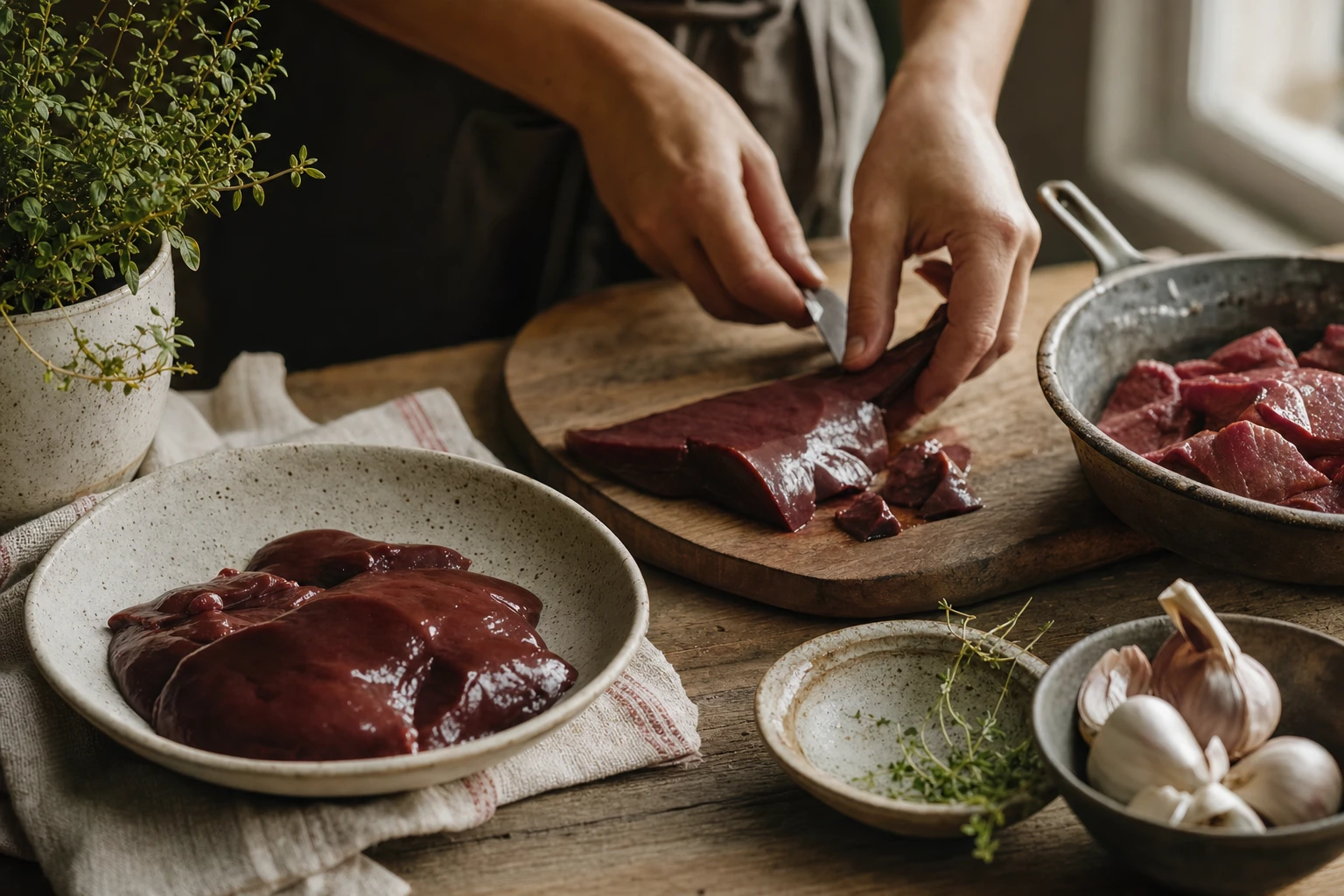
When you eat liver, your body obtains all three forms naturally. The liver stores B12 in all three forms because the liver needs to use all three itself. When you absorb B12 from liver, you're absorbing the forms your body is most likely to use immediately. The conversion process that would be necessary if you took cyanocobalamin alone has already been done for you.
Supplements typically offer one form. Most commonly cyanocobalamin, the cheapest to manufacture. Some premium supplements offer methylcobalamin, which is more expensive and already in an active form. But even methylcobalamin-only supplements are missing adenosylcobalamin, which is critical for energy production at the mitochondrial level.
Liver gives you all three forms of B12. Most supplements give you one and expect your body to make do with it.
Intrinsic factor: the absorption molecule you can't manufacture
Intrinsic factor is a protein produced by the parietal cells of your stomach.1 Its job is to bind to B12 in your food and protect it as it travels through your digestive tract, allowing it to be absorbed in the terminal ileum of your small intestine. Without intrinsic factor, B12 cannot be absorbed efficiently, no matter how much you consume.
As you age, intrinsic factor production declines. This is one reason why B12 deficiency becomes increasingly common with age. By the time you're seventy, your intrinsic factor production might be half what it was at thirty. Stomach acid, which is needed to release B12 from food, also declines with age and with common medications like proton pump inhibitors.2
When you eat liver, the B12 is released by stomach acid, binds to intrinsic factor, and is transported to the terminal ileum where it's absorbed into the bloodstream. The entire natural absorption pathway is engaged. Your digestive system processes it as food, not as a foreign chemical.
When you take a supplement, particularly an isolated form like cyanocobalamin, the absorption pathway is different. Supplements don't require intrinsic factor for absorption in the same way food does. But this also means they bypass some of the regulatory mechanisms that ensure proper absorption and utilisation. The absorption is less efficient, and the body's ability to regulate how much is used versus excreted is diminished.

Liver versus supplements: the bioavailability difference
One hundred grams of beef liver contains approximately 60 to 80 micrograms of B12, most of it in bioavailable forms.3 Your absorption rate from liver is typically 50 to 70 percent, meaning you absorb roughly 30 to 50 micrograms of usable B12. The body integrates this into its existing B12 stores and uses what it needs.
A typical B12 supplement contains 1,000 to 2,000 micrograms. The absorption rate from cyanocobalamin supplements is approximately 0.5 to 1 percent under normal circumstances.1 With age or with reduced stomach acid, it falls further. This means from a 2,000 microgram supplement, you absorb roughly 10 to 20 micrograms, with most of the dose being excreted in urine.
Supplements compensate for this poor absorption by providing enormous doses. The logic is that even at 0.5 to 1 percent absorption, taking 2,000 micrograms will result in adequate absorption. This works, mathematically. But it's inefficient. You're taking one hundred times the dose you would from food to achieve comparable absorption. And you're missing the cofactors and the natural regulatory mechanisms that make food-sourced B12 work more reliably.
Some supplements use sublingual or injected forms to bypass the intrinsic factor requirement entirely. This works for B12 absorption. But it's because you're bypassing the normal digestive mechanism, not because the supplement form is superior. The need for injection or sublingual administration is a sign that you're working around your digestive system, not with it.
Get ingredient guides like this, free
Two short reads a week on the ingredients that matter and how to actually use them.
By signing up you agree to receive emails from us. No spam, unsubscribe anytime.
Cyanocobalamin: the cheap form supplements use
Cyanocobalamin is the form most commonly used in supplements because it's cheap to manufacture and stable in storage. But it's not a form that naturally occurs in significant quantities in your body. Your body has to convert cyanocobalamin to methylcobalamin or adenosylcobalamin before it can use it. This conversion requires enzymes, it requires energy, and it's not always efficient.
Some people have genetic variations that reduce their ability to convert cyanocobalamin to active forms. For these people, taking cyanocobalamin supplements may not raise functional B12 levels at all, even if blood B12 levels look adequate. They might be absorbing the cyanocobalamin, but they can't convert it into forms their body can use. They remain deficient despite supplementation.
This is one reason why people can take B12 supplements and continue to show signs of deficiency. Their blood tests might show adequate B12, but it's in the form their body can't use. They're not actually deficient in B12 quantity. They're deficient in bioavailable B12.

1 of 9
Daily blend
100,000+ thriving families4.9 on Trustpilot
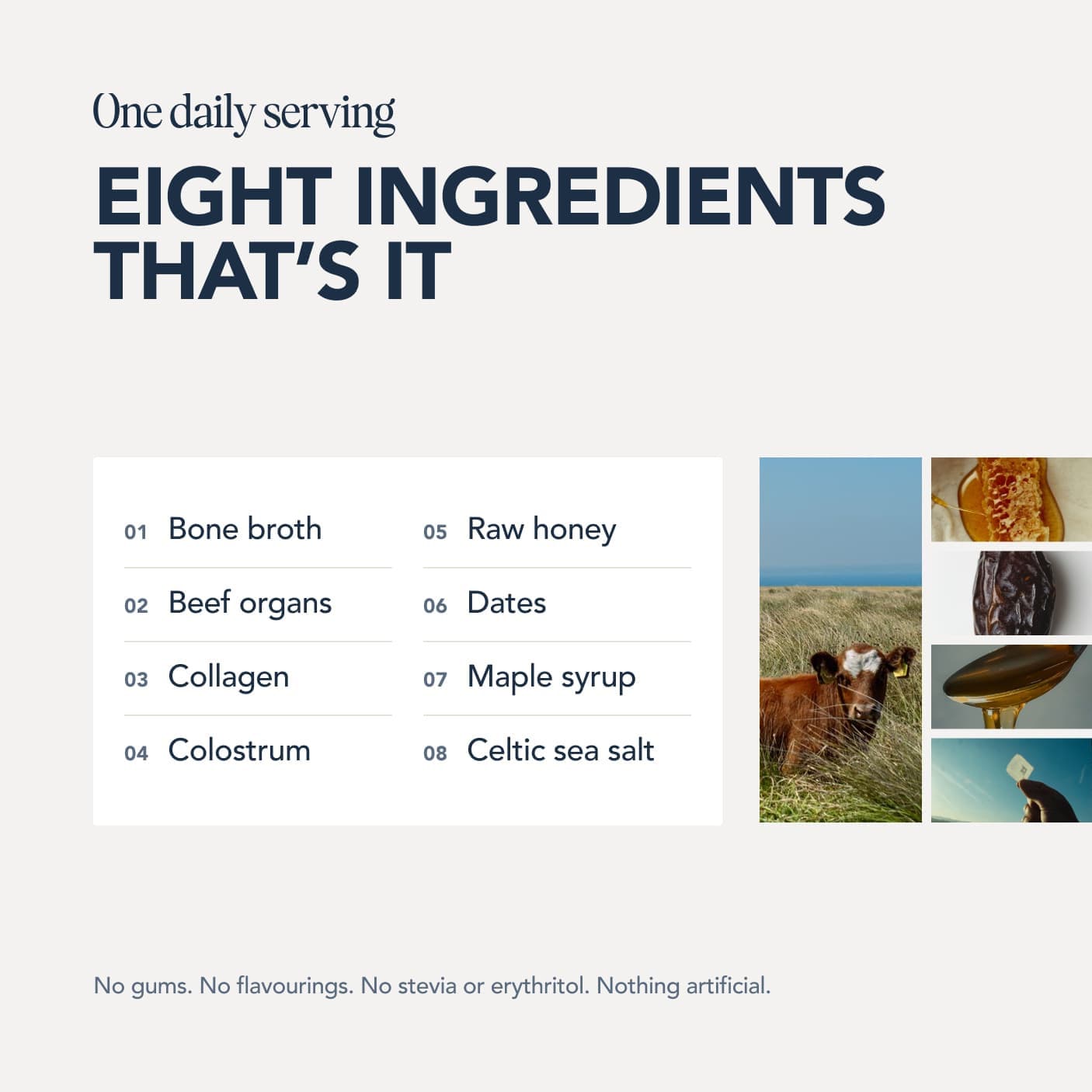
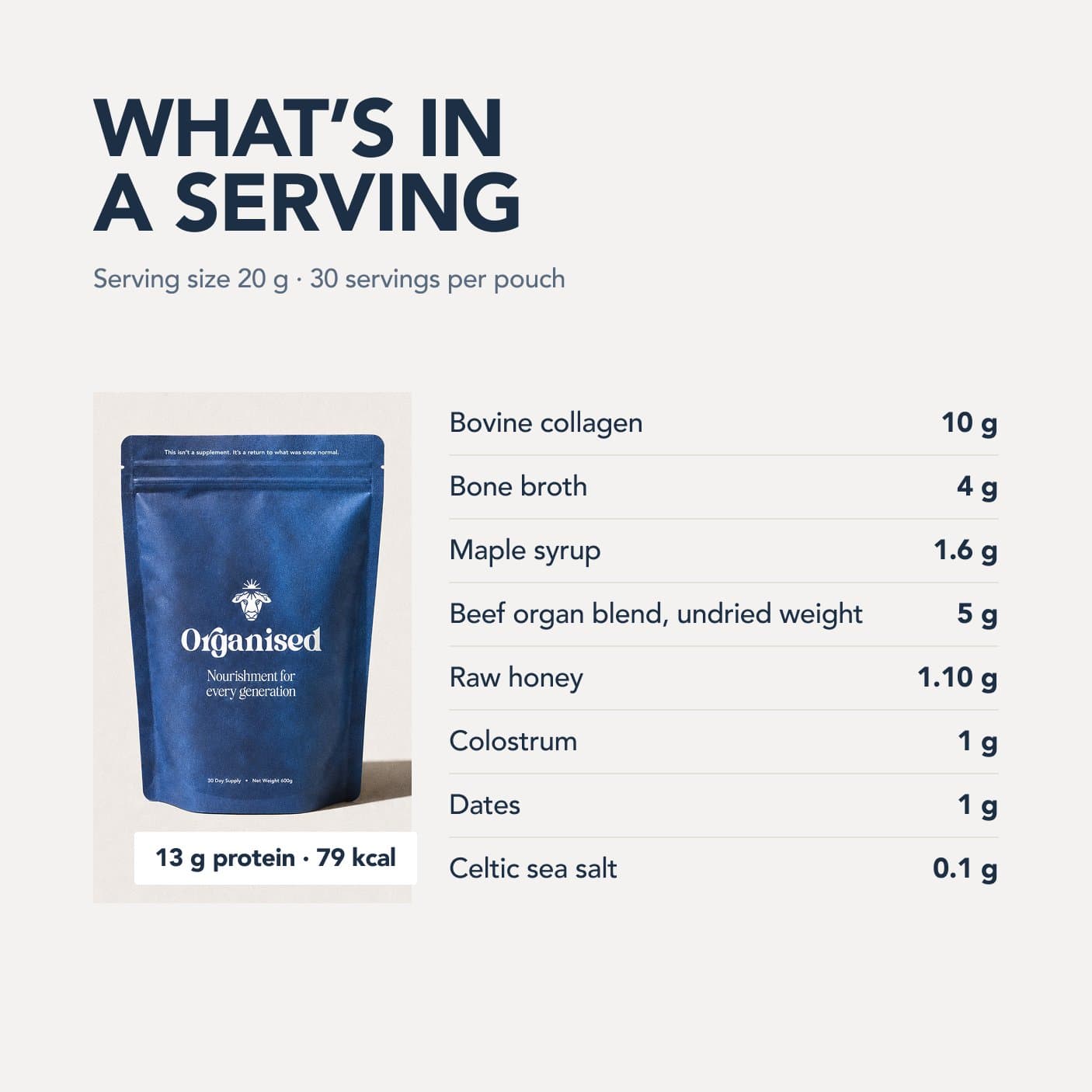
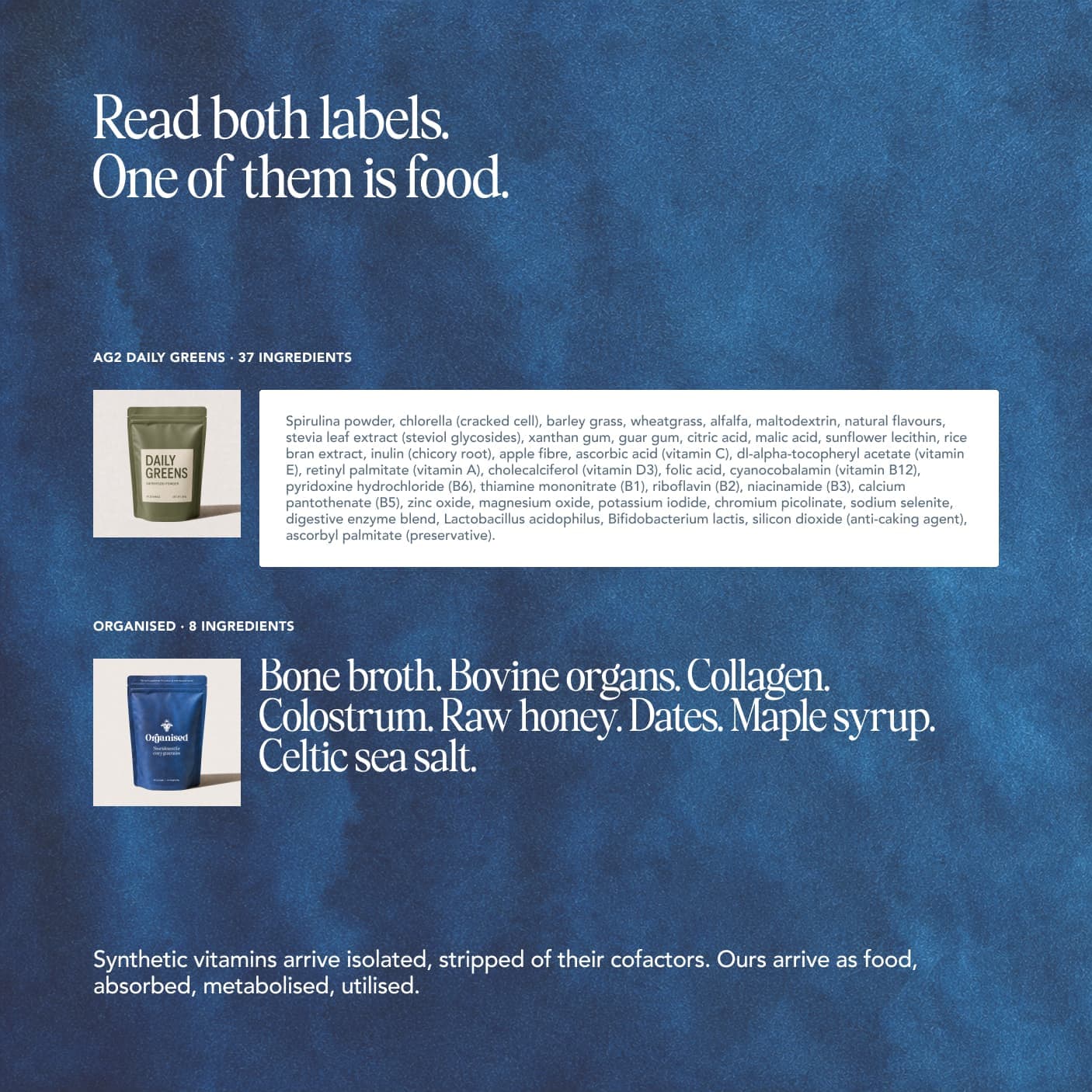
Eight real ingredients built around grass-fed beef organs, collagen and colostrum. Nothing synthetic added.
Free with your first order, worth £38. Plus £10 off the pouch with a subscription.


Free UK shipping · Made in England · 100 day money back guarantee on your first pouch · Skip, pause or cancel anytime
Methylcobalamin and adenosylcobalamin: the forms your body needs
Methylcobalamin is the active form used in your nervous system and for the critical process of converting homocysteine back to methionine. Elevated homocysteine is a risk factor for cardiovascular disease, cognitive decline, and depression. Methylcobalamin is required to keep homocysteine in the safe range. If you're deficient in the active form, your homocysteine rises regardless of your total B12 levels.
Adenosylcobalamin is the active form used in your mitochondria for energy production, particularly in tissues with high energy demands like your brain, your heart, and your muscles. This is why B12 deficiency shows up as fatigue and weakness. Without adequate adenosylcobalamin, mitochondrial energy production slows down.
Liver contains both forms naturally. When you consume liver, you're getting the exact forms your body uses immediately. Some of it is already in the metabolic form. Some of it is in cyanocobalamin form that gets converted. But the conversion happens in the context of eating whole food, with all the cofactors that support the process, rather than your body being asked to manufacture active forms from an isolated supplement.
Signs you're B12 deficient
B12 deficiency whispers before it shouts. Early signs include fatigue that doesn't improve with sleep, brain fog, difficulty concentrating, and mood changes like depression or irritability.4 As deficiency progresses, numbness and tingling develop in your extremities, usually starting in the feet and moving upward. Your gait might change. Your memory might decline. Your reflexes might become sluggish.
By the time these neurological signs appear, you've been deficient for a long time. The myelin around your nerves has been quietly degrading. Some of this damage can be reversed if B12 is restored quickly. Some of it is permanent. This is why prevention through adequate dietary B12 is so important. Don't wait for symptoms.
Blood tests for B12 can be deceptive. They measure total B12, which includes inactive forms. You can have a normal blood B12 level and still be functionally deficient if most of your B12 is in a form your body can't use. A better marker is methylmalonic acid (MMA) and homocysteine, which increase when you're deficient in usable B12.1
The bottom line
If you eat organ meats regularly, particularly liver, your B12 status is probably secure. One serving of liver per week provides more than adequate B12. If you don't eat organ meats, if you're vegetarian or vegan, if you're over sixty, or if you take medications that reduce stomach acid, you need B12 support. When you add it, add methylcobalamin or better yet, eat liver. Your brain depends on it more than you realise.
References
Every source below was checked on 27 August 2026. Each PubMed, PMC and DOI identifier was resolved against NCBI or Crossref, and what it opens is printed under the citation, so you can see the link goes where the citation says without leaving the page. Where a citation and its identifier disagreed, the citation was corrected to the record or the reference was deleted along with the sentence marker that pointed at it, and where the resolved paper turned out not to support the sentence, the sentence was cut back to what it does support. Borrowed authority is worse than none, because it looks like rigour.
- National Institutes of Health, Office of Dietary Supplements. Vitamin B12 — Health Professional Fact Sheet.
- Andres E et al. Vitamin B12 (cobalamin) deficiency in elderly patients. CMAJ, 2004. PMID 15289425.Checked 27 August 2026: PMID 15289425 opens Andrès E, Loukili NH, Noel E et al, Vitamin B12 (cobalamin) deficiency in elderly patients. CMAJ 2004;171(3):251-9. PubMed indexes it as: Review.
- U.S. Department of Agriculture, FoodData Central. Beef, variety meats and by-products, liver — nutrient profile.
- NHS. Vitamin B12 or folate deficiency anaemia — Symptoms.
Who wrote and reviewed this guide
Niall Kiddle
Author · Founder, Organised
Niall is the founder of Organised. He started the company in 2024 after fixing his own health the slow way: in 2022 he swapped a cupboard of synthetic supplements for real food, raw milk, organ meats, bone broth and honey, and felt the difference within months.
Areas of expertise: Ancestral nutrition, Organ meats, Whole-food supplementation, Gut health, Regenerative sourcing
Read Niall's full profile
Pedro Rodrigues
Reviewer · Agronomist (farming and sourcing only)
Pedro is the agronomist Organised works with on farming and sourcing. His job on the guides is to keep the science honest: he reviews what we publish about soil health, regenerative agriculture, grazing and the way food is actually produced.
Areas of expertise: Regenerative agriculture, Agronomy, Soil health, Grass-fed farming, Food sourcing
Reviewed this guide on
Read Pedro's full profileMore on nutritional deep-dives
View all- Can Adults Benefit from Colostrum? (It's Not Just for Calves)
- CoQ10 from Beef Heart vs CoQ10 Supplements: Is There a Difference?
- Honey and Gut Health: Prebiotic Properties You Might Not Know About
- How Organ Meats Were Eaten Throughout History
- Selenium in Beef Kidney: Why This Trace Mineral Is Essential
- Why Beef Protein Is Easier to Digest Than You Think
- Why We Stopped Being Afraid of Salt (And You Should Too)
Browse the guides library
All guidesKeep reading

Ingredients
Collagen for Gut Health: Rebuilding Your Intestinal Lining
Discover how collagen supports gut health by supplying glycine, proline and the amino acids your intestinal lining draws on to repair and stay resilient.

Ingredients
The Nutritional Profile of Dates and Why They Beat Processed Sugar
Compare dates vs sugar to see why dates pair natural sweetness with fibre, minerals and polyphenols, changing how your body handles each one. Worth knowing.

Ingredients
Can You Get Enough Collagen from Food Alone?
Explore whether real food sources of collagen are sufficient for joint health and skin quality, and when supplementation becomes necessary.
Real food, made effortless
Try the organ blendA few ways to use it
All recipes
Energy Balls with Organised, Dates and Raw Honey
Make no-bake energy balls with Organised, dates, and raw honey. Perfect lunch box, pre-workout, or on-the-go snack. Simple recipe.

Organised Protein Pancakes: A Weekend Favourite
A high-protein pancake recipe using beef protein, eggs, and raw milk. Cooked in cast iron, naturally sweetened with banana and honey. Real food breakfast.

Raw Milk Ice Cream with Organised
Make raw milk ice cream at home with Organised for a seasonal, nutrient-dense treat. Three simple flavours to try whenever the craving strikes.


 Join over 100,000+ members
Build a better food system with us
The Organised community is thousands of people choosing real food and backing the farmers who grow it, all of us trying to leave the world a little better than we found it. If that is what you care about too, you belong here.