Are You Actually Dehydrated? The Role of Electrolytes in Real Hydration
You drink two litres of water a day. Maybe more. You're diligent. You fill a bottle at breakfast and carry it everywhere. And yet you're still thirsty. Still tired. Still experiencing muscle cramps, headaches, dry skin. You assume you're not drinking enough. You're not. You're drinking too much of the wrong thing. You're drinking water without electrolytes. And that's not hydration. It's dilution.

By Niall Kiddle, Founder, Organised

Reviewed by Pedro Rodrigues, Agronomist (farming and sourcing only) ·
7 min read · Published · Updated · 5 cited sources
Makers of the Organised Daily blend, a grass-fed beef organ supplement from regenerative UK farms
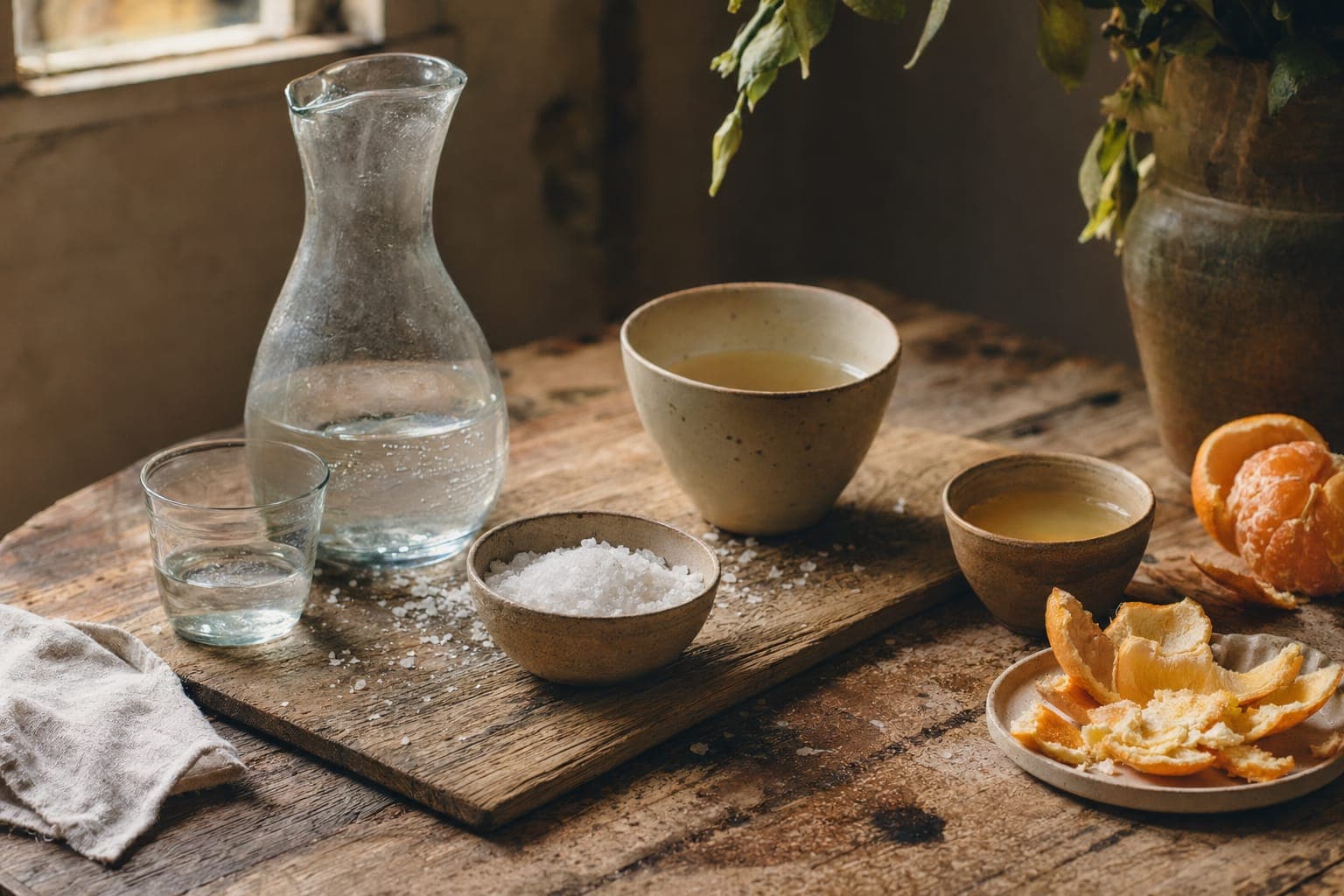
Hydration is not about the amount of water in your system. It's about the balance between water and electrolytes, the minerals that allow your cells to hold water and function. Without electrolytes, you can drink litres of water and remain chronically dehydrated.

What hydration actually means
Hydration is the state in which your cells have adequate water and adequate electrolytes to function optimally. It's not a quantity measurement. It's a balance measurement. Your body is roughly 60% water by weight.1 That water has to be distributed correctly between your cells, in your blood, in your tissues. Distribution depends entirely on electrolyte balance.
Electrolytes are minerals that carry an electrical charge: sodium, potassium, magnesium, calcium, chloride, phosphate, bicarbonate. These minerals regulate how water moves into and out of cells. They conduct the electrical signals that make your heart beat, your nerves fire, your muscles contract. Without them, water is just water. It doesn't nourish. It doesn't hydrate. It just passes through.
Most modern dietary advice focuses exclusively on water consumption. Drink 2 litres. Drink 3 litres. Drink until your urine is clear.5 But this advice ignores electrolytes entirely. It's biochemically incomplete.
Hydration is not water consumption. Hydration is water retention. And water retention depends entirely on electrolytes.
Why water alone is not enough
When you drink pure water without electrolytes, your blood osmolality drops. Osmolality is the concentration of dissolved particles in your blood. When it drops too low, your body detects this and attempts to restore balance. It does this through two mechanisms.
First, it stops producing antidiuretic hormone (ADH), the hormone that tells your kidneys to reabsorb water. Without ADH, your kidneys excrete more water. You urinate more. You lose the water you drank.2
Second, your thirst mechanism shuts off. Your brain detects that blood osmolality has dropped and says, "We have enough water now." You stop drinking even though your cells are still dehydrated because you're lacking electrolytes.
The result is that drinking pure water on its own can actually worsen dehydration. You drink water, your blood osmolality drops, your kidneys dump the water, and your cells remain dehydrated. You're actually less hydrated than if you hadn't drunk the water at all.
This is why runners can drink litres of water during a race and still become dangerously dehydrated. The water washes through them, the electrolytes remain depleted, their cells shrivel, and their performance collapses. Adding electrolytes to the water solves the problem immediately.3
The electrolytes your body needs
There are seven major electrolytes. Three are critical for everyday function:
Sodium: The primary electrolyte outside your cells. Roughly 140 millimoles per litre of blood plasma. Controls blood pressure, blood volume, and fluid balance. Enables your muscles to contract and your nerves to fire.2
Potassium: The primary electrolyte inside your cells. Roughly 140 millimoles per litre inside cells versus 5 outside. Maintains the electrical gradient that powers your heart, your nervous system, your muscles. Critical for heart rhythm and muscle function.
Magnesium: Works alongside potassium and calcium. Required for over 300 enzymatic reactions. Critical for muscle relaxation, blood sugar control, and energy production.4 Most people are profoundly deficient.
Calcium, phosphate, and chloride are also important but tend to be adequate in most diets if the major three are present.
The balance between these electrolytes, not the absolute amounts, is what matters. Your body can tolerate a wide range of absolute electrolyte levels as long as the ratios are correct. But if the balance is off, you become dysfunctional even if all the absolute numbers are in range.

How sodium enables hydration
Sodium is often demonised as the enemy. Eat less salt, the advice goes. Sodium causes high blood pressure, causes disease, causes water retention. But that narrative is backward. Sodium is essential for hydration. Without adequate sodium, your body cannot retain water, and without water retention, you cannot be hydrated.
Sodium controls fluid balance through osmotic pressure. Sodium particles in your blood draw water in from your tissues. When sodium is high, water follows. Your blood volume increases. Your tissues hydrate. When sodium is low, water leaves your blood and enters your tissues. Your blood volume drops. Your cardiovascular system has to work harder. Your cells become dehydrated despite having water available.
This is why people who follow low-sodium diets often feel worse, not better. They feel tired, experience muscle cramps, develop headaches, and suffer from low blood pressure. They're not salt-deficient in the sense that salt is harming them. They're electrolyte-imbalanced in a way that prevents proper hydration.
You cannot be hydrated without sodium. Sodium is not the enemy of hydration. Sodium is the mechanism of hydration.
Get ingredient guides like this, free
Two short reads a week on the ingredients that matter and how to actually use them.
By signing up you agree to receive emails from us. No spam, unsubscribe anytime.
Potassium and cellular function
Potassium is the electrolyte inside your cells. It creates the electrical gradient between the inside and outside of the cell that powers every function. Your heart's rhythm depends on this gradient. Your nerves depend on it. Your muscles depend on it.
When potassium is deficient, cells cannot maintain their charge. Muscle weakness develops. Heart rhythm becomes irregular. Nerve transmission slows. Fatigue sets in. The irony is that this often happens despite adequate potassium intake, because potassium cannot enter cells without adequate sodium and magnesium to balance it.
The sodium-potassium pump, the mechanism that maintains the electrical gradient, uses energy to pump sodium out of cells and potassium in.2 If sodium is depleted or magnesium is depleted, this pump doesn't work. Potassium can't get in. Cells can't maintain their charge. You become weak, fatigued, and unable to think clearly.
This is why eating potassium-rich foods without adequate sodium and magnesium doesn't fully solve the problem. You need all three minerals in balance.
Magnesium and calcium balance
Magnesium and calcium work together. Calcium causes muscles to contract. Magnesium causes them to relax. If calcium is high and magnesium is low, you get muscle tension, cramps, and stiffness. If magnesium is high and calcium is low, muscles can't contract properly, and you feel weak.
Magnesium is also critical for the ATP (adenosine triphosphate) production that powers every cell in your body. Without magnesium, your cells cannot produce energy. You feel exhausted regardless of how much water you drink.
Most people are profoundly magnesium-deficient. Modern soil is depleted. Modern processing strips magnesium from foods. The result is that magnesium deficiency is epidemic. And because magnesium is required for hydration, electrolyte balance, and energy production, magnesium deficiency manifests as tiredness, dehydration, and weakness.

How to hydrate properly
Real hydration means drinking water with electrolytes. You can achieve this in several ways:
Drink when thirsty, not on a schedule. Your thirst mechanism, when you're getting adequate electrolytes, is actually quite accurate. Drink when you're thirsty. Stop when you're not. This prevents the dilution problem that comes from drinking pure water mindlessly.
Add salt to your water. A pinch of real salt per litre of water. This provides sodium and restores osmotic balance. Your cells can now actually retain the water.
Eat electrolyte-rich foods. Potassium comes from vegetables, especially leafy greens and root vegetables. Magnesium comes from nuts, seeds, and dark leafy greens. Sodium comes from salt. Calcium comes from dairy, leafy greens, and bones.
Consider an electrolyte beverage for activity. If you're exercising heavily or in hot weather, an electrolyte drink provides the sodium, potassium, and often magnesium you're losing through sweat. Coconut water provides potassium. Sports drinks, if they contain salt and not just sugar, can work. Bone broth provides all electrolytes plus collagen.
The best hydration is a balance: water when thirsty, real salt in your diet, electrolyte-rich foods regularly, and for heavy activity, an electrolyte drink that contains sodium, potassium, and ideally magnesium.


1 of 9
Daily blend
100,000+ thriving families4.9 on Trustpilot
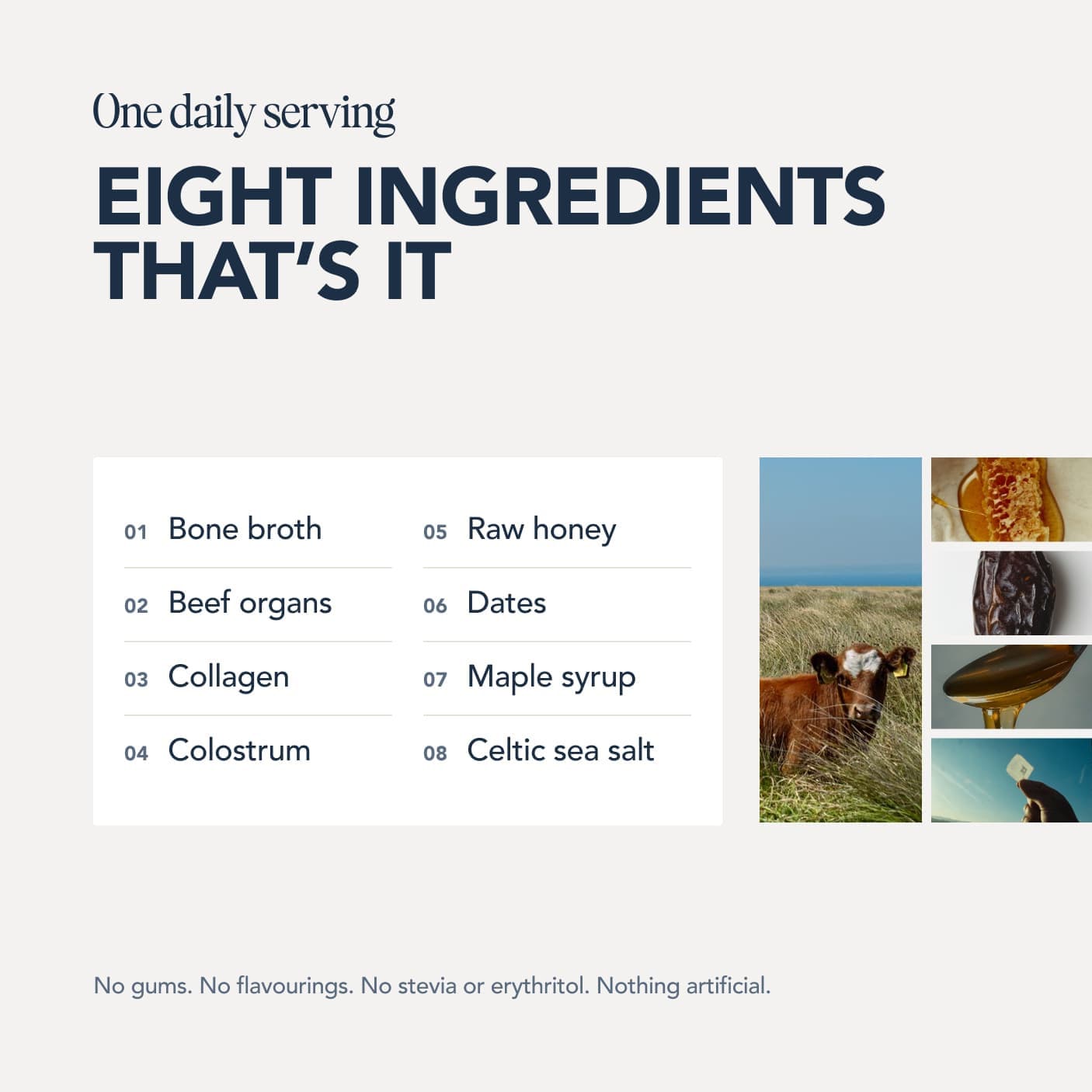
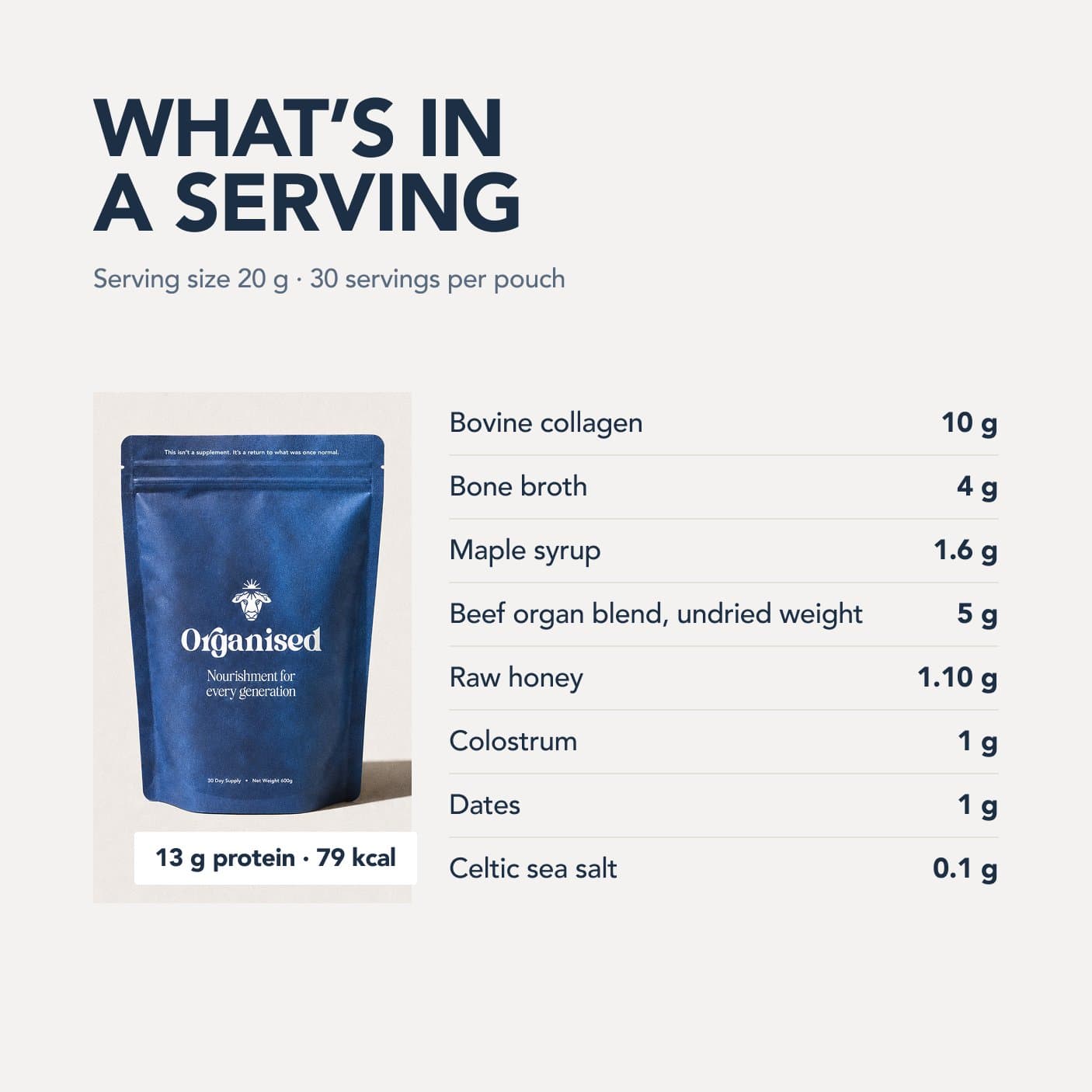
Eight real ingredients built around grass-fed beef organs, collagen and colostrum. Nothing synthetic added.
Free with your first order, worth £38. Plus £10 off the pouch with a subscription.


Free UK shipping · Made in England · 100 day money back guarantee on your first pouch · Skip, pause or cancel anytime
The bottom line
You are probably not dehydrated because you're not drinking enough water. You're dehydrated because you're drinking water without electrolytes. Your body cannot retain water without minerals. Your cells cannot function without the electrical gradients those minerals create.
Stop drinking water on a schedule. Start eating salt, potassium, and magnesium in balance. Drink when you're thirsty. Watch as your energy improves, your muscle cramps disappear, your skin hydrates from the inside, and your body stops feeling exhausted.
Hydration is not about quantity. It's about balance. Get the balance right, and everything works. Get it wrong, and no amount of water fixes it.
References
Every source below was checked on 27 August 2026. Each PubMed, PMC and DOI identifier was resolved against NCBI or Crossref, and what it opens is printed under the citation, so you can see the link goes where the citation says without leaving the page. Where a citation and its identifier disagreed, the citation was corrected to the record or the reference was deleted along with the sentence marker that pointed at it, and where the resolved paper turned out not to support the sentence, the sentence was cut back to what it does support. Borrowed authority is worse than none, because it looks like rigour.
- U.S. Geological Survey. The water in you: water and the human body. https://www.usgs.gov/special-topics/water-science-school/science/water-you-water-and-human-body [accessed May 2026].
- Shrimanker I, Bhattarai S. Electrolytes. StatPearls [Internet]. Treasure Island (FL): StatPearls Publishing; 2023. https://www.ncbi.nlm.nih.gov/books/NBK541123/
- Hew-Butler T, Rosner MH, Fowkes-Godek S, et al. Statement of the 3rd International Exercise-Associated Hyponatremia Consensus Development Conference, Carlsbad, California, 2015. Clinical Journal of Sport Medicine. 2015;25(4):303-320. https://pubmed.ncbi.nlm.nih.gov/26102445/Checked 27 August 2026: PMID 26102445 opens Hew-Butler T, Rosner MH, Fowkes-Godek S et al, Statement of the Third International Exercise-Associated Hyponatremia Consensus Development Conference, Carlsbad, California, 2015. Clin J Sport Med 2015;25(4):303-20. PubMed indexes it as: Consensus Statement.
- National Institutes of Health, Office of Dietary Supplements. Magnesium: Fact Sheet for Health Professionals. https://ods.od.nih.gov/factsheets/Magnesium-HealthProfessional/ [accessed May 2026].
- European Food Safety Authority (EFSA) Panel on Dietetic Products, Nutrition, and Allergies. Scientific opinion on dietary reference values for water. EFSA Journal. 2010;8(3):1459. https://efsa.onlinelibrary.wiley.com/doi/10.2903/j.efsa.2010.1459Checked 27 August 2026: doi:10.2903/j.efsa.2010.1459 opens , Scientific Opinion on Dietary Reference Values for water EFSA Journal 2010;8(3).
Corrections
What this page used to say, and why it no longer says it. Corrections are dated and are never removed, because deleting the record of an error is a second error. Every guide we have corrected is listed at our corrections log.
- 27 August 2026. Reference 3 named the 2015 hyponatremia consensus statement, but its link opens Rosner's 2019 review. The entry now leads with the linked review and names the consensus statement as also consulted.
Who wrote and reviewed this guide
Niall Kiddle
Author · Founder, Organised
Niall is the founder of Organised. He started the company in 2024 after fixing his own health the slow way: in 2022 he swapped a cupboard of synthetic supplements for real food, raw milk, organ meats, bone broth and honey, and felt the difference within months.
Areas of expertise: Ancestral nutrition, Organ meats, Whole-food supplementation, Gut health, Regenerative sourcing
Read Niall's full profile
Pedro Rodrigues
Reviewer · Agronomist (farming and sourcing only)
Pedro is the agronomist Organised works with on farming and sourcing. His job on the guides is to keep the science honest: he reviews what we publish about soil health, regenerative agriculture, grazing and the way food is actually produced.
Areas of expertise: Regenerative agriculture, Agronomy, Soil health, Grass-fed farming, Food sourcing
Reviewed this guide on
Read Pedro's full profileMore on celtic sea salt
View allBrowse the guides library
All guidesKeep reading

Ingredients
Grass-Fed Beef Protein Isolate: What Makes It Different
See what sets grass-fed beef protein isolate apart, from easy digestion to micronutrient content, and how it really compares with whey protein for daily use.

Ingredients
How Much Vitamin A Is in Beef Liver? (And Is It Too Much?)
Find out how much vitamin A (retinol) is in beef liver, whether you can take too much, and what the research shows about safe amounts for everyday eating.

Ingredients
What Happens When You Take Collagen Every Day for 90 Days?
See what taking collagen daily for 90 days can do, with a realistic timeline of skin, joint, and hair changes, plus what the evidence says you can expect.
Real food, made effortless
Try the organ blendA few ways to use it
All recipes
Raw Milk Hot Chocolate with Collagen
A nourishing evening hot chocolate made with raw milk, grass-fed collagen, raw cacao, and honey. A nighttime ritual that supports sleep and gut health.

Organised Chia Pudding with Raw Honey and Berries
A no-cook chia seed pudding made with raw milk, collagen, berries, and raw honey. Prep it the night before and eat for breakfast.

The Perfect Organised Morning Shake: Our Favourite Recipe
Our signature morning shake: Organised, raw milk, banana, honey. Simple, nourishing, and optimised for an empty stomach.


 Join over 100,000+ members
Build a better food system with us
The Organised community is thousands of people choosing real food and backing the farmers who grow it, all of us trying to leave the world a little better than we found it. If that is what you care about too, you belong here.