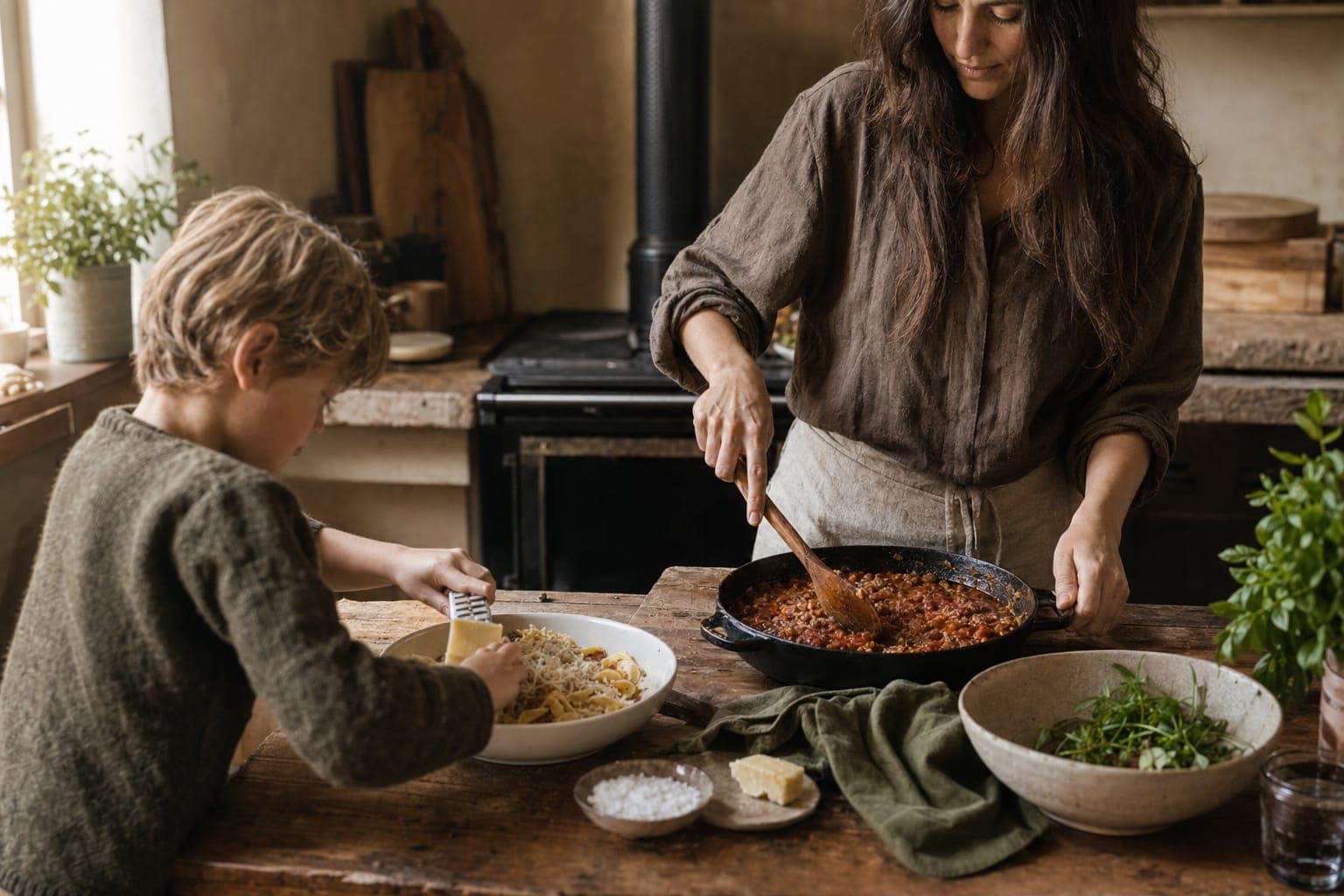
How to Nourish Your Whole Family with Real Food
Discover how real food nutrition can feed your whole family across different ages and tastes with one simple approach, plus practical tips to make it stick.
 Niall Kiddle · Founder, OrganisedReviewed by Pedro Rodrigues7 min read · Updated
Daily blend
Eight real ingredients built around grass-fed beef organs, collagen and colostrum. Nothing synthetic added.
4.9 on Trustpilot · 200,000+ thriving familiesFeeding a family is a logistical puzzle. Your baby needs soft foods. Your toddler is picky. Your partner might prefer carbs. Your teenager skips meals. And yet one nutrient-dense whole-food approach can nourish all of them, if you understand the slight adjustments each person needs.
You don't need separate meals. You need one solid foundation, then minor modifications for each person at the table.

One system, many needs
The nutrients that matter: protein, fat, micronutrients. These are universal. Everyone needs them. The only variables are quantity and presentation.
A meal of slow-cooked beef, roasted vegetables, and bone broth works for your 70-year-old parent, your postpartum self, your teenager, and your toddler. The 70-year-old might eat a full portion. You might add butter for recovery. Your teenager might load theirs with extra potatoes. Your toddler gets soft-cooked pieces. Same meal, different adaptations.
This is the entire principle. Not "everyone eats the same thing," but "everyone eats from the same meal, adapted to their stage." It's dramatically less work than separate meals and dramatically more nourishing than compromise cooking.
The foundation everyone needs
Protein at every meal. For your baby, this might be egg yolk or finely shredded meat. For your toddler, fingers of cooked fish or meat. For you, a normal portion. For your parent concerned with sarcopenia, a generous portion.
Fat at every meal. Butter, ghee, olive oil, full-fat dairy, egg yolk. The amount scales with age (your baby needs proportionally more fat for brain development; your teenager might need less), but everyone benefits. Fat carries the fat-soluble vitamins A, D, K2, and E.3 Without it, your family can't absorb the nutrients in the food.
Vegetables or fruit. Not mandatory in any specific quantity, but present. Your toddler might eat three pieces of carrot. Your parent might eat a full bowlful of greens. Your baby might gum a piece of sweet potato. It's all valuable. Variety matters less than consistency, so don't stress about five colours. Regular greens, roots, seasonal vegetables. That's enough.
Iron-rich foods a few times a week minimum. Liver, red meat, shellfish, eggs.1 This is non-negotiable across all ages. Iron is what carries oxygen through your child's developing brain and your parent's aging body. It's what powers energy and mood.
Adapting for different ages
Your baby (6 to 12 months): soft-cooked foods, no added salt or sugar, single ingredients first to identify allergies.2 A piece of soft-cooked liver, egg yolk, bone broth, steamed vegetables. No processed foods. Watch for allergies.
Your toddler (1 to 3 years): small pieces, still soft, normal seasoning now acceptable. They can eat what the family eats, just in smaller portions and softer textures when needed. Don't separate the toddler meal from the family meal. If you're eating stew, they're eating stew, just pre-cut into smaller pieces.
Your school-age child (4 to 10 years): one portion at the family meal, normal texture. If they're picky, ensure at least one accepted food is present, but don't cook separately. The picky eating often disappears when the alternative isn't offered.
Your teenager: adult portions plus extras. They're often hungrier than you think. Offer seconds without judgment. Stock the house with nutrient-dense snacks they can grab. A growing teenager needs enormous amounts of food. Feed them.
Your partner: normal adult portions, adjusted to their preferences. If they prefer more starch, add it. If they prefer more protein, serve extra. No compromise required, just acknowledgement.
Yourself: depends on your stage. If you're postpartum, you eat the most nutrient-dense version with extra fat. If you're in your reproductive years, adjust to your cycle. If you're perimenopausal, prioritise iron and minerals.
Your parent: potentially smaller portions depending on appetite, softer textures if dentition is an issue, emphasis on protein and minerals for bone and muscle maintenance. Slow-cooked foods become especially valuable because they're easier to chew and digest.
Why nutrient density solves the puzzle
The brilliance of nutrient-dense whole food is that it scales beautifully. A toddler eating two mouthfuls of liver gets more iron than a child eating a whole bowl of pasta. A 6-month-old eating one egg yolk gets more brain-building fats than a teenager eating cereal. The small portions pack enormous nutrition.
This is why you don't need separate meals. You're not trying to get everyone the same calories. You're getting everyone the same nutrients, which happens through different amounts and presentations of the same foods.
What makes real food family-friendly
Real food is actually easier to scale than processed food because it's simpler. You're not trying to balance separate meals with competing macros and micronutrient targets. You're just cooking meat, vegetables, and fat in a way that works for everyone.
Slow-cooked meals are naturally family-friendly. A slow cooker does the heavy lifting. Beef stew, pulled pork and slow-roasted chicken all cook for hours and arrive soft, forgiving to all ages, and full of minerals from the cooking liquid. Your baby eats soft pieces. Your toddler eats small pieces. Everyone else eats normally.
Roasted meals are straightforward. Roast a whole chicken, roast vegetables, done. Your baby's portion is soft pieces. Your toddler's is smaller pieces. Your teenager loads their plate with extra. You add whatever vegetables you want. One oven. One dinner.
Soups and broths are infinitely flexible. Bone broth with vegetables, with meat, with rice, with nothing. Your baby drinks it plain. Your toddler eats it with soft vegetables and meat. Your parent eats a full bowl knowing it's restoring collagen and minerals. Everyone fed from one pot.
Get life-stage nutrition guides, free
Two short reads a week on eating well through pregnancy, childhood and older age.
Unsubscribe anytime.
Practical meal structures
Build every family meal around this structure: protein source plus fat source plus vegetables or fruit plus optional starch.
Example 1: roasted chicken thighs (protein and fat from the skin) plus roasted broccoli with butter (vegetables and fat) plus roasted potatoes (starch). Everyone eats. Everyone thrives. Zero complexity.
Example 2: slow-cooked beef and carrots in bone broth, served with crusty bread and butter. Simpler to cook, stretches further, still nourishes everyone.
Example 3: poached fish, steamed greens with olive oil, boiled potatoes. Takes 20 minutes. Every age can eat it in some form.
Cook once. Plate differently. Your baby gets soft pieces. Your toddler gets small pieces. You add extra butter and greens. Your teenager loads their plate. Your parent eats a balanced portion. One meal, infinite variations.
Stop cooking separate meals for picky eaters. One meal, thoughtfully constructed, adapts to everyone at the table. Picky eating often disappears when the alternative isn't offered.
Addressing common challenges
My partner won't eat vegetables. Then your partner doesn't eat vegetables. Serve them meat, fat, and starch. They're still nourished. Your children see you eating vegetables and eventually follow. You're not forcing alignment. You're serving real food and letting biology do the work.
My child is a picky eater. Children often are, especially toddlers. Offer the meal. If they don't eat it, they're not hungry. Offer again at the next meal. Don't cook alternatives. The picky phase often ends when the child realises the alternative isn't coming. Food insecurity creates pickiness. Abundance and consistency resolve it.
My teenager says they're not hungry and skips meals. Teenagers in growth phases can feel disconnected from their hunger signals. Serve meals. Offer snacks. Stock the fridge with cold chicken, cheese, nuts, fruit, bone broth. They'll eat when their body catches up to what it actually needs.
My elderly parent has no appetite. This is often a sign that meals aren't nutrient-dense enough. Instead of forcing volume, increase nutrient density. Add more fat. Use bone broth instead of water. Make meals smaller but richer. A small portion of stewed beef with butter is often more appealing than a large plate of food.
I'm too busy to cook complex meals. Then don't. The meals described above (roasted chicken, slow-cooked stew, soup) are the least complex possible. Use a slow cooker. Use an oven. Use one pot. Cooking for a family of eight takes barely more time than cooking for two if the meal is built on one protein and one method.
Building sustainable routines
This system only works if it's sustainable. You can't maintain separate meals. But you can maintain one meal cooked well.
Build a rotation of meals you actually like eating. Monday might be roasted poultry. Wednesday might be slow-cooked beef. Friday might be fish. Repeat the same meals every couple of weeks. Families that eat well aren't inventing new recipes constantly. They're cooking the same reliable meals over and over, which means less planning and more consistency.
Stock your cupboard with the basics. Eggs, butter, good olive oil, bone broth (fresh or frozen), liver (fresh or frozen), red meat, fish, seasonal vegetables. Have these available and you can always assemble a meal that works.
Involve family members in preparation when they're old enough. A 4-year-old can tear lettuce. A 6-year-old can crack eggs. A 10-year-old can chop vegetables with supervision. A teenager can cook independently. Involving them makes meals meaningful and teaches skills they'll need as adults.
The bottom line
Your family doesn't need perfect nutrition plans for each person. It needs one solid approach and the flexibility to adapt portions and textures. Feed the whole family real food, and each person will get what their stage of life requires. Start with one meal structure this week. Roast a chicken, cook some vegetables, add some potatoes. Plate it differently for each person. See how much simpler feeding a family becomes when you stop trying to compromise and start cooking food that works for everyone.
References
Every source below was checked on 27 August 2026. Each link was requested and read. Where a citation and its identifier disagreed, the citation was corrected to the record or the reference was deleted along with the sentence marker that pointed at it, and where the resolved paper turned out not to support the sentence, the sentence was cut back to what it does support. Borrowed authority is worse than none, because it looks like rigour.
- National Institutes of Health, Office of Dietary Supplements. Iron: Fact Sheet for Health Professionals. https://ods.od.nih.gov/factsheets/Iron-HealthProfessional/ [accessed May 2026].
- NHS. Your baby's first solid foods. https://www.nhs.uk/conditions/baby/weaning-and-feeding/babys-first-solid-foods/ [accessed May 2026].
- National Institutes of Health, Office of Dietary Supplements. Vitamin A and Carotenoids: Fact Sheet for Health Professionals. https://ods.od.nih.gov/factsheets/VitaminA-HealthProfessional/ See also Vitamin D, Vitamin K, and Vitamin E fact sheets [accessed May 2026].
Who wrote and reviewed this guide
Niall Kiddle
Author · Founder, Organised
Niall is the founder of Organised. He started the company in 2024 after fixing his own health the slow way: in 2022 he swapped a cupboard of synthetic supplements for real food, raw milk, organ meats, bone broth and honey, and felt the difference within months.
Areas of expertise: Ancestral nutrition, Organ meats, Whole-food supplementation, Gut health, Regenerative sourcing
Read Niall's full profile
Pedro Rodrigues
Reviewer · Agronomist (farming and sourcing only)
Pedro is the agronomist Organised works with on farming and sourcing. His job on the guides is to keep the science honest: he reviews what we publish about soil health, regenerative agriculture, grazing and the way food is actually produced.
Areas of expertise: Regenerative agriculture, Agronomy, Soil health, Grass-fed farming, Food sourcing
Reviewed this guide on
Read Pedro's full profilePublished · Updated
3 cited sourcesMakers of the Organised Daily blend, a grass-fed beef organ supplement from regenerative UK farms

Daily blend
Read next