How to Meal Prep for a Week of Whole Food Nutrition
Sunday afternoon. A few hours of work now means five days of eating real food without the cooking. This is what meal prep actually looks like when you're building it around whole foods, not convenience.
By Niall Kiddle, Founder, Organised

Reviewed by Pedro Rodrigues, Agronomist (farming and sourcing only) ·
7 min read · Published · Updated · 2 cited sources
Makers of the Organised Daily blend, a grass-fed beef organ supplement from regenerative UK farms
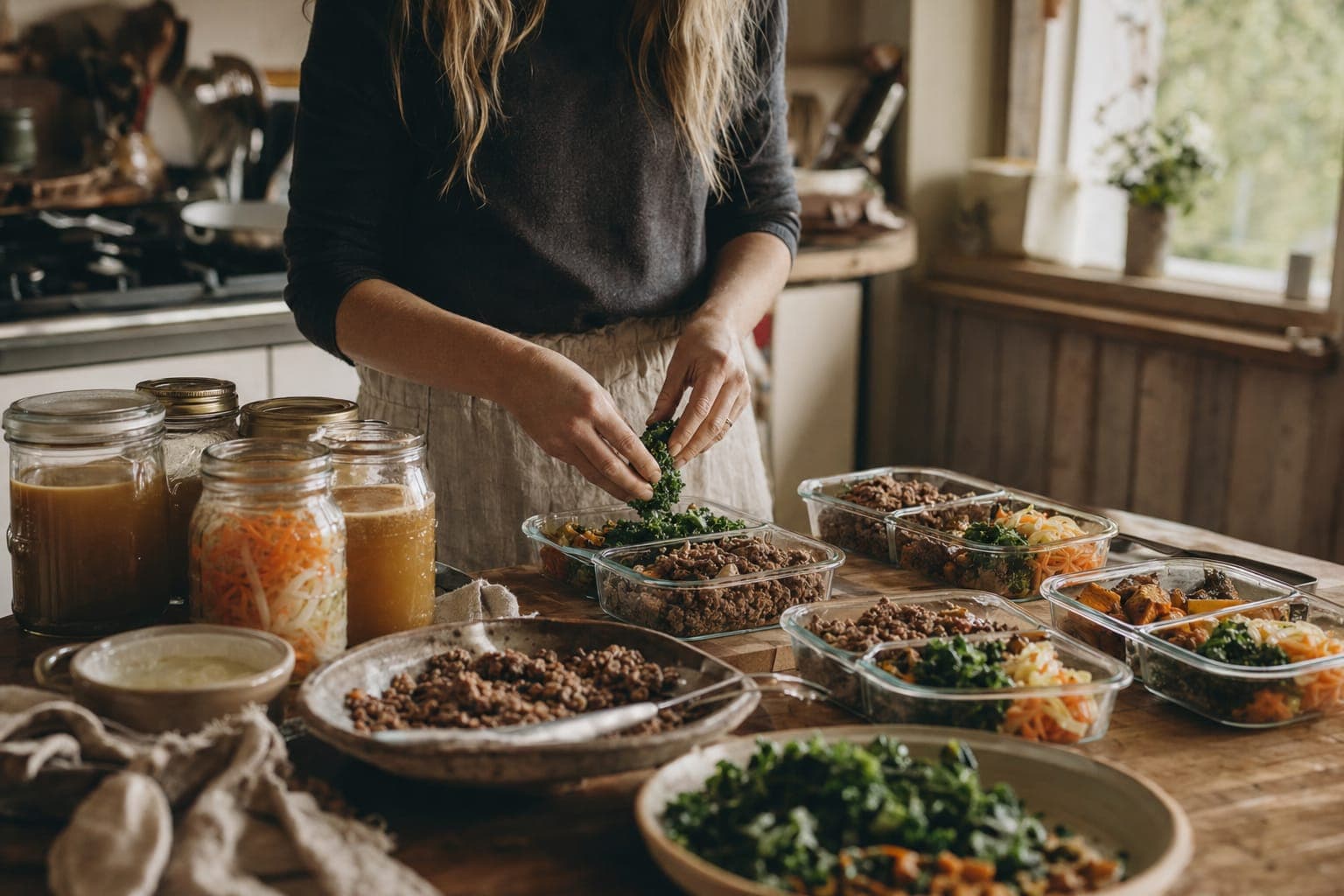
Most meal prep is about pre-cooking everything and eating reheated portions all week. That's fine, but it's not optimal for nutrition. Real food loses micronutrients when cooked and then heated again. A better approach is to prep components on Sunday and assemble them fresh each day.
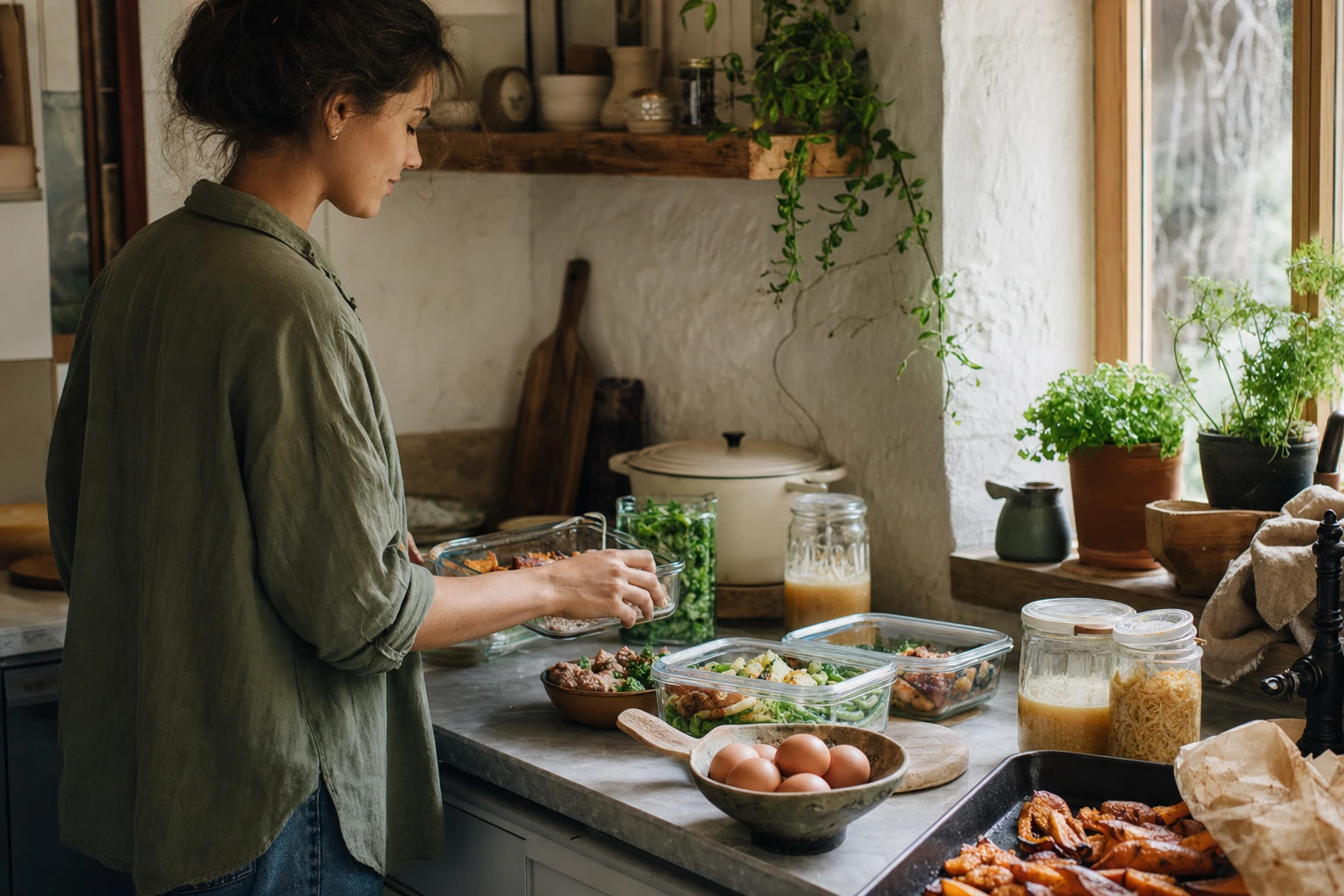
The Sunday prep strategy
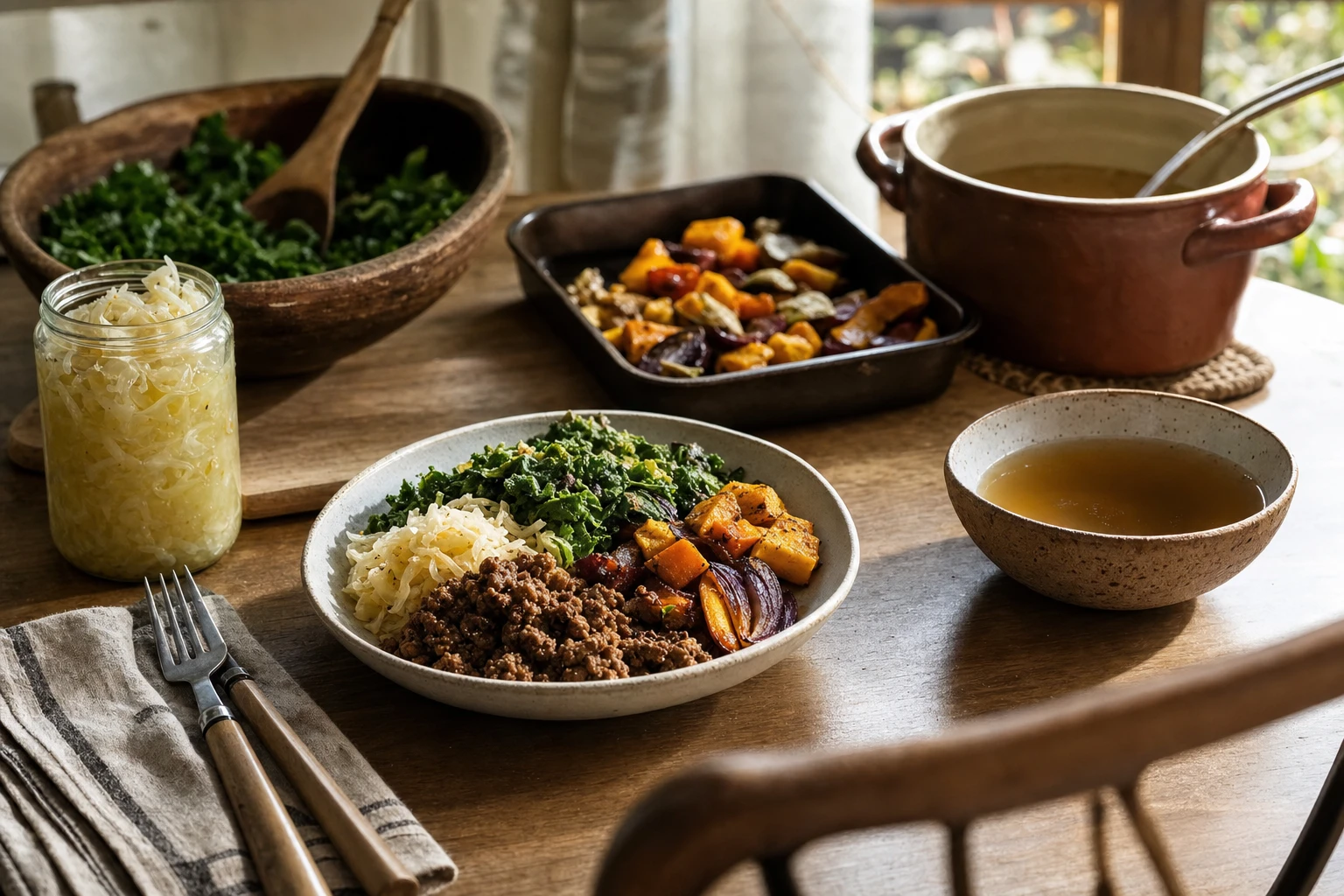
You're not cooking five days of meals. You're preparing four components: bone broth, protein, fermented vegetables, and fresh vegetables. Then during the week, you assemble them into meals. This keeps food fresher and nutrient density higher than traditional meal prep.
The schedule looks like this: start bone broth early morning, prepare protein mid-morning, ferment vegetables in the afternoon, and assemble your first few meals in the evening. By bedtime, you have components ready. Your whole week's protein is prepped. One hour each day during the week, you assemble breakfast, lunch, and dinner from what's waiting for you.
Prep components, not complete meals. This keeps your food fresher and more nutrient-dense throughout the week.
Morning: Start your bone broth
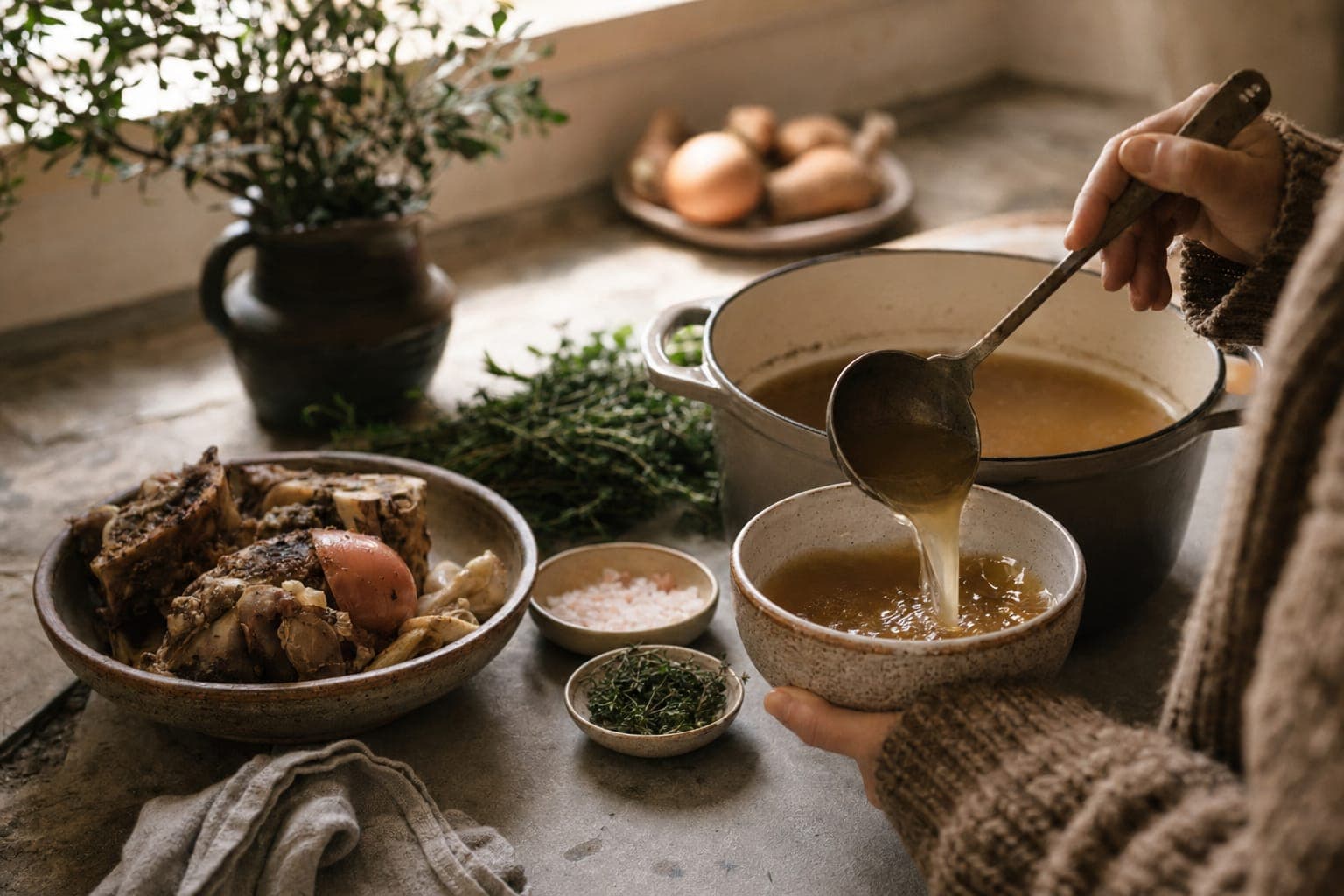
First thing on Sunday, fill a large pot with water. Add two kilograms of beef bones, or two kilograms of chicken carcasses, or a mixture. Add a splash of apple cider vinegar. Bring to a boil, then immediately reduce to a gentle simmer. Leave it all day. Twelve to twenty-four hours, the longer the better.
You're not attending to this. It simmers unattended. A small amount of acid (such as vinegar) is traditionally added to bone broth to help solubilise minerals from bone matrix during simmering.2 You'll come back to a pot of golden liquid at the end of the day. Strain it. Cool it. Refrigerate it or freeze it in ice cube trays for portion control.
This single step gives you bone broth for morning sipping, for cooking grains, for adding to soups, for adding to your Organised. One batch covers your entire week.
Bone broth simmering all day means you start with the foundation of your entire week's nutrition.
Early afternoon: Prepare your protein
Once your broth is simmering, start your protein. Brown two kilograms of organ meat mince or ground beef in a large pan over medium-high heat. This takes about fifteen minutes. Season with sea salt and nothing else at this stage. No garlic powder or fancy spices. Just salt.
You're cooking it in batches. As the first batch browns, set it aside. Brown the next batch. Keep going until all two kilograms are cooked. This is your protein foundation for the week. With this much cooked protein, you can make five different meals and still have leftovers.
Cool the meat and store it in glass containers in the fridge. It lasts about four days, five if it's organ meat because of the antimicrobial compounds it contains. This is your lunch protein, your dinner base, your breakfast with eggs.
Two kilograms of cooked organ mince on Sunday means you have protein ready for every meal all week.
Mid-afternoon: Ferment your vegetables
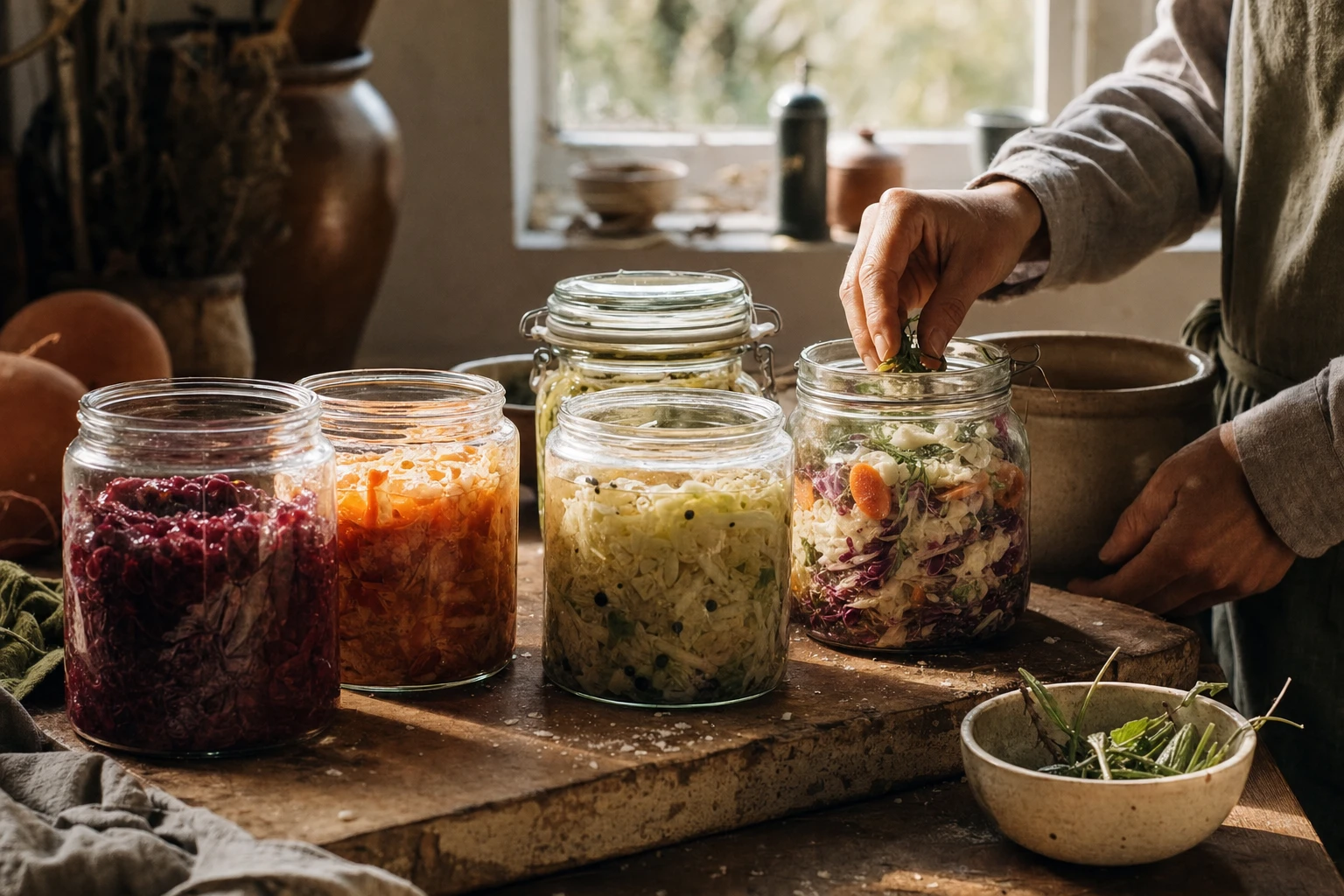
Chop two cups of cabbage, two cups of carrot, one cup of onion. Mix in a large jar with one tablespoon of sea salt and the juice of one lemon. Pack it down so the vegetables are submerged under their own liquid. Cover loosely with a cloth to keep dust out but allow fermentation gases to escape.
Leave it on the counter at room temperature. By Wednesday, it'll be lightly fermented. By Friday, it'll be noticeably tart. Either stage is perfect. Fermented vegetables provide live beneficial bacteria and have been associated with positive effects on the gut microbiome in several studies.1
Some people make multiple jars with different vegetable combinations. Cabbage and carrot. Beetroot and caraway. Cauliflower and turmeric. Variety matters for bacterial diversity. One jar is enough to start. Multiple jars is better.
Fermented vegetables take five minutes to make and improve the nutrition of every meal they sit alongside.
Evening: Assemble your meals
Your bone broth is done simmering. Cool it slightly and portion it into containers. You have protein cooked and cooling. You have fermented vegetables starting to ferment. Now make your first few meals.
Monday breakfast: two eggs fried in grass-fed butter, a handful of cooked organ mince mixed in, fermented vegetables on the side, one cup of bone broth alongside. Store it in a container. Microwave for thirty seconds in the morning if you want it warm. Eat it cold if you don't. Both work.
Monday lunch: a bowl with one cup of bone broth, two cups of mixed vegetables (some fresh, some cooked), your cooked organ mince, fermented vegetables, a pinch of sea salt. Store separately and combine when you're ready to eat. This keeps things fresher than pre-mixing.
Make two to three of these combinations on Sunday evening. Breakfast for two days, lunch for two days. This gives you something concrete waiting, rather than a pile of ingredients you need to think about.
Assembly meals in the evening means you wake to breakfast already prepared and lunch already planned.
Get recipes and routines, free
Two short reads a week of simple, nutrient-dense recipes and daily routines.
By signing up you agree to receive emails from us. No spam, unsubscribe anytime.
During the week: Assembly line eating
Tuesday morning, you're not cooking. You're assembling. Grab your cooked protein. Add fresh or cooked vegetables. Add a serving of bone broth. Add fermented vegetables. Eat it. Five minutes.
Wednesday you repeat the process with slightly different proportions and vegetable combinations. The components stay the same. The assembly changes. Your meals feel different even though you've prepped the same basic elements.
By Thursday, your fermented vegetables are ready. Your bone broth is ready. Your protein is at its freshest still. Friday you're eating your last portions. Saturday you're back to needing fresh food because your prep is done.
This rhythm means you're cooking substantial meals but you're never cooking. Your prep work on Sunday has given you six days of meals with zero weeknight cooking. Thursday and Friday you might add some fresh grilled fish or a roasted chicken as variety. But your base components do ninety per cent of the work.
During the week, you're assembling breakfast in two minutes, lunch in five minutes, dinner in ten. No cooking. Just combining.


1 of 9
Daily blend
100,000+ thriving families4.9 on Trustpilot
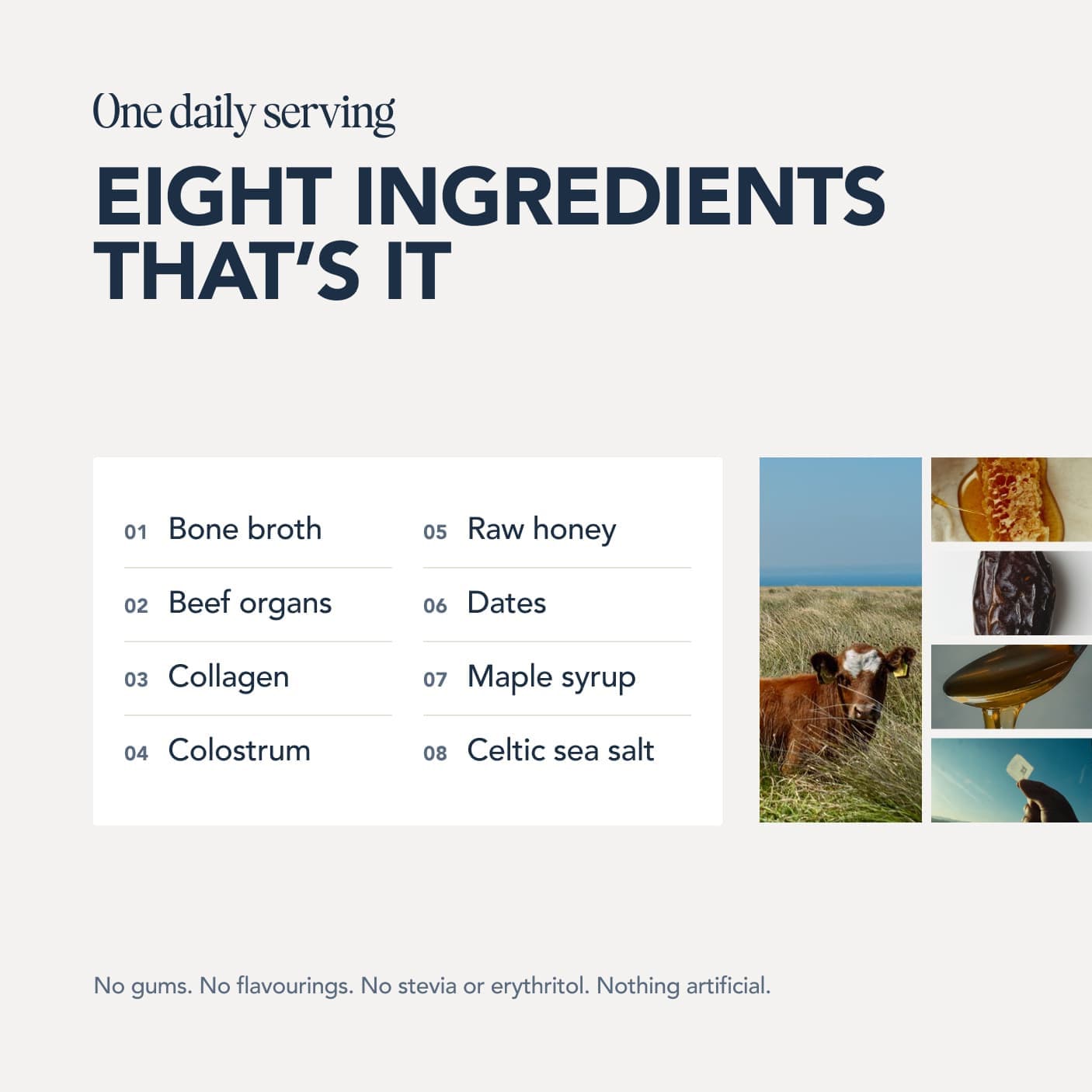
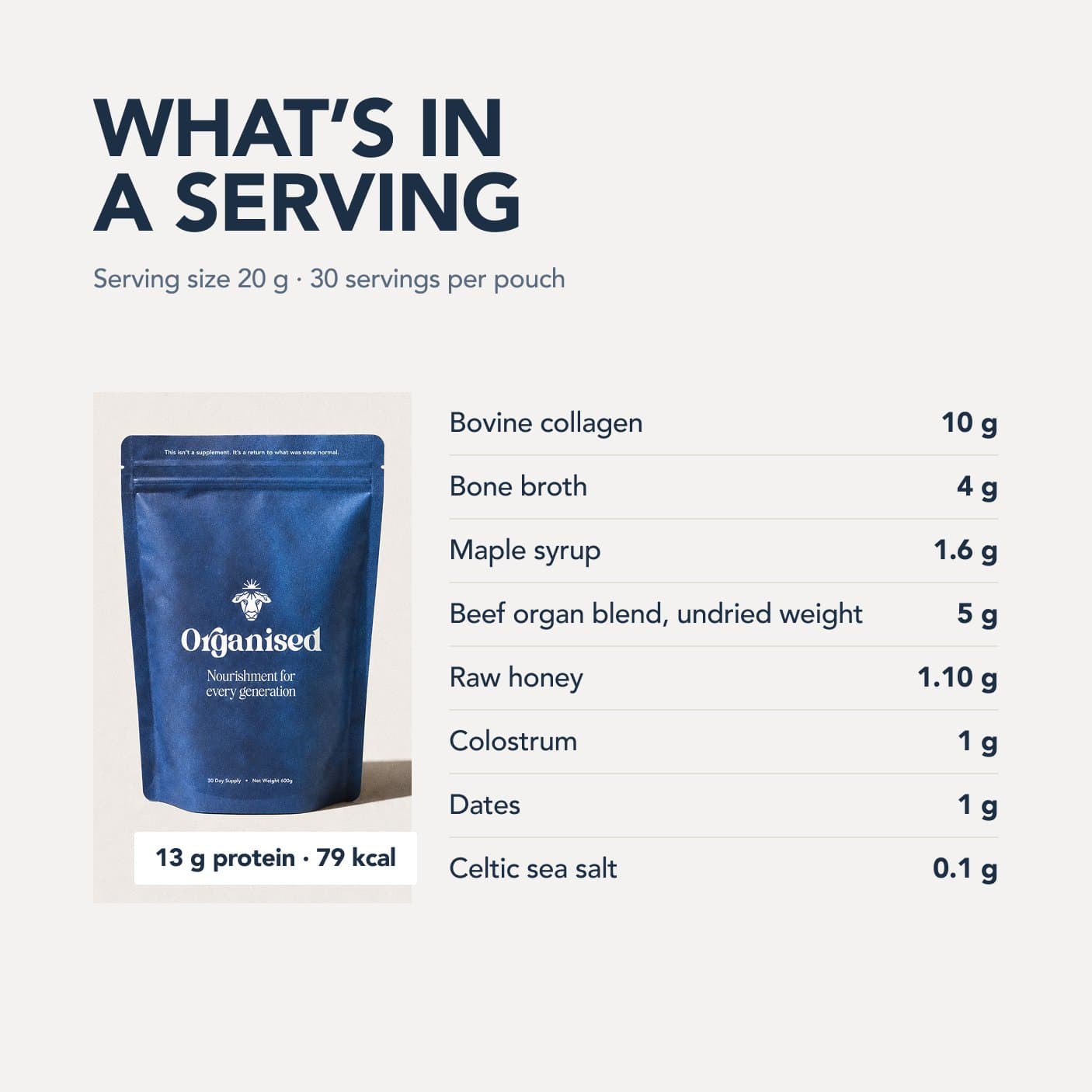
Eight real ingredients built around grass-fed beef organs, collagen and colostrum. Nothing synthetic added.
Free with your first order, worth £38. Plus £10 off the pouch with a subscription.



Free UK shipping · Made in England · 100 day money back guarantee on your first pouch · Skip, pause or cancel anytime
The bottom line
One Sunday afternoon working in your kitchen gives you a whole week of real food meals without weeknight cooking. Bone broth simmering all day. Organ mince browned in bulk. Vegetables fermenting on the counter. Each evening, you assemble meals from what's waiting.
This keeps your food fresher and more nutrient-dense than traditional meal prep because you're not heating components repeatedly. It's faster during the week because you're assembling, not cooking. And it's cheaper than buying prepared meals or eating restaurant food every day.
Your Sunday becomes your biggest cooking day. But you're not cooking for Sunday. You're cooking for six days ahead. That trade-off is worth making.
Simple proteins to batch-prep
On Sunday, cook a batch of ground beef or minced organ meat. Season it simply: salt, pepper, maybe some herbs. Use this throughout the week: in salads, with vegetables, folded into eggs. Two kilos of mince takes about 20 minutes to brown and crumble in a large pan. Divided into containers, it becomes five or six meals.
Similarly, batch-roast bone-in chicken thighs. They're cheaper than breasts, more forgiving, and more nutritious. Season them, roast at 200 degrees Celsius for 40 minutes, and you have protein and fat for days. The bones can go straight into your broth pot.
Batch cooking one protein takes 30 minutes and solves half your week's dinners.
Vegetables and storage
Prep vegetables raw and store them in containers. Chopped carrots, celery, cucumber, and leafy greens last three to four days. Some vegetables benefit from light cooking: roast root vegetables, quick-sauté leafy greens, boil beets. These take slightly longer to prep but store better and are faster to eat during the week.
Don't prep a huge rainbow. Pick three vegetables, prep them, and use them throughout the week. Simpler is better for adherence.
The real meal-prep secret
The secret isn't fancy meals or Instagram-worthy containers. It's having ingredients ready, not meals. A container of cooked mince, a container of roasted vegetables, a jar of bone broth, eggs in the fridge. You can make dozens of different meals from these components without any of them being fancy or boring. A bowl of mince with vegetables and broth is different enough when the components taste genuinely good.
Most people who fail at meal prep are bored by eating the same prepared meal five times. But eating the same components mixed differently? That works. The friction is removed because the food is ready, but the variety is built in.
References
Every source below was checked on 27 August 2026. Each PubMed, PMC and DOI identifier was resolved against NCBI or Crossref, and what it opens is printed under the citation, so you can see the link goes where the citation says without leaving the page. Where a citation and its identifier disagreed, the citation was corrected to the record or the reference was deleted along with the sentence marker that pointed at it, and where the resolved paper turned out not to support the sentence, the sentence was cut back to what it does support. Borrowed authority is worse than none, because it looks like rigour.
- Marco ML, et al. Health benefits of fermented foods: microbiota and beyond. Curr Opin Biotechnol. 2017;44:94-102. PMID 27998788Checked 27 August 2026: PMID 27998788 opens Marco ML, Heeney D, Binda S et al, Health benefits of fermented foods: microbiota and beyond. Curr Opin Biotechnol 2017;44:94-102. PubMed indexes it as: Review.
- Hsu DJ, et al. Essential and toxic metals in animal bone broths. Food Nutr Res. 2017;61(1):1347478. PMID 28804437Checked 27 August 2026: PMID 28804437 opens Hsu DJ, Lee CW, Tsai WC et al, Essential and toxic metals in animal bone broths. Food Nutr Res 2017;61(1):1347478.
Who wrote and reviewed this guide
Niall Kiddle
Author · Founder, Organised
Niall is the founder of Organised. He started the company in 2024 after fixing his own health the slow way: in 2022 he swapped a cupboard of synthetic supplements for real food, raw milk, organ meats, bone broth and honey, and felt the difference within months.
Areas of expertise: Ancestral nutrition, Organ meats, Whole-food supplementation, Gut health, Regenerative sourcing
Read Niall's full profile
Pedro Rodrigues
Reviewer · Agronomist (farming and sourcing only)
Pedro is the agronomist Organised works with on farming and sourcing. His job on the guides is to keep the science honest: he reviews what we publish about soil health, regenerative agriculture, grazing and the way food is actually produced.
Areas of expertise: Regenerative agriculture, Agronomy, Soil health, Grass-fed farming, Food sourcing
Reviewed this guide on
Read Pedro's full profileMore on routines
View all- The Busy Parent's Guide to Whole Food Nutrition
- The Morning Routine That Changed My Health
- A Day of Eating for Optimal Skin Health
- Evening Wind-Down: A Nutrition Protocol for Better Sleep
- How to Build a Supplement-Free Daily Routine
- Shift Workers: How to Eat for Energy When Your Schedule Is Upside Down
- The Healthy Morning Routine Reddit Swears By: An Honest Breakdown
- The Weekend Reset: A 2-Day Whole Food Protocol
- Travel Nutrition: How to Stay Nourished on the Go
Browse the guides library
All guidesKeep reading

Recipes & routines
Evening Wind-Down: A Nutrition Protocol for Better Sleep
A science-backed evening nutrition protocol for deeper sleep. Timing, glycine-rich foods, magnesium, and how to reduce blue light exposure.
Recipes & routines
Bone Broth from Scratch: A Step-by-Step Guide
Step-by-step guide to making bone broth at home. Stovetop, slow cooker, and Instant Pot methods. Rich in collagen and gut-healing minerals.
Recipes & routines
Organ Bolognese: The Family Dinner That Heals
Practical organ meat recipe using fresh beef liver and heart. Family-friendly bolognese that bridges supplements to whole food.
Real food, made effortless
Add it to my routineA few ways to use it
All recipesBone Broth from Scratch: A Step-by-Step Guide
Step-by-step guide to making bone broth at home. Stovetop, slow cooker, and Instant Pot methods. Rich in collagen and gut-healing minerals.
Organ Bolognese: The Family Dinner That Heals
Practical organ meat recipe using fresh beef liver and heart. Family-friendly bolognese that bridges supplements to whole food.
5-Minute High-Protein Breakfasts Using Organised
Quick, high-protein breakfast ideas using Organised. Five recipes you can make in minutes with real food. No fussing around.


 Join over 100,000+ members
Build a better food system with us
The Organised community is thousands of people choosing real food and backing the farmers who grow it, all of us trying to leave the world a little better than we found it. If that is what you care about too, you belong here.