The Gut Microbiome and Mental Health: What We Know So Far
You've probably heard it before. Gut health affects your mood. It sounds like wellness speak, the kind of thing that gets thrown around on social media without much substance behind it. But the research is real. Your gut bacteria are literally producing neurotransmitters that regulate your mood, your anxiety, your ability to handle stress. This is the psychobiome, and it's not marketing hype. It's emerging science with solid biological mechanisms.

By Niall Kiddle, Founder, Organised

Reviewed by Pedro Rodrigues, Agronomist (farming and sourcing only) ·
7 min read · Published · Updated · 5 cited sources
Makers of the Organised Daily blend, a grass-fed beef organ supplement from regenerative UK farms

The connection between your gut and your brain isn't metaphorical. It's biochemical, anatomical, and increasingly well-documented in peer-reviewed literature. Understanding this connection changes how you think about mental health and what levers you can actually pull to improve it.

How your gut produces neurotransmitters
Around 90% of body serotonin is produced in the gut, primarily by enterochromaffin cells.1 Not in your brain. In your gut. This fact alone should stop you. Serotonin is the neurotransmitter that regulates mood, sleep, appetite, and your resilience to stress. When serotonin is low, you feel flat, anxious, and fragile. Your emotional baseline drops. Joy feels distant.
But serotonin isn't made by your gut cells alone. It's made by specific strains of bacteria in your microbiome. These bacteria synthesise serotonin from the amino acid tryptophan, which you absorb from the protein you eat. No tryptophan in your diet, no serotonin synthesis. Poor quality bacteria in your gut, no efficient conversion of tryptophan into serotonin. Dysbiosis means serotonin production plummets.
The same applies to GABA, gamma-aminobutyric acid, the brain's primary calming neurotransmitter. When GABA is adequate, you feel grounded, composed, and capable of handling stress. When GABA is low, the nervous system becomes excitable. Your thoughts race. Anxiety spirals. You can't settle. GABA is also produced by specific bacterial strains. Dysbiosis means depleted GABA production.
Your gut bacteria aren't just passive residents. They're actively manufacturing the neurochemistry that determines your mental state. Your mood is partly in your head, but it's substantially in your gut.
Your gut bacteria synthesise serotonin, GABA, dopamine, and other neurotransmitters that regulate your mood and mental resilience. Dysbiosis means depleted neurotransmitter production and a brain chemistry that favours anxiety.

The vagus nerve highway
Even if your gut bacteria are synthesising serotonin, how does that serotonin reach your brain? Your brain is locked behind the blood-brain barrier, a highly selective filter that keeps most molecules out. Serotonin molecules are too large to cross it easily. The answer is the vagus nerve.
The vagus nerve is the longest nerve in your body. It runs from your brainstem down through your chest and abdomen, innervating your heart, lungs, and entire digestive tract. It's a two-way information superhighway. Signals travel down from your brain to tell your gut what to do. Signals travel up from your gut to tell your brain what's happening. About 80% of vagal traffic travels upward, from gut to brain.
Your gut bacteria communicate with nerve endings in your intestinal wall. These nerve endings send signals up the vagus nerve directly to your brain. When your microbiome is healthy and producing adequate neurotransmitters, the signals sent up the vagus nerve promote calm, emotional stability, and mental clarity. When dysbiosis prevails, the signals promote anxiety, hypervigilance, and emotional fragility.
Researchers including Mayer and colleagues have documented gut-brain communication via the vagus nerve and microbial metabolites.3 The gut-brain axis isn't theoretical. It's anatomical. The vagus nerve is literally a nerve. Your bacteria are literally signalling through it. And those signals directly influence your emotional state.
Short-chain fatty acids and brain chemistry
When you eat fermentable fibre, gut bacteria ferment it into short-chain fatty acids — primarily acetate, propionate and butyrate.2 These aren't just fuel for your colonic cells. They're signalling molecules that influence neurotransmitter production throughout your body and directly affect your brain function.
Butyrate is particularly important. It crosses the blood-brain barrier more easily than many other compounds. It acts as a histone deacetylase inhibitor, which sounds technical but essentially means it helps regulate which genes get expressed in your brain cells. Higher butyrate means better cognitive function, improved mood regulation, and reduced anxiety-like behaviour in research models. Lower butyrate means cognitive fog and mood dysregulation.
But here's the crucial catch: you don't produce butyrate yourself. Your bacteria do. And they only produce it if you're eating the fibres they ferment. If you're eating a fibre-poor diet of refined carbohydrates and processed food, your bacteria are starved of their primary food source. Butyrate production plummets. Your brain feels the effects within weeks. Mood crashes. Anxiety increases. Mental clarity declines.
This is why adding fibre suddenly often helps depression and anxiety so quickly. You're feeding your bacteria the substrate they need to produce the neurotransmitters your brain depends on.
Fibre-fed bacteria produce butyrate, which crosses the blood-brain barrier and influences mood regulation and cognitive function. Dysbiosis means butyrate starvation and a brain chemistry that struggles.

Get the science, plainly, free
Two short reads a week on what the research actually says about nutrition.
By signing up you agree to receive emails from us. No spam, unsubscribe anytime.
Which bacteria matter most
Not all bacteria are equal. Research into the psychobiome has identified specific genera that have outsized effects on mental health. Lactobacillus and Bifidobacterium species are strongly associated with lower anxiety and better mood regulation. Some randomised trials of Lactobacillus and Bifidobacterium probiotics have shown small reductions in anxiety and depressive symptoms, though the literature is heterogeneous.4 Faecalibacterium prausnitzii is a keystone butyrate producer. When it's abundant, mental clarity improves and mood is more stable. When it's depleted, brain fog and low mood follow.
Akkermansia muciniphila is associated with mucus layer integrity and metabolic health markers in observational and animal studies.5 and has been associated with better stress resilience. Roseburia faecis is another butyrate producer. Bacteroides uniformis has been linked to better mood outcomes in multiple studies.
The work of Tim Spector and the ZOE research group has mapped these connections in large cohorts of real people, not just animal models. The pattern is consistent: the more diversity you have in your microbiome, the better your mental health markers tend to be. Dysbiosis, conversely, correlates with higher rates of depression and anxiety across multiple independent studies.
What dysbiosis does to your mood
When your microbiome becomes dysbiotic, several things happen simultaneously. Neurotransmitter-producing bacteria are depleted, so serotonin and GABA production drops. Inflammatory bacteria proliferate and produce lipopolysaccharides that cross a compromised gut barrier, triggering neuroinflammation in your brain. Short-chain fatty acid production plummets. The vagus nerve receives signals of threat and distress rather than safety and stability.
The result is a brain chemistry that favours anxiety, depression, and cognitive dysfunction. You don't feel like yourself. The world feels more threatening. Sleep is fragmented and unrefreshing. Stress tolerance bottoms out. You feel anxious about things that wouldn't normally worry you. Food sensitivities emerge because your gut lining is inflamed. Your mood becomes emotionally labile, swinging from okay to overwhelmed at small provocations.
And here's the vicious cycle that many people don't recognise: when you're anxious and stressed, your nervous system shifts into sympathetic dominance. Your digestion worsens. Your gut motility slows. Your gut permeability increases. Your microbiome becomes more dysbiotic. The dysbiosis signals more anxiety up the vagus nerve. The cycle perpetuates itself. Dysbiosis causes anxiety. Anxiety worsens dysbiosis.
Breaking the cycle
The dysbiosis-anxiety cycle is bidirectional. Breaking it requires attacking from both ends. You can improve your microbiome through diet, but if you're chronically stressed, sleep-deprived, and sedentary, that dysbiosis will persist. Conversely, you can try stress-reduction techniques and meditation, but if your microbiome is dysbiotic and not producing adequate GABA and serotonin, your nervous system will struggle to genuinely calm.
The most effective approach addresses both simultaneously: improve your microbiome and calm your nervous system. This means real food, adequate sleep, regular movement, and stress reduction. Not one without the others. All together, working in concert.


1 of 9
Daily blend
100,000+ thriving families4.9 on Trustpilot
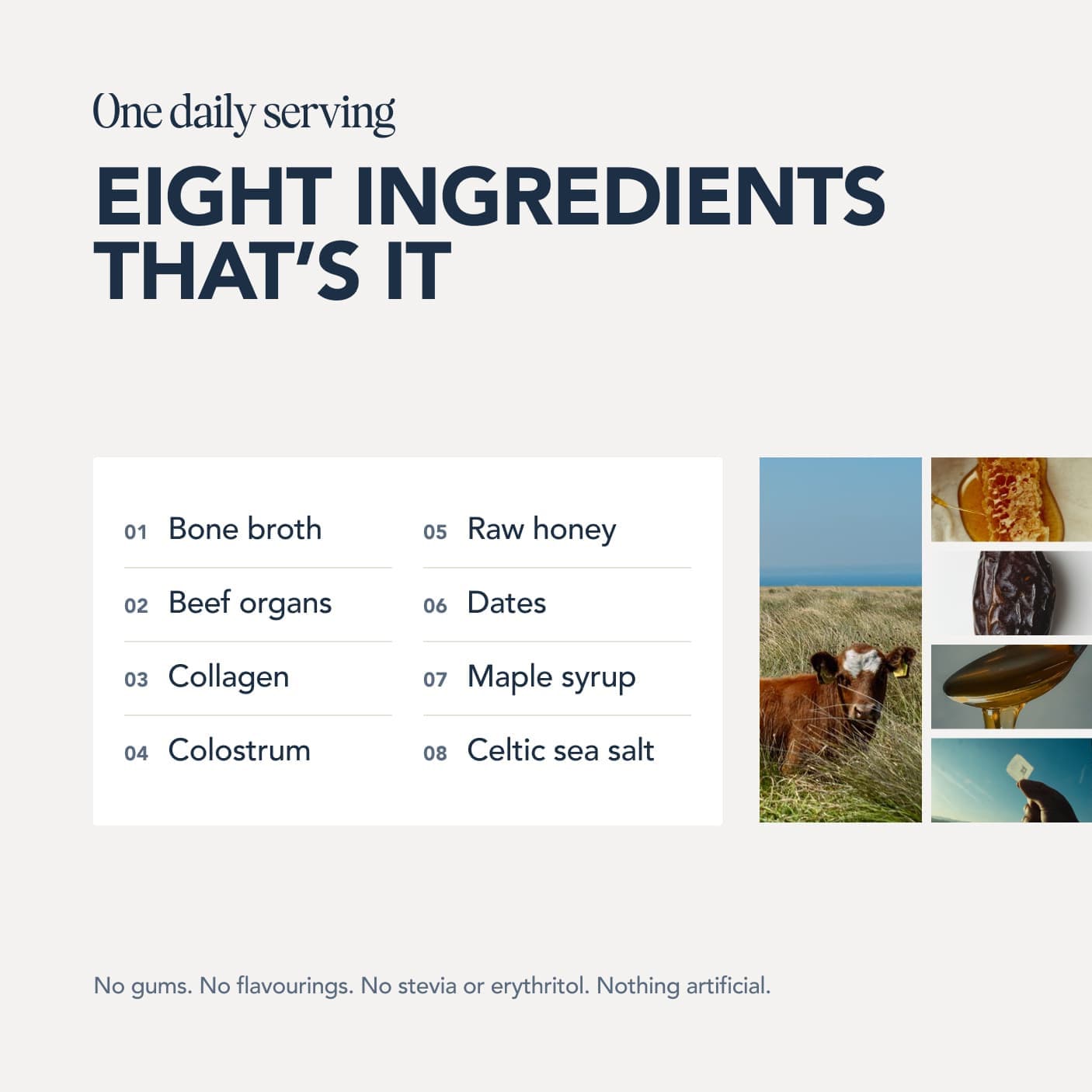
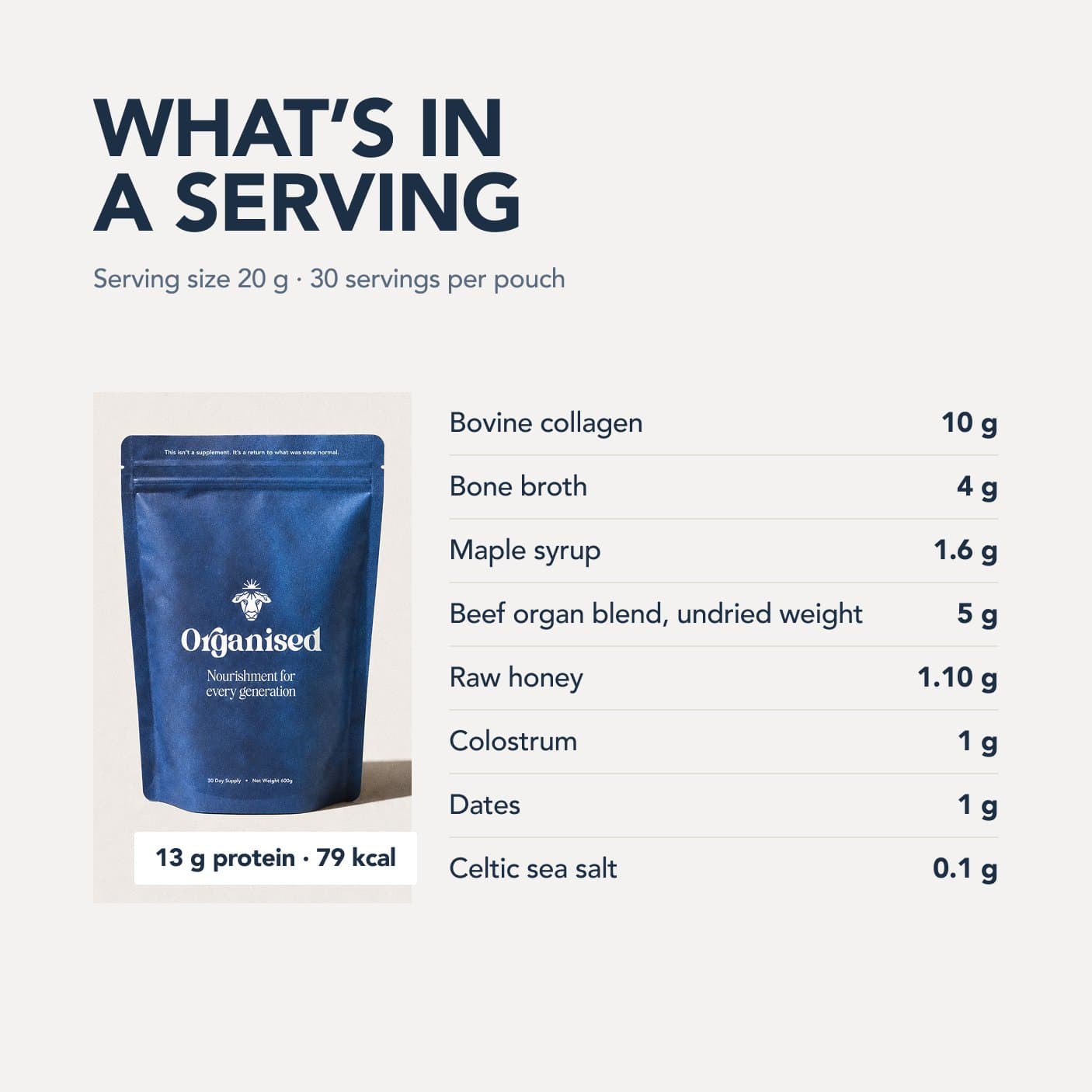
Eight real ingredients built around grass-fed beef organs, collagen and colostrum. Nothing synthetic added.
Free with your first order, worth £38. Plus £10 off the pouch with a subscription.

Free UK shipping · Made in England · 100 day money back guarantee on your first pouch · Skip, pause or cancel anytime
The practical implication
If you're struggling with anxiety or depression, your gut health deserves serious attention. Not as a replacement for medical support if you need it, but as a foundational intervention that works alongside whatever else you're doing. Feed your bacteria the foods they thrive on. Eat diverse plants, fermented foods like sauerkraut and kefir, bone broth, gelatinous cuts of meat rich in glycine. Sleep deeply and consistently to allow your nervous system to shift parasympathetic. Reduce the things that damage your microbiome: processed food, excess alcohol, antibiotics when avoidable, chronic stress.
Movement matters. A 20-minute walk shifts your nervous system parasympathetic. Movement also improves gut motility and blood flow to your digestive system. Social connection matters. Loneliness damages the microbiome. Time in nature matters. Sunlight supports vitamin D synthesis, which influences immune regulation and mood.
The psychobiome is real. Your bacteria are listening. And they're influencing your mood with every meal you eat, every night you sleep, and every moment of stress you're under. Start there.
References
Every source below was checked on 27 August 2026. Each PubMed, PMC and DOI identifier was resolved against NCBI or Crossref, and what it opens is printed under the citation, so you can see the link goes where the citation says without leaving the page. Where a citation and its identifier disagreed, the citation was corrected to the record or the reference was deleted along with the sentence marker that pointed at it, and where the resolved paper turned out not to support the sentence, the sentence was cut back to what it does support. Borrowed authority is worse than none, because it looks like rigour.
- Yano JM, et al. Indigenous bacteria from the gut microbiota regulate host serotonin biosynthesis. Cell. 2015;161(2):264-76. PMC4393509Checked 27 August 2026: PMC4393509 opens Yano JM, Yu K, Donaldson GP et al, Indigenous bacteria from the gut microbiota regulate host serotonin biosynthesis. Cell 2015;161(2):264-76.
- Koh A, et al. From Dietary Fiber to Host Physiology: Short-Chain Fatty Acids as Key Bacterial Metabolites. Cell. 2016;165(6):1332-1345. PMID 27259147Checked 27 August 2026: PMID 27259147 opens Koh A, De Vadder F, Kovatcheva-Datchary P et al, From Dietary Fiber to Host Physiology: Short-Chain Fatty Acids as Key Bacterial Metabolites. Cell 2016;165(6):1332-1345. PubMed indexes it as: Review.
- Bonaz B, Bazin T, Pellissier S. The Vagus Nerve at the Interface of the Microbiota-Gut-Brain Axis. Front Neurosci. 2018;12:49. PMC5808284Checked 27 August 2026: PMC5808284 opens Bonaz B, Bazin T, Pellissier S, The Vagus Nerve at the Interface of the Microbiota-Gut-Brain Axis. Front Neurosci 2018;12:49. PubMed indexes it as: Review.
- Liu RT, et al. Prebiotics and probiotics for depression and anxiety: A systematic review and meta-analysis of controlled clinical trials. Neurosci Biobehav Rev. 2019. PMID 31004628Checked 27 August 2026: PMID 31004628 opens Liu RT, Walsh RFL, Sheehan AE, Prebiotics and probiotics for depression and anxiety: A systematic review and meta-analysis of controlled clinical trials. Neurosci Biobehav Rev 2019;102:13-23. PubMed indexes it as: Meta-Analysis, Systematic Review.
- Cani PD, et al. Akkermansia muciniphila: paradigm for next-generation beneficial microorganisms. Nat Rev Gastroenterol Hepatol. 2022. PMID 35641786Checked 27 August 2026: PMID 35641786 opens Cani PD, Depommier C, Derrien M et al, Akkermansia muciniphila: paradigm for next-generation beneficial microorganisms. Nat Rev Gastroenterol Hepatol 2022;19(10):625-637. PubMed indexes it as: Review.
Who wrote and reviewed this guide
Niall Kiddle
Author · Founder, Organised
Niall is the founder of Organised. He started the company in 2024 after fixing his own health the slow way: in 2022 he swapped a cupboard of synthetic supplements for real food, raw milk, organ meats, bone broth and honey, and felt the difference within months.
Areas of expertise: Ancestral nutrition, Organ meats, Whole-food supplementation, Gut health, Regenerative sourcing
Read Niall's full profile
Pedro Rodrigues
Reviewer · Agronomist (farming and sourcing only)
Pedro is the agronomist Organised works with on farming and sourcing. His job on the guides is to keep the science honest: he reviews what we publish about soil health, regenerative agriculture, grazing and the way food is actually produced.
Areas of expertise: Regenerative agriculture, Agronomy, Soil health, Grass-fed farming, Food sourcing
Reviewed this guide on
Read Pedro's full profileMore on emerging research
View allBrowse the guides library
All guidesKeep reading

Science
What Is Bioavailability and Why Does It Matter for Supplements?
What bioavailability means, why it matters for supplement effectiveness, and how it changes everything about your nutrition strategy.

Science
How to Read a Nutritional Study Without Being Misled
Learn how to read nutritional studies without being misled. Tell apart observational and RCT research, and spot confounders, funding and healthy user bias.
Science
Methylation: What It Is and Why It Matters
Understand methylation, the chemical process fundamental to every cell. Learn how B12, folate, and choline support it, and why organs are key sources.
Real food, made effortless
See the blendA few ways to use it
All recipes
Bone Broth from Scratch: A Step-by-Step Guide
Step-by-step guide to making bone broth at home. Stovetop, slow cooker, and Instant Pot methods. Rich in collagen and gut-healing minerals.

Raw Milk Ice Cream with Organised
Make raw milk ice cream at home with Organised for a seasonal, nutrient-dense treat. Three simple flavours to try whenever the craving strikes.

Organ Bolognese: The Family Dinner That Heals
Practical organ meat recipe using fresh beef liver and heart. Family-friendly bolognese that bridges supplements to whole food.


 Join over 100,000+ members
Build a better food system with us
The Organised community is thousands of people choosing real food and backing the farmers who grow it, all of us trying to leave the world a little better than we found it. If that is what you care about too, you belong here.