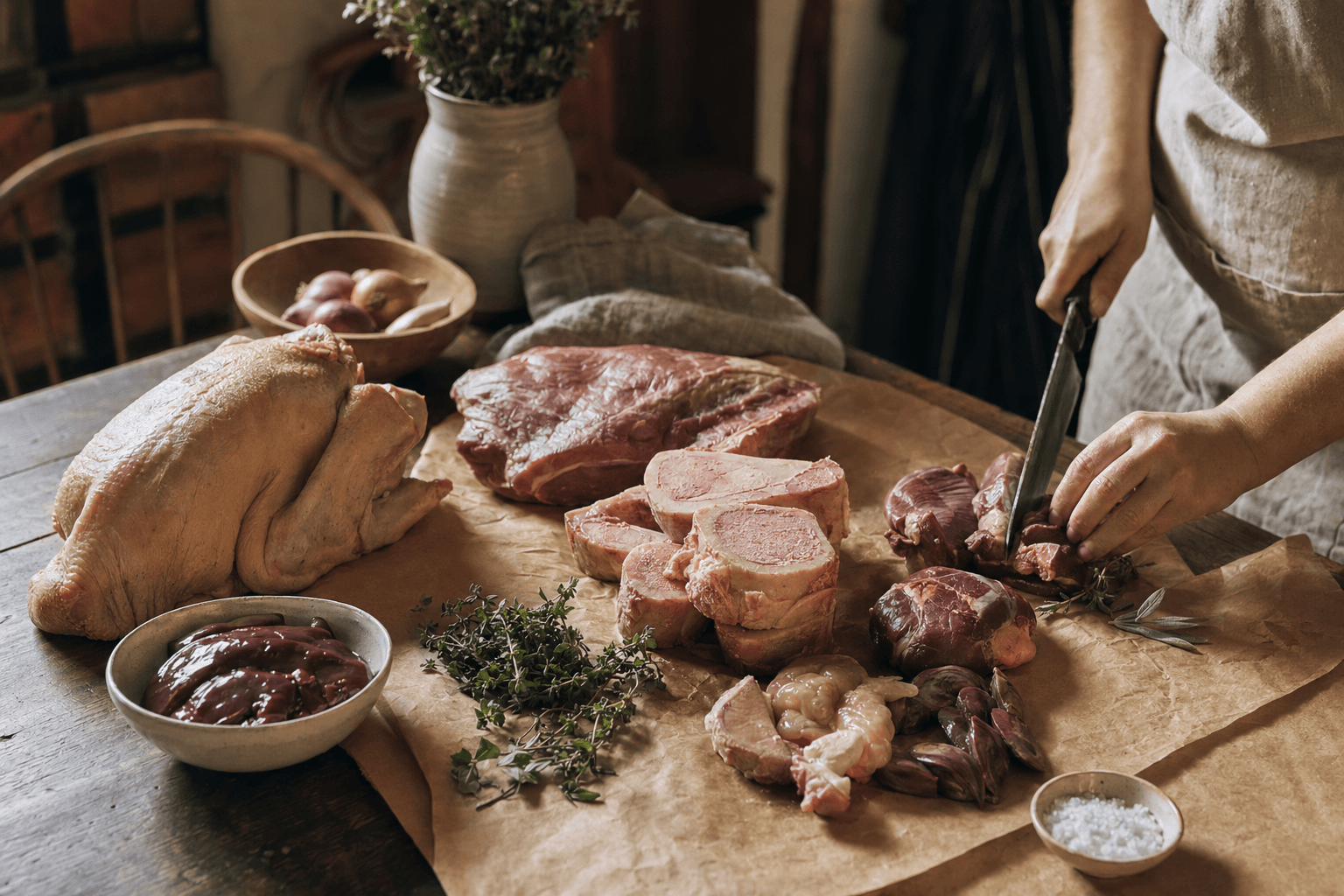

When a hunter brought down a deer, the liver came first. The heart next. The brain was prised open. Every part was used because nothing was wasted and everything had purpose. That relationship with food, that completeness, is what nose-to-tail eating is trying to recover. It's not nostalgia. It's recognition of a system that worked for hundreds of thousands of years, then was abandoned for convenience, and is now being reclaimed by people who want to eat well.
What nose-to-tail eating actually means
Nose-to-tail eating is simple in theory and quietly radical in practice: you use every part of an animal. Not just the steak and the mince. The liver, the heart, the kidneys, the spleen, the tongue, the marrow, the bone for broth. If it's edible, it's food.
It's called nose-to-tail because it means everything, from the tip of the nose to the base of the tail. The name matters. It's a philosophy that recognises the whole animal as worthy. Nothing gets thrown away because nothing has less value.
The practice itself is ancient. Every traditional culture on the planet did this. Not because they were sentimental about animals. Because organs kept them alive. The Inuit ate seal liver. The Masai drank blood and ate organs alongside meat. The Japanese made offal a delicacy. Medieval Europeans served liver and kidneys to the wealthy and the common alike.
Nose-to-tail eating is not about being thrifty, though it is. It's about eating the foods that made humans resilient.
Then came industrialisation. Suddenly there was enough muscle meat that organs became unnecessary. They became cheap, unfashionable, relegated to pet food and rendered waste. An entire category of the most nutrient-dense foods ever known got quietly removed from the Western diet.
Why your ancestors prised organs above muscle
Here's the uncomfortable truth: muscle meat, the thing we've built our food culture around, is actually less nutrient-dense than organs. A steak is protein and some B vitamins. Beef liver is a different category entirely.
Organs are the body's nutrient repositories. The liver is where the animal stores its fat-soluble vitamins. The heart is where nutrient density concentrates in muscle tissue. The kidneys filter and concentrate minerals. Evolution designed organs to be nutrient vaults, and they still are.
Grass-fed beef liver contains more vitamin A than almost any plant food. It's one of the few reliable food sources of heme iron, the form your body absorbs best.51 It carries copper, selenium, zinc, and choline in quantities that steak simply cannot match.
A 100-gram serving of beef liver provides more nutrition than a kilogram of broccoli. That's not marketing. That's biochemistry. Your great-grandmother knew this without needing a lab report.
The heart is lean muscle but metabolically different from skeletal muscle. It's rich in CoQ10, an antioxidant critical for heart health and energy production.2 It's higher in B vitamins and minerals than any piece of steak. The tongue is collagen and minerals and taste.
The organs were never cheap because they were inferior. They were cheap because we stopped understanding their value.
Bone marrow isn't an afterthought. It's collagen, minerals, and fat-soluble vitamins in one place. Bone broth made from bones and connective tissue has been a staple of every healing tradition: Russian, Chinese, Jewish, Italian, British. Your body recognises collagen and minerals from broth differently than collagen powder.
This isn't sentiment. It's nutrition.
The nutrient density case
When nutritionists talk about nutrient density, they're measuring how many nutrients you get per calorie or per gram. By that measure, organs dominate. Always.
Beef liver has more nutrient density per 100 calories than any other whole food. More than eggs. More than fish. More than organs from other animals. It's not close.
Kidney is overlooked but extraordinary. It's rich in selenium, a mineral most people are running low on. It contains CoQ10, B vitamins, and phosphorus. A small serving provides a week's worth of copper.
Tongue is pure collagen and minerals. It's one of the best food sources of B vitamins, particularly B12. It's easier to digest than leaner muscle meat because of its fat content.
Spleen is less commonly eaten but worth understanding. It's rich in iron, particularly heme iron. It contains antioxidants that support immune function. Traditional Chinese medicine has used spleen meat for millennia to support digestion and immune resilience.
The thymus gland, sweetbread as it's known, is tender and nutrient-dense. It's high in B vitamins and minerals, particularly zinc and selenium.
You cannot eat enough spinach to match the nutrient density of a single serving of liver. That's not a judgment on spinach. It's biochemistry.
For someone trying to address a nutrient deficiency, organs work differently than food alone. The quantities are small. A 100-gram serving of liver weekly provides more iron, copper, and B vitamins than most people get monthly from conventional food. That's not supplementation. That's eating food as medicine.
The organs to know
Starting nose-to-tail eating doesn't require you to immediately embrace every organ. Begin with the ones that are most accessible and most nutrient-dense.
Beef liver is the obvious starting point. It's the most nutrient-dense food on the planet. If you can only add one organ meat to your diet, this is it. Grass-fed liver is superior: the animals have eaten grass and clover, which concentrate the vitamins the liver stores. A single 100-gram serving contains more vitamin A than a month of conventional eating, more iron than a steak, and copper in quantities that support dopamine production and connective tissue formation.
Beef heart is excellent for beginners because its flavour is mild and texture is familiar. It's lean muscle but from the organ itself, so it carries different nutrients than steak. It's rich in CoQ10, an antioxidant that powers mitochondrial energy production. It contains taurine, an amino acid critical for heart function and liver health.3 The heart meat is exceptionally pure, free from the inflammatory compounds that can build up in skeletal muscle.
Bone marrow is marrow from inside the bone. It's pure fat and collagen. Grass-fed marrow carries fat-soluble vitamins A, D, E, and K2, working together as a synergistic nutrient package.4 It tastes rich and is simple to extract by roasting bones at 200C until the marrow is soft enough to scoop out with a spoon. The flavour is buttery and deeply satisfying.
Kidney has a distinct flavour that takes adjustment, but it's worth the effort. High in selenium, a mineral that most people are deficient in. Contains CoQ10. Rich in B vitamins, particularly B12. Soak it before cooking to reduce the strong taste. Braised with red wine and herbs becomes surprisingly palatable.
Liver from lamb or pork offers variation if beef liver becomes repetitive. Lamb liver is slightly sweeter. Pork liver is milder. Both are nutrient powerhouses. Both support the same organ systems that beef liver does.
Bone broth is collagen and minerals extracted by slow cooking bones with vegetables and acid (vinegar or lemon). Every traditional culture made this. Your body recognises the collagen and releases gelatin during digestion, which supports joint health, gut lining integrity, and bone formation. Simmer bones for 12 to 24 hours to extract maximum mineral content and gelatin.
Oxtail and other collagenous cuts are not organs but are organised into this category for good reason. They contain high collagen content and benefit from long, slow cooking. The resulting broth is gelatinous and supremely healing.
Beyond beef, organs from grass-fed lamb, pastured pork, wild-caught fish, and pastured poultry are equally valuable. The principle is the same: whole animal eating returns the nutrient density that muscle alone cannot provide. Different animals offer different nutrient profiles. Rotating between them ensures broader nutrient coverage.
Start with liver. Once you taste it prepared well, you will understand why your ancestors prised it above any cut of meat.
How to start: moving beyond supplements
The beautiful thing about nose-to-tail eating is that you can begin before you're ready to cook organs yourself. Supplements exist because humans created a gap between traditional foods and modern diet.
Desiccated organ supplements are freeze-dried versions of the organs themselves. They're whole food in concentrated form. A single capsule of liver is equivalent to eating several grams of liver. For someone building tolerance or testing whether they actually like organs, supplements are a gateway. They're not inferior. They're a practical entry point into an ancestral way of eating.
The advantage of supplements is control. You can start with a single capsule daily and build up. You can test your tolerance. You can see how your body responds without the commitment of cooking whole organs. If you have digestive sensitivity, supplements allow you to rebuild your capacity gradually.
But supplements are a start, not an endpoint. Real liver tastes different. Your body recognises it differently. The cofactors and synergies in whole food are more complex than anything extracted and dried. The texture, the satiety, the psychological satisfaction of eating real food cannot be replicated in a capsule.
Once you're comfortable with supplements, try cooking organs. Liver prepared well is nothing like the overcooked versions from school dinners. Pan-fry it briefly in butter with salt and pepper. The inside should be slightly pink. Serve with sauerkraut or sautéed greens to support digestion. The sourness helps break down the iron.
Heart can be slow-cooked in a stew or braised with root vegetables. Kidney requires soaking to remove the strong flavour, but patience is rewarded. Bone marrow roasts in 15 minutes at 200C. Tongue braised until tender is mild and delicious, the collagen making it unctuously satisfying.
Find a butcher who sells grass-fed organs. Ask what they have. Tell them you're starting nose-to-tail eating. Many will support the conversation and may even offer organs they usually discard. Support them back by buying regularly. Build a relationship with farmers who understand that you value the whole animal.
If fresh organs are difficult to source, frozen is acceptable. Many online suppliers deliver grass-fed organs. Some are more expensive, but the availability now is better than it was five years ago. As demand increases, supply increases. You're voting with your purchases.
The cost is lower than steak. The nutritional return is orders of magnitude higher. This is what food economics should be.
The bottom line
Nose-to-tail eating isn't extremism. It's a return to what every healthy culture did without thinking about it. Your ancestors were not trying to optimise their diet. They were trying to stay alive. And organs kept them alive. They nourished births. They supported growth. They sustained people through winters. They created resilience.
Start somewhere. A liver supplement. A single serving of organ meat. Bone broth in your cooking. The question isn't whether you like organs. It's whether you can afford not to eat them. Because the gap between your nutrient intake and what you actually need might only be closed by organs. You can eat broccoli until you're exhausted. You can take vitamins until your liver complains. Or you can eat liver once weekly and close the gap completely.
Everything from the nose to the tail was designed to nourish. We're only beginning to remember why. And in remembering, we're discovering that the foods we discarded were the foods that kept us strongest.
References
- 1. National Institutes of Health Office of Dietary Supplements. Vitamin A and Carotenoids - Health Professional Fact Sheet. NIH ODS Vitamin A.
- 2. Saini R. Coenzyme Q10: The essential nutrient. J Pharm Bioallied Sci. PMC3178961.
- 3. Schaffer S, Kim HW. Effects and mechanisms of taurine as a therapeutic agent. Biomol Ther (Seoul). PMC5933890.
- 4. National Institutes of Health Office of Dietary Supplements. Vitamin K - Health Professional Fact Sheet. NIH ODS Vitamin K.
- 5. National Institutes of Health Office of Dietary Supplements. Iron - Health Professional Fact Sheet. NIH ODS Iron.
- Ancestral NutritionThe Forgotten Art of Tallow: Nature's SkincareBeef tallow is nature's skin balm. Fatty acid profile, history of skin care, how to render it, and why it works.
- Ancestral NutritionFood Additives You Should Actually Worry AboutMost food additives are safe, but some are genuinely problematic. Here's which ones actually matter and why.
- Ancestral NutritionWhat Happened When We Stopped Eating OrgansPost-WWII shift to convenience foods and muscle meat only. The nutrient decline and chronic disease that followed.
Nourishment, without the taste.
Start with a single serving of grass-fed liver this week. Notice how you feel.