Why We Will Never Add Artificial Sweeteners to Organised
We could make Organised sweeter still, with one lab-made additive that costs pennies. We never will. The sweetness in Organised comes from raw honey, dates and maple syrup, real food that keeps its promise. Here's why artificial sweeteners will never make the list.

By Niall Kiddle, Founder, Organised

Reviewed by Pedro Rodrigues, Agronomist (farming and sourcing only) ·
6 min read · Published · Updated · 4 cited sources
Makers of the Organised Daily blend, a grass-fed beef organ supplement from regenerative UK farms


The seduction of sweetness
Humans are drawn to sweetness. It's neurological. Sweet tastes signal energy (calories) to your brain, triggering reward pathways. For most of human history, this was useful. Sweet foods were rare, calorie-dense, and valuable.
But now we can engineer sweetness without calories. We can trigger the reward pathway without providing energy. This is the basic promise of artificial sweeteners: all the pleasure, none of the consequences.
It's also a lie. There are consequences. They're just hidden and poorly understood by most people.
The temptation for any food company is real. Artificial sweetness is cheap, intense, and moreish. But triggering the reward pathway while breaking the promise behind it is a betrayal of what we're trying to do.
How artificial sweeteners disrupt gut bacteria
This is where the trouble starts. Your gut bacteria have evolved over millennia to process specific foods. They recognise glucose, fructose, and other sugars. They have metabolic pathways to break them down.
Artificial sweeteners (aspartame, sucralose, saccharin) are molecular shapes that don't exist in nature. Your gut bacteria have no evolutionary history with them. When exposed to artificial sweeteners, some bacteria can consume them, but the process is messy.
Studies show that regular consumption of artificial sweeteners significantly alters the composition of gut bacteria.1 Beneficial bacteria decline. Opportunistic bacteria increase. The diversity of the microbiome drops.
Artificial sweeteners are literally foreign molecules to your gut. Your bacteria don't know what to do with them, and the chaos disrupts your health.
This dysbiosis has downstream effects: increased intestinal permeability (leaky gut), reduced production of beneficial metabolites (like butyrate), altered immune function, and increased inflammation.
The damage isn't theoretical. Multiple studies have shown that people who consume artificial sweeteners regularly have worse metabolic health, higher rates of weight gain, and increased disease risk compared to people who don't.2

The insulin signalling problem
Here's where it gets counterintuitive. Artificial sweeteners don't spike blood glucose. They should be metabolically neutral. But they're not.
Your brain registers sweetness and expects glucose. When glucose doesn't arrive, it's confused. The insulin signalling pathways still activate slightly. Your body becomes less responsive to sweet tastes (taste receptor adaptation). Over time, regular consumption of sweeteners impairs your ability to regulate appetite and detect satiety.
Studies show that people who regularly consume artificial sweeteners have higher fasting insulin levels, suggesting ongoing metabolic disruption even when they're not consuming the sweetener.3
The proposed mechanism: your body is constantly anticipating glucose that never arrives, keeping you in a state of metabolic confusion. It's a constant false alarm.
Taste receptor confusion
Your taste buds have sweetness receptors. They detect sweet compounds and send a signal to your brain. This signal normally correlates with calorie content and glucose load.
When you consume artificial sweeteners regularly, your taste buds send the sweetness signal, but glucose doesn't follow. This breaks the association. Your taste receptors become less sensitive to sweetness overall, so you need more intense sweetness to feel satisfied.
This is why people who consume diet sodas regularly find natural fruit too subtle. Their taste receptors have adapted to artificial intensity.
More importantly, the confusion between sweet taste and actual calories interferes with satiety signalling. Your brain gets less accurate information about energy intake, and you end up overeating because the hunger signals are disrupted.
Artificial sweeteners train your body to expect calories that don't come. It's a form of chronic metabolic manipulation.
Why even "natural" sweeteners matter
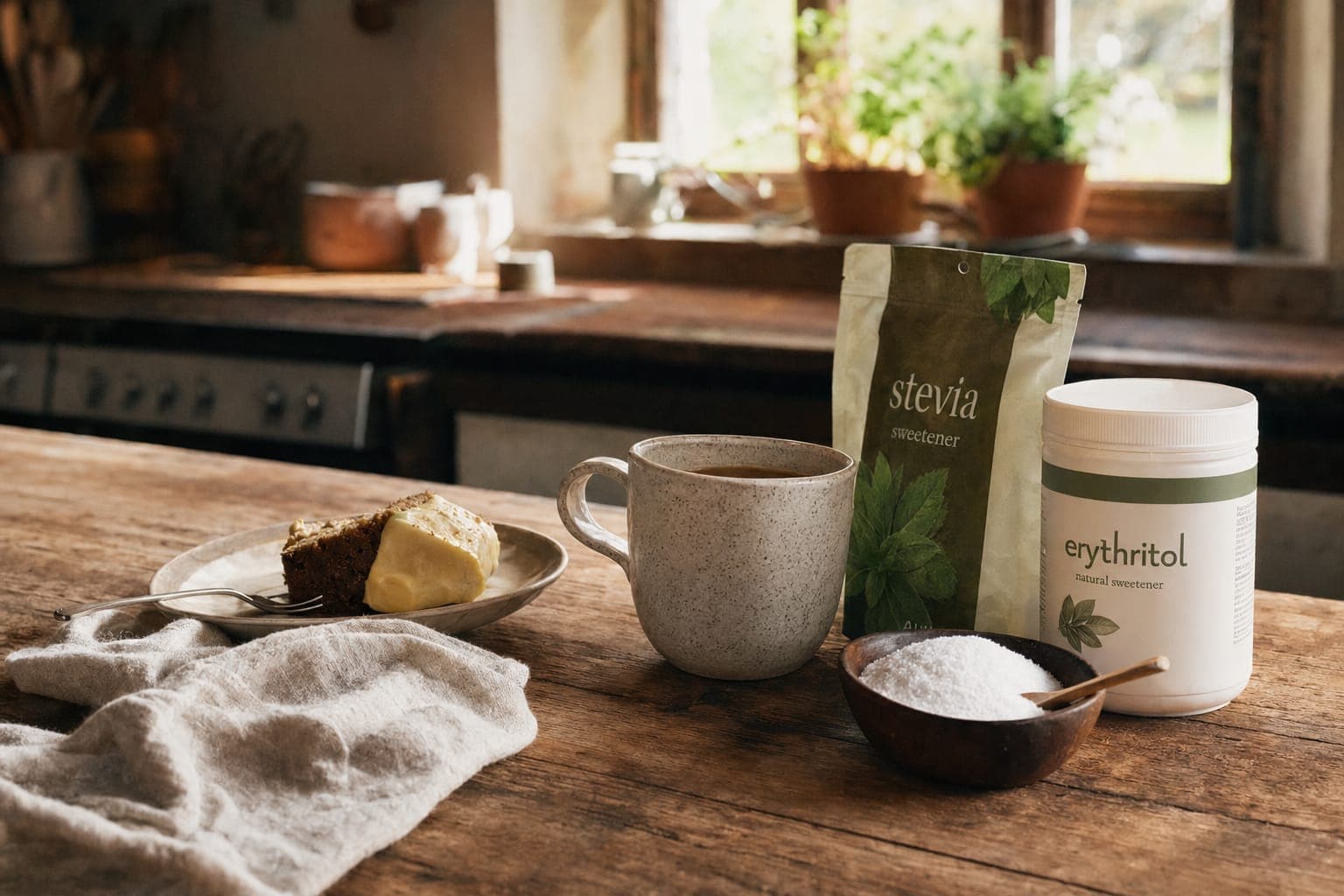
Some people argue that "natural" sweeteners like stevia and erythritol are safer. They're non-caloric, plant-derived, and don't spike glucose. Better, right?
Maybe. But the research is still limited. Both stevia and erythritol can alter gut bacteria composition, though perhaps less aggressively than artificial sweeteners.4 Both can trigger insulin responses in some people (the effect is variable). Both can cause digestive distress at high doses.
Are they better than aspartame? Probably. Are they neutral? No. They still involve your body detecting sweetness without calorie arrival. They still disrupt taste adaptation to some degree.
If we're being honest, the safest approach is to consume less intensely sweet stuff, period. Not to find a "better" sweetener and keep consuming sweetness at the same intensity.
Notice what stevia and erythritol share with aspartame: sweetness with no energy behind it. Whole sweet foods, honey, dates, maple syrup, are a different category altogether. The sweet taste arrives with the calories it promises, plus minerals, antioxidants, and fibre in the case of dates. Your body's ledger balances.
Get ancestral nutrition guides, free
Two short reads a week on traditional ways of eating, examined with modern evidence.
By signing up you agree to receive emails from us. No spam, unsubscribe anytime.
The choice we made
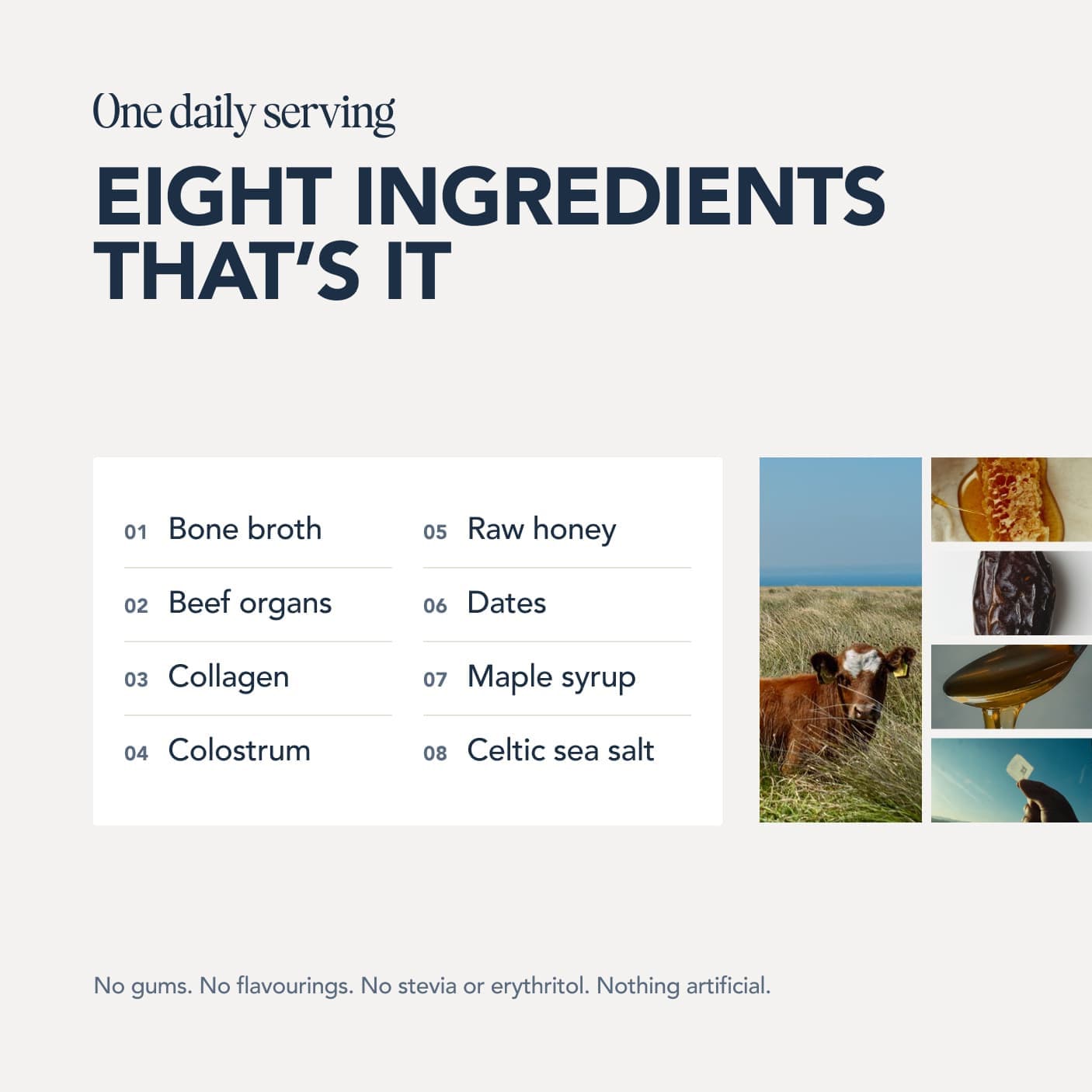
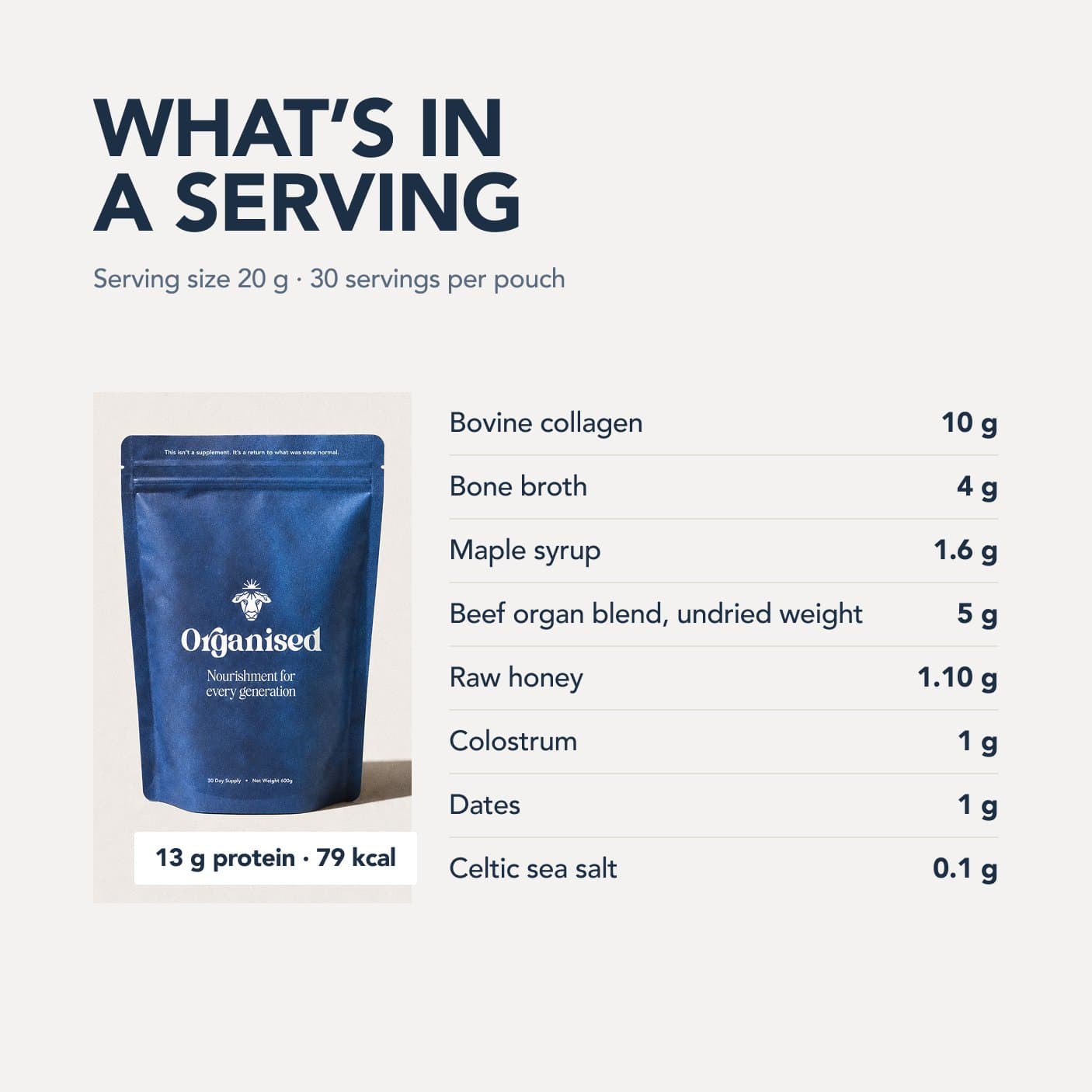
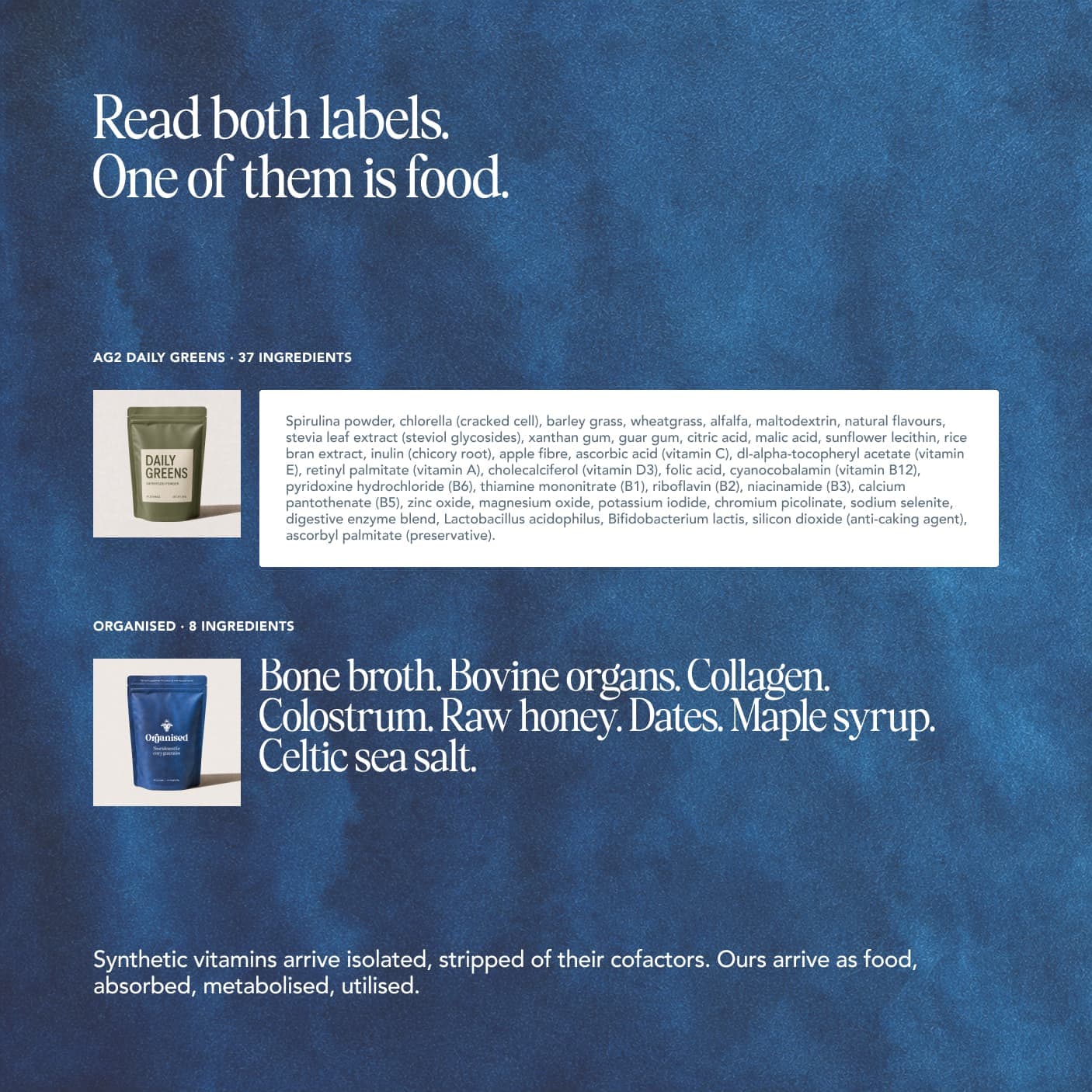
Organised is naturally sweet, and the sweetness is food: raw honey, whole dates, Canadian maple syrup. Three of the eight ingredients. When you taste the gentle, rounded sweetness of the blend, you're tasting things your great-grandmother would have recognised on sight.
We could push it further. Add sucralose and it would taste like a milkshake mix for pennies. Add stevia and the label could still whisper "natural". The product would be cheaper to make and easier to sell on the first sip.
But we'd be breaking the one promise the blend is built on: everything in the pouch is food. Sweetness from honey, dates, and maple arrives with the calories, minerals, and antioxidants it promises. Sweetness from a packet arrives with a lie attached. We know which one belongs in a whole food blend.
So the policy is simple, and permanent. Real food sweetness, never an artificial one. This is real, whole food, with organs as a key ingredient, and there's nothing artificial in there to disguise what it is. We love that, and we're keeping it that way.
The sweetness in Organised keeps its promise. That's the whole policy, and it will never change.
The intensity race we refuse to run
We know for a fact that an artificial sweetener would win a blind first-sip test against almost anything. That's what these molecules are engineered to do: they're hundreds of times sweeter than sugar, and they reset your palate to expect that intensity everywhere.
The question is: at what cost? We'd be chasing an intensity that makes real food taste dull. We'd be optimising for the first sip at the expense of every meal that comes after it.
Organised's sweetness works the other way. It's the gentle, rounded sweetness of honey, dates, and maple: rich stirred through thick yoghurt, milkshake-like in a smoothie with milk and banana, warm in porridge. It doesn't shout on the first sip. It's still a pleasure on the three-hundredth morning, and the three-hundredth morning is the one that matters.
One honest note: if the taste is new to you, give it ten goes before you judge it. That's roughly how long a palate takes to adjust to any real food, especially one with organs in it and nothing artificial standing in front of them.
The companies that add artificial sweeteners are betting you'll judge everything on sip one. We're betting on customers who want breakfast to taste like food, every day, for years.
That's you, reading this. If you're thinking about Organised, you're already in that camp. That's the customer we built this for.
1 of 9
Daily blend
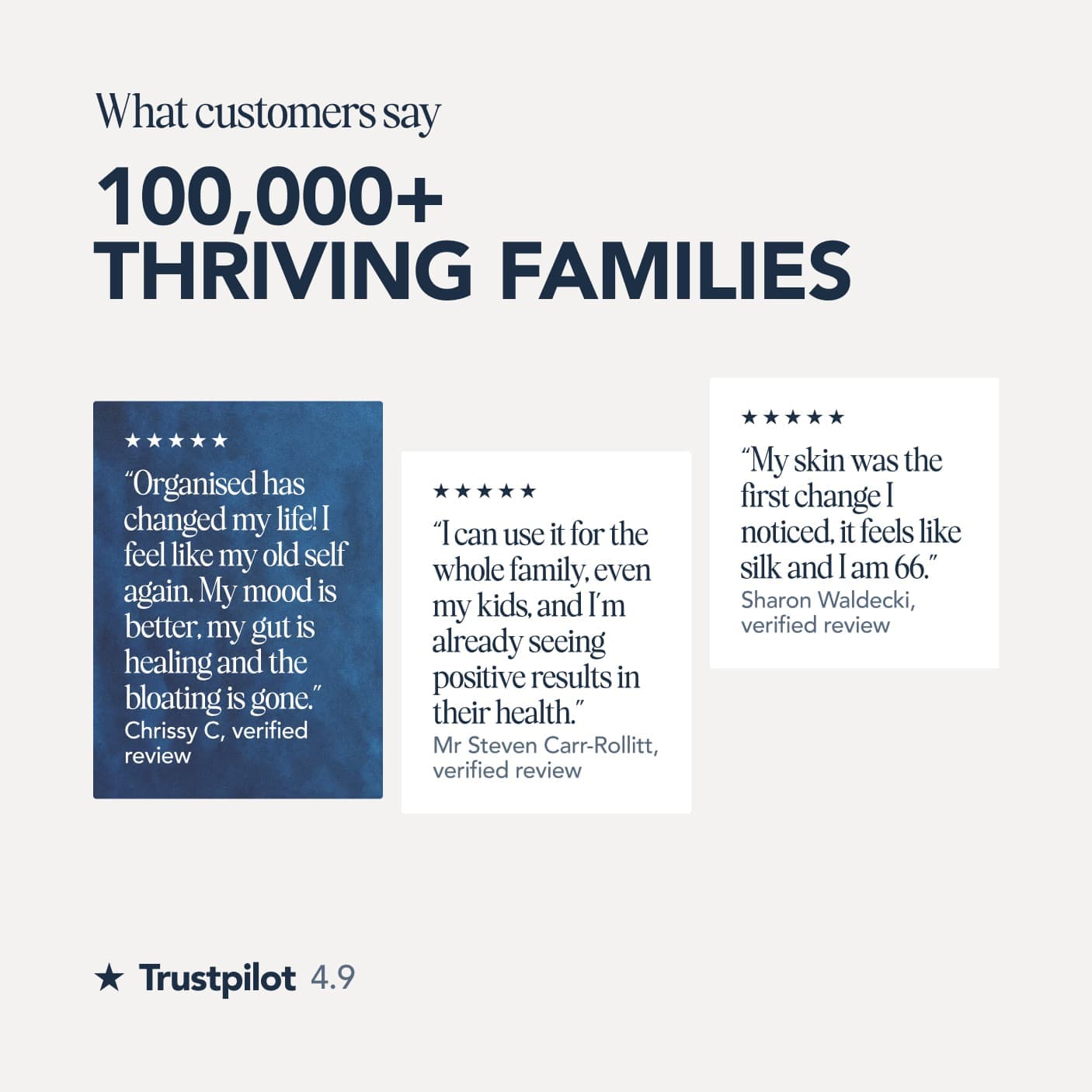
100,000+ thriving families4.9 on Trustpilot
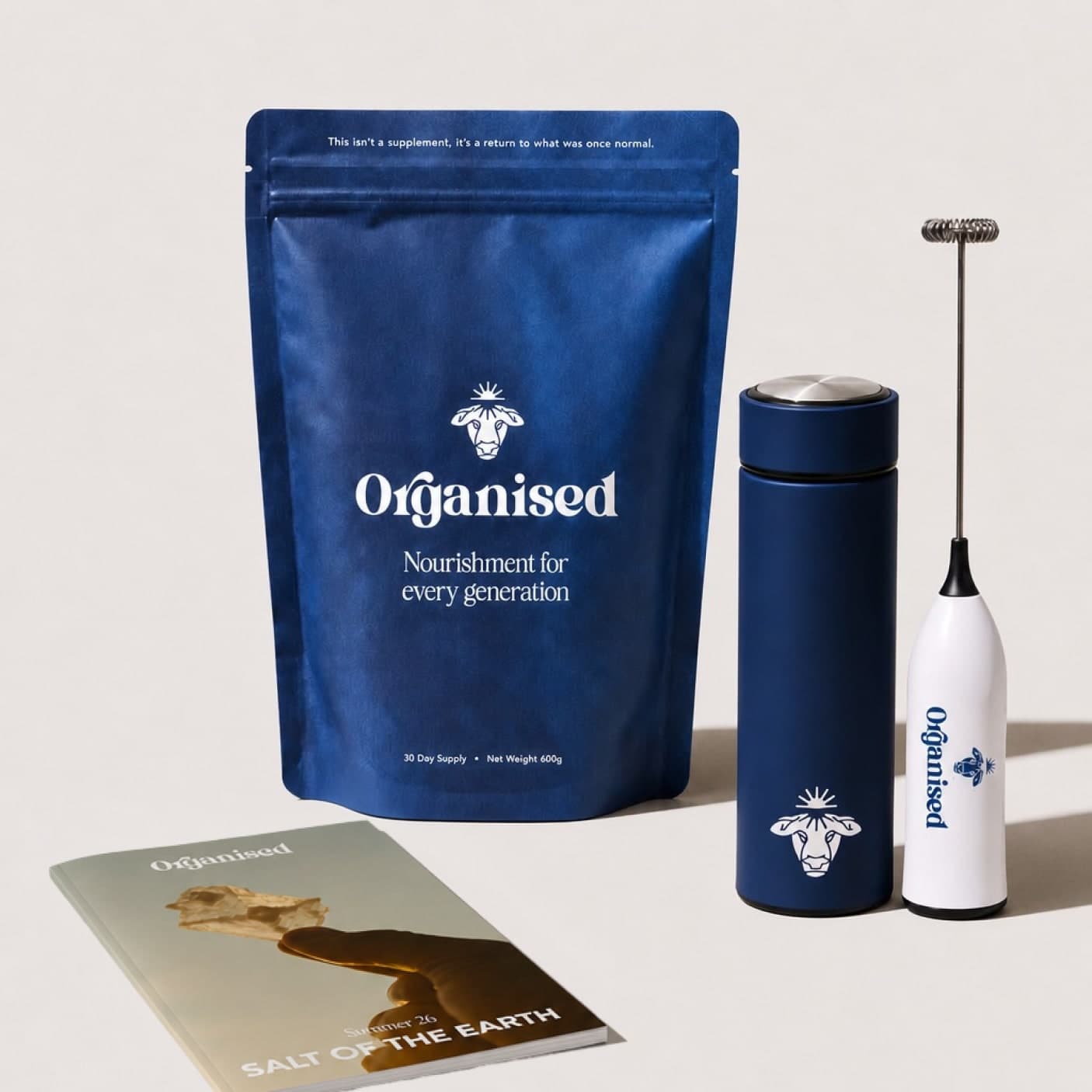
Eight real ingredients built around grass-fed beef organs, collagen and colostrum. Nothing synthetic added.
Free with your first order, worth £38. Plus £10 off the pouch with a subscription.

Free UK shipping · Made in England · 100 day money back guarantee on your first pouch · Skip, pause or cancel anytime
What this means for you
If you're choosing between Organised and an artificially sweetened competitor, this is why. We're not taking the easier route. We're not chasing lab-made intensity at the cost of health.
As you're building your own supplement stack or choosing products, think about sweeteners in the same way. Every sweetener, even natural ones, is a compromise. What problem does it solve? Is that problem more important than the unknowns it introduces?
The safest choice is always whole food without manipulation. That's what Organised is. That's what we'll stay.
References
Every source below was checked on 27 August 2026. Each PubMed, PMC and DOI identifier was resolved against NCBI or Crossref, and what it opens is printed under the citation, so you can see the link goes where the citation says without leaving the page. Where a citation and its identifier disagreed, the citation was corrected to the record or the reference was deleted along with the sentence marker that pointed at it, and where the resolved paper turned out not to support the sentence, the sentence was cut back to what it does support. Borrowed authority is worse than none, because it looks like rigour.
- Suez J et al. Personalized microbiome-driven effects of non-nutritive sweeteners on human glucose tolerance. Cell. PMC12025785.Checked 27 August 2026: PMC12025785 opens Hetta HF, Sirag N, Elfadil H et al, Artificial Sweeteners: A Double-Edged Sword for Gut Microbiome. Diseases 2025;13(4). PubMed indexes it as: Review.The authors' own declaration, from the record: The authors declare no conflicts of interest.
- Debras C et al. Artificial sweeteners and cancer risk: Results from the NutriNet-Sante population-based cohort study. PLoS Med. PubMed PMID: 35324894.Checked 27 August 2026: PMID 35324894 opens Debras C, Chazelas E, Srour B et al, Artificial sweeteners and cancer risk: Results from the NutriNet-Santé population-based cohort study. PLoS Med 2022;19(3):e1003950.The authors' own declaration, from the record: I have read the journal's policy and the authors of this manuscript have the following competing interests: SG is co-founder of Open Food Facts, a non-profit project developed by thousands of volunteers from around the world. It is a free and open-data food product database designed to help citizens make better food choices.
- Pepino MY. Metabolic effects of non-nutritive sweeteners. Physiol Behav. PMC4661066.Checked 27 August 2026: PMC4661066 opens Pepino MY, Metabolic effects of non-nutritive sweeteners. Physiol Behav 2015;152(Pt B):450-5. PubMed indexes it as: Review.
- Ruiz-Ojeda FJ et al. Effects of Sweeteners on the Gut Microbiota: A Review of Experimental Studies and Clinical Trials. Adv Nutr. PMC6363527.Checked 27 August 2026: PMC6363527 opens Ruiz-Ojeda FJ, Plaza-Díaz J, Sáez-Lara MJ et al, Effects of Sweeteners on the Gut Microbiota: A Review of Experimental Studies and Clinical Trials. Adv Nutr 2019;10(suppl_1):S31-S48.
Who wrote and reviewed this guide
Niall Kiddle
Author · Founder, Organised
Niall is the founder of Organised. He started the company in 2024 after fixing his own health the slow way: in 2022 he swapped a cupboard of synthetic supplements for real food, raw milk, organ meats, bone broth and honey, and felt the difference within months.
Areas of expertise: Ancestral nutrition, Organ meats, Whole-food supplementation, Gut health, Regenerative sourcing
Read Niall's full profile
Pedro Rodrigues
Reviewer · Agronomist (farming and sourcing only)
Pedro is the agronomist Organised works with on farming and sourcing. His job on the guides is to keep the science honest: he reviews what we publish about soil health, regenerative agriculture, grazing and the way food is actually produced.
Areas of expertise: Regenerative agriculture, Agronomy, Soil health, Grass-fed farming, Food sourcing
Reviewed this guide on
Read Pedro's full profileMore on whole food philosophy
View allBrowse the guides library
All guidesKeep reading

Ancestral
Why We Believe Whole Food Is the Future of Nutrition
Why whole food nutrition works better than supplements. Bioavailability, cofactors, and the science of nutrient synergy explained.
Ancestral
Stevia, Erythritol and the Gut Microbiome
How artificial sweeteners disrupt the microbiome, insulin response, and metabolic health. Why this pillar avoids them entirely.

Ancestral
Are 'Superfoods' Just Marketing? A Nutrient Density Reality Check
Acai, goji and kale dominate wellness marketing, but how do nutrient-dense superfoods compare to liver, eggs and bone broth? See what the data shows.
Real food, made effortless
Bring it into my routineA few ways to use it
All recipes
Ancestral Breakfast Ideas from Around the World
Traditional breakfast recipes from cultures that got nutrition right. Japanese, Turkish, Scottish, and more. Whole-food breakfast inspiration.
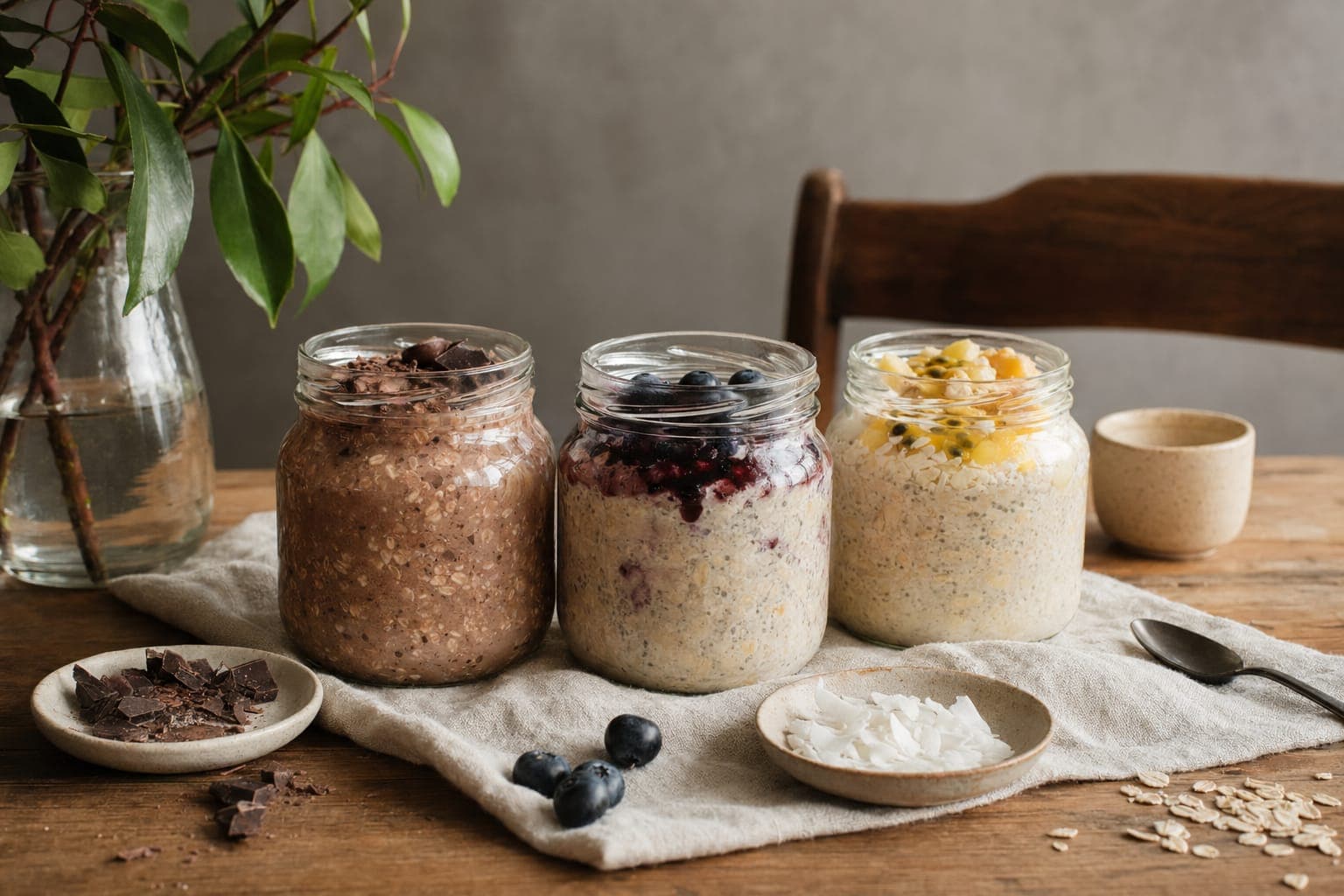
Organised Overnight Oats: 3 Variations
Three delicious overnight oats variations with Organised. Chocolate, berry, tropical flavours. Make them Sunday, eat them all week.
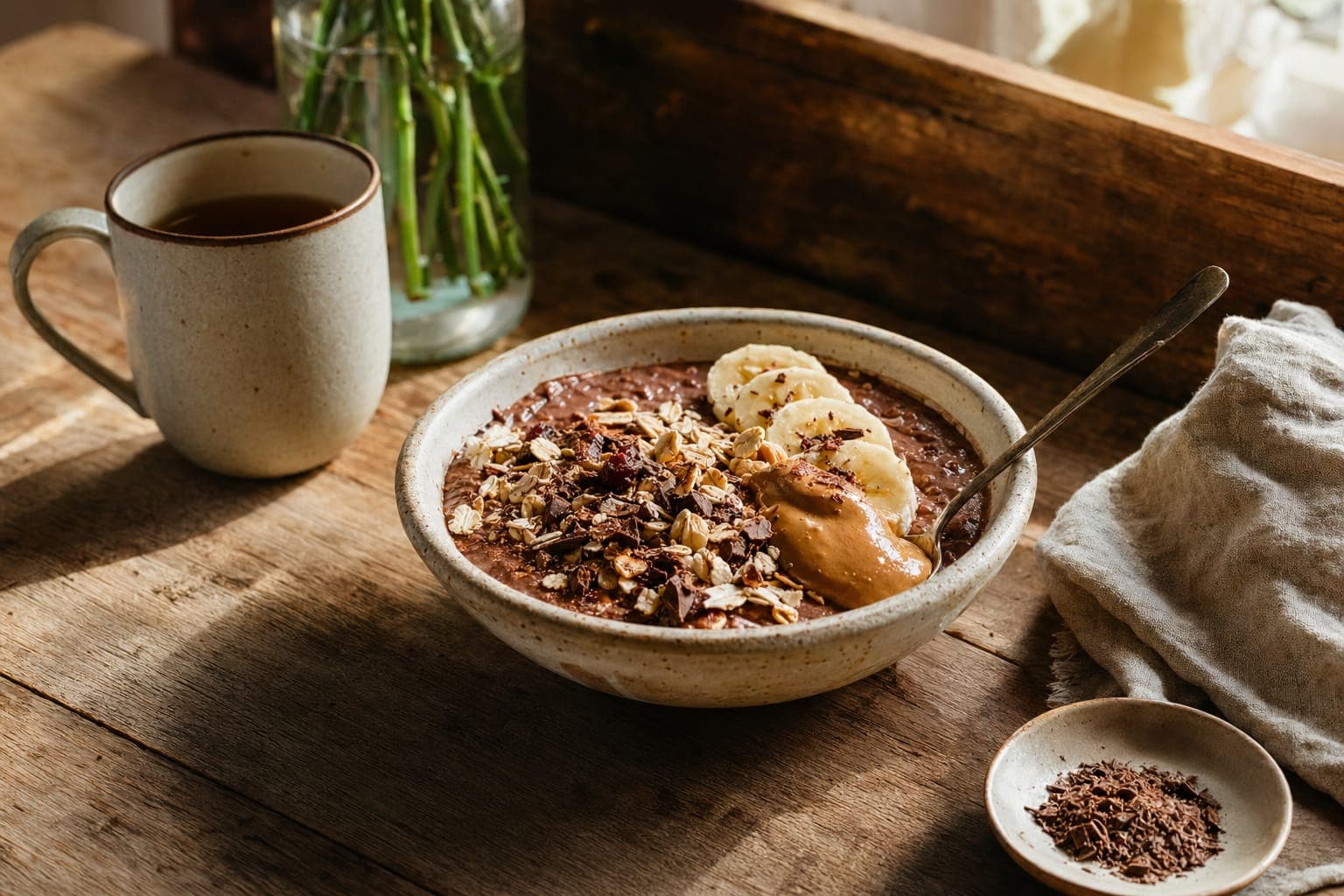
10 Ways to Use Organised That Aren't Just a Shake
Move beyond the basic shake. Discover 10 creative ways to use Organised in smoothie bowls, oats, yoghurt, baking, and more.


 Join over 100,000+ members
Build a better food system with us
The Organised community is thousands of people choosing real food and backing the farmers who grow it, all of us trying to leave the world a little better than we found it. If that is what you care about too, you belong here.