The Truth About Beef: Grain-Fed vs Grass-Fed vs Regenerative
Open your supermarket meat counter. The beef looks identical. The price varies wildly. The nutritional and environmental differences are enormous. Here's what actually matters.
By Niall Kiddle, Founder, Organised

Reviewed by Pedro Rodrigues, Agronomist (farming and sourcing only) ·
9 min read · Published · Updated · 3 cited sources
Makers of the Organised Daily blend, a grass-fed beef organ supplement from regenerative UK farms
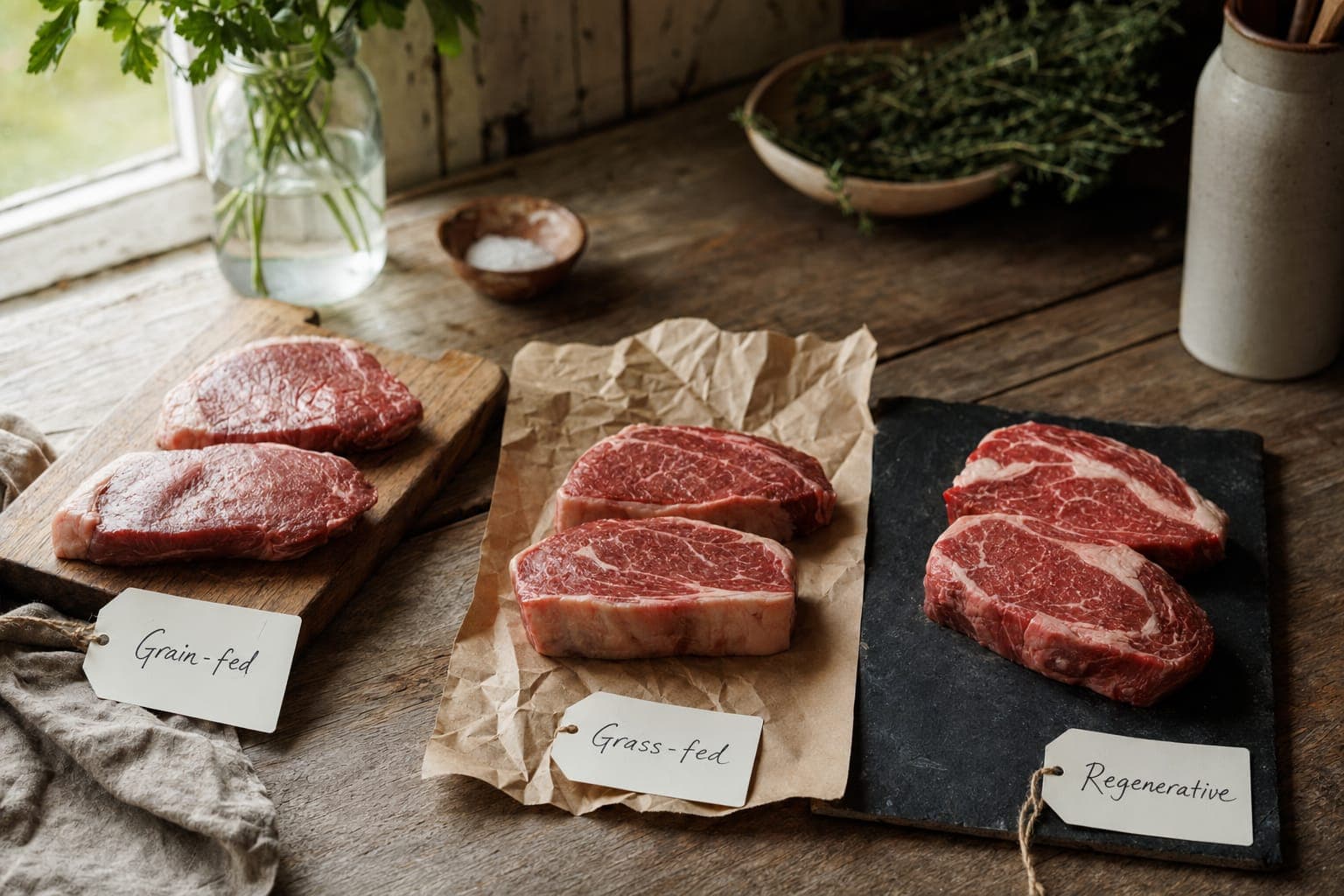
This is not a simple good-versus-bad story. Each system has trade-offs. But understanding them changes what ends up on your plate.
The conventional grain-fed system
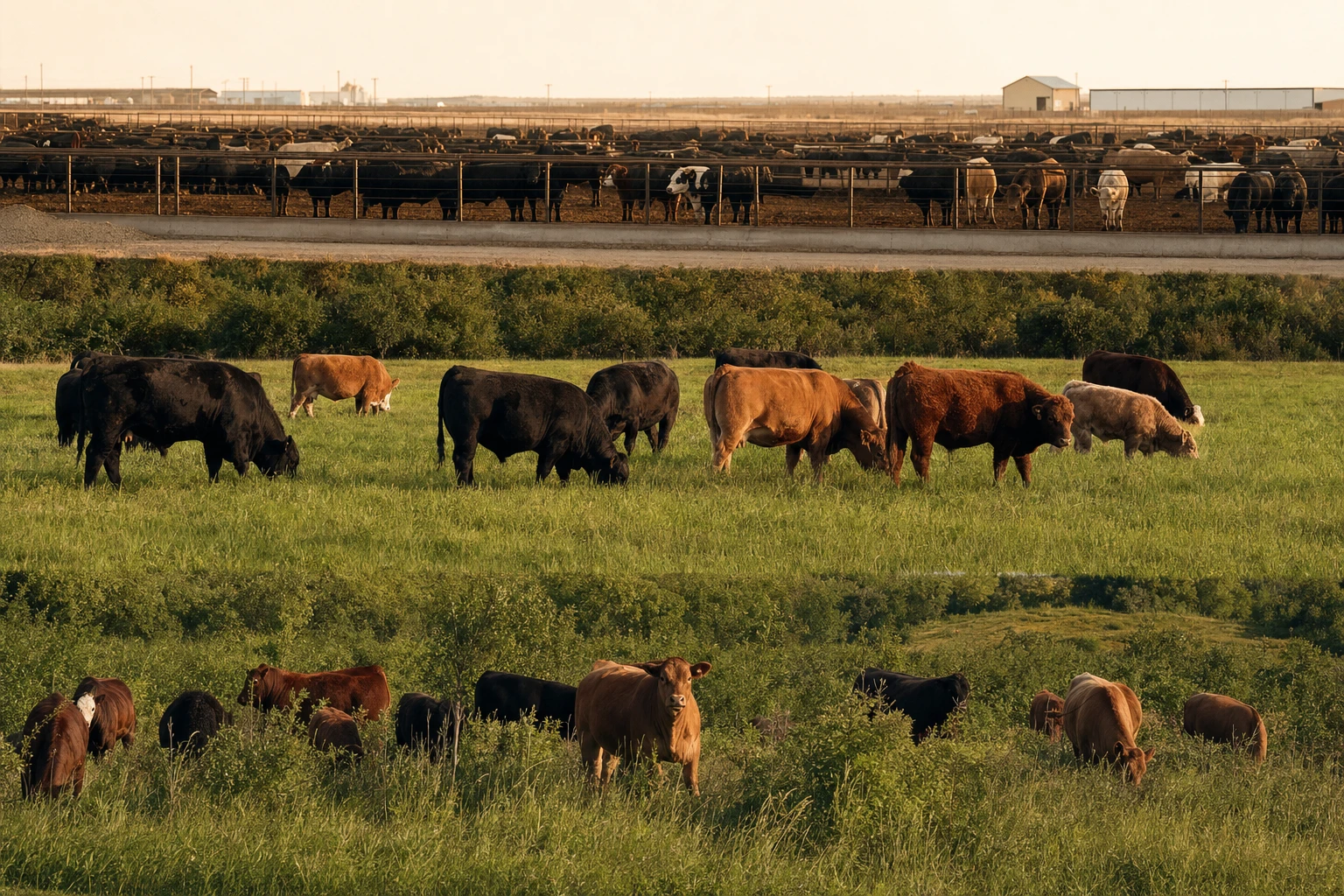
Grain-fed cattle spend most of their lives on pasture (6-18 months), then finish in a feedlot on grain (corn, soy, or barley) for 4-6 months. This accelerates weight gain and fat deposition, producing meat faster and cheaper than pasture-only systems.
The feedlot concentrates thousands of cattle in close quarters. It's efficient for production, less efficient for animal health (higher antibiotic use), and creates significant localised environmental impact (manure runoff, groundwater contamination).
The grain diet creates changes in the beef itself: fat composition shifts heavily toward omega-6, stress hormones accumulate in the meat, and nutrient density (particularly fat-soluble vitamins) declines relative to grass-fed.
The system works at scale. Grain-fed beef is cheap. A conventional steak costs half what a grass-fed equivalent does. At volume, this matters for household budgets.
Is grain-fed beef unhealthy? Not inherently. Beef is still nutrient-dense. But it's nutritionally inferior to grass-fed in specific, measurable ways.
Grain-fed beef is efficient food production. It's not nutrient-optimal beef.
Grass-fed: what it actually means
Grass-fed means the animal ate grass for most or all of its life. But here's the catch: it doesn't specify the finishing phase. Many grass-fed cattle are grass-fed for 18-24 months, then grain-finished for 4-6 months before slaughter. They still carry the grass-fed label.
True grass-finished beef has never been grain-finished. The animal eats grass from birth to slaughter. This is less common and typically costs 20-40 percent more.
Grass-fed improves the nutritional profile: higher omega-3, lower omega-6, higher CLA (conjugated linoleic acid), higher vitamin E and beta-carotene, and higher K2 (a vitamin found almost exclusively in grass-fed animal fats).
The animal welfare is typically better. Cattle are herd animals. Pasture allows natural behaviour. Grain finishing in a feedlot does not.
The environmental impact is mixed. A grass-fed cow eating pasture for two years uses less grain (a concentrated input) than grain-fed, but may use more total land. It depends on how the pasture is managed. Regenerative grazing improves land. Poor pasture management doesn't.
Regenerative beef
Regenerative beef is grass-fed beef produced under management practices designed to improve soil, increase carbon sequestration, and restore degraded land. It's typically grass-finished (never grain-finished), managed with rotational grazing that mimics natural herd movement, and produced on diverse pasture with active soil management.
Examples include White Oak Pastures (Georgia, USA), Pasture for Life certified operations (UK and EU), and smaller-scale farms using holistic planned grazing.
Regenerative beef carries the nutritional benefits of grass-fed (high CLA, high K2, good omega ratio) and adds the environmental and land-health benefit. The trade-off: it typically costs 30-50 percent more than conventional grain-fed, and significantly more than cheap supermarket beef.
It also requires sourcing knowledge. You can't find regenerative beef at every supermarket. You need to know the farm, the producer, or use specialist suppliers.
Nutritional comparison: CLA and conjugated linoleic acid
Conjugated linoleic acid (CLA) is a fat found almost exclusively in ruminant meat and dairy. Grass-fed cattle produce 2-5 times more CLA than grain-fed cattle.1
CLA has been shown in research to promote muscle protein synthesis, reduce body fat accumulation, and improve insulin sensitivity. The evidence is modest but consistent. You're not going to lose weight by eating CLA-rich beef, but it supports metabolic health in ways grain-fed beef doesn't.
CLA levels are highest in truly grass-finished beef (never grain-finished). Grass-fed that finishes on grain still carries more CLA than grain-fed throughout, but loses some benefit in that finishing phase.
Omega-3 and omega-6 profile
Grass-fed beef has an omega-3 to omega-6 ratio of roughly 1:2 to 1:3. Grain-fed is closer to 1:10 to 1:15.1 This matters for inflammation. A diet high in grass-fed beef, fish, and greens rebalances your body's ratio toward something ancestral. A diet high in grain-fed beef and seed oils amplifies modern inflammatory patterns.
This isn't a dramatic effect per steak. But over months, if grass-fed beef is a regular part of your diet, the cumulative shift in body composition (your actual tissue) toward higher omega-3 is measurable.
Vitamins and minerals
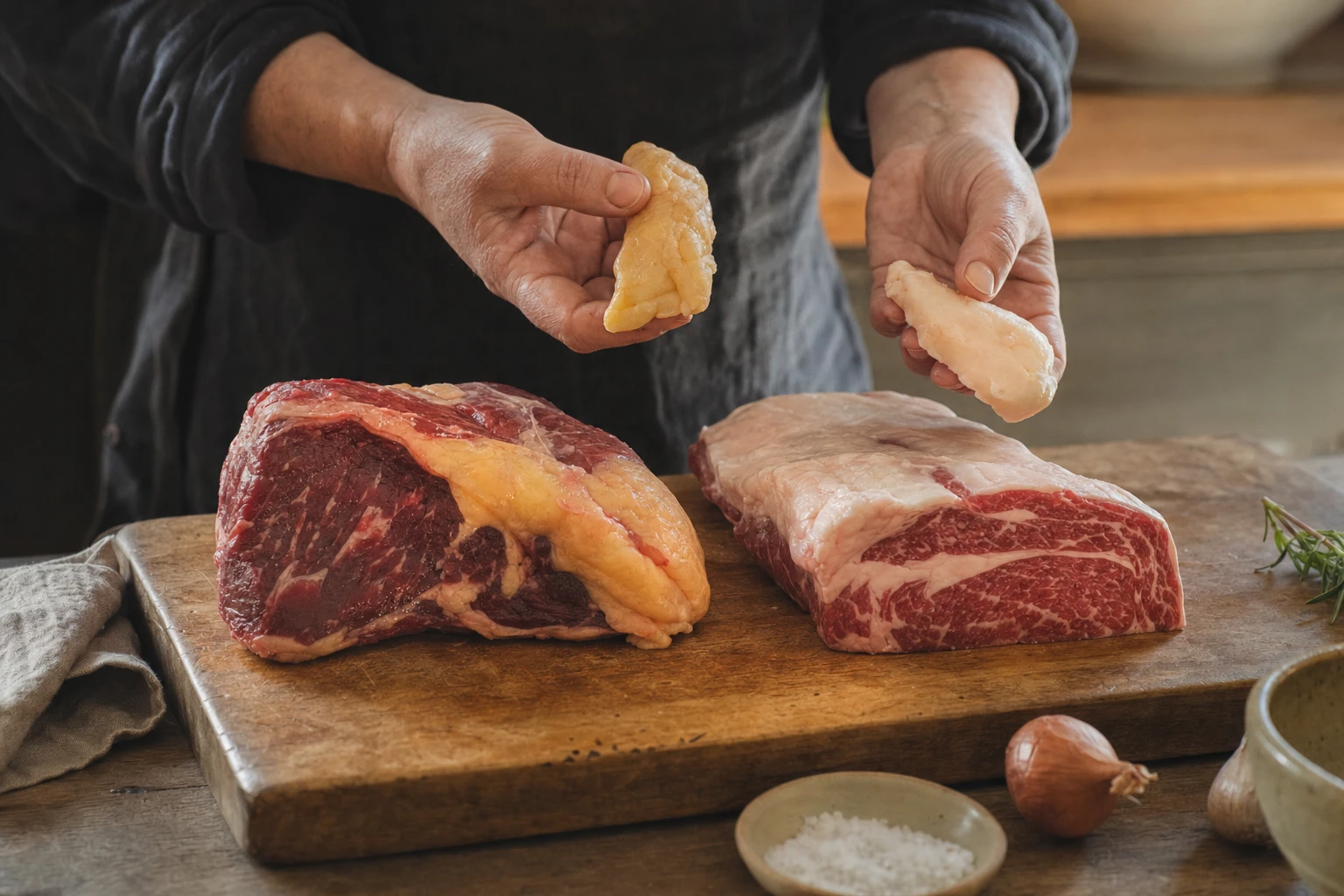
Grass-fed beef is higher in fat-soluble vitamins: vitamin E (up to 3 times higher), vitamin A (as beta-carotene, which gives grass-fed beef a faint yellow tinge to the fat), and vitamin K2 (almost entirely absent from grain-fed beef fat, abundant in grass-fed).12
K2 is particularly relevant. It's a critical nutrient for bone health, arterial elasticity, and proper calcium distribution.2 Grass-fed butter and grass-fed beef fat are among the few food sources of K2. Modern grain-fed diets are K2 deficient.
Mineral content is similar across systems, but absorption is better from grass-fed beef because the fat profile supports better nutrient absorption.
Animal welfare: the unspoken comparison
Grain-fed cattle in feedlots experience chronic stress. They're evolved for grazing, moving, and social hierarchies across open land. A feedlot is the opposite. High density, grain that causes digestive distress, dust and noise, and restricted movement.
This stress accumulates in the animal's body: elevated cortisol, compromised immune function, inflammation. Some of this transfers into the meat.
Grass-fed cattle move and graze, which aligns with their biology. The stress of transport and slaughter is unavoidable, but the years of life are spent doing what cattle evolved to do.
Regenerative grazing practices often result in lower stocking density than conventional pasture, further reducing stress.
If you care about animal welfare (and Organised readers often do), grass-fed is materially better. It's not cruelty-free, but it's substantially less cruel.
Grain-fed cattle spend their final months in conditions that would be considered confinement for any other animal. Grass-fed cattle spend their lives doing what their bodies expect. The meat reflects that difference.
Environmental impact
Grain-fed cattle eat concentrated feed (corn, soy). Much of that grain is grown on industrial monoculture land, which depletes soil and requires synthetic inputs. The system is land-efficient (produces more beef per acre of pasture) but input-heavy.
Grass-fed cattle eat pasture, which requires more total land but no synthetic inputs. The environmental trade-off depends on grazing management. Well-managed grass-fed improves soil and sequesters carbon. Poorly managed grass-fed degrades pasture just as industrial agriculture does.
Regenerative beef, by definition, improves the land. Rotational grazing increases soil carbon, improves water infiltration, and restores biodiversity.3 It's the environmentally positive option, though it typically uses more land per animal than grain-fed or poorly managed grass-fed.
Methane from cattle is real, but it's not solved by grain-fed. Methane production depends on rumen fermentation, which happens regardless of diet. Regenerative grazing may actually reduce methane intensity (methane per calorie of food produced) by improving forage quality and reducing animal stress.
For climate impact: regenerative is best, grass-fed is better than grain-fed, grain-fed is still better than continuing to degrade soil with industrial monoculture. The real climate problem is soil depletion, not cattle.
Get farming and sourcing guides, free
Two short reads a week on regenerative farming and where real food comes from.
By signing up you agree to receive emails from us. No spam, unsubscribe anytime.
Cost and accessibility
Grain-fed: 6-8 GBP per 100g for supermarket beef.
Grass-fed: 10-14 GBP per 100g at a farmers market or specialist butcher.
Regenerative: 12-18 GBP per 100g from a specialist supplier or farm direct.
Accessibility is a real issue. If you're living on a tight budget, grain-fed is what you can afford. That's not a moral failure. That's economics. The recommendation isn't eat only regenerative beef. It's eat less meat, better meat, if you can.
If beef is 20 percent of your diet, switching to grass-fed costs maybe 30 GBP per week extra (roughly 5 percent of a typical food budget). If you're eating less but better, the cost becomes manageable.
Real-world examples from UK and beyond
To understand the difference concretely, consider specific examples. A conventional grain-fed steer from a UK feedlot finishes at 24-30 months of age, having spent most of its life on grass but the final 4-6 months on grain. Its CLA content is around 0.5-0.8 mg per gram of fat. Its omega-3 to omega-6 ratio is close to 1:15.
A grass-fed but grain-finished animal from the same region, finished at 24-30 months with 18 months of grazing followed by grain finishing, has CLA around 1.2-1.5 mg/g and an omega-3 to omega-6 ratio closer to 1:5 to 1:7. Nutritionally better, but compromised by the finishing phase.
A grass-finished animal from UK operations like those certified by Pasture for Life, finished at 24-30 months with grass from birth to slaughter (managed rotational grazing year-round), has CLA around 2.5-4.0 mg/g and an omega ratio of 1:3 to 1:2. Substantially different nutritional profile.
A regenerative beef operation specifically selecting for nutrient density (like some of the smaller UK producers), aged slightly longer (30-36 months) on pasture with soil management focus, can achieve CLA above 4.0 mg/g and omega ratios closer to 1:2. This is the outer edge of what grass-based systems produce.
The nutritional difference between systems is measurable, significant, and reflected in the price. Cheap beef and premium beef are different products.
If you're buying meat weekly, the difference between conventional and grass-fed is the difference between moderate metabolic support and genuine nutritional upgrading. Over months, this compounds. Your tissue is made of what you eat. The difference between grain-fed and grass-finished beef is written in your body composition.


1 of 9
Daily blend
100,000+ thriving families4.9 on Trustpilot
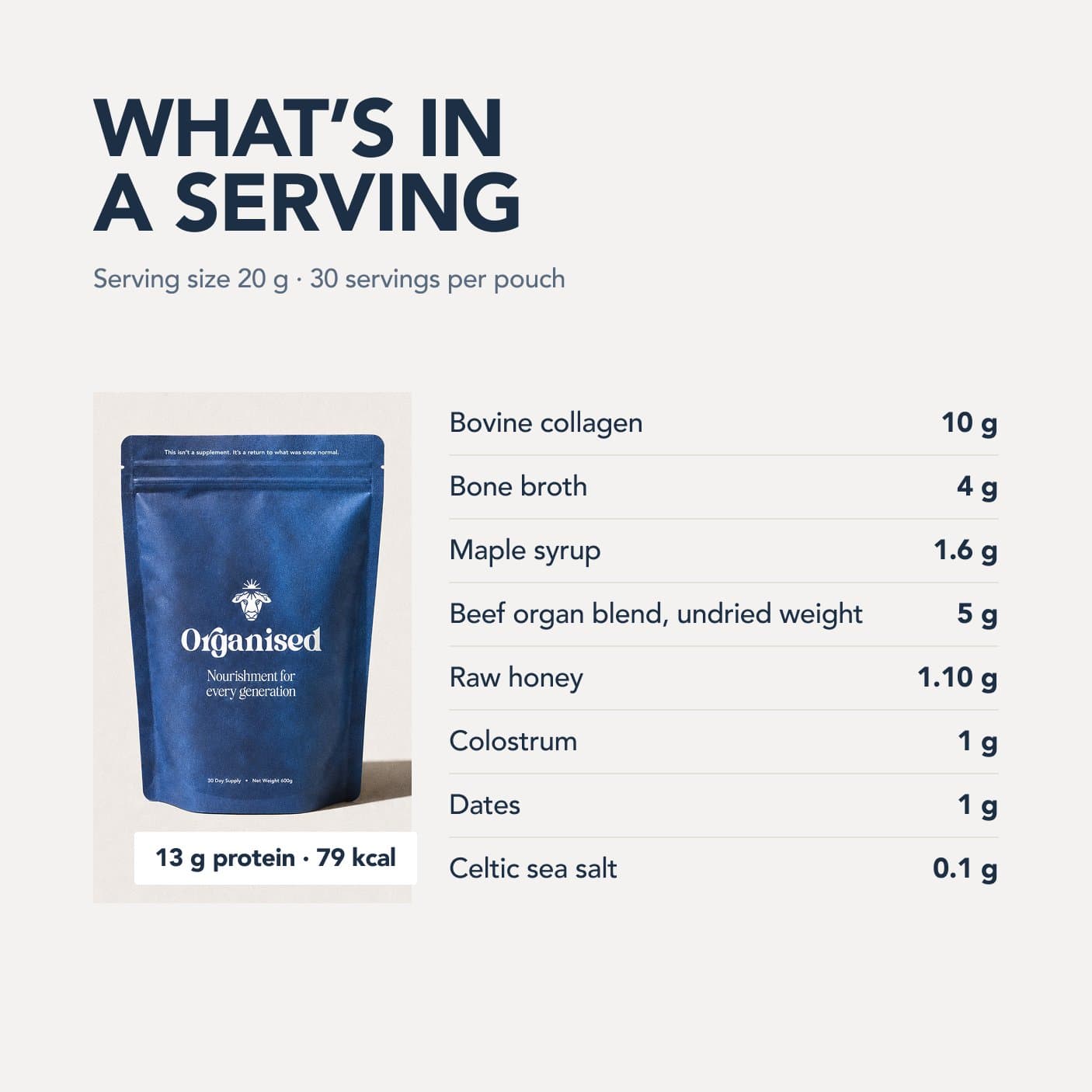
Eight real ingredients built around grass-fed beef organs, collagen and colostrum. Nothing synthetic added.
Free with your first order, worth £38. Plus £10 off the pouch with a subscription.


Free UK shipping · Made in England · 100 day money back guarantee on your first pouch · Skip, pause or cancel anytime
Is the regenerative premium worth it?
Regenerative beef costs 50-100% more than conventional. For a household buying 500g of beef per week, that's an extra GBP 4-8 per week, or roughly GBP 200-400 per year. For most UK households, this is affordable if it's a priority. It's not affordable for everyone. That's not a moral judgment. It's an economic reality.
The question isn't whether regenerative is better (it is). The question is whether the premium is worth the benefit to you. If you have metabolic issues (insulin resistance, inflammatory markers, poor recovery), the nutrient density matters significantly. If you're generally healthy and the cost is prohibitive, grass-fed grain-finished is a meaningful step up from conventional and costs less.
The real harm comes from commodity beef at commodity prices, eaten in large quantities, as the primary protein source. This shifts your body's omega ratio progressively toward inflammation, reduces your intake of K2 and fat-soluble vitamins, and over years, contributes to chronic disease patterns. If you're going to eat beef, the question isn't regenerative versus conventional. It's whether you're willing to eat less better beef, or more poor beef.
How to choose
Best: regenerative beef from a farm you know or can verify. Check for rotational grazing, soil management, and grass-finished (never grain-finished).
Good: grass-finished beef from a farmers market or butcher. Ask whether the animal was grain-finished in the final months. If not, you've got the full benefit.
Acceptable: grass-fed beef from a supermarket (usually grain-finished, but still nutritionally superior to conventional grain-fed).
Minimal: conventional grain-fed beef. It's still food, still nutritious, just nutritionally inferior and produced in a system you probably wouldn't choose if you understood it.
If regenerative or truly grass-finished is unavailable or unaffordable, grass-fed is a meaningful step up. If you can only afford conventional, eat less beef and pair it with organ meats (liver is equally nutritious regardless of feed system) and fish.
The honest summary: grain-fed beef is cheap because it externalises costs (environmental, animal welfare, human health). Grass-fed and regenerative beef internalises those costs. The difference in price reflects a difference in reality. Choose based on what you value and what you can afford. But don't pretend the three systems are equivalent. They're not.
References
Every source below was checked on 27 August 2026. Each PubMed, PMC and DOI identifier was resolved against NCBI or Crossref, and what it opens is printed under the citation, so you can see the link goes where the citation says without leaving the page. Where a citation and its identifier disagreed, the citation was corrected to the record or the reference was deleted along with the sentence marker that pointed at it, and where the resolved paper turned out not to support the sentence, the sentence was cut back to what it does support. Borrowed authority is worse than none, because it looks like rigour.
- Daley CA et al. A review of fatty acid profiles and antioxidant content in grass-fed and grain-fed beef. Nutr J. 2010;9:10.Checked 27 August 2026: PMC2846864 opens Daley CA, Abbott A, Doyle PS et al, A review of fatty acid profiles and antioxidant content in grass-fed and grain-fed beef. Nutr J 2010;9:10. PubMed indexes it as: Review.
- National Institutes of Health, Office of Dietary Supplements. Vitamin K: Fact Sheet for Health Professionals.
- Teague WR et al. The role of ruminants in reducing agriculture's carbon footprint in North America. J Soil Water Conserv. 2016;71(2):156-164.Checked 27 August 2026: PMID 27091963 opens Qian G, Rao CR, Sun X et al, Boosting association rule mining in large datasets via Gibbs sampling. Proc Natl Acad Sci U S A 2016;113(18):4958-63.The authors' own declaration, from the record: The authors declare no conflict of interest.
Who wrote and reviewed this guide
Niall Kiddle
Author · Founder, Organised
Niall is the founder of Organised. He started the company in 2024 after fixing his own health the slow way: in 2022 he swapped a cupboard of synthetic supplements for real food, raw milk, organ meats, bone broth and honey, and felt the difference within months.
Areas of expertise: Ancestral nutrition, Organ meats, Whole-food supplementation, Gut health, Regenerative sourcing
Read Niall's full profile
Pedro Rodrigues
Reviewer · Agronomist (farming and sourcing only)
Pedro is the agronomist Organised works with on farming and sourcing. His job on the guides is to keep the science honest: he reviews what we publish about soil health, regenerative agriculture, grazing and the way food is actually produced.
Areas of expertise: Regenerative agriculture, Agronomy, Soil health, Grass-fed farming, Food sourcing
Reviewed this guide on
Read Pedro's full profileBrowse the guides library
All guidesKeep reading
Farming
What 'Grass-Fed' Actually Means (And What It Doesn't)
Grass-fed has vague definitions. Some cattle are grass-fed then grain-finished. Learn UK vs US standards, Pasture for Life, and what labels actually promise.
Farming
Grass-Fed vs Grass-Finished: Why the Distinction Matters
Grass-fed vs grass-finished beef is not the same. Learn what each term means, why most grass-fed cattle are grain-finished, and how it affects nutrients.
Farming
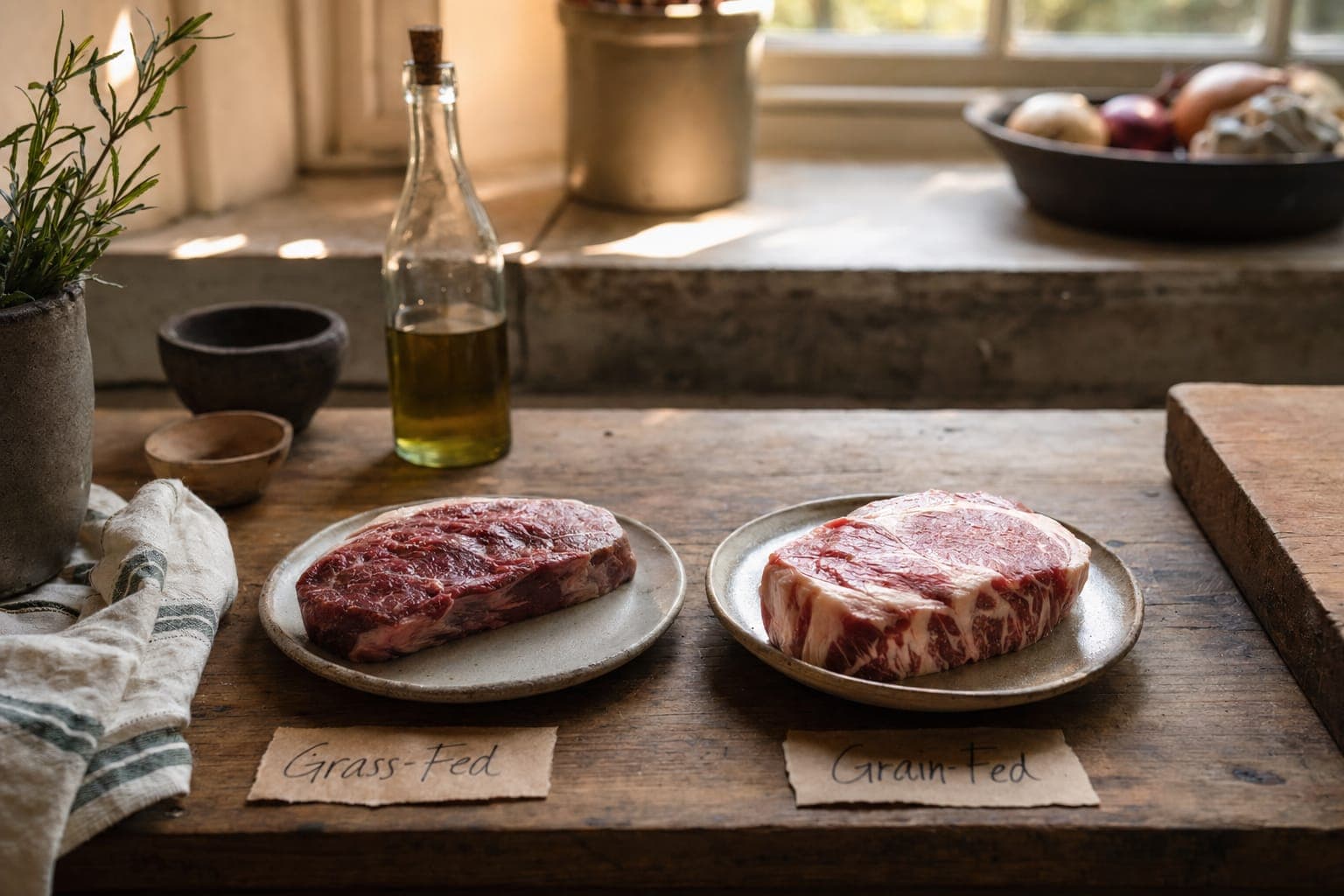
The Nutritional Difference Between Grass-Fed and Grain-Fed Beef
Grass-fed beef has 2-5x more CLA, 3x vitamin E, higher K2, and better omega-3 ratio. Here's the complete nutrient-by-nutrient comparison.
Real food, made effortless
Shop the blendA few ways to use it
All recipes
Organised Smoothie Bowl Recipes for Every Season
Four seasonal smoothie bowl recipes using Organised. Berry in summer, apple-cinnamon in autumn, tropical in spring, warming chocolate in winter.

10 Ways to Use Organised That Aren't Just a Shake
Move beyond the basic shake. Discover 10 creative ways to use Organised in smoothie bowls, oats, yoghurt, baking, and more.

Bone Broth from Scratch: A Step-by-Step Guide
Step-by-step guide to making bone broth at home. Stovetop, slow cooker, and Instant Pot methods. Rich in collagen and gut-healing minerals.


 Join over 100,000+ members
Build a better food system with us
The Organised community is thousands of people choosing real food and backing the farmers who grow it, all of us trying to leave the world a little better than we found it. If that is what you care about too, you belong here.