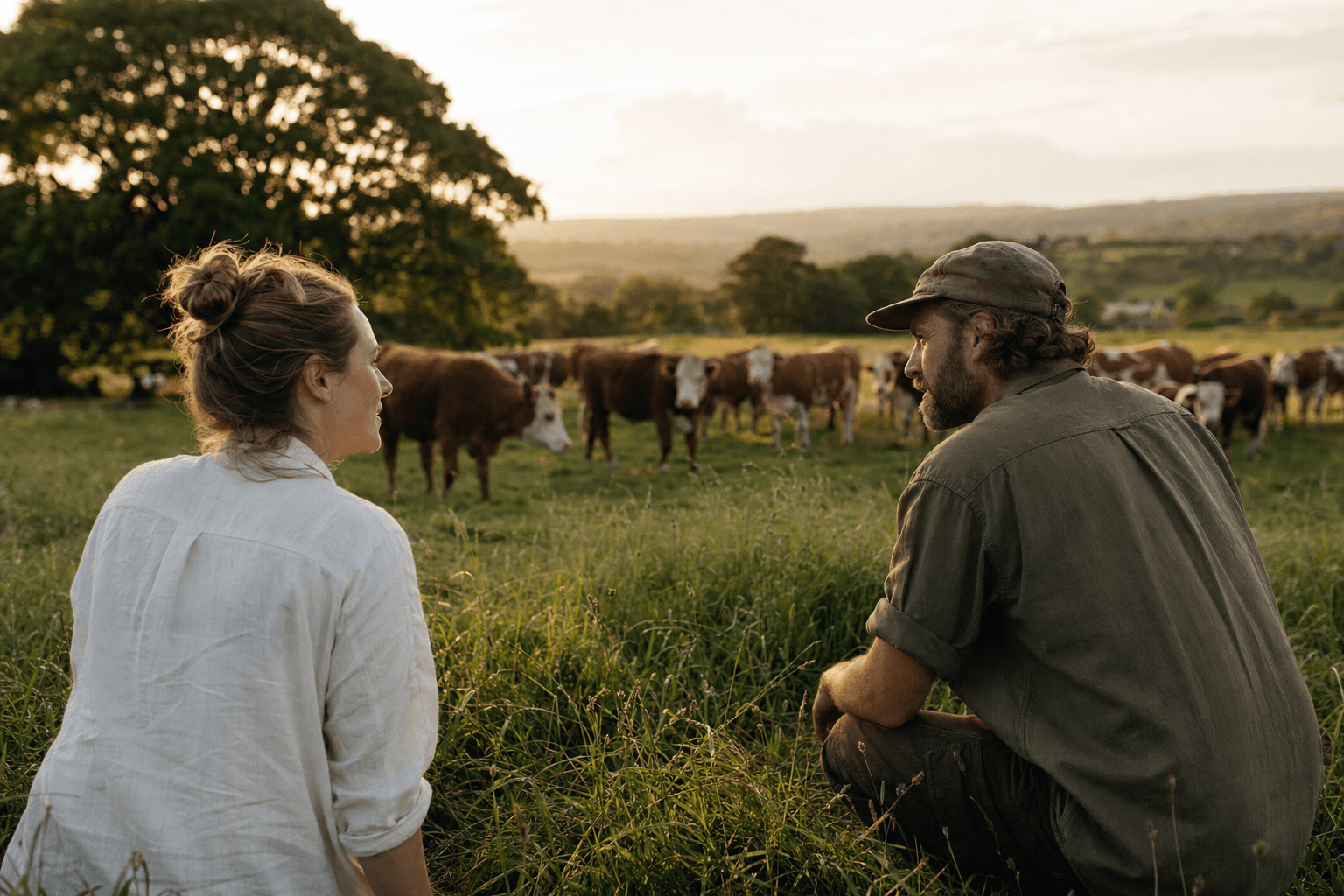

Most people have never met the farmer producing their food. They've never seen the animals. They've never walked the land. They're completely dependent on the integrity of industrial supply chains and the goodwill of corporations to keep them fed. That's not food security. That's food vulnerability.
What sovereignty actually means
Food sovereignty is the capacity of a community to feed itself. Not independence, necessarily. Not rejecting all trade. But having enough local capacity, knowledge, and control to ensure food access even if global systems fail.
It's built on three pillars. First, local food production. Not all food, but enough key proteins, vegetables, and staples that the region isn't entirely import-dependent. Second, knowledge. Understanding what grows locally, how to process and preserve it, how to farm it well. Third, control. Local farmers owning land and making decisions about production rather than being contractors for distant corporations.
This is neither romantic nor revolutionary. It's a straightforward observation that communities that can feed themselves are more resilient than communities dependent on global supply chains. And every person who can shift from global supply chains to local sources increases that resilience.
When you know the farmer producing your food, you have access to information. You know what they're doing. You can ask questions. You can adjust your purchasing based on their seasonal cycles. You're not at the mercy of a corporation's cost-cutting decisions or a supply chain's fragility.
A supply chain you understand and can influence is incomparably more stable than a supply chain you can only observe from a distance.
Fragility in global supply chains
The global food system is extraordinary at moving calories from wherever they're cheap to wherever they can be sold. But it's extraordinarily fragile in the face of disruption.
The 2020 pandemic created strange moments of instability. Lettuce was destroyed at farms because transport networks were broken and it would rot before reaching markets. Meanwhile, supermarkets had bare shelves. The mismatch between supply and demand happened because the system was so optimised for normal conditions that any deviation created chaos.
Closer examination shows the fragility is systemic. Most countries import a significant portion of their calories. Britain imports about 40 percent of total food. That dependency is entirely voluntary in peacetime and catastrophic if disrupted.
A single chokepoint disruption ripples through the entire system. A shipping blockade at the Suez Canal doesn't just affect imported goods. It affects the price of shipping everything globally. A bad harvest in a key region affects global availability of a crop months later. A processing facility fire creates national shortages overnight.
These aren't theoretical concerns. They've happened repeatedly. And they'll happen again. The system that produces cheap calories is the same system that creates catastrophic vulnerability if anything goes wrong.
Building local food knowledge
Food sovereignty is partly built by individuals making different purchasing choices. But it's really built by communities recovering knowledge about what grows locally and how to farm it.
This doesn't mean everyone becomes a farmer. It means the knowledge exists in the community. It means young people can learn from experienced farmers rather than starting from zero. It means recipes and food traditions preserve knowledge about local crops and their seasons.
It means farmers experimenting with varieties that grow well in local conditions rather than just commodity crops. It means understanding which vegetables peak which seasons and building eating patterns around that cycle rather than expecting strawberries in December.
A farmer can produce food. But if no one in the community knows how to preserve it, how to cook it, what the plant looks like, you've just created a beautiful harvest with no value. Local knowledge is what transforms production into actual food security.
This is being rebuilt now. Farmers markets are increasing. Community supported agriculture schemes are proliferating. Young farmers are returning to land. The knowledge is fragmentary and often needs recovery from historical sources, but it's being rebuilt.
A community with local food knowledge can be disrupted and adapt.2 A community dependent on imports and processed food has no fallback.
The economics of local systems
Local food systems are often described as more expensive.1 In the short term, they are. A head of lettuce from local production costs more than commodity lettuce shipped globally.
The economics work differently over time. When you have a relationship with a farmer, you buy their surplus in season at low prices and preserve it. You accept their entire product line, not just the premium cuts. You buy from multiple farmers and build a seasonal eating pattern rather than expecting everything all year.
The economic advantage of global supply chains is based on externalised costs. Shipping is cheap because fuel is underpriced. Labour is cheap because regulations are loose in producing countries. Water depletion isn't charged to the farmer. Soil degradation isn't charged to the product. The supermarket price doesn't reflect the true cost.
Local systems do charge the true cost, because the farmer is managing their own land and they have to sustain it. This means the price is higher. But it's also more honest. You're paying for what the food actually costs, not subsidised by destroyed ecosystems elsewhere.
Over decades, the comparison is stark. A global food system optimised for cost creates agricultural bankruptcy, soil depletion, and community collapse. A local food system optimised for resilience creates healthier land, employed farmers, and stable food security.
How to start
Food sovereignty begins with the people near you. Find a farmers market. Go regularly. Ask farmers questions. Where is their land? How long have they farmed there? What do they grow in different seasons?
Join a Community Supported Agriculture scheme if one exists near you. You get a box of seasonal produce weekly. You're building a relationship with a specific farm. You learn what crops are abundant when.
Buy from a butcher who knows their suppliers. Not a supermarket. A butcher who can tell you which farm the meat came from, what the animals ate, how they were raised. These relationships build information density.
If you have any space, grow something. Even herbs in a windowsill. This teaches you about seasonality, about the relationship between plant and environment, about why farmers make the decisions they do.
Share knowledge. If someone grows well, tell other people. If you learn to preserve food, teach others. Food sovereignty is built through accumulated knowledge and relationships within a community.
Long supply chains are fragile by nature
You cannot optimise a system simultaneously for maximum efficiency and maximum resilience. Global food systems optimise for efficiency. This creates fragility.
The COVID-19 supply chain disruptions revealed how close the system is to breaking. Not because it's poorly managed. Because it's optimised so tightly that any deviation becomes catastrophic. Efficient systems are fragile systems.
Resilient systems have redundancy. They're less efficient. Multiple food sources for each nutrient rather than one global provider. Local farming capacity that could meet community needs even if imports ceased. Knowledge distributed across the community rather than concentrated in corporations.
These seem like luxuries until they become necessities. Then they become your only option.
You cannot have maximum efficiency and maximum security simultaneously. Choose one. For food, security is the more important choice.
The bottom line
Food sovereignty isn't about rejecting all global trade or pretending that local production can meet all needs immediately. It's about building capacity, knowledge, and relationships so that your community is not utterly dependent on distant supply chains.
When you know the farmer producing your food, when you understand the land it comes from, when you can adjust your consumption to their seasonal cycles, you've opted out of fragility. You've built real food security. Not the false security of a full supermarket shelf that depends on nothing going wrong anywhere in the world. Real security. The kind that survives disruption.
References
- 1. DEFRA. Food Statistics in your pocket: global and UK supply. UK Department for Environment, Food & Rural Affairs. gov.uk/food-statistics.
- 2. FAO. Food security and nutrition in the world. Food and Agriculture Organization. fao.org/publications/sofi.
- Farming & TransparencyA Day on a Regenerative FarmStep inside a regenerative farm and discover what actually happens daily. Meet the farmers and animals behind your food.
- Farming & TransparencyThe State of British Beef Farming in 2026UK beef farming is under pressure. Here are the real challenges facing British farmers and why whole-animal use matters.
- Farming & TransparencyThe Future of Food: Why Regenerative, Not Lab-Grown, Is the AnswerLab-grown meat offers a technological fix. Regenerative farming offers a system overhaul. Here's why the latter actually matters.
Nourishment, without the taste.
Find a farmers market or farm near you this week. Introduce yourself to a farmer. Ask them one question. Build from there.