How Organised Is Made: From Farm to Pouch
The organs in your pouch have been through a journey. They didn't start as powder. They started as living tissue. Here's what happens between the farm and your hand.
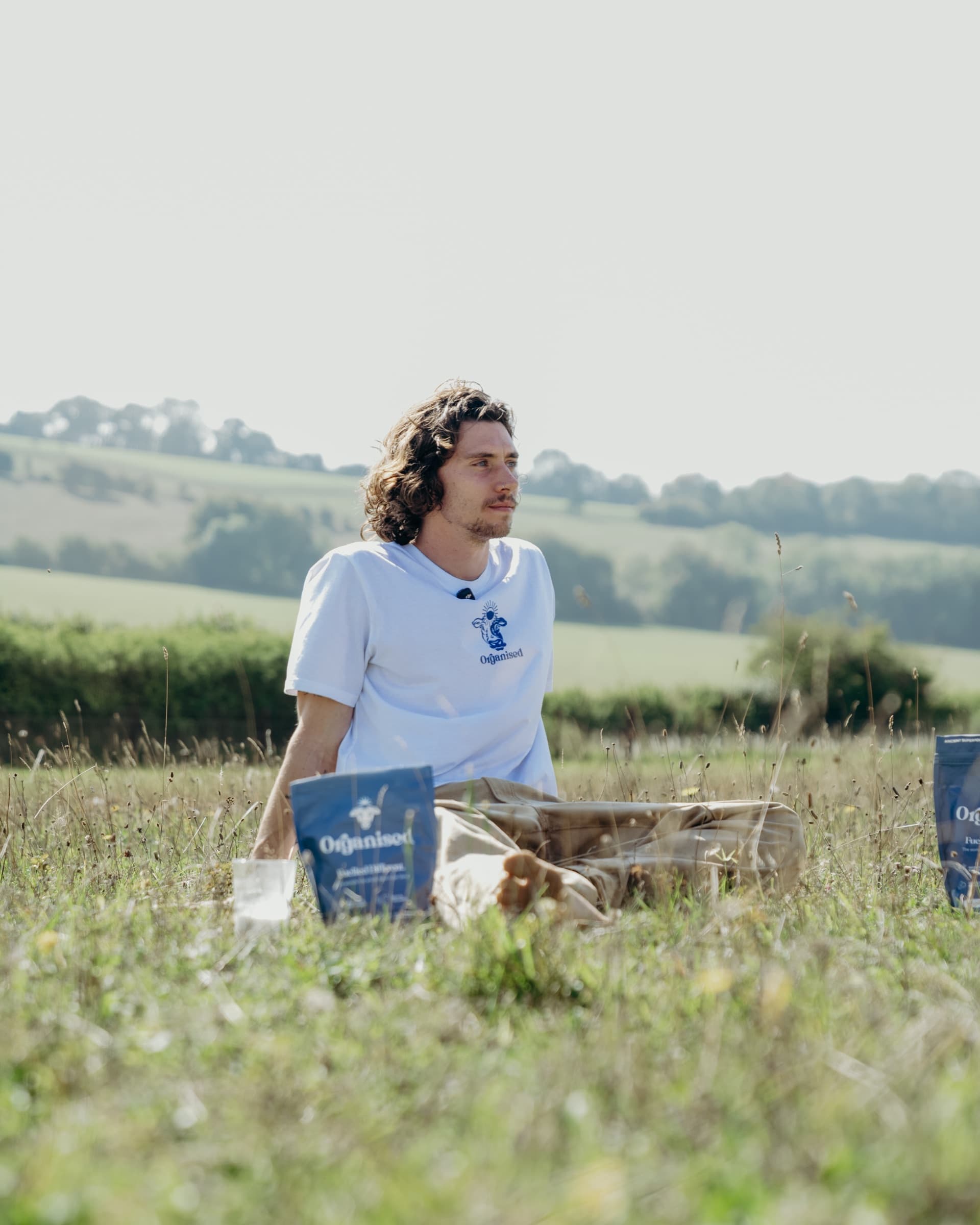
By Niall Kiddle, Founder, Organised

Reviewed by Pedro Rodrigues, Agronomist (farming and sourcing only) ·
6 min read · Published · Updated · 3 cited sources
Makers of the Organised Daily blend, a grass-fed beef organ supplement from regenerative UK farms
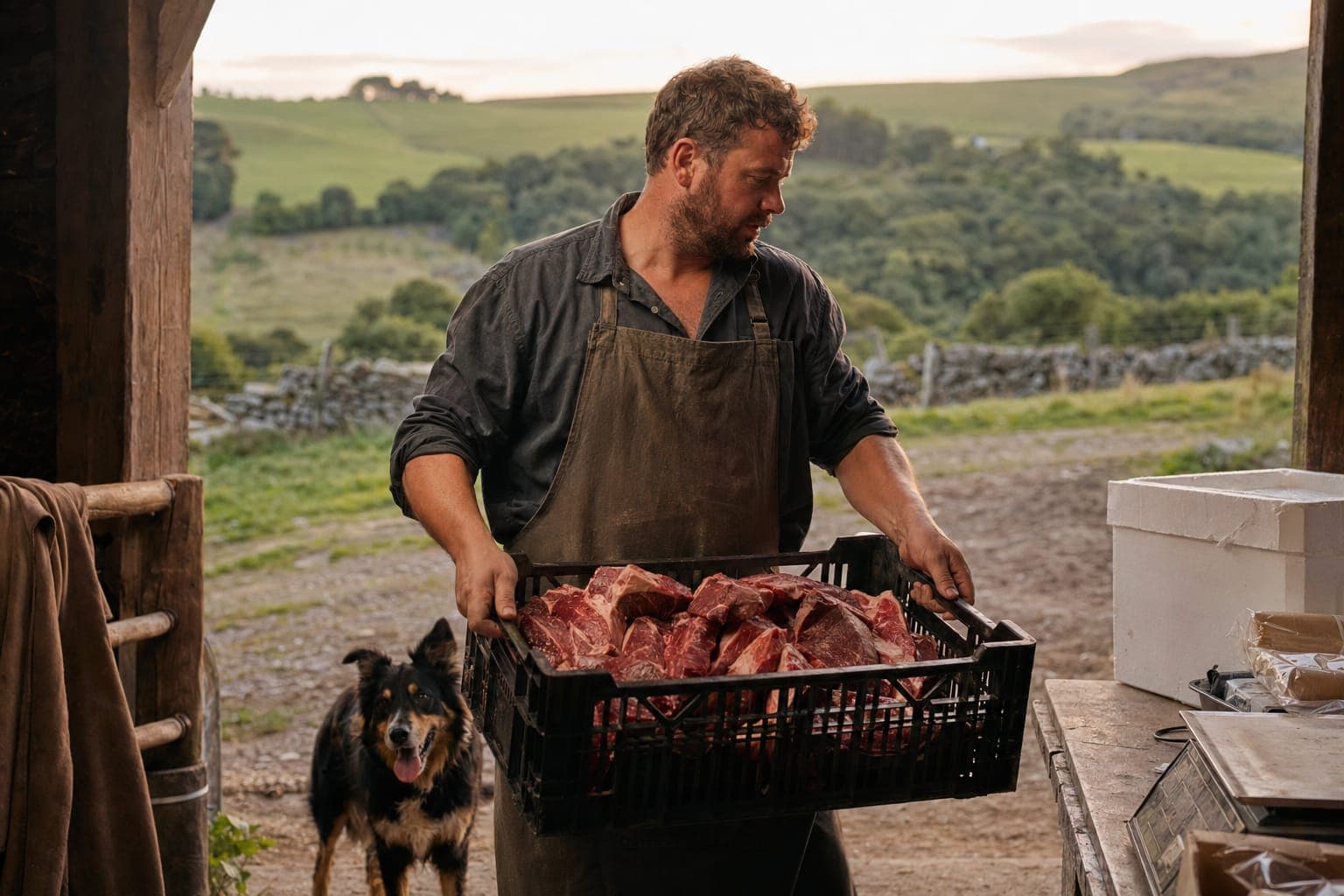
Most supplement brands outsource their manufacturing. They send a spec to a factory, get product back, and hope for the best. We control every step because we want to know the story.
The sourcing step
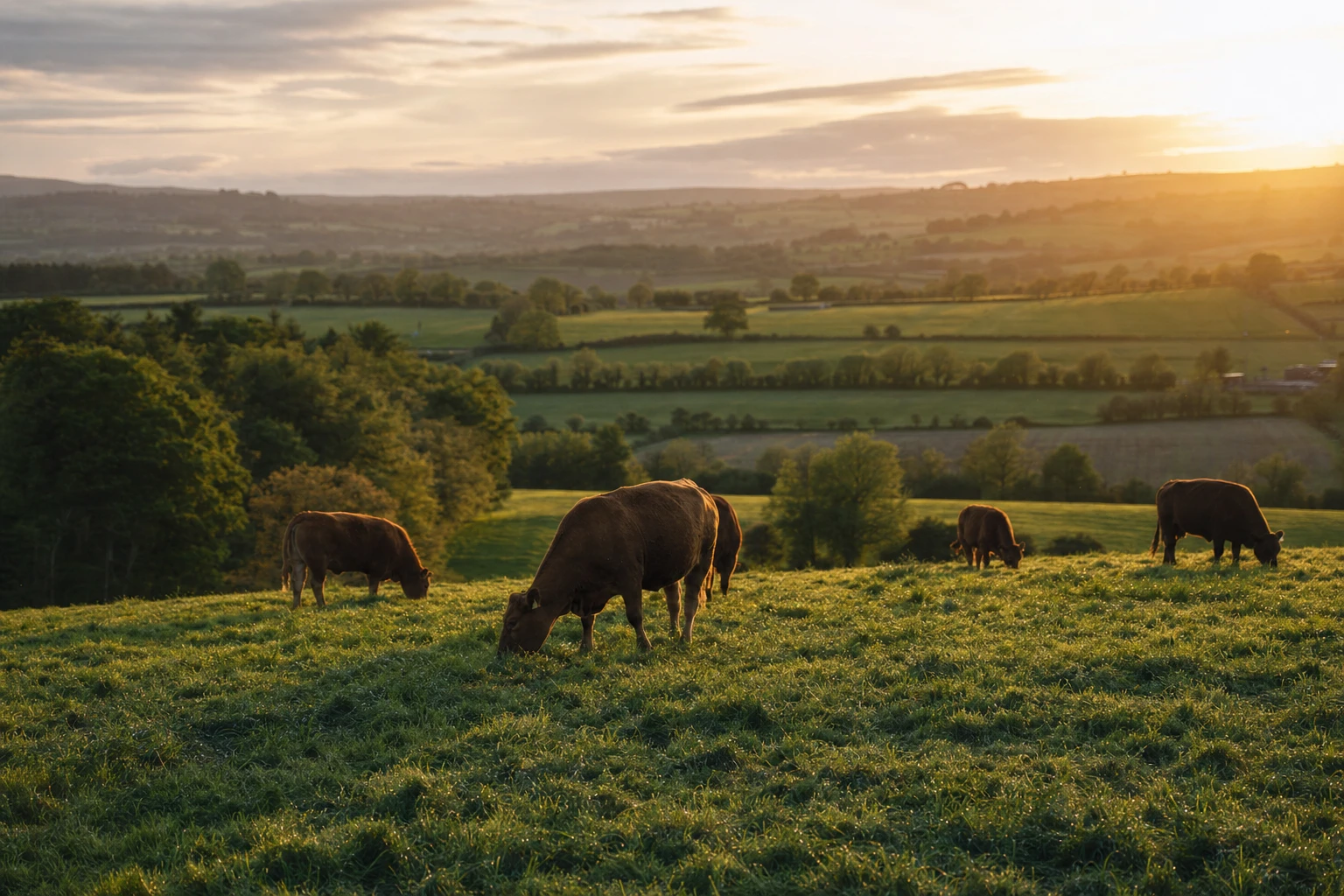
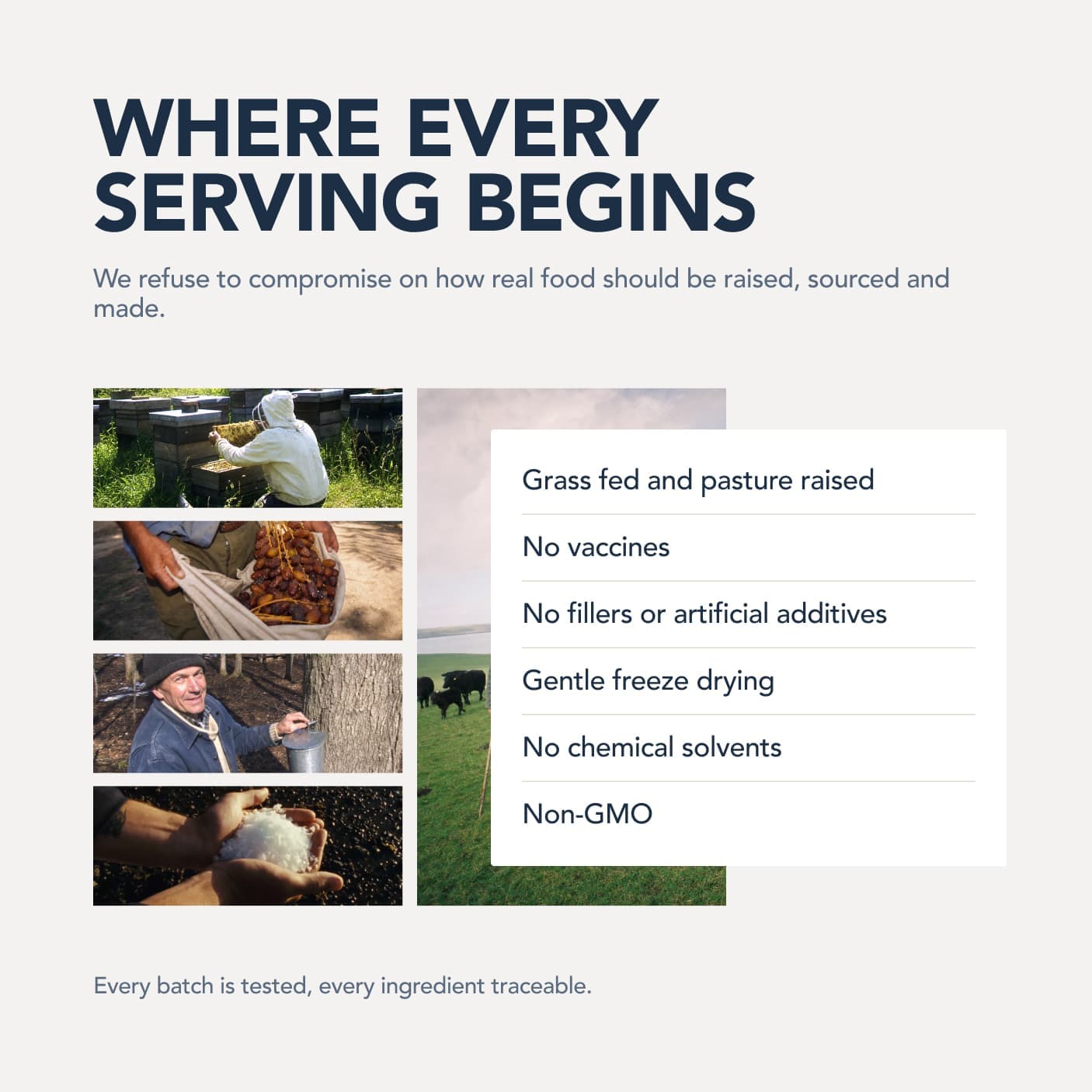
It starts on the farm. The cattle we partner with are raised on regenerative pasture in the UK (primarily the West Country, Scottish Highlands, and Pennines). The animals are raised for meat or dairy, not specifically for supplements. The organs are a byproduct that would otherwise be wasted.
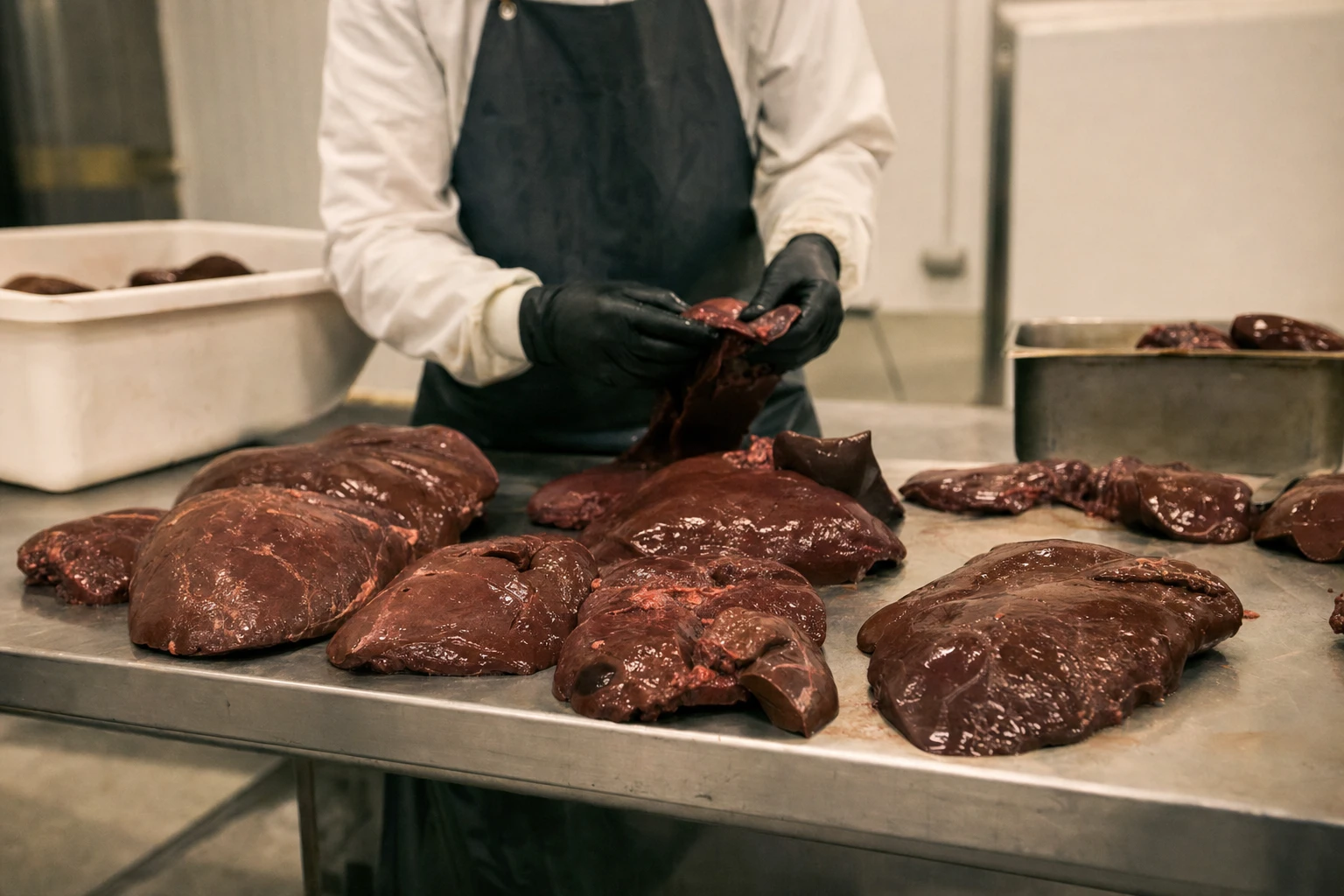
When the animal reaches slaughter, the organs are processed at a licensed abattoir. Liver, heart, kidney, lung, spleen. Each is separated, inspected for quality, and prepared for the next step. We work with abattoirs that prioritise animal welfare at slaughter (low-stress handling, skilled operators, minimal transport time).
The organs are brought to us still fresh, ideally within hours of slaughter. We don't buy them frozen from a distributor weeks later. Fresh is important because oxidation and cellular damage happen quickly after death. The sooner the organ is frozen, the better the nutrient preservation.
We're transparent about farm partners. If you ask which farm your batch came from, we can tell you the region, the farming practices, and the welfare standards. We know our suppliers. This isn't generic sourcing.
The freshness of the organs when they arrive determines the quality of the final product. Everything that follows protects and concentrates that quality.
Processing and freezing
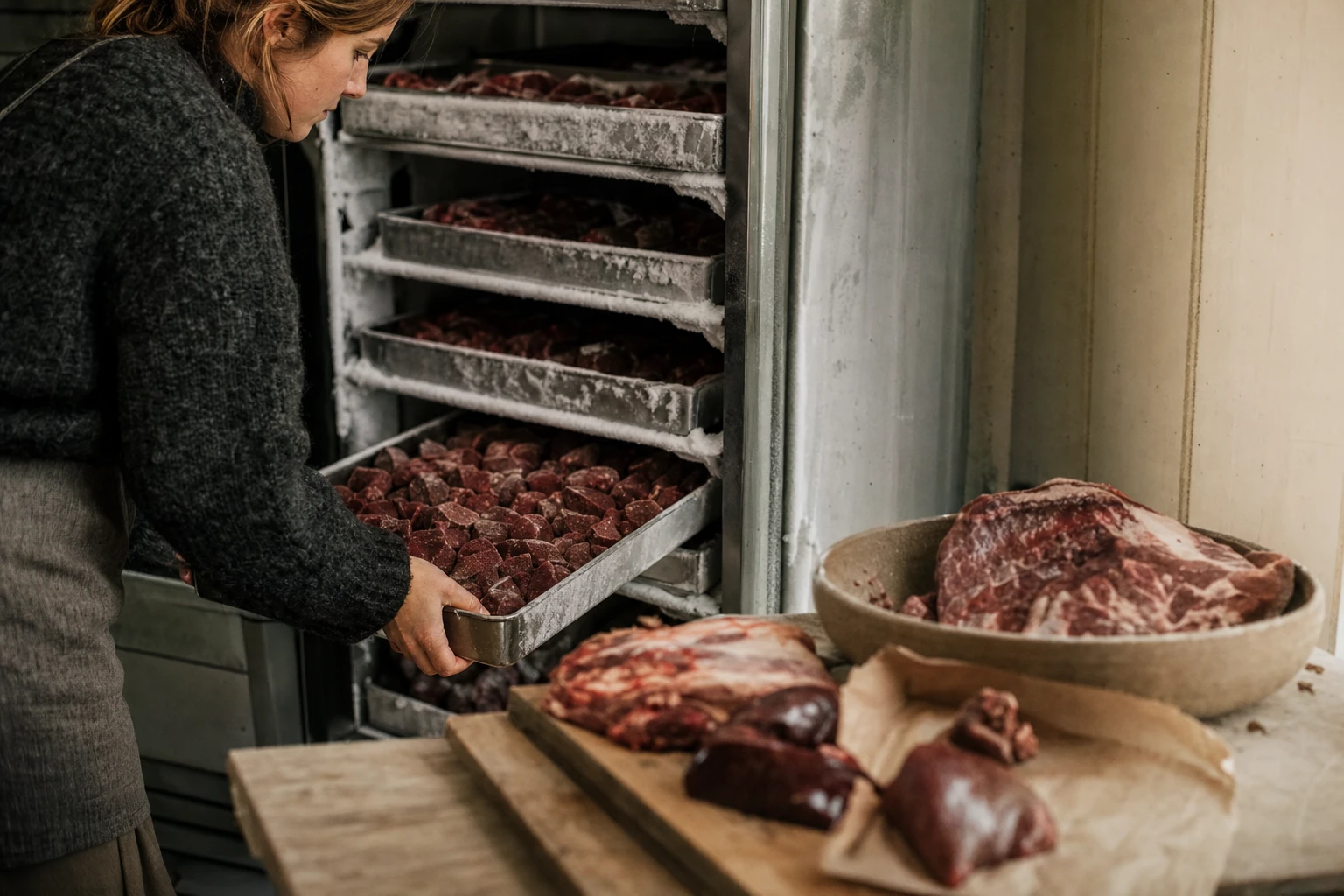
The organs are trimmed (removing any connective tissue or blood), inspected again, and placed on trays. They go directly into a blast freezer at minus 40 degrees Celsius. This happens within hours of delivery to minimise oxidation.
Rapid blast freezing produces smaller ice crystals than slow freezing, which preserves cellular structure better in animal tissues.1 When the organs are thawed later (if they ever are), they retain more structure and nutrient integrity.
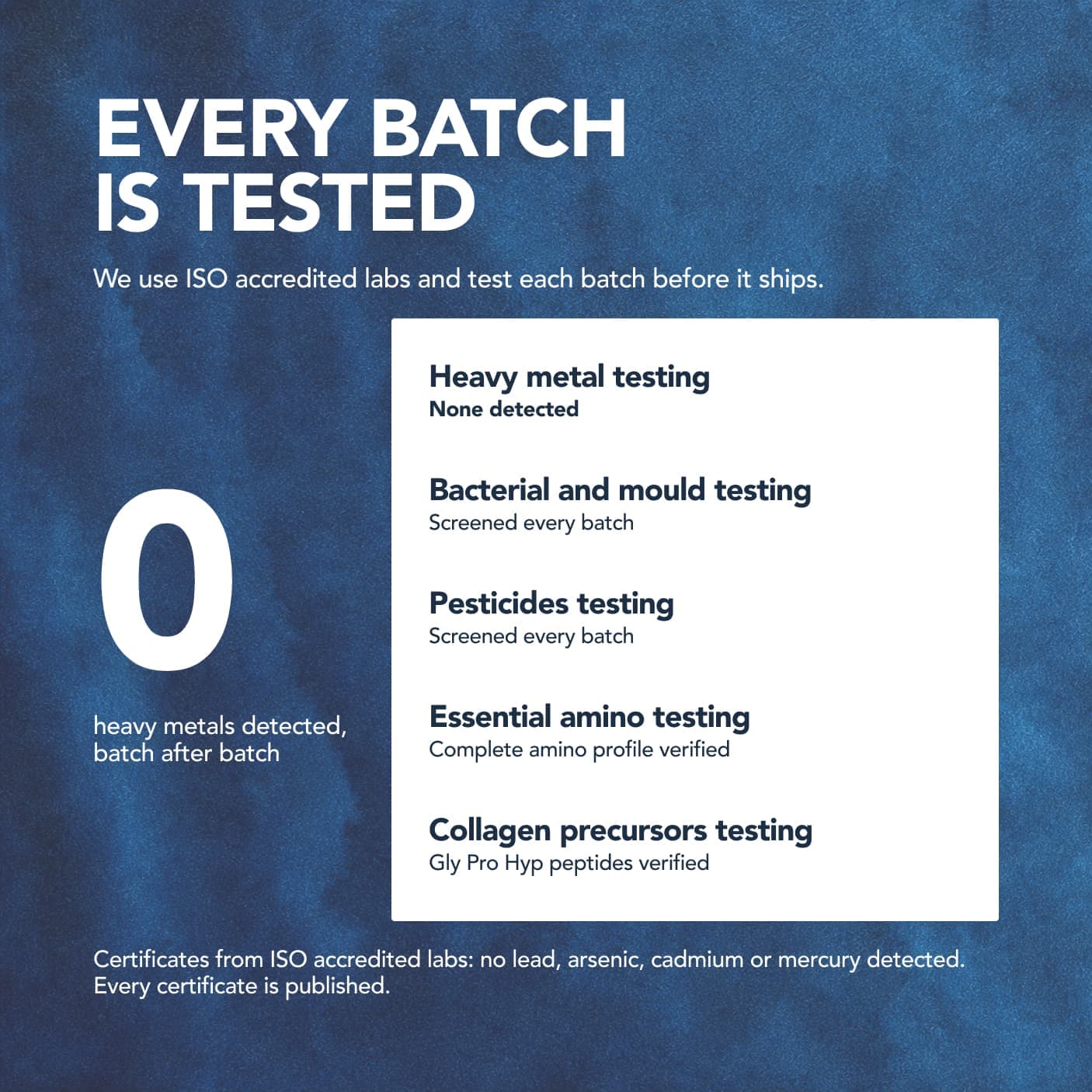
At this point, we take the representative sample for testing. We're not sending frozen organs through any further processing until we have lab results back confirming the batch is clean. This is where most companies cut corners. We don't.
Freezing within hours, testing before proceeding: this is where quality is actually made, not later.
Our testing checkpoint
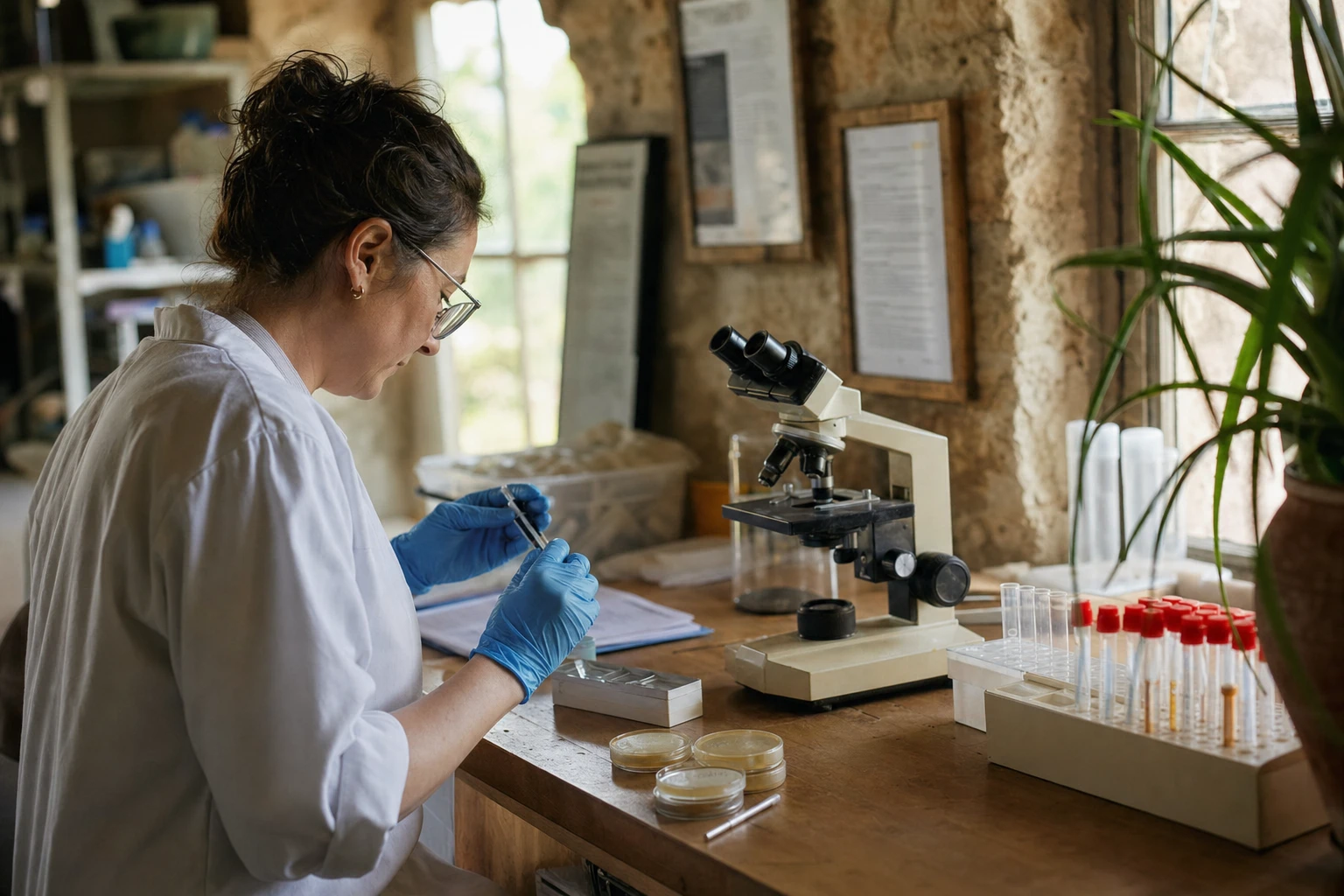
This is where we differ from most processors. The organs are frozen and tested before freeze-drying begins. If they fail testing, they don't get processed. We absorb the loss.
Every batch is lab tested for heavy metals, mould, pesticides and mycotoxins. We publish the results.
Testing takes 2 to 3 weeks. The organs sit frozen. Once results come back clean, we proceed. If anything is off, the batch is rejected.
This delays product getting to market. It costs money. Most companies skip this step or test sporadically (a few batches per year, or only if they suspect a problem). We do it every batch because if something goes wrong at this stage, you find out before it's freeze-dried and packed.
The results aren't kept in a drawer, they're published. And if you ask which farm your batch came from, we'll tell you. Transparency is the point.
The freeze-drying process
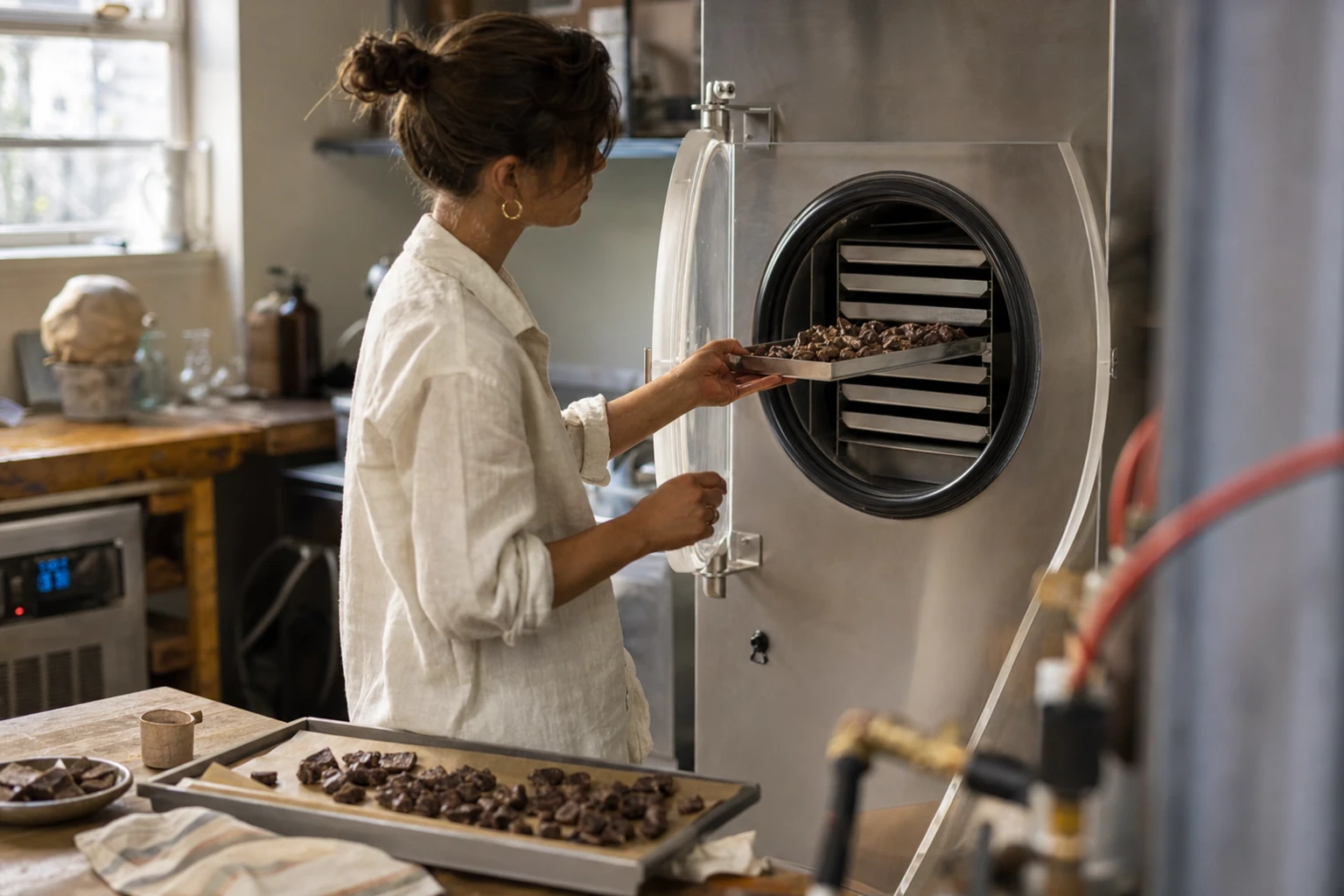
Once testing clears, the organs are moved into the freeze-dryer. This is where the magic happens and the nutrient density is preserved.
Freeze-drying removes water but not much else. The organs are already frozen. The freeze-dryer applies a vacuum (removing air pressure) and gentle heat (without raising the temperature above 40 to 50 degrees Celsius). Water sublimes (goes directly from ice to vapour) without passing through liquid form.
Because the temperature stays low and water sublimes under vacuum, freeze-drying preserves heat-sensitive nutrients better than spray-drying or heated air-drying.2 The cellular structure is maintained.
The process takes 24 to 48 hours. Beef liver is roughly 70% water, so removing the water concentrates the remaining nutrients by a factor of around 3 to 4.3 The nutrient density isn't added; it's concentrated from what was already there.
Freeze-drying is slower and more expensive than spray-drying. But it preserves nutrients the way whole food would if you could just remove the water.
Get farming and sourcing guides, free
Two short reads a week on regenerative farming and where real food comes from.
By signing up you agree to receive emails from us. No spam, unsubscribe anytime.
Milling, blending and packing
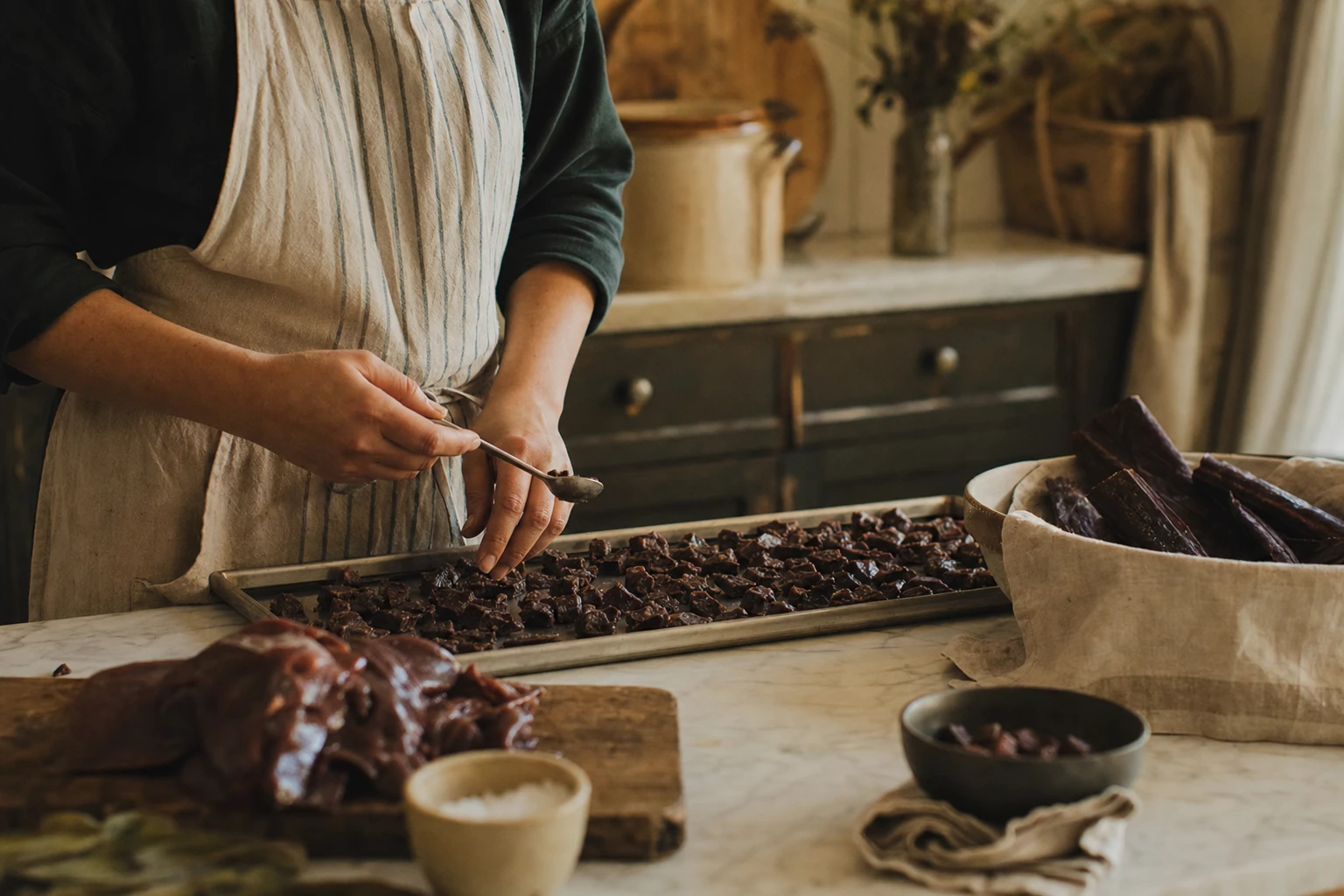
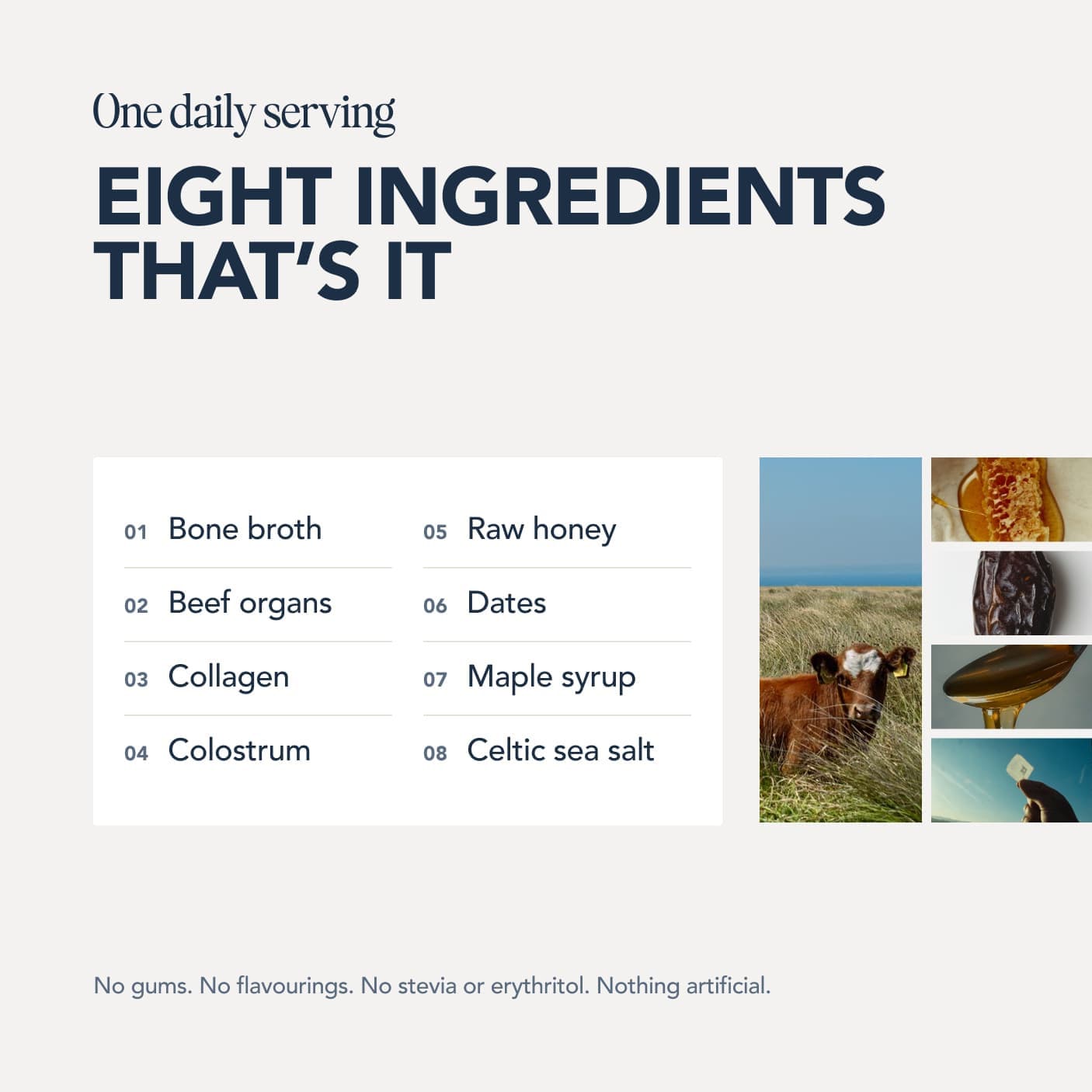
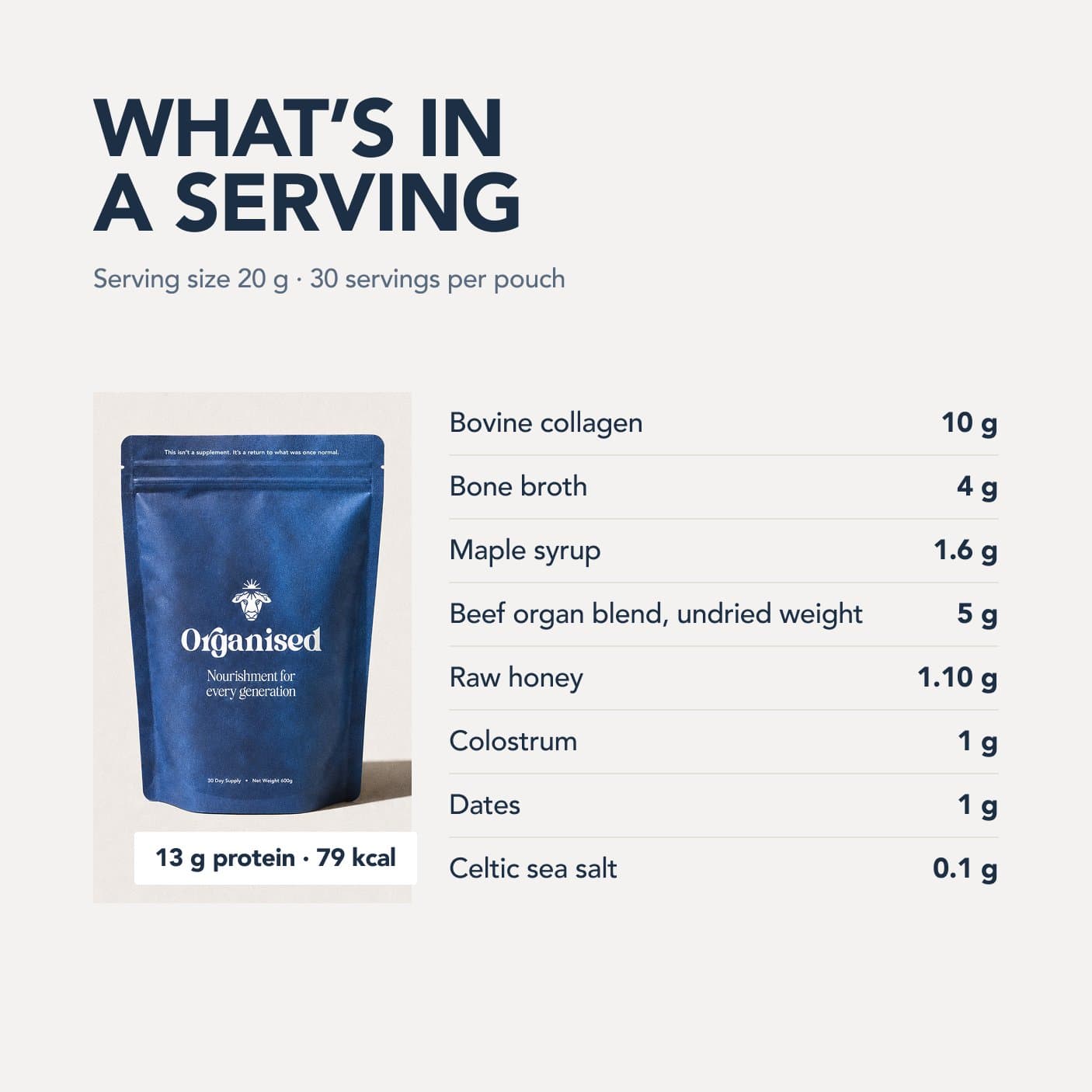
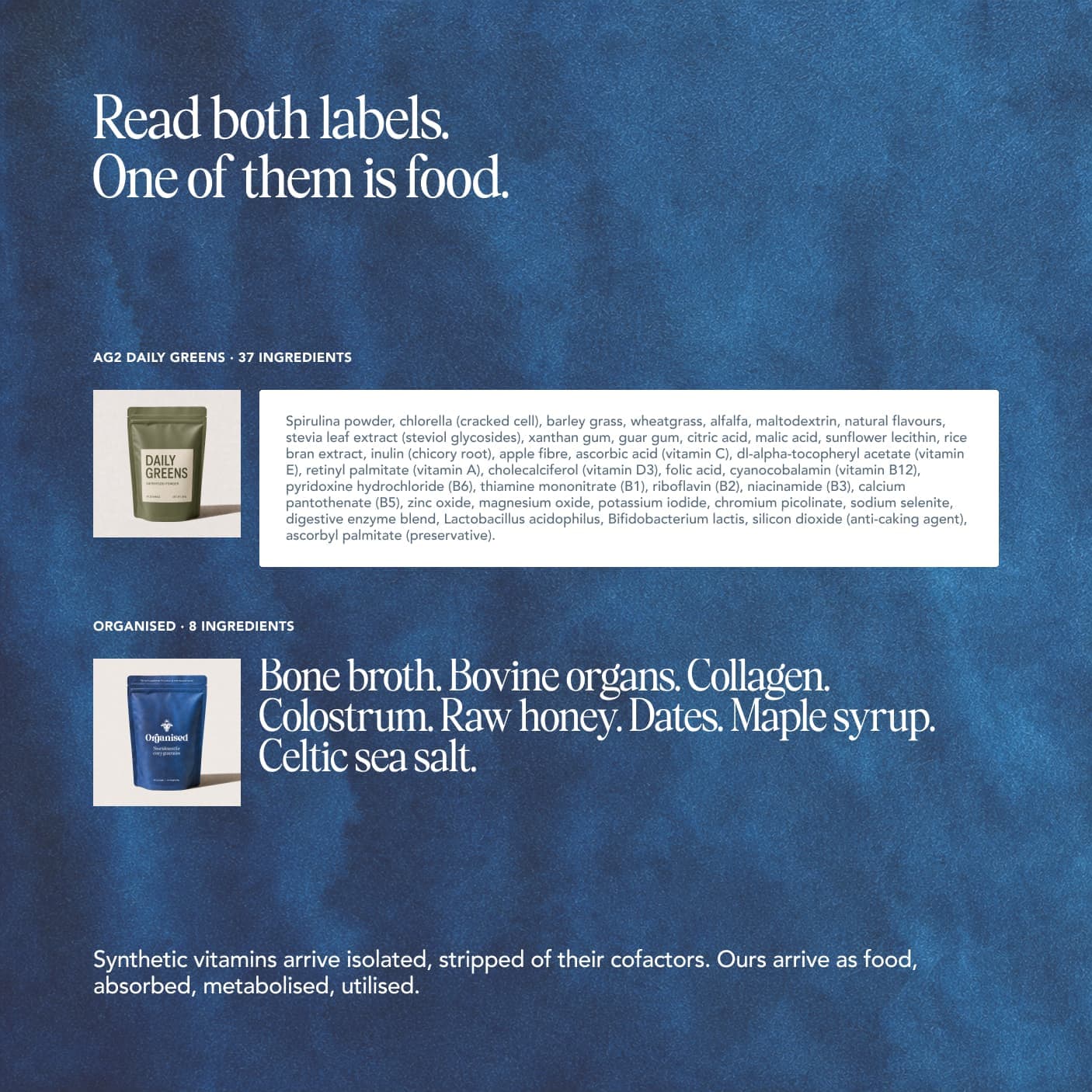
Once freeze-dried, the organs are ground into a fine powder and blended with the rest of the eight ingredients: grass-fed bone broth, collagen peptides, bovine colostrum, raw honey, dates, Canadian maple syrup, and Celtic sea salt. There are no capsules to fill, because Organised is only ever a powder in a pouch. The finished blend goes into pouches with an inert atmosphere (nitrogen flushed) to prevent oxidation during storage.
Everything is done in a clean facility meeting pharmaceutical GMP (Good Manufacturing Practice) standards. Pouches are checked for defects. Weights are verified. Batches are labelled with batch numbers so they can be traced back to the farm and test results.
Finished product is stored in a cool, dry environment, exactly how we'd suggest you store it at home: a cool, dry cupboard, with the best before date on the pouch as your reference. We rotate stock using FIFO (first in, first out) to ensure freshness.
From product to you
Your pouch goes into a box, gets your address, and ships. The whole process from farm to your door takes 4 to 8 weeks depending on slaughter timing, testing schedules, and shipping.
Each pouch has a batch number. That number corresponds to a specific slaughter date, specific farm, specific test results. You can ask us which farm, which paddock even (if the farm tracks that level of detail), and we'll tell you.
The organs in your blend came from animals that lived on regenerative pasture. They were sourced fresh, frozen immediately, tested thoroughly, and freeze-dried to preserve every nutrient possible. That's the story of your pouch. It's transparent because we believe you deserve to know where your food comes from.
This entire process exists to get something from an animal that lived well into your body with as much nutrient integrity as possible. Everything else is just supporting that.
1 of 9
Daily blend
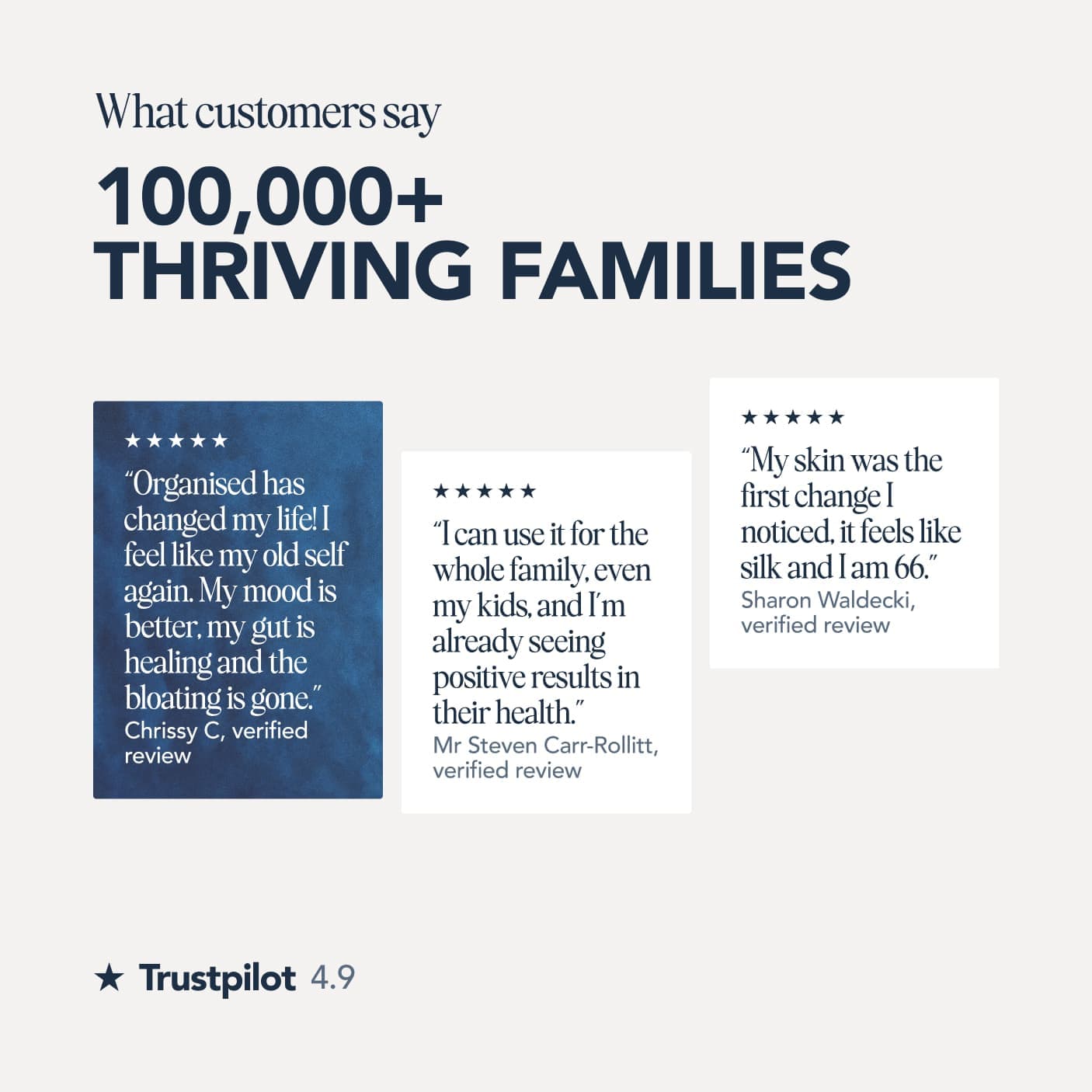
100,000+ thriving families4.9 on Trustpilot
Eight real ingredients built around grass-fed beef organs, collagen and colostrum. Nothing synthetic added.
Free with your first order, worth £38. Plus £10 off the pouch with a subscription.
Free UK shipping · Made in England · 100 day money back guarantee on your first pouch · Skip, pause or cancel anytime
Why transparency matters at scale
Most supplement companies scale by outsourcing. The quality control gets diffused through the supply chain. Testing becomes sporadic. Traceability disappears. By the time something goes wrong, the accountability is unclear.
We scale differently. We maintain direct relationships with farms. We control the freezing and testing. We know the freeze-dryer. This costs more and limits how fast we can grow. But it means every batch has a story we can tell.
This approach makes sense for a brand built on transparency. We're not trying to be the biggest supplement company. We're trying to be the one you trust.
The bottom line
The journey from farm to pouch is intentional at every step. Fresh sourcing. Quick freezing. Thorough testing. Gentle freeze-drying. Careful packaging. Transparent traceability. Nothing is rushed. Nothing is optimised for cost at the expense of quality.
That's why this takes time and costs more than supplements made from aged, transported, spray-dried ingredients. But that's also why the thing you're taking is worth taking. You're not buying a generic supplement. You're buying an organ from a specific animal, raised in a specific way, processed with specific care. You know where it came from. That matters.
References
Every source below was checked on 27 August 2026. Each PubMed, PMC and DOI identifier was resolved against NCBI or Crossref, and what it opens is printed under the citation, so you can see the link goes where the citation says without leaving the page. Where a citation and its identifier disagreed, the citation was corrected to the record or the reference was deleted along with the sentence marker that pointed at it, and where the resolved paper turned out not to support the sentence, the sentence was cut back to what it does support. Borrowed authority is worse than none, because it looks like rigour.
- Petzold G, Aguilera JM. Ice morphology: fundamentals and technological applications in foods. Food Biophysics. 2009. (See also Bhatta et al. PMC7022747)Checked 27 August 2026: PMC7022747 opens Bhatta S, Stevanovic Janezic T, Ratti C, Freeze-Drying of Plant-Based Foods. Foods 2020;9(1). PubMed indexes it as: Review.The authors' own declaration, from the record: The authors declare no conflict of interest.
- Bhatta S, Stevanovic Janezic T, Ratti C. Freeze-Drying of Plant-Based Foods. Foods. 2020;9(1):87. PMC7022747Checked 27 August 2026: PMC7022747 opens Bhatta S, Stevanovic Janezic T, Ratti C, Freeze-Drying of Plant-Based Foods. Foods 2020;9(1). PubMed indexes it as: Review.The authors' own declaration, from the record: The authors declare no conflict of interest.
- USDA FoodData Central. Beef, variety meats and by-products, liver. FoodData Central
Corrections
What this page used to say, and why it no longer says it. Corrections are dated and are never removed, because deleting the record of an error is a second error. Every guide we have corrected is listed at our corrections log.
- 27 August 2026. Reference 1 led with a 2009 paper on ice morphology and linked Bhatta et al. on freeze-drying. The entry now names the paper the link opens.
Who wrote and reviewed this guide
Niall Kiddle
Author · Founder, Organised
Niall is the founder of Organised. He started the company in 2024 after fixing his own health the slow way: in 2022 he swapped a cupboard of synthetic supplements for real food, raw milk, organ meats, bone broth and honey, and felt the difference within months.
Areas of expertise: Ancestral nutrition, Organ meats, Whole-food supplementation, Gut health, Regenerative sourcing
Read Niall's full profile
Pedro Rodrigues
Reviewer · Agronomist (farming and sourcing only)
Pedro is the agronomist Organised works with on farming and sourcing. His job on the guides is to keep the science honest: he reviews what we publish about soil health, regenerative agriculture, grazing and the way food is actually produced.
Areas of expertise: Regenerative agriculture, Agronomy, Soil health, Grass-fed farming, Food sourcing
Reviewed this guide on
Read Pedro's full profileBrowse the guides library
All guidesKeep reading
Farming
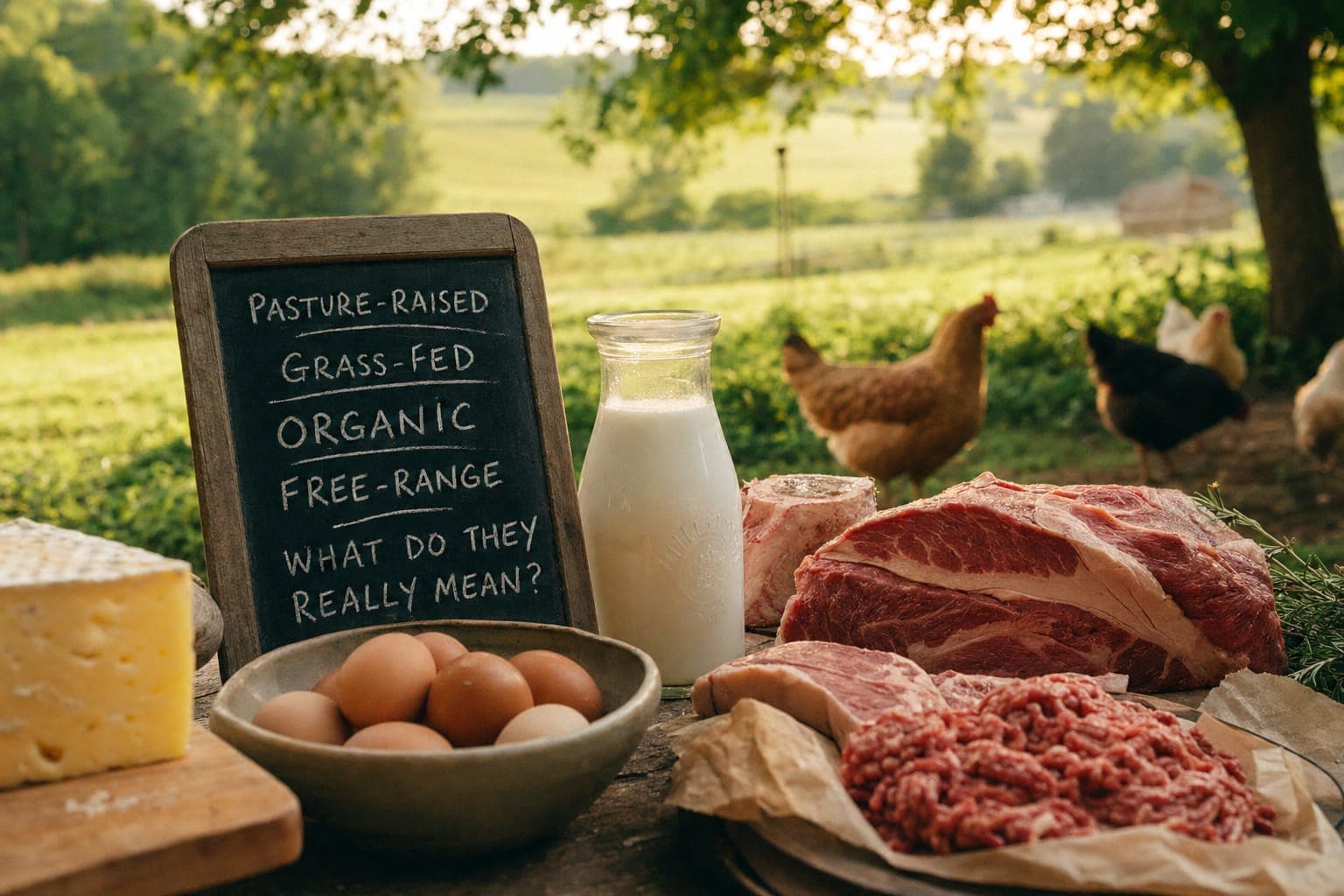
What the Labels Don't Tell You: Pasture-Raised, Grass-Fed and More
What pasture-raised, grass-fed, organic, and free-range actually mean. Find the real story behind the labels on your meat and dairy.
Farming
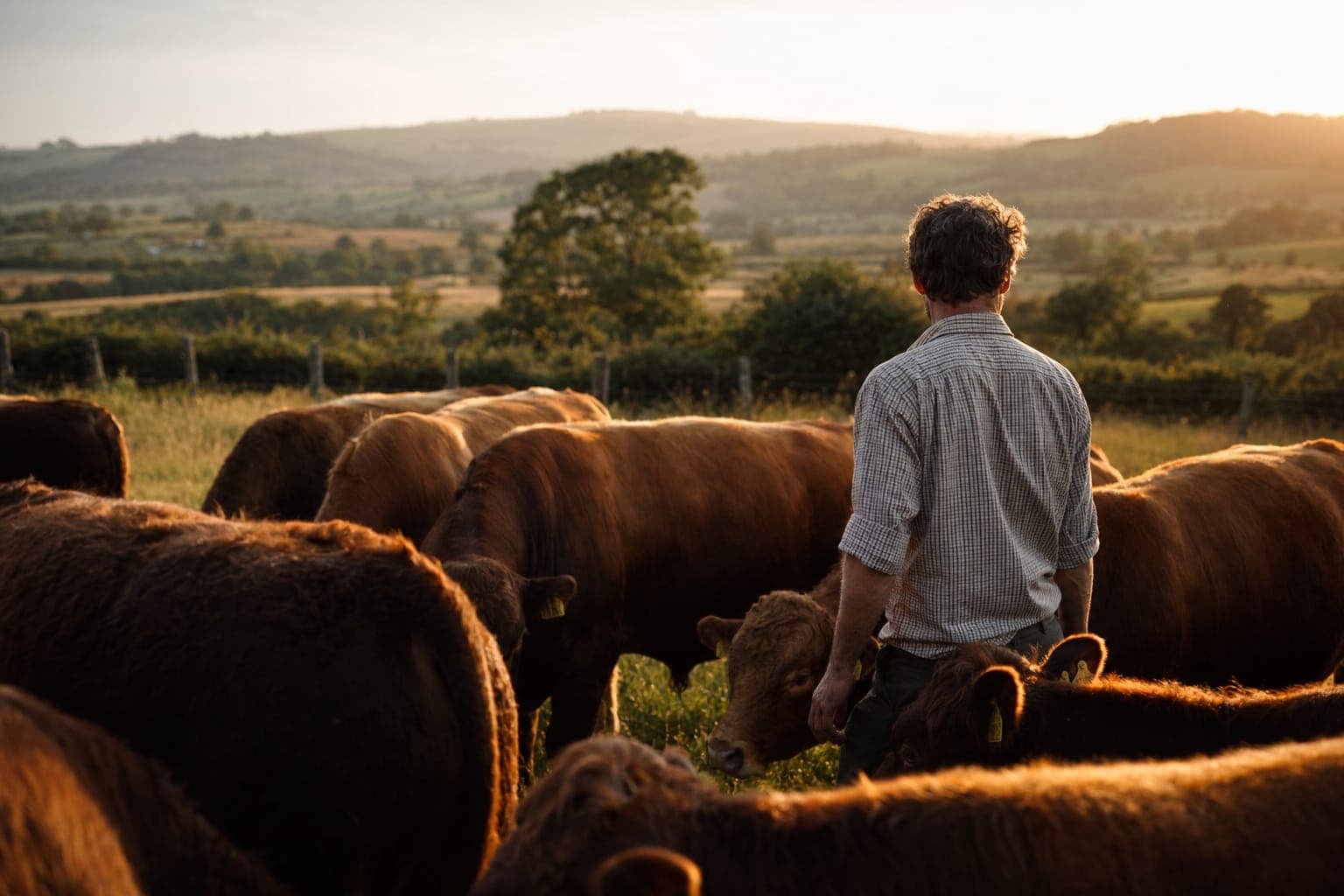
Why We Partner with Regenerative Farms
Our sourcing criteria explained. Why we chose regenerative farms, our selection process, and how traceability works from farm to pouch.
Farming
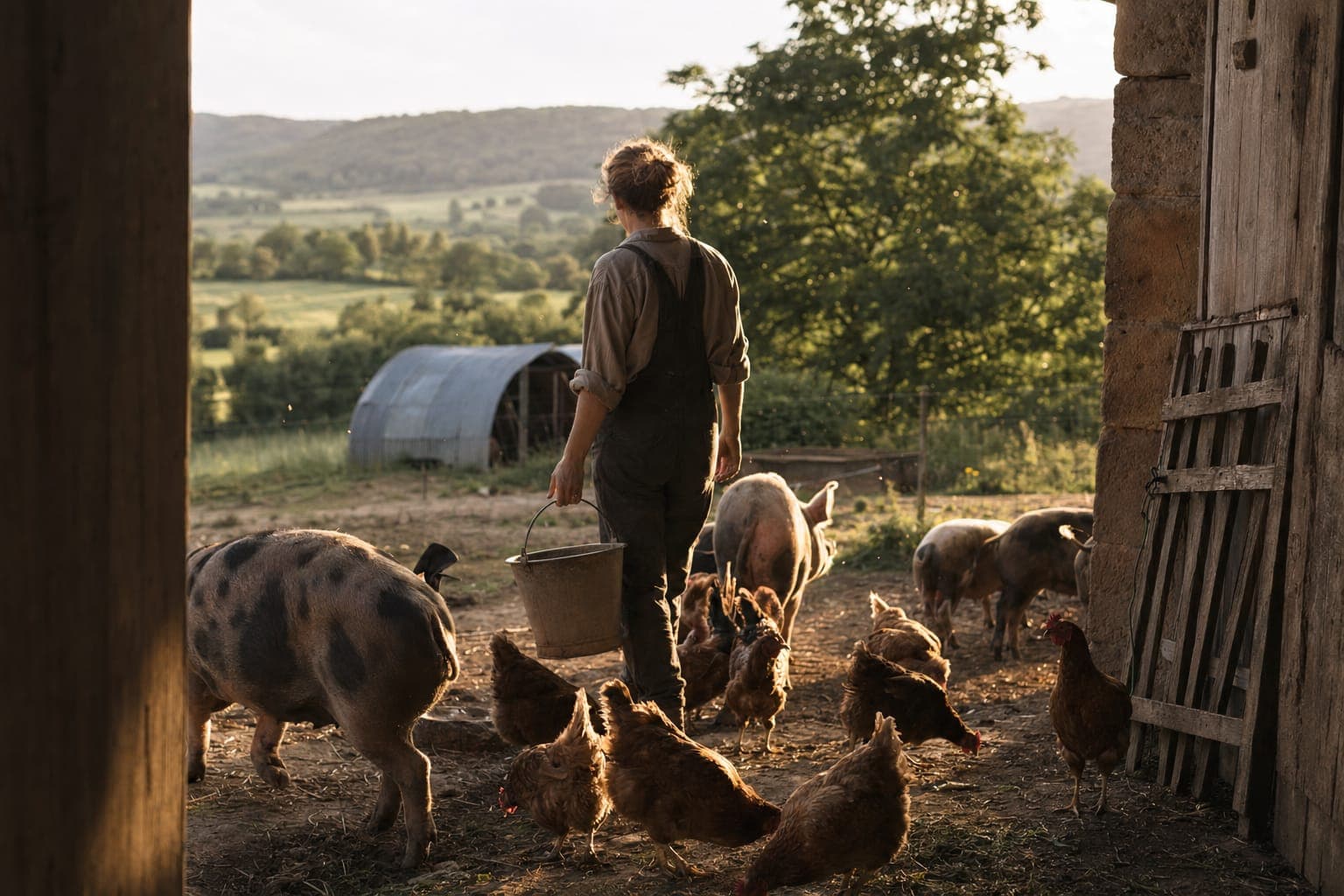
A Day on a Regenerative Farm
Step inside a regenerative farm and discover what actually happens daily. Meet the farmers and animals behind your food.
Real food, made effortless
Shop the blendA few ways to use it
All recipes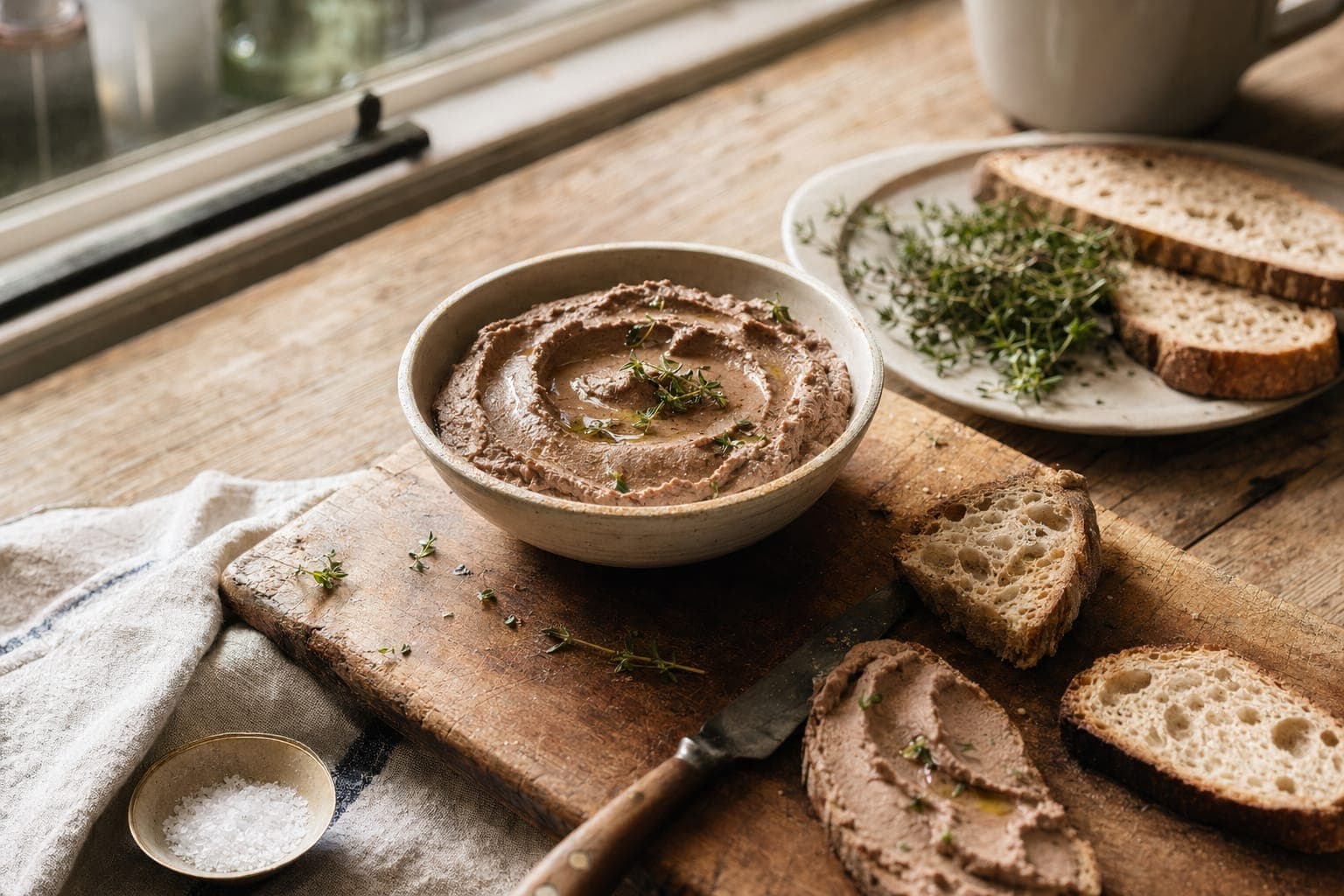
Liver Pate for Beginners: A Gentle Introduction to Organ Meats
Simple liver pate recipe to start eating organ meats. Chicken liver, butter, and herbs. Gentle introduction to nutrient-dense whole foods.
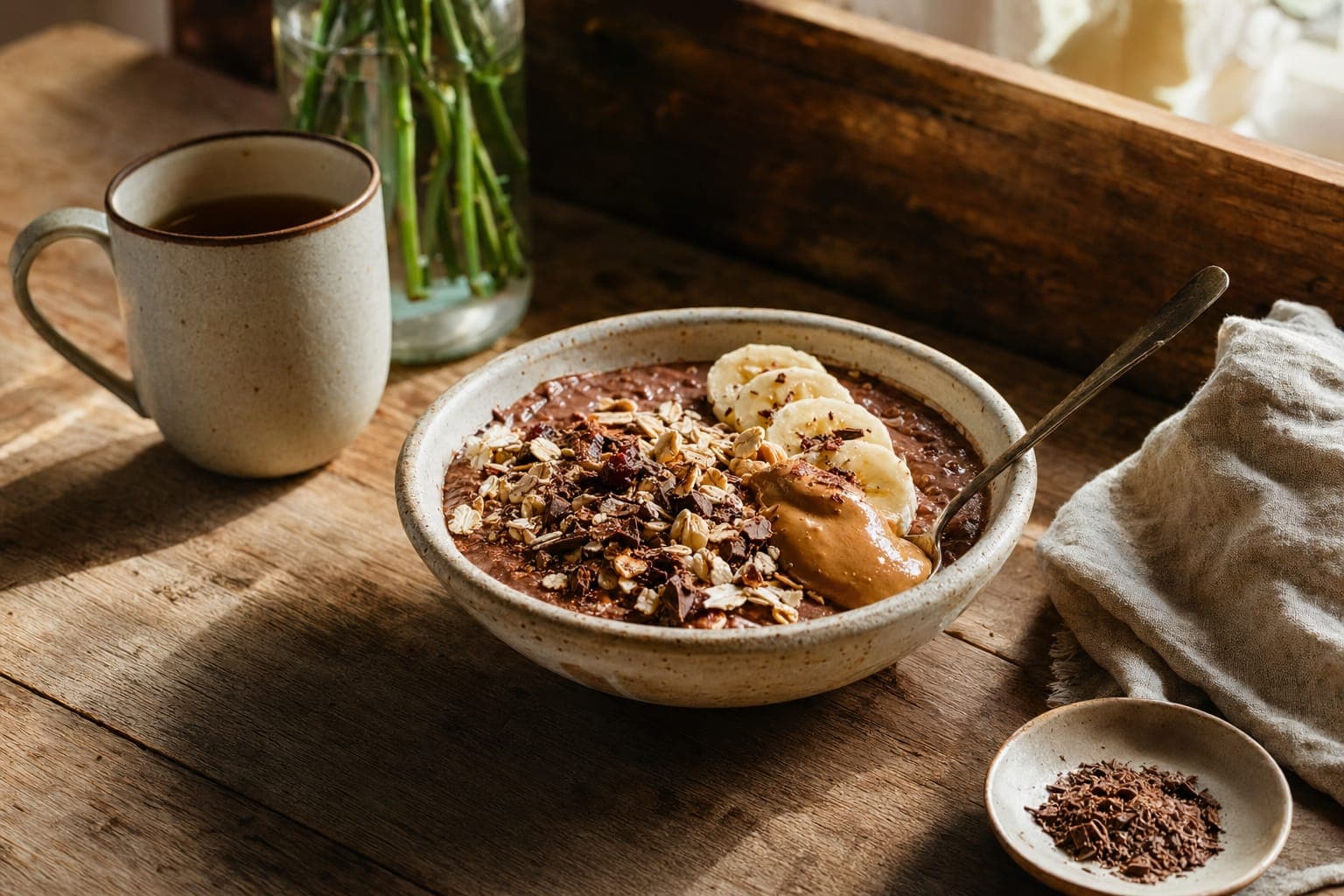
10 Ways to Use Organised That Aren't Just a Shake
Move beyond the basic shake. Discover 10 creative ways to use Organised in smoothie bowls, oats, yoghurt, baking, and more.
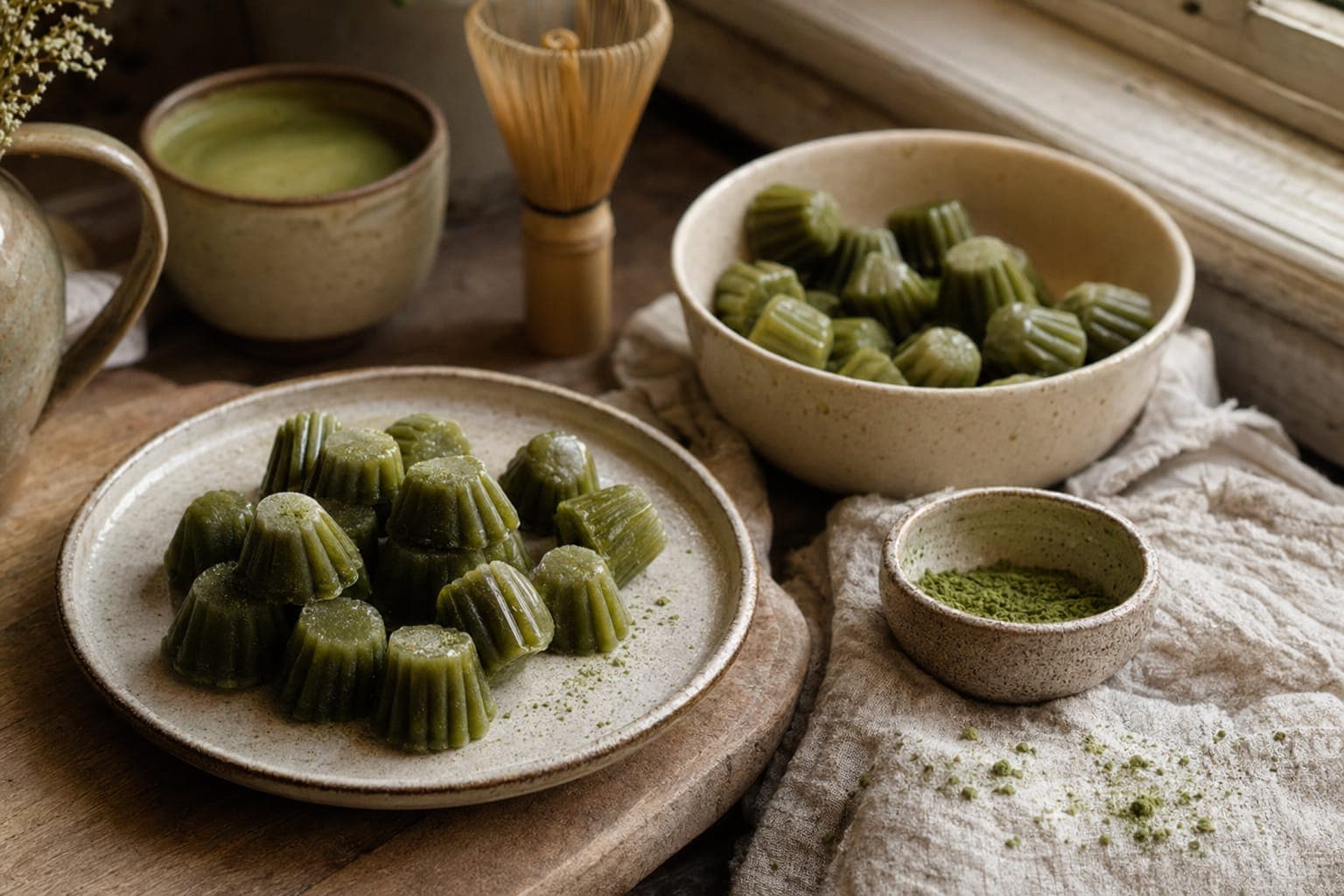
Matcha Latte Gummies with Collagen and Gelatine
Make visually stunning matcha latte gummies infused with collagen and gelatine. Simple recipe for gut-healing sweets you'll actually want to eat.


 Join over 100,000+ members
Build a better food system with us
The Organised community is thousands of people choosing real food and backing the farmers who grow it, all of us trying to leave the world a little better than we found it. If that is what you care about too, you belong here.