What Is Regenerative Agriculture? A Complete Guide
Industrial agriculture mines soil like a bank account. Regenerative agriculture builds soil like a savings account. Here's how it works, what makes it different from organic, and whether it's actually scalable.
By Niall Kiddle, Founder, Organised

Reviewed by Pedro Rodrigues, Agronomist (farming and sourcing only) ·
9 min read · Published · Updated · 3 cited sources
Makers of the Organised Daily blend, a grass-fed beef organ supplement from regenerative UK farms
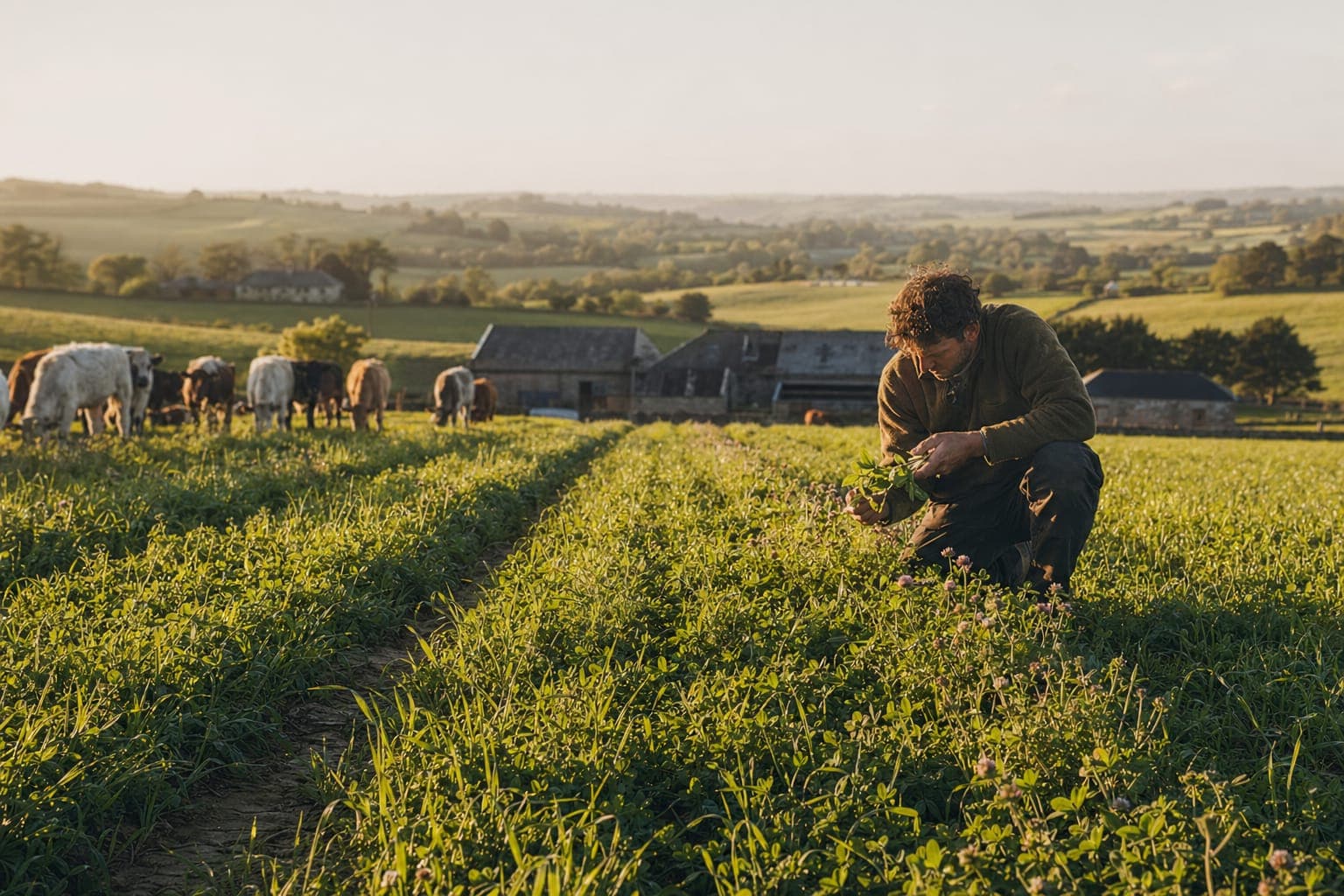
Regenerative agriculture is not a certification. It's not a brand. It's a set of practices designed to improve land rather than just extract from it.
What regenerative agriculture is and isn't
Regenerative agriculture is defined by outcomes, not inputs. The question is: does this farm leave the soil richer, more carbon-dense, more alive than it was before?
It's not organic. Organic farms can be regenerative, and many are, but the certifications measure different things. Organic measures what you don't use (synthetic inputs). Regenerative measures what you actively build (soil).
It's not a single practice. It's a suite of practices: cover crops, reduced tilling, crop rotation, compost application, animal integration. Different farms use different combinations based on climate, soil, and crop type.
It's not a guarantee. A farm can use regenerative-style practices (cover crops, minimal tilling) without actually improving soil. Outcomes, not practices, are what matter.
It's not new. Many small traditional farms have been regenerative for centuries. Farmers knew that crop rotation and livestock integration improved land. Industrial agriculture abandoned these practices for efficiency. Regenerative is a modern relearning of ancestral knowledge.
The five core principles
Regenerative agriculture, as outlined by the Rodale Institute and Regenerative Organic Alliance, rests on five overlapping principles.
First: minimise soil disturbance. Tilling destroys soil structure and kills the microbial life that builds fertility. No-till farming leaves soil intact. This is perhaps the single most important practice.
Second: keep soil covered. Bare soil erodes, loses organic matter, and becomes vulnerable to heat and UV damage. Cover crops (planting off-season crops specifically to protect and enrich soil) keep living plants on the land year-round.
Third: maintain plant diversity. Monoculture depletes soil and requires synthetic inputs. Crop rotation (planting different crops in sequence) balances nutrients and breaks pest cycles. Polyculture (growing multiple crops simultaneously) builds resilience.
Fourth: integrate livestock. Properly managed grazing animals (cattle, sheep, goats) stimulate plant growth, deposit nutrient-rich manure, and build soil through their movement and grazing patterns.
Fifth: minimise synthetic inputs. This overlaps with organic but goes further. The goal is to build soil fertility from within (compost, manure, nitrogen-fixing cover crops) rather than applying external synthetic fertiliser.
Soil health: the foundation
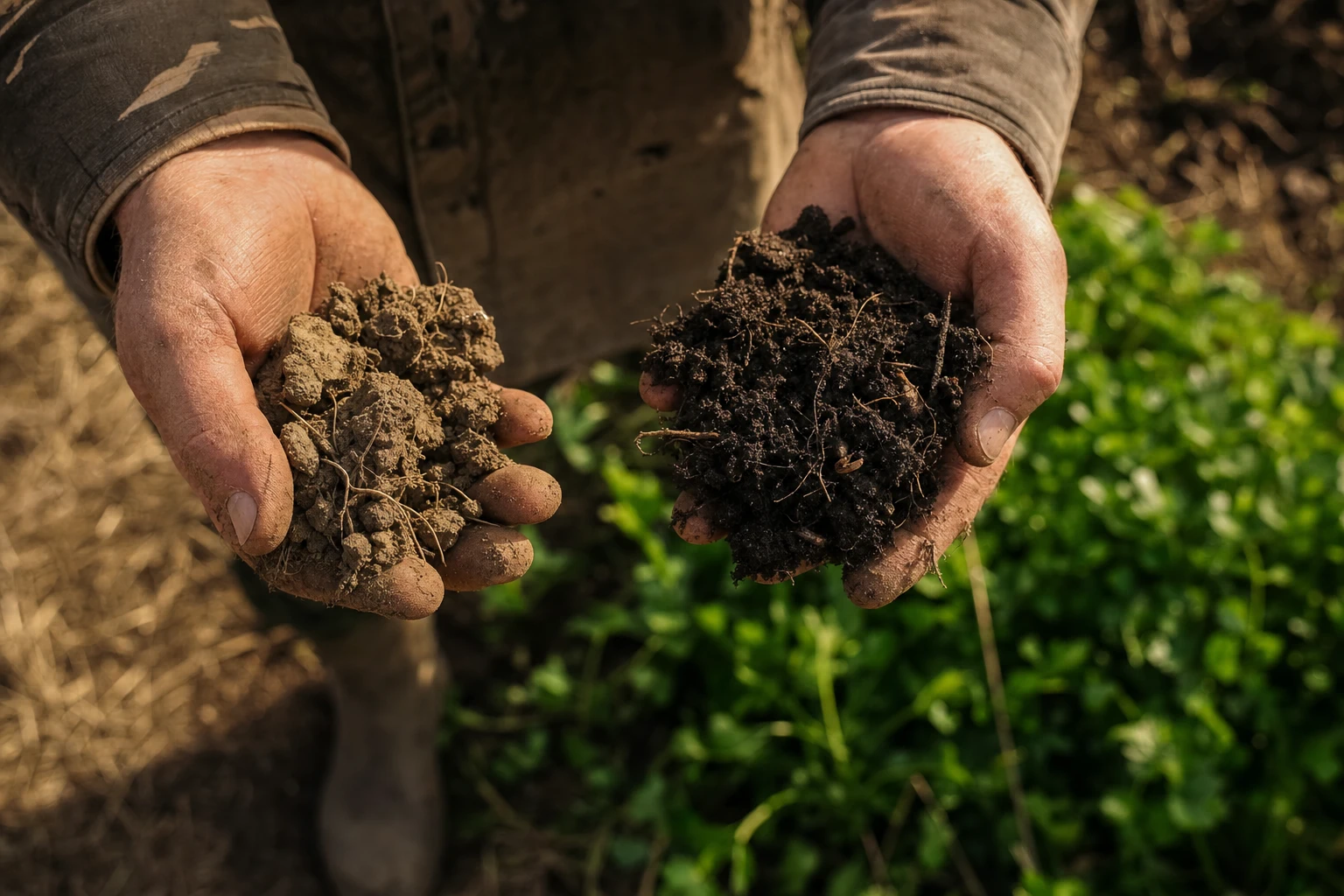
Soil is a living ecosystem. A handful of healthy soil contains more organisms than there are humans on Earth: bacteria, fungi, nematodes, arthropods, all in relationship with plant roots.
Industrial agriculture treats soil as an inert medium for holding plants upright while fertiliser feeds them from the top. This approach works for a few decades, then the soil degrades. Organic matter depletes. Structure collapses. Erosion accelerates.
Regenerative agriculture focuses on building and maintaining soil organisms. A healthy soil is a living system that cycles nutrients, retains water, and supports plant health without external inputs.
Soil health is measured through several metrics: organic matter content (percentage of carbon in the soil), aggregate stability (how well soil particles stick together), water infiltration (how quickly water soaks in), and microbial diversity (which organisms are present).
Most industrial soils have dropped from 5-10 percent organic matter (pre-industrial baseline) to 1-3 percent today.1 Regenerative practices rebuild organic matter by 0.1-0.5 percent per year, depending on climate and management.
You cannot see soil health with the naked eye. You can only see its outcomes: water retention, plant vigour, erosion resistance, and long-term productivity.
Cover crops and crop rotation
A cover crop is a crop planted specifically to protect and build soil, not for harvest. Common examples: clover (which fixes nitrogen from the air), hairy vetch, rye, oats, and legumes.
In industrial agriculture, fields sit bare in winter. Rain erodes bare soil. Nutrients leach away. Microbes go dormant. A cover crop keeps the soil alive and active.
Crop rotation rotates the main crop planted: corn one year, soybeans the next, then wheat or pasture. This breaks pest cycles (a pest that infects corn won't find food if you plant soybeans next), balances soil nutrient depletion (legumes replenish nitrogen that corn depletes), and keeps soil diverse.
Industrial monoculture plants the same crop year after year on the same land. This depletes specific nutrients, builds pest populations, and requires escalating synthetic inputs to maintain yield.
Cover crops and rotation are labour-intensive and logistically complex. They reduce total productivity in any given year (land isn't producing cash crop). But they maintain productivity long-term and reduce input costs.
No-till and minimal-till farming
No-till farming involves planting crops directly into the residue of the previous crop (or cover crop) without turning over the soil. A special seeder opens a small slot in the soil to place the seed, then closes over it.
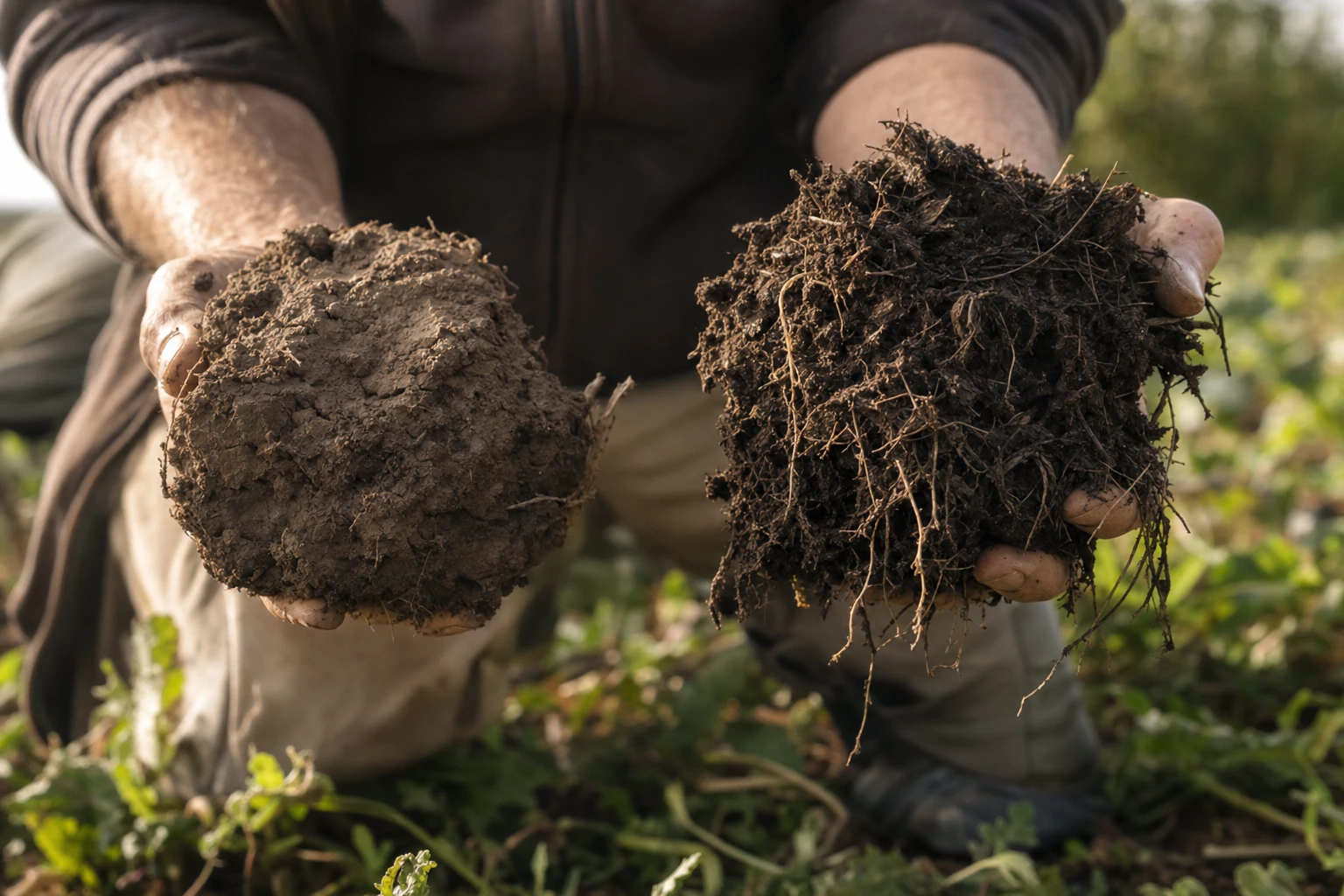
Tilling (ploughing, harrowing) was the standard practice for 10,000 years. But tilling destroys soil structure, kills fungal networks (mycorrhizae) that support plants, and exposes soil to erosion and oxidation.
No-till requires fewer passes over the field (less fuel, less cost) and allows soil to build structure and life over time. The trade-off: you need either cover crops or crop residue to suppress weeds (no tilling to bury them).
Minimal-till (tilling less frequently, or shallower) is a compromise between conventional tilling and true no-till. It reduces soil damage while maintaining some of the weed control of traditional tilling.
Research consistently shows that no-till increases soil organic matter, water retention, and aggregate stability compared to conventional tilling.2 It's the single most impactful regenerative practice.
Animal integration and grazing
Regenerative grazing uses livestock (cattle, sheep, goats) as tools to manage land. Animals eat vegetation, deposit nutrient-rich manure, trample plant residue into soil, and stimulate new plant growth through grazing.
The key is rotational grazing: animals are moved frequently (daily or weekly) across pasture, mimicking natural herd migration. They graze intensely in one area, then move on, giving plants time to recover and regenerate.
Industrial grazing is static: animals are left on the same pasture for months. This leads to overgrazing (plants are eaten to the ground, then trampled by repeat grazing animals), degradation, and compaction.
Regenerative rotational grazing can restore degraded land because the intense but brief grazing stimulates plant growth and soil processes without overgrazing. The animals provide the power and the incentive: move them where you want soil improvement.
This requires more labour (moving animals frequently, managing fences and water) but improves productivity and land health simultaneously. It's central to regenerative beef and lamb production.
Get farming and sourcing guides, free
Two short reads a week on regenerative farming and where real food comes from.
By signing up you agree to receive emails from us. No spam, unsubscribe anytime.
Carbon sequestration: myth and reality
A common claim: regenerative grazing can sequester enough carbon to offset livestock emissions and even remove carbon from the atmosphere. This is based on Allan Savory's Holistic Planned Grazing theory.
The mechanism is sound: dense grazing stimulates plant growth, and more plant growth means more photosynthesis, which pulls carbon from the air and stores it in soil.
The evidence is mixed. Some farm-scale studies show carbon sequestration. But large-scale, peer-reviewed studies on the actual carbon offset from regenerative grazing are limited. Some recent analyses suggest the carbon claims are overstated.3
The honest answer: regenerative grazing likely improves soil carbon and increases carbon sequestration relative to conventional grazing. Whether it offsets livestock emissions entirely is uncertain. Whether it scales globally for carbon removal is even more uncertain.
The better framing: regenerative practices improve land health, increase water retention, and likely build soil carbon. Treat carbon sequestration as a bonus, not the primary benefit.
Regenerative practices improve land health: more productive, more resilient, less dependent on external inputs. Carbon sequestration is real but secondary to soil restoration.
Measuring regenerative outcomes
Unlike organic (which you measure by absence of inputs), regenerative requires measuring actual soil outcomes.
Soil carbon testing measures organic matter content. A regenerative farm should show increasing soil carbon over years (0.1-0.5 percent per year, depending on practice and climate).
Water infiltration testing measures how quickly water soaks into soil. Healthy soil infiltrates water rapidly. Degraded soil is compacted and slow. Regenerative practices improve infiltration within 2-3 years.
Biological diversity can be measured through microbial testing (DNA analysis of soil organisms) or visually through earthworm counts and fungal presence.
Most regenerative farms don't do these measurements routinely. The cost and complexity are barriers. Some certification schemes (like Regenerative Organic in the US) require soil testing. Many don't.
Without measurement, regenerative becomes a practice claim ("we use cover crops") rather than an outcome claim ("our soil carbon increased 0.3 percent annually"). The outcome is what matters.


1 of 9
Daily blend
100,000+ thriving families4.9 on Trustpilot
Eight real ingredients built around grass-fed beef organs, collagen and colostrum. Nothing synthetic added.
Free with your first order, worth £38. Plus £10 off the pouch with a subscription.



Free UK shipping · Made in England · 100 day money back guarantee on your first pouch · Skip, pause or cancel anytime
Scaling challenges and successes
Regenerative farming works at small to medium scale (200-1,000 acres). The labour requirements and management complexity are manageable. The economic model works if you're selling at premium price (direct to consumers, farmers markets, specialty retailers).
Scaling to industrial scale (10,000+ acres) is harder. Regenerative practices are site-specific and require observation and adjustment. Monoculture can be standardised and automated. Regenerative cannot.
There are exceptions: some larger regenerative operations (White Oak Pastures, some UK farms using Regenerative Organic Certification) prove scaling is possible. But they require: significant management labour, direct sales or premium pricing, and regional infrastructure for processing and distribution.
For commodity crops (corn, wheat, soy), regenerative at scale is economically difficult. Farmers depend on commodity prices, which don't reflect soil health costs. A regenerative wheat farm produces less total grain, which doesn't command proportionally higher price.
The realistic path: regenerative spreads where economics allow (grass-fed beef, vegetables, regional grains sold direct). Industrial agriculture persists in commodity crops and large-scale monoculture. Over decades, the ratio shifts as soil degradation makes industrial systems less viable and regenerative systems prove superior long-term.
The complete picture
Regenerative agriculture is not a single practice. It's a framework for thinking about farming: build soil, maintain life, reduce external inputs, measure outcomes.
It works best on pasture, perennials, and smaller-scale mixed farms. It's harder for commodity grains, large-scale monoculture, and systems dependent on commodity pricing.
It does improve land health: soil carbon, water retention, biodiversity, resilience to drought and flood. These benefits are real and measurable.
It does not solve global food security single-handedly. Yield is typically lower than industrial monoculture (though more stable long-term). Scaling requires changes in economics, infrastructure, and consumer expectations.
The honest vision: a mixed food system. Regenerative practices on pasture, perennials, and vegetables. More efficient but still improved industrial practices on grain. A diet that relies more on regeneratively-produced foods (meat, dairy, seasonal produce) and less on commodity grains and processed food.
That's achievable in the next 20 years. A complete shift to regenerative-only is not, unless global population and consumption patterns change dramatically.
But starting somewhere beats waiting for perfect scale. A single farm regenerated is a proof of concept. A region of regenerated land is a movement. A nation of mixed regenerative and improved industrial is the realistic end state, and it's substantially better than the current trajectory.
References
Every source below was checked on 27 August 2026. Each PubMed, PMC and DOI identifier was resolved against NCBI or Crossref, and what it opens is printed under the citation, so you can see the link goes where the citation says without leaving the page. Where a citation and its identifier disagreed, the citation was corrected to the record or the reference was deleted along with the sentence marker that pointed at it, and where the resolved paper turned out not to support the sentence, the sentence was cut back to what it does support. Borrowed authority is worse than none, because it looks like rigour.
- Food and Agriculture Organization of the United Nations. The Importance of Soil Organic Matter: Key to drought-resistant soil and sustained food production. FAO Soils Bulletin 80. https://www.fao.org/4/a0100e/a0100e.pdf See also FAO Status of the World's Soil Resources, which reports that 33% of global soils are moderately-to-highly degraded and SOC declines of 15-30% on conversion of natural land to cropland.
- Mechanisms of soil organic carbon stability and its response to no-till: A global synthesis and perspective. Global Change Biology. 2021. https://pubmed.ncbi.nlm.nih.gov/34726342/ See also Bai X et al. Responses of soil carbon sequestration to climate-smart agriculture practices: A meta-analysis. https://pubmed.ncbi.nlm.nih.gov/31002465/Checked 27 August 2026: PMID 34726342 opens Kan ZR, Liu WX, Liu WS et al, Mechanisms of soil organic carbon stability and its response to no-till: A global synthesis and perspective. Glob Chang Biol 2022;28(3):693-710. PubMed indexes it as: Review. PMID 31002465 opens Bai X, Huang Y, Ren W et al, Responses of soil carbon sequestration to climate-smart agriculture practices: A meta-analysis. Glob Chang Biol 2019;25(8):2591-2606. PubMed indexes it as: Meta-Analysis.
- Garnett T, Godde C, Muller A, et al. Grazed and Confused? Ruminating on cattle, grazing systems, methane, nitrous oxide, the soil carbon sequestration question - and what it all means for greenhouse gas emissions. Food Climate Research Network, University of Oxford; 2017. See also Powlson DS et al. discussions of limited net SOC change with no-till at depth, e.g. Nature Climate Change. 2014;4:678-683.
Who wrote and reviewed this guide
Niall Kiddle
Author · Founder, Organised
Niall is the founder of Organised. He started the company in 2024 after fixing his own health the slow way: in 2022 he swapped a cupboard of synthetic supplements for real food, raw milk, organ meats, bone broth and honey, and felt the difference within months.
Areas of expertise: Ancestral nutrition, Organ meats, Whole-food supplementation, Gut health, Regenerative sourcing
Read Niall's full profile
Pedro Rodrigues
Reviewer · Agronomist (farming and sourcing only)
Pedro is the agronomist Organised works with on farming and sourcing. His job on the guides is to keep the science honest: he reviews what we publish about soil health, regenerative agriculture, grazing and the way food is actually produced.
Areas of expertise: Regenerative agriculture, Agronomy, Soil health, Grass-fed farming, Food sourcing
Reviewed this guide on
Read Pedro's full profileBrowse the guides library
All guidesKeep reading
Farming
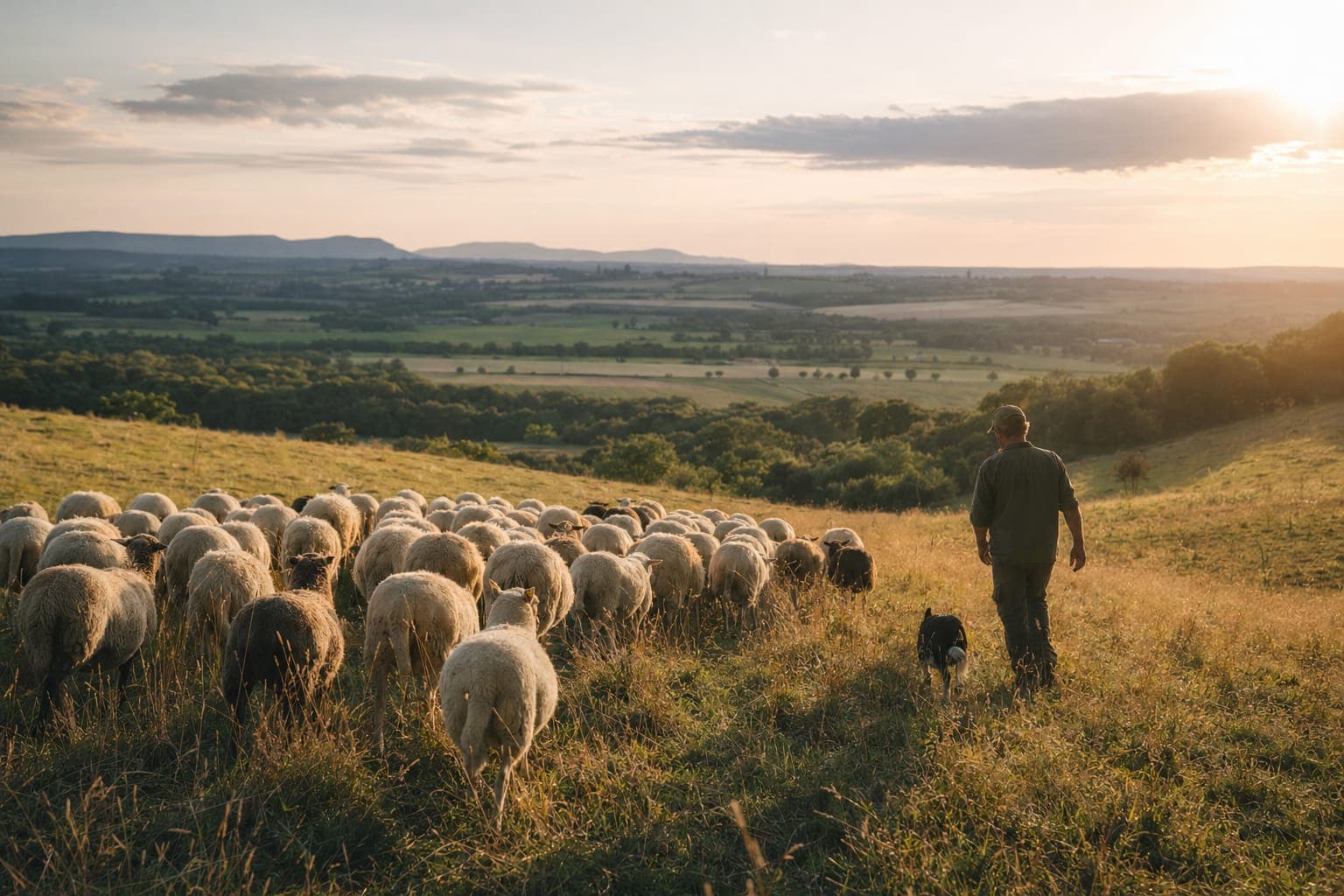
Can Regenerative Agriculture Feed the World?
Explores whether regenerative farming can scale to feed global populations. Examines yield data, Savory Institute research, and White Oak Pastures case study.
Farming
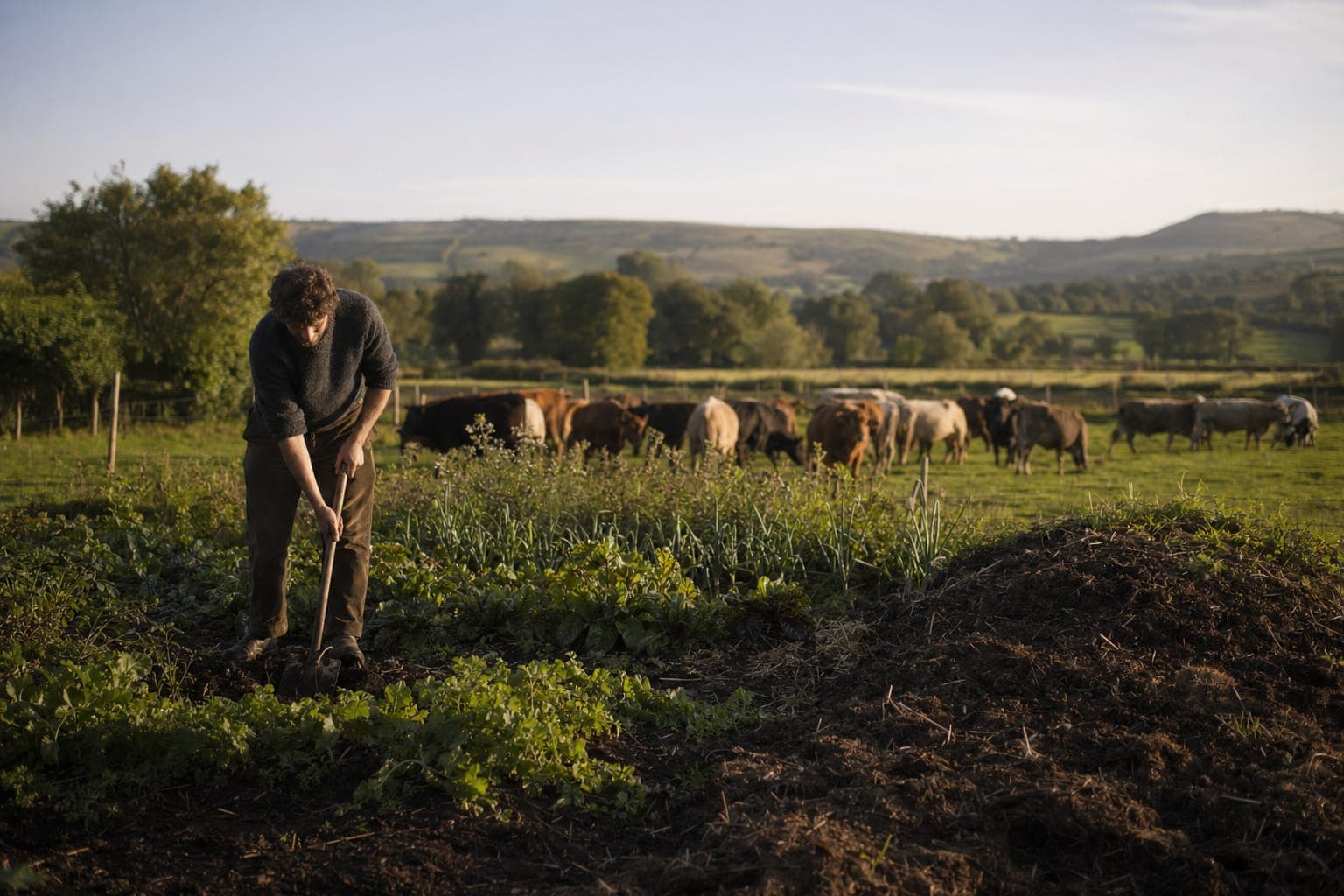
The Difference Between Organic and Regenerative Farming
Understand organic vs regenerative farming clearly. Organic excludes chemicals while regenerative rebuilds soil health. See where they overlap and differ.
Farming
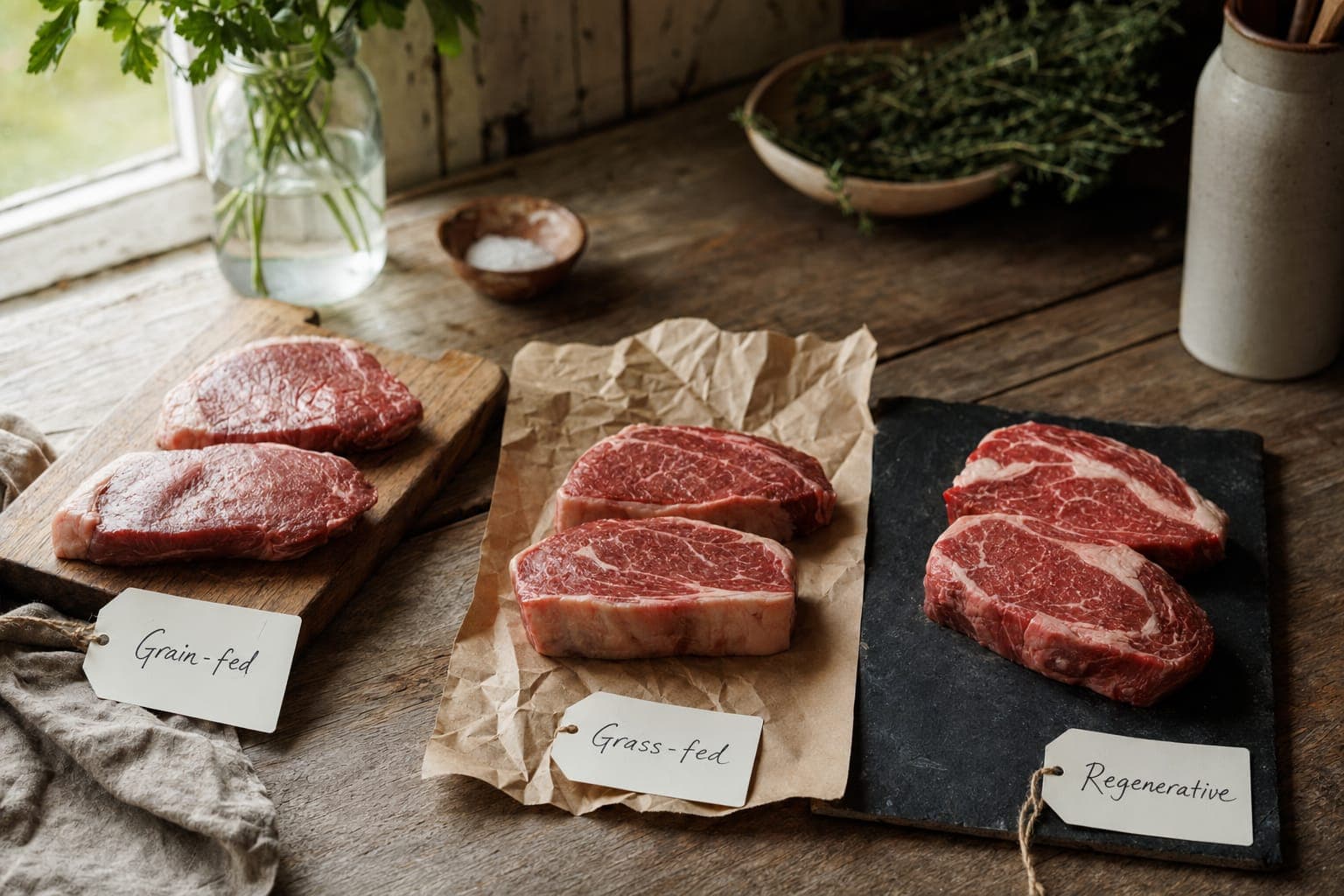
The Truth About Beef: Grain-Fed vs Grass-Fed vs Regenerative
Compare grass-fed vs grain-fed and regenerative beef on nutrition, welfare and environment. See how CLA, omega ratios and vitamins shift with how cattle live.
Real food, made effortless
Shop the blendA few ways to use it
All recipes
Organised Chia Pudding with Raw Honey and Berries
A no-cook chia seed pudding made with raw milk, collagen, berries, and raw honey. Prep it the night before and eat for breakfast.

Raw Milk Ice Cream with Organised
Make raw milk ice cream at home with Organised for a seasonal, nutrient-dense treat. Three simple flavours to try whenever the craving strikes.

Raw Milk Hot Chocolate with Collagen
A nourishing evening hot chocolate made with raw milk, grass-fed collagen, raw cacao, and honey. A nighttime ritual that supports sleep and gut health.


 Join over 100,000+ members
Build a better food system with us
The Organised community is thousands of people choosing real food and backing the farmers who grow it, all of us trying to leave the world a little better than we found it. If that is what you care about too, you belong here.