Why We Partner with Regenerative Farms
Most supplement brands buy their ingredients through middlemen. A distributor buys from a processor who bought from a farm nobody's met. The supply chain is a black box. We did something different.
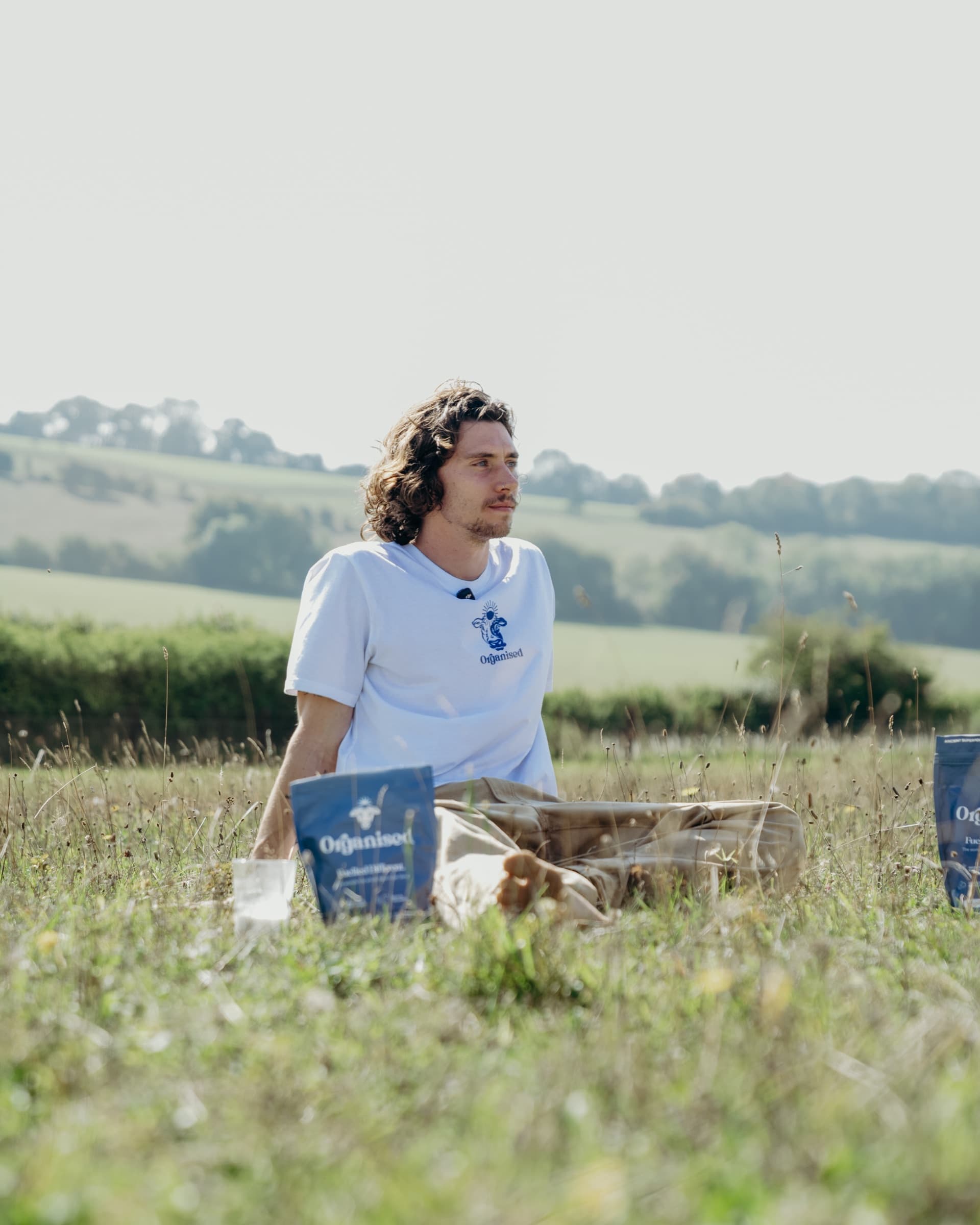
By Niall Kiddle, Founder, Organised

Reviewed by Pedro Rodrigues, Agronomist (farming and sourcing only) ·
6 min read · Published · Updated · 2 cited sources
Makers of the Organised Daily blend, a grass-fed beef organ supplement from regenerative UK farms
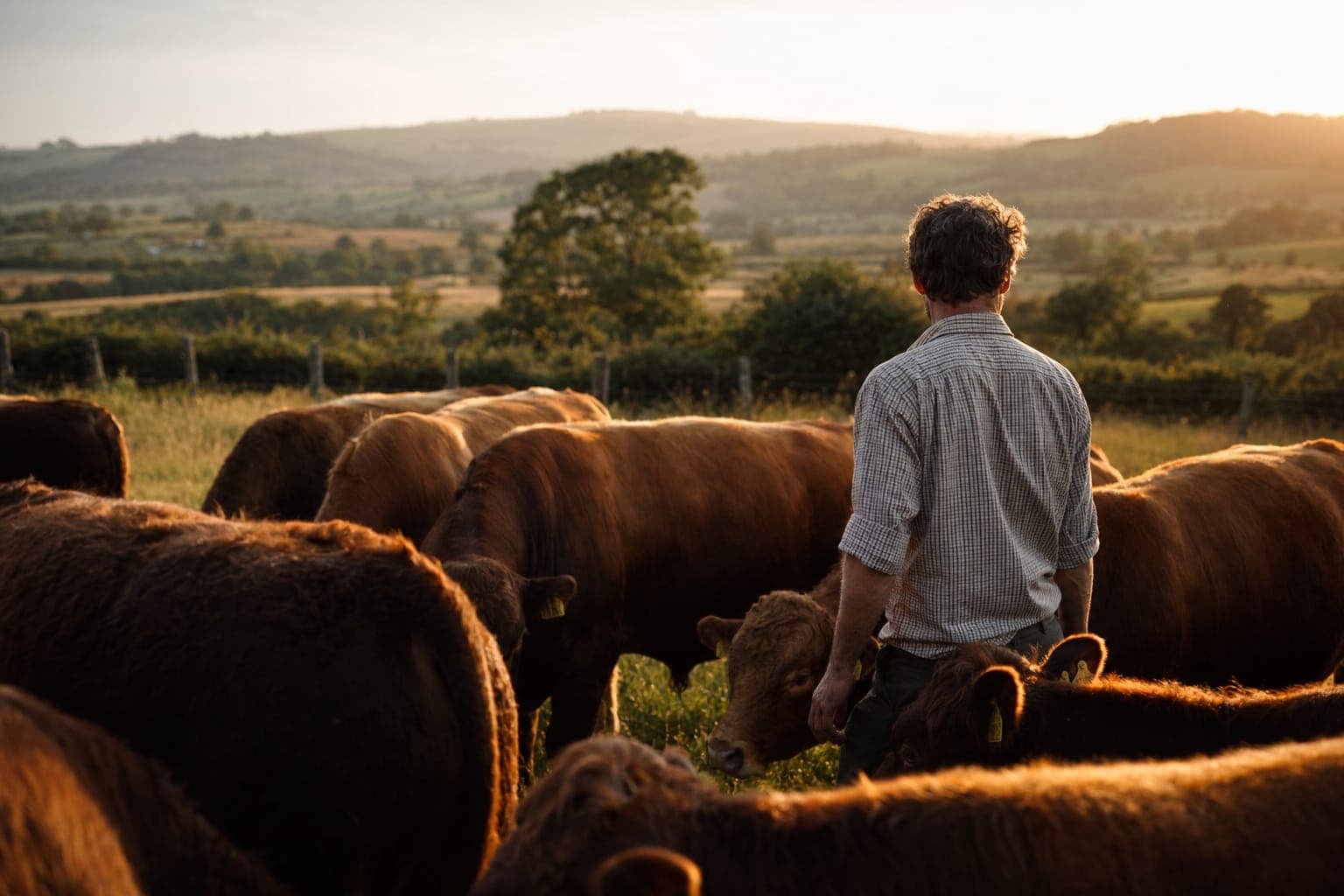
We work directly with regenerative farms. Not because it's a marketing angle (though it doesn't hurt). Because the animals raised on these farms produce organs and tissue with a nutritional profile that genuinely outperforms the alternative.
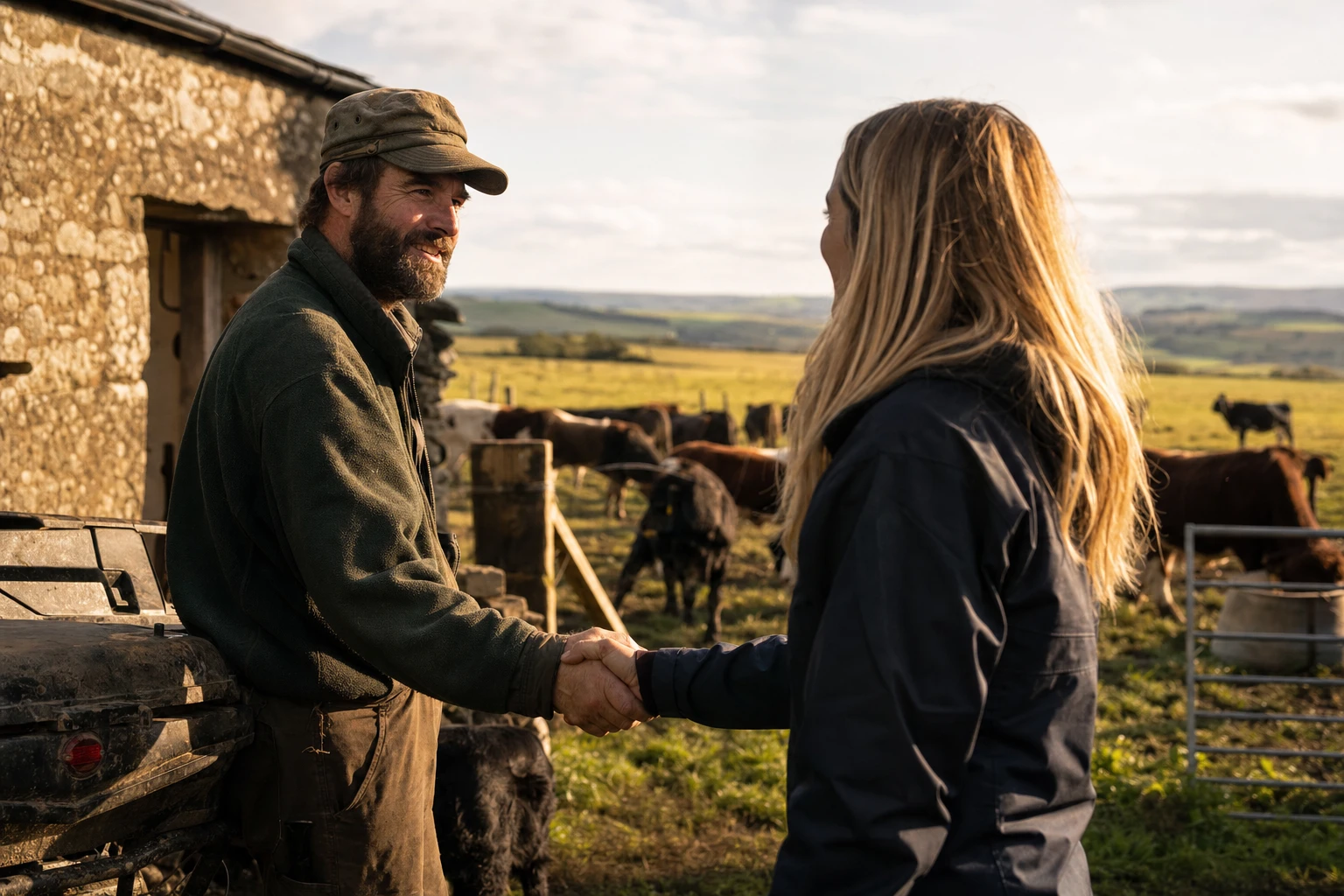
How most supplements are sourced
The standard model: a supplement brand has a product specification. They send it to a supplier who sources the ingredients to that spec, does basic testing, and delivers. The brand doesn't know the farm. Doesn't know the practices. Doesn't know if the animal was well-treated or raised on monoculture pasture sprayed with pesticides.
Cost is the driver. A distributor can buy grass-fed organ powder cheaper from a farm practicing minimal grazing management than from one building soil and diversity. The end product looks identical on a label. The nutrient density is very different.
Most brands accept this trade-off. It keeps costs down and margins up. The customer sees grass-fed and assumes all grass-fed is equal.
A supply chain is only as good as the person asking the hard questions at the beginning.
We ask those questions.
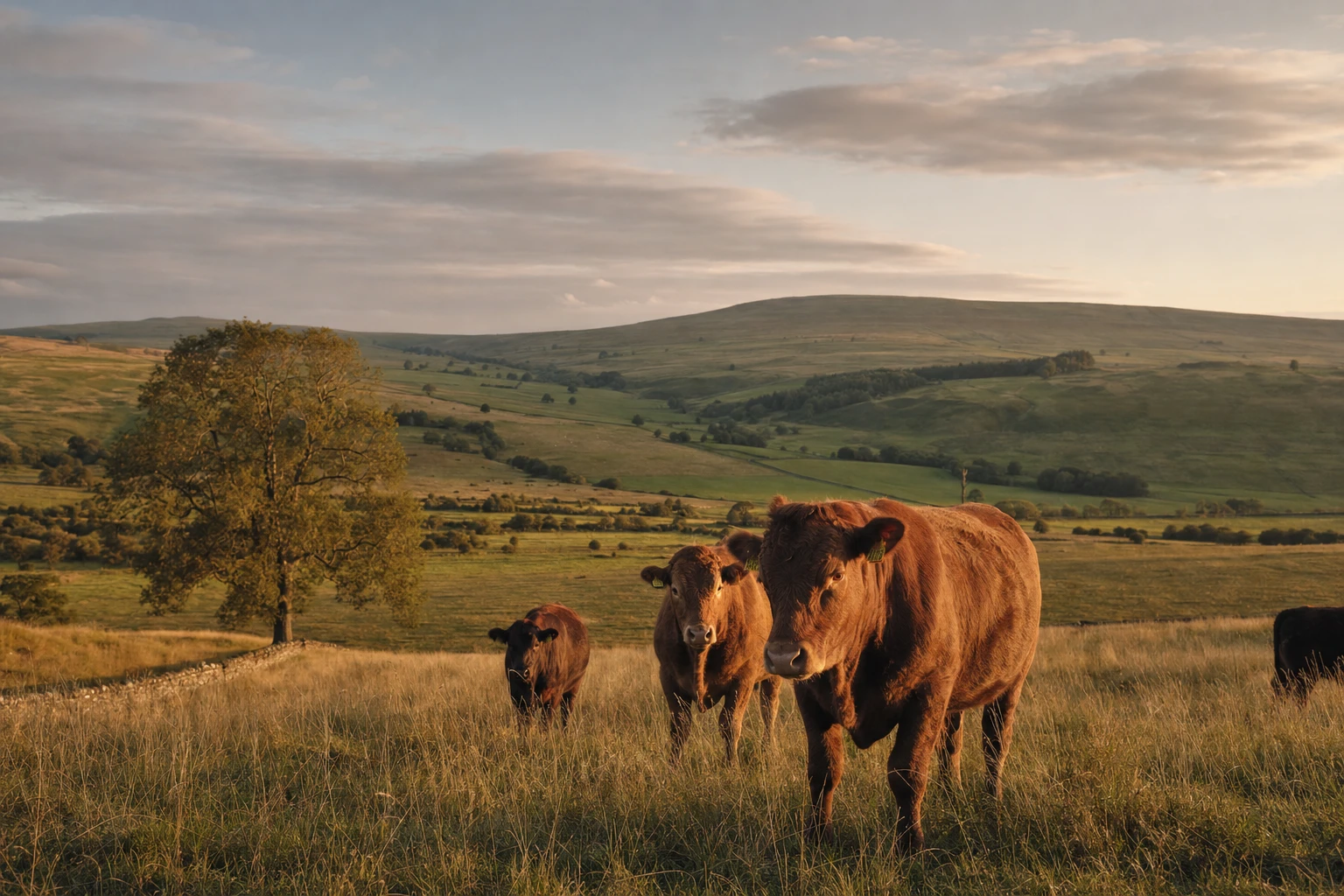
Why regenerative farming matters for our products
An organ is a concentration of whatever the animal ate. If the animal grazed on monoculture grass with low mineral density, the organs reflect that deficit. If it ate on regenerative pasture with dozens of plant species, mineral-rich deep-rooted plants, and soil biology supporting nutrient uptake, the organs reflect abundance.
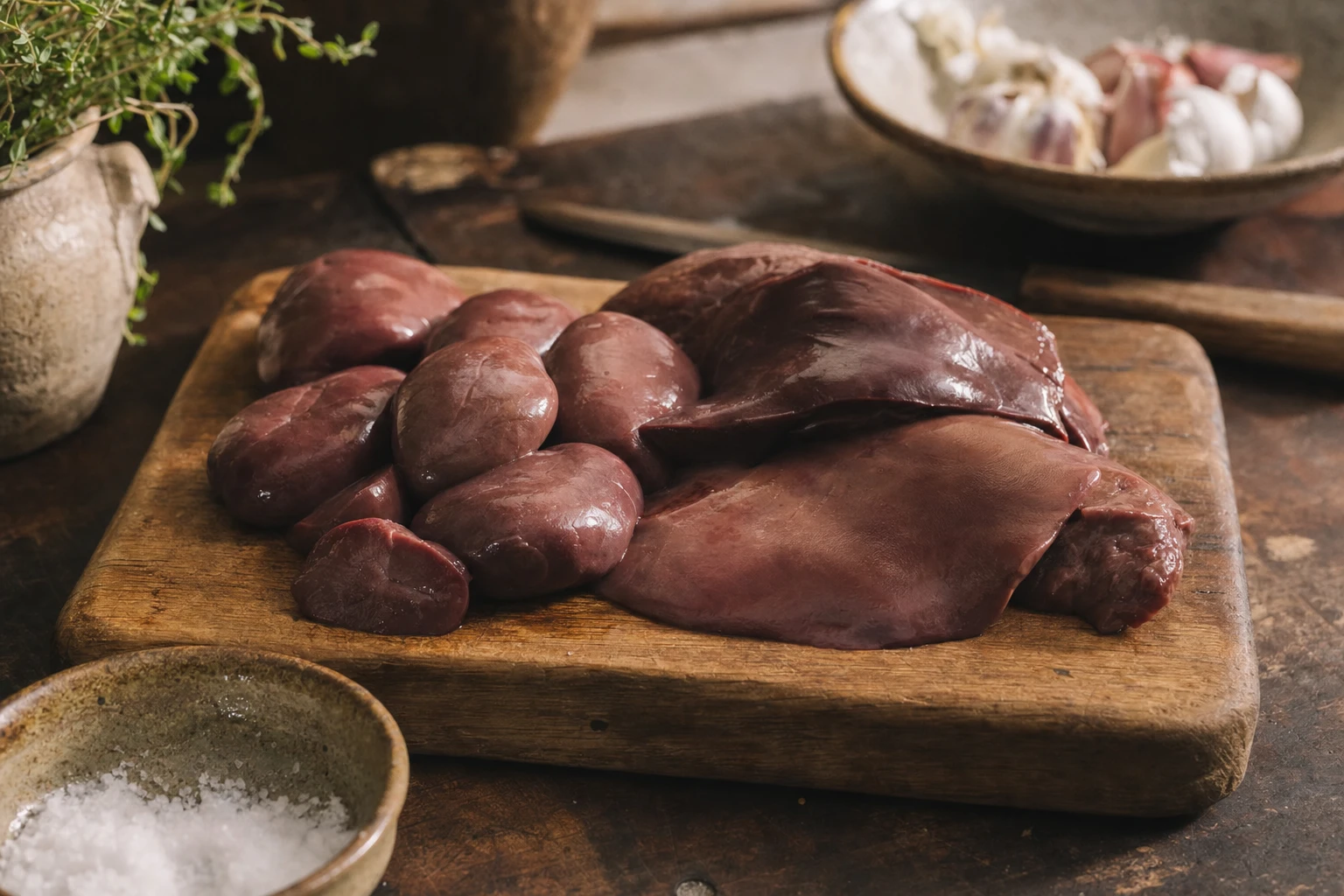
Liver from a regeneratively-raised animal has higher levels of selenium, copper, zinc, and iron simply because the animal ate a more mineral-rich diet. Heart muscle tissue has a better balance of fatty acids.1 Kidney tissue has more vitamin D and fat-soluble vitamins.
We chose regenerative farms because our customers are taking these organs to fill nutritional gaps. It would make no sense to fill a gap with tissue that's already mineral-depleted. We source from farms where the animal was actually well-fed.
The quality of the animal is the quality of the product. There's no shortcut around this.
Regenerative farms also practise lower antibiotic use (many use none). They breed for health. They handle animals in ways that keep stress hormones low. The tissue quality reflects an animal that lived well.
Our selection criteria for farm partners
We don't work with every regenerative farm. We're specific.
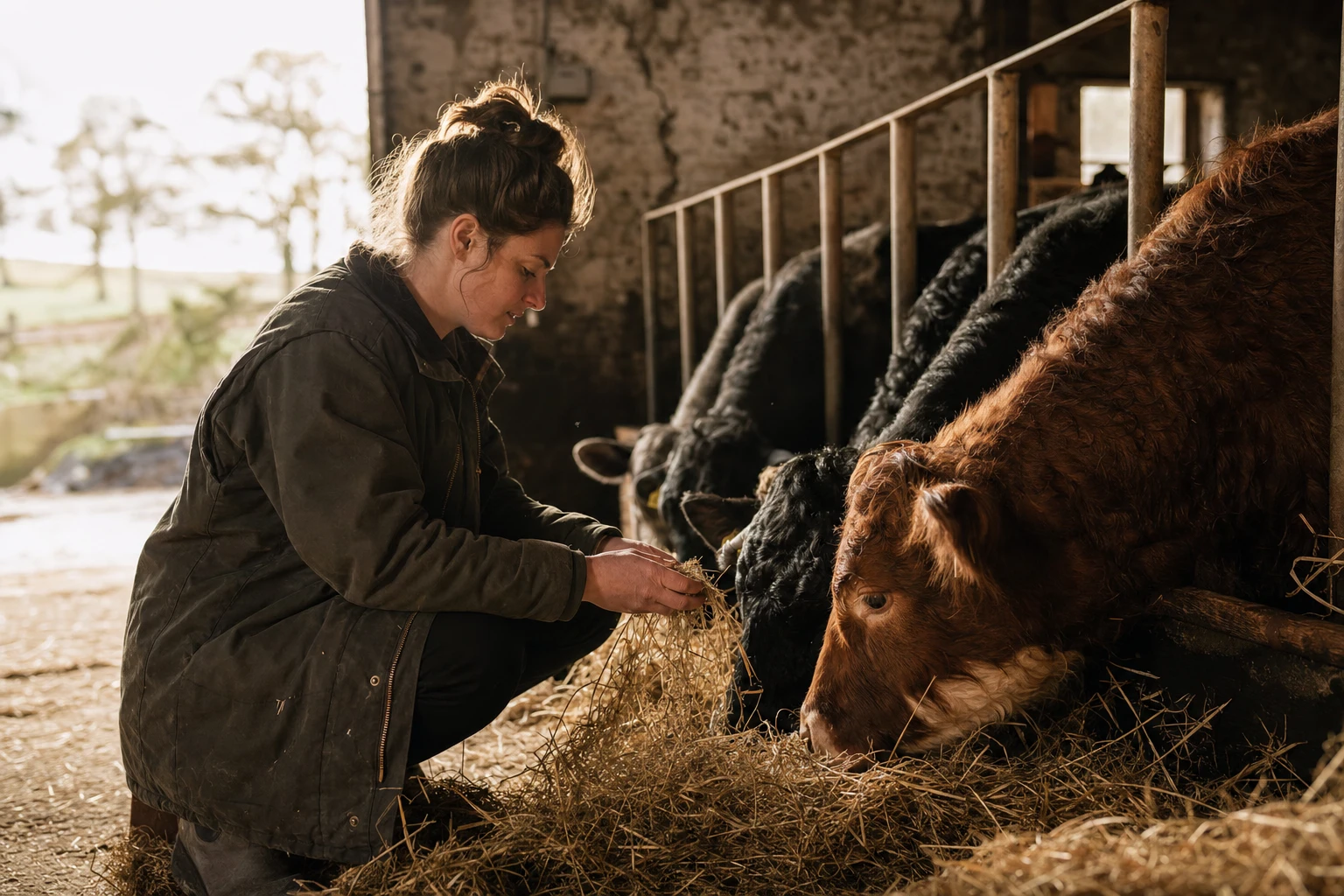
First: rotational grazing with proper rest periods. The farm moves cattle in high-density herds and allows recovery time. This isn't negotiable. It's the core of regenerative practice.
Second: soil testing and improvement trajectory. We ask to see soil carbon measurements over time. Are they trending up? Most regenerative farms have this data. The ones who don't aren't actually regenerative, they're just grass-feeding on static pasture.2
Third: animal welfare practices we can verify. No growth promoters. Minimal antibiotics (ideally zero, but we're pragmatic). Calves stay with mothers longer than in conventional systems. Animals are handled quietly. Breeding is for health.
Fourth: transparency about inputs. What are they feeding in winter? Are they using synthetic supplements? What's the forage quality during off-season? Some farms are genuinely regenerative year-round. Others cut corners in winter. We want to know.
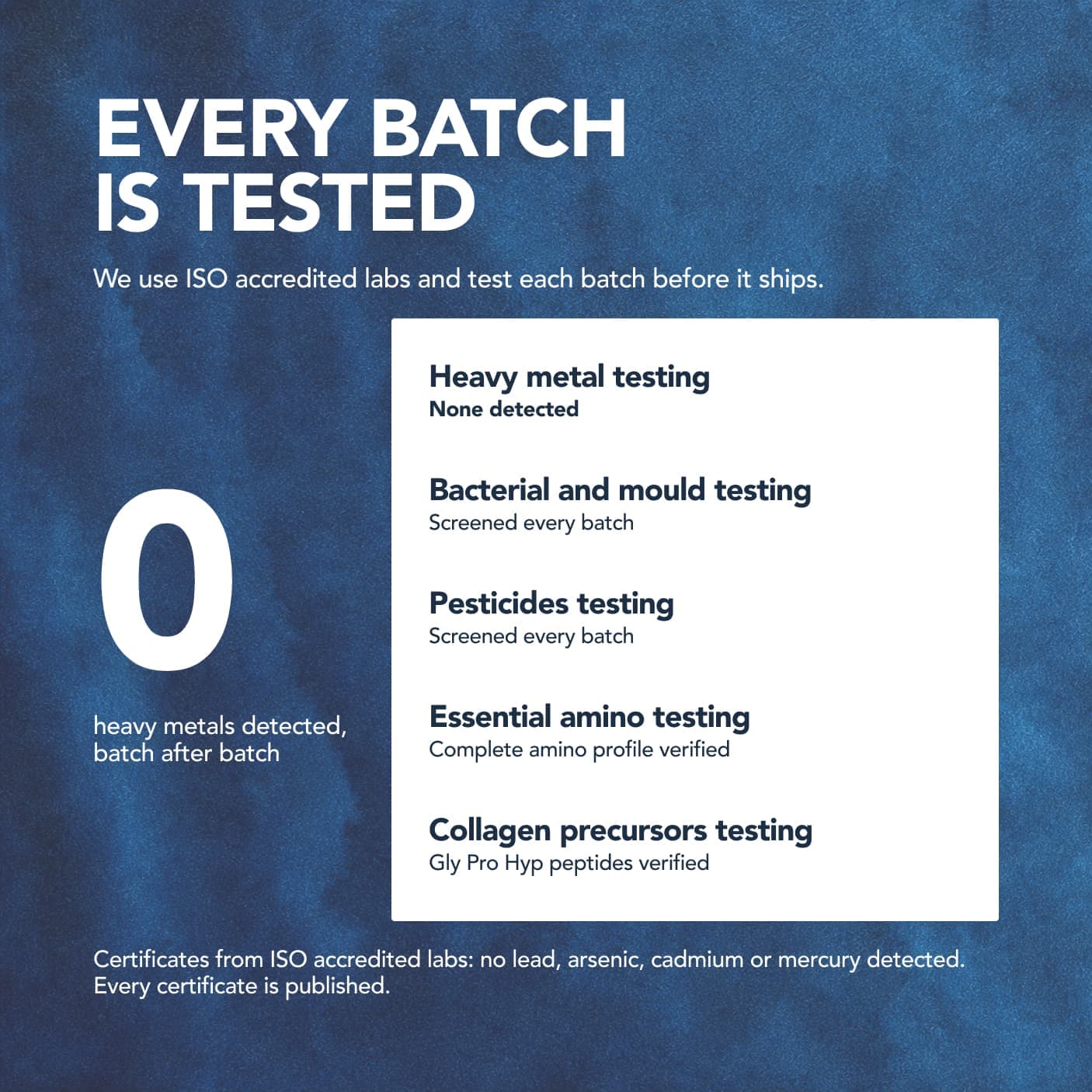
Fifth: they have to agree to supply testing on batch samples. We do heavy metals screening, amino acid verification, and bacterial testing. If a farm won't allow this, we don't work with them.
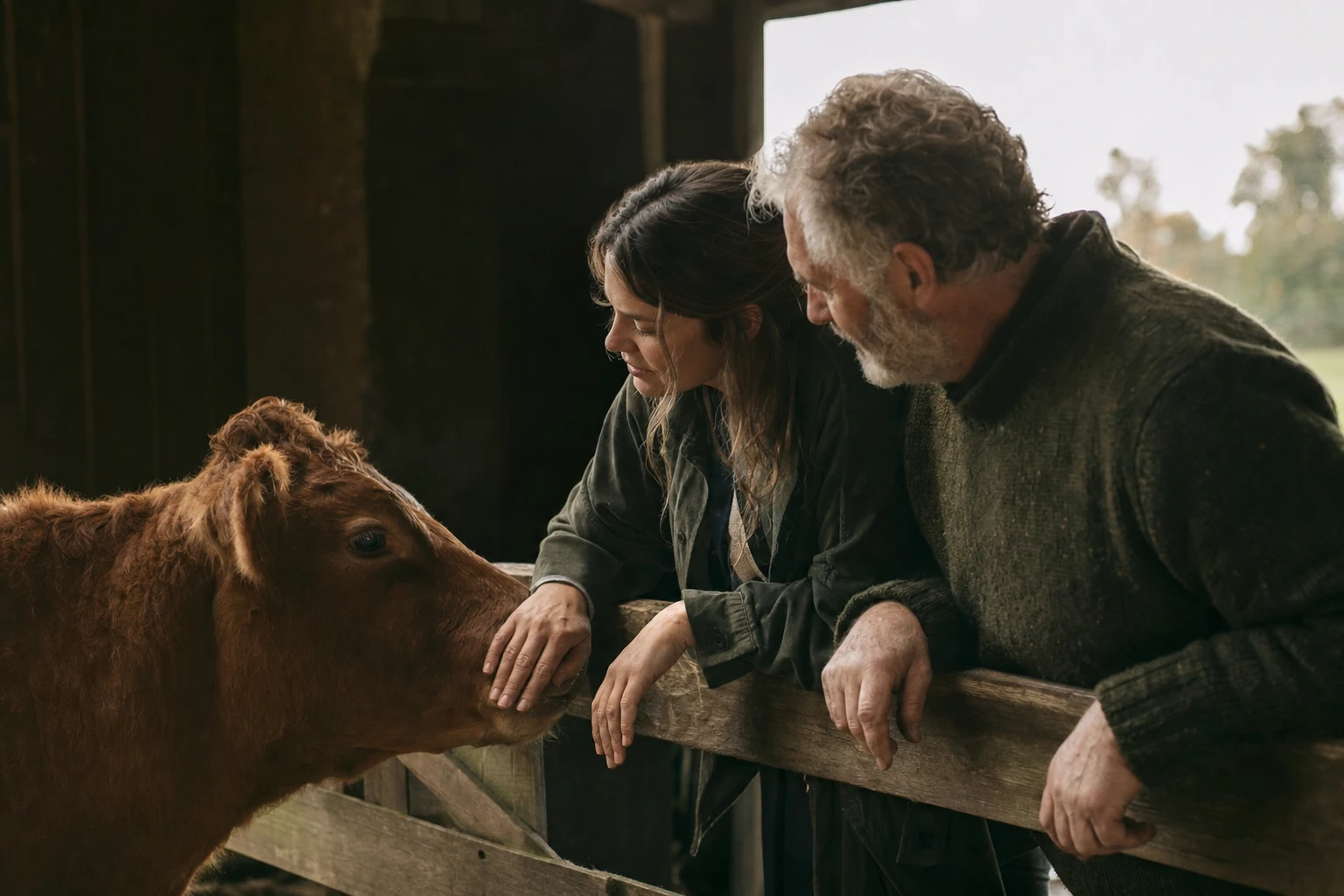
Partnership means you're willing to be questioned. If a farm balks at testing or transparency, that tells us something.
Traceability and testing
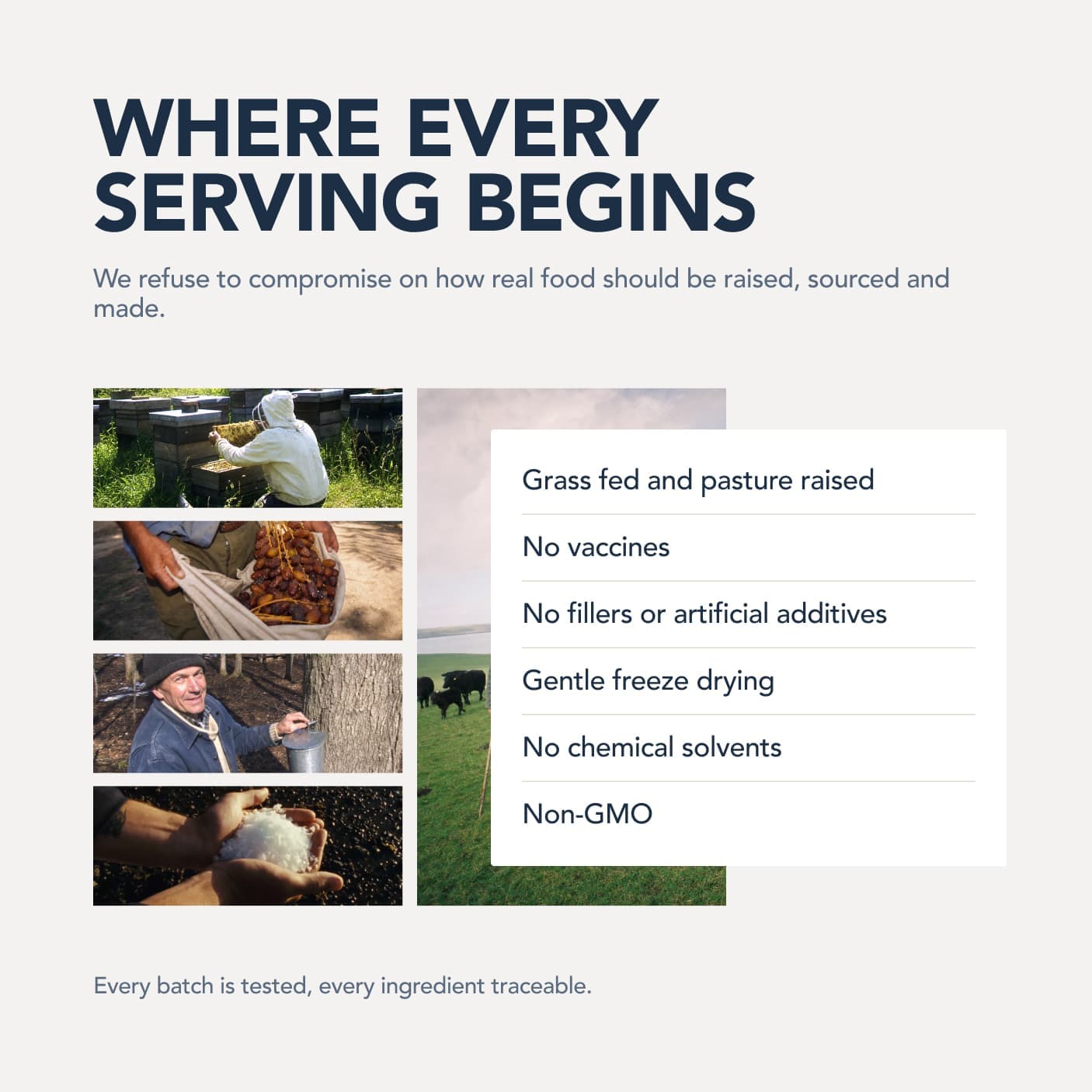
Every batch of organs we process is traceable back to specific farms. We know which paddocks the cattle grazed. We have the grazing records. When we freeze-dry, each batch is tested for heavy metals, bacterial contamination, and amino acid profile.
This is expensive. It slows down production. It means we occasionally have to reject batches that don't meet our standard. Most supplement companies don't do this because it eats into margins.
We do it because if you're buying our products to fill nutritional gaps, you deserve to know exactly what you're getting and where it came from.
Every batch has a provenance. You could trace your pouch back to the farm and the paddock if you wanted to. Most customers don't care. The ones who do can.
Get farming and sourcing guides, free
Two short reads a week on regenerative farming and where real food comes from.
By signing up you agree to receive emails from us. No spam, unsubscribe anytime.
What this means for you
When you buy Organised, you're buying organs from animals that ate exceptionally well. The nutritional density is genuinely higher than equivalents from commodity sourcing.
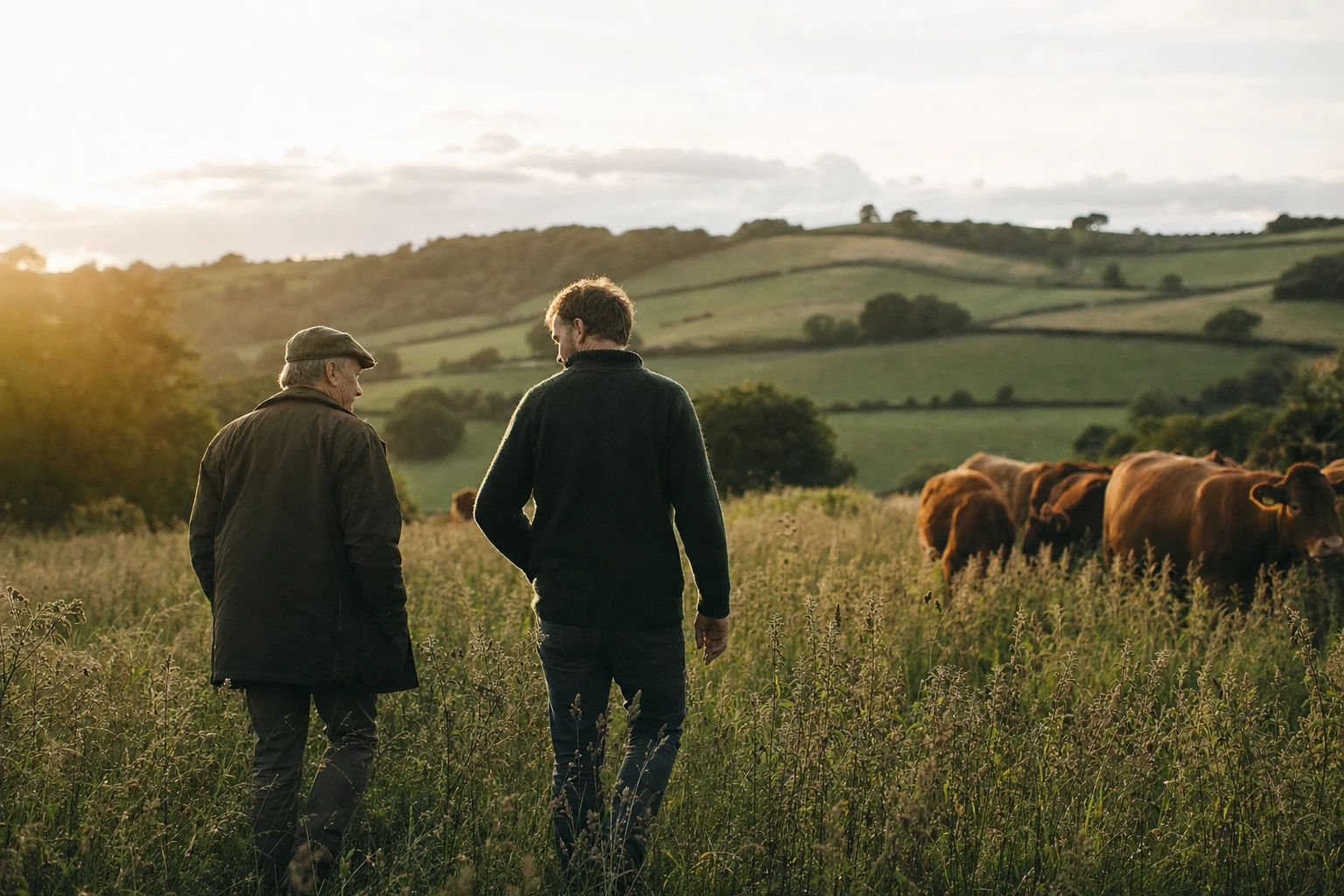
You're also supporting farming practices that heal land instead of strip it. Every animal we process means another paddock in the West Country or Scottish Highlands is building soil carbon instead of depleting it.
And you're buying from a company that's willing to be transparent about where things came from. If you want to know which farm, which paddock, which season, you can ask. We'll tell you.
Good sourcing isn't a selling point. It's the bare minimum. We just happen to think you deserve the minimum.
This is why we've stayed small and grown slowly. We could cut costs, expand faster, and hit bigger margins by sourcing conventionally. We haven't, because the moment we do, we stop being Organised in the way that matters.
1 of 9
Daily blend
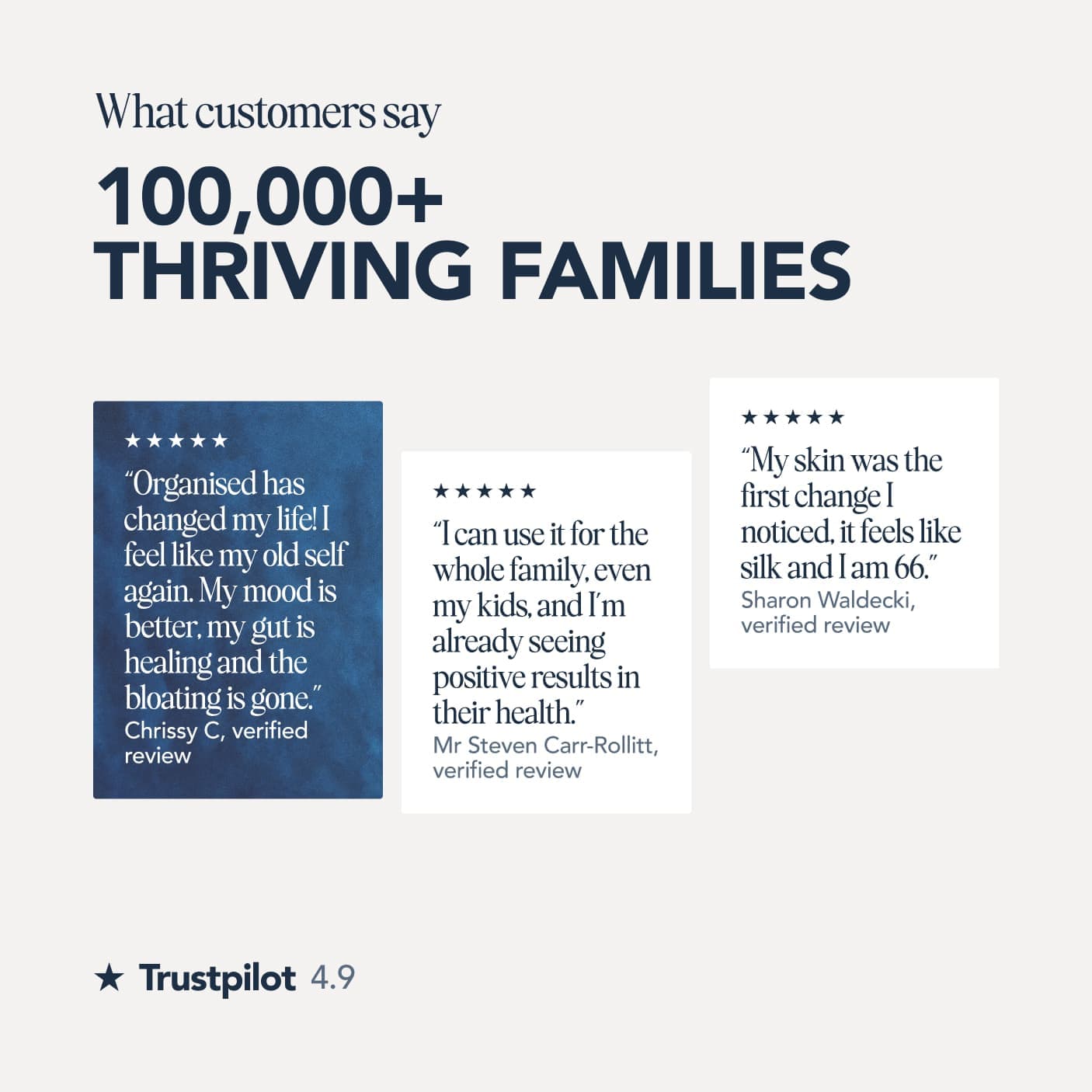
100,000+ thriving families4.9 on Trustpilot
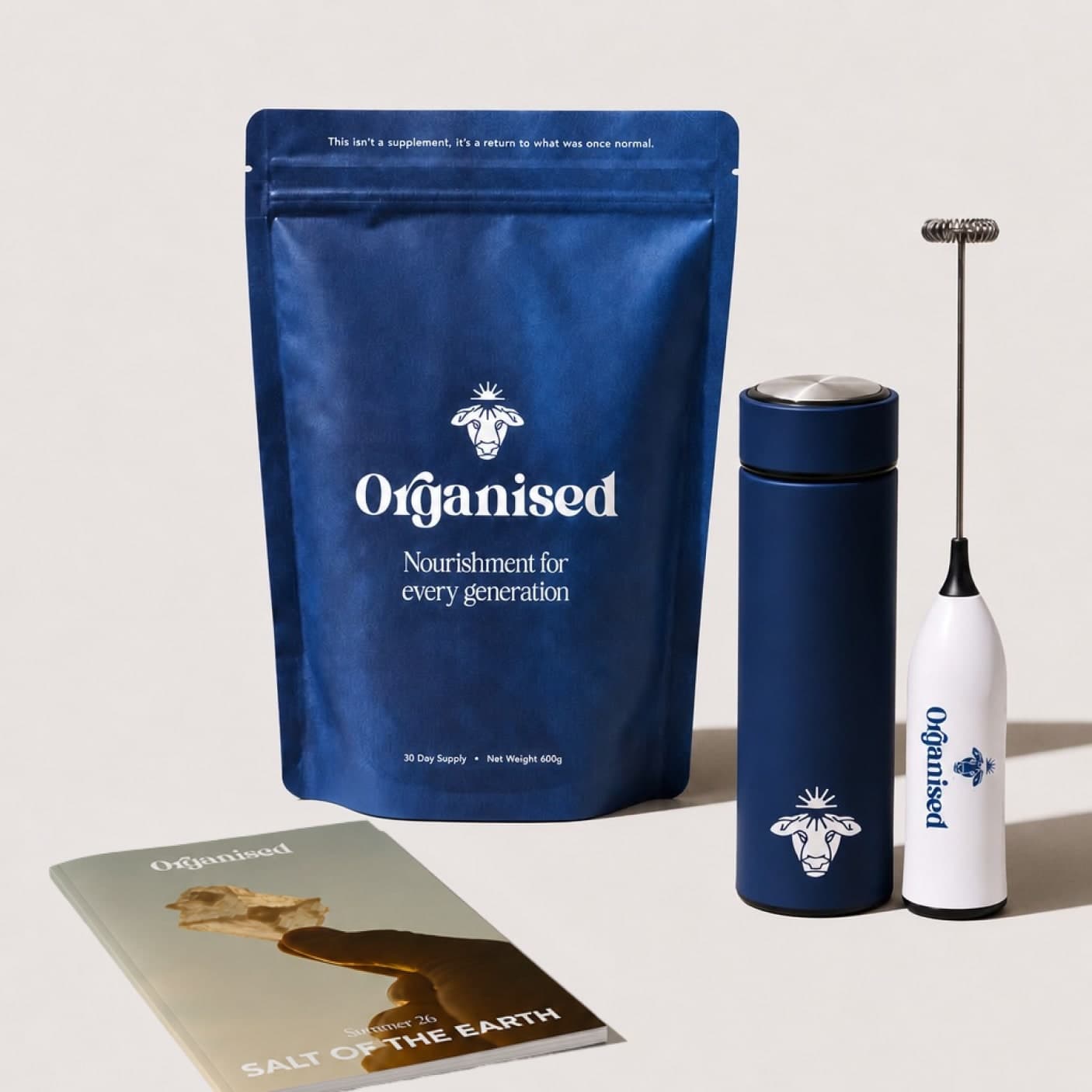
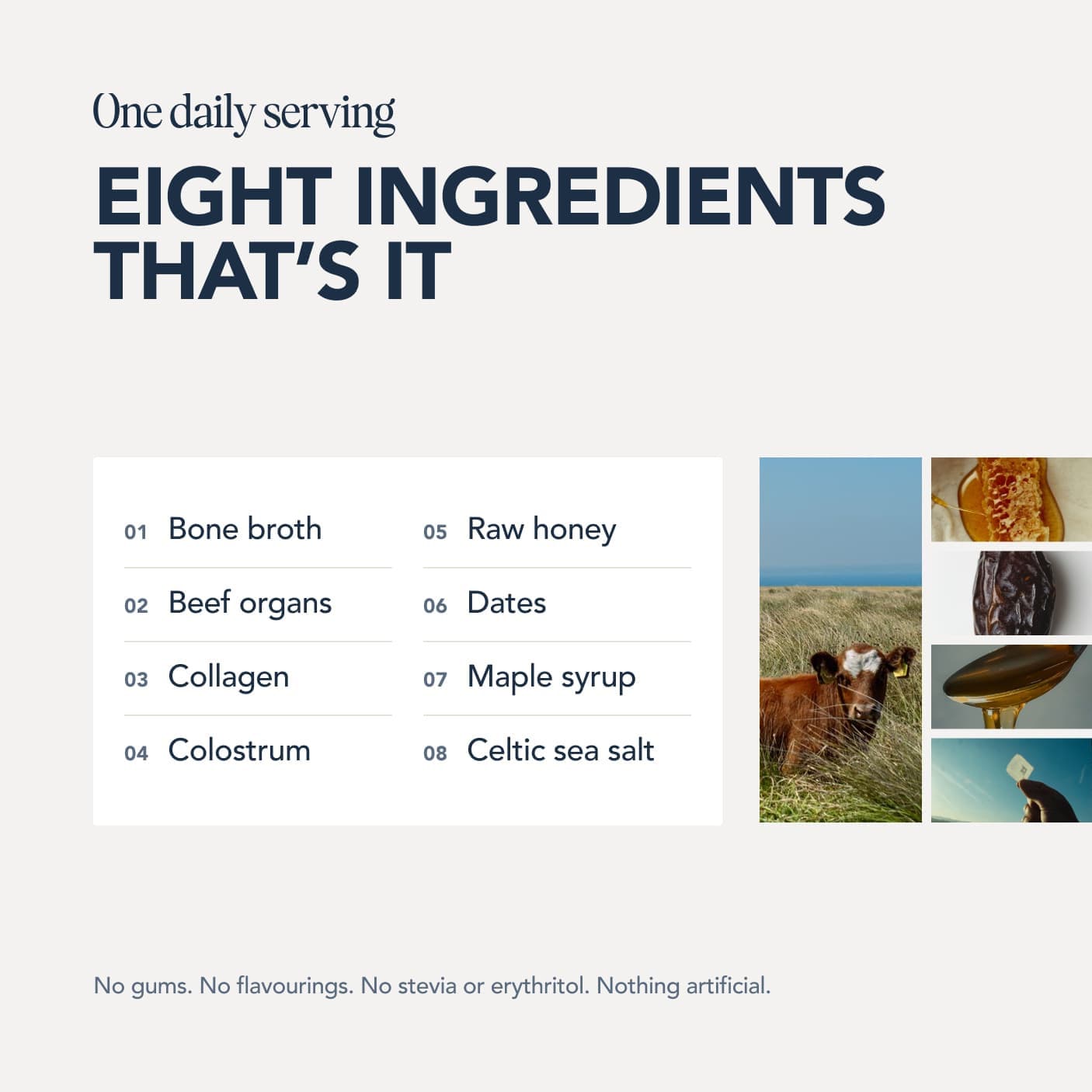
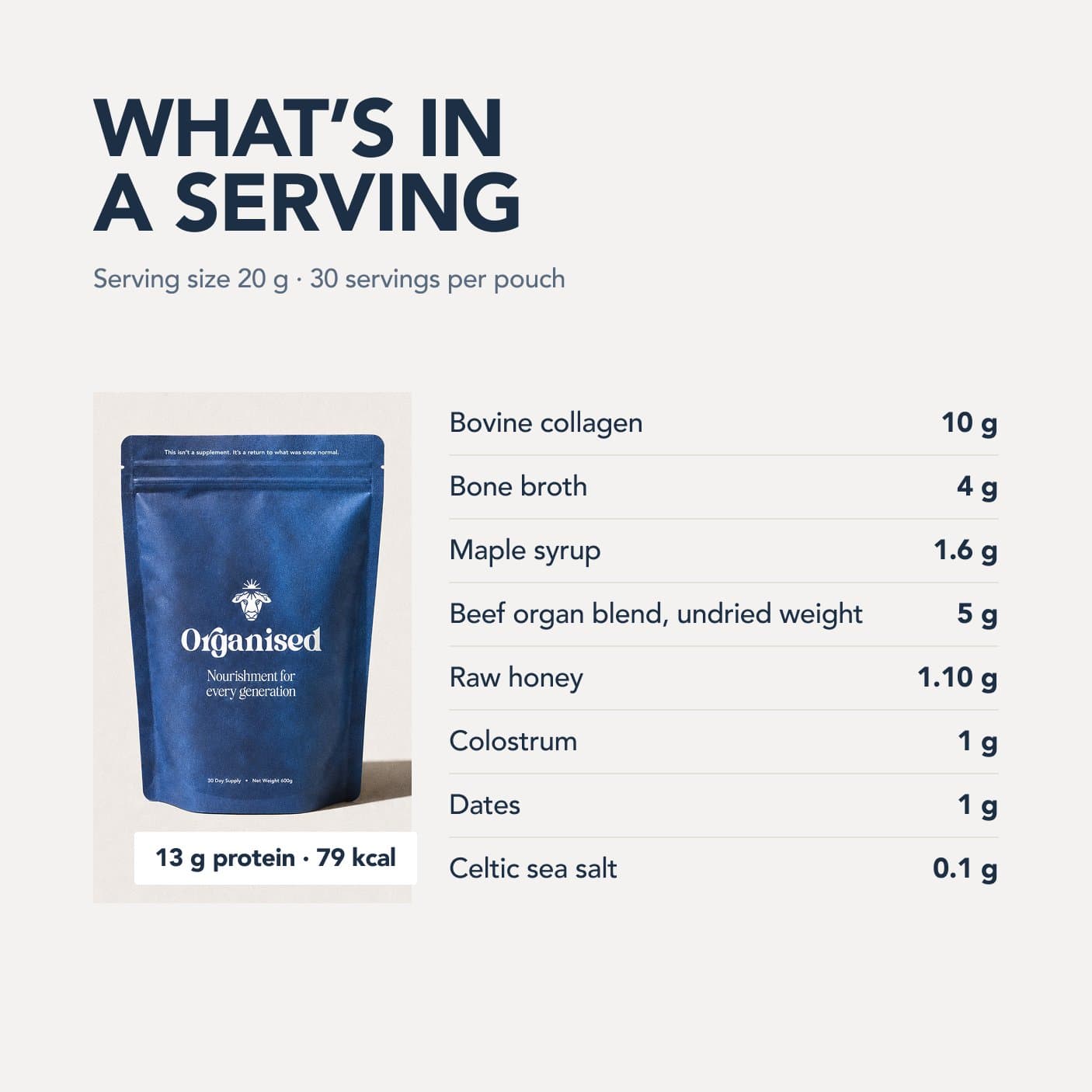
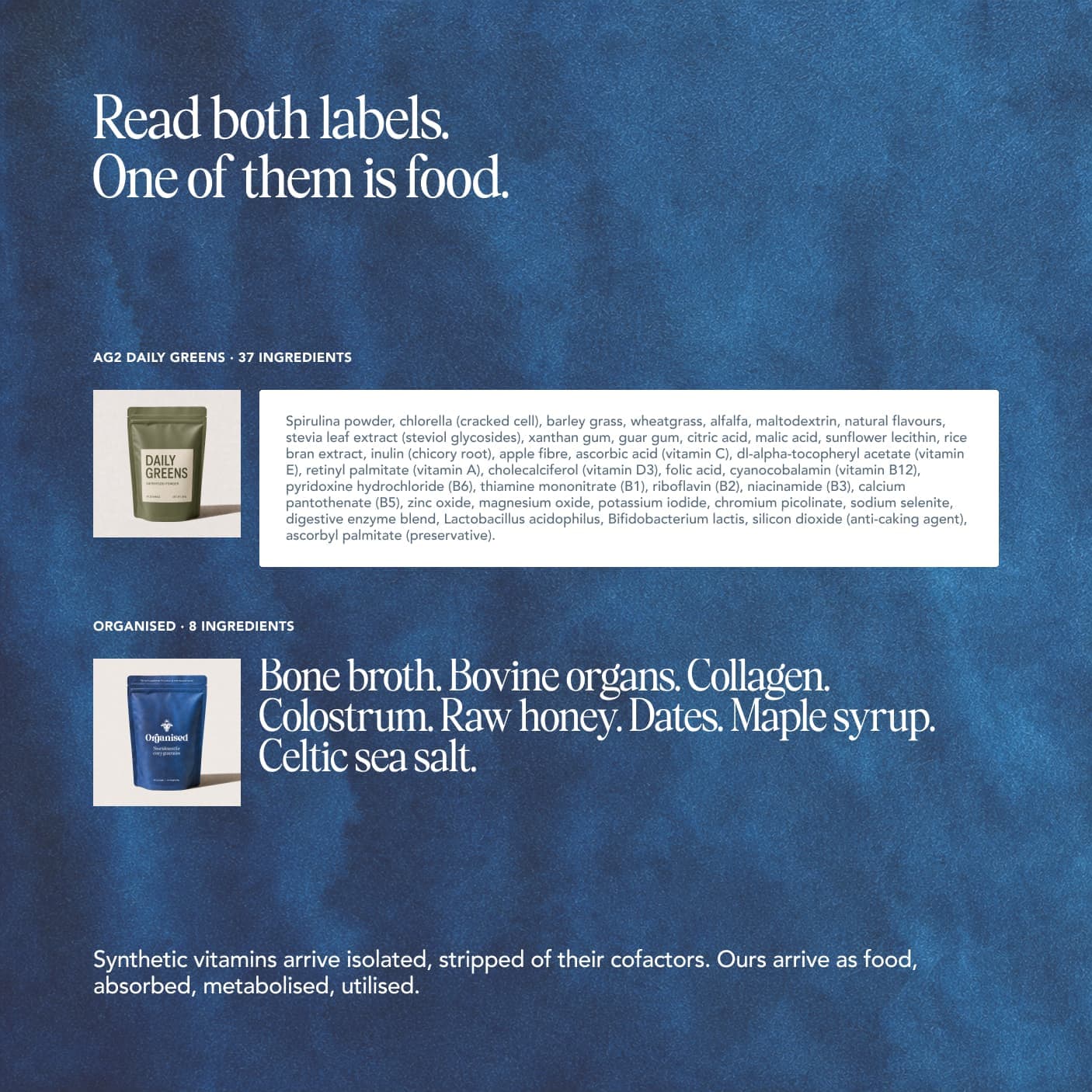
Eight real ingredients built around grass-fed beef organs, collagen and colostrum. Nothing synthetic added.
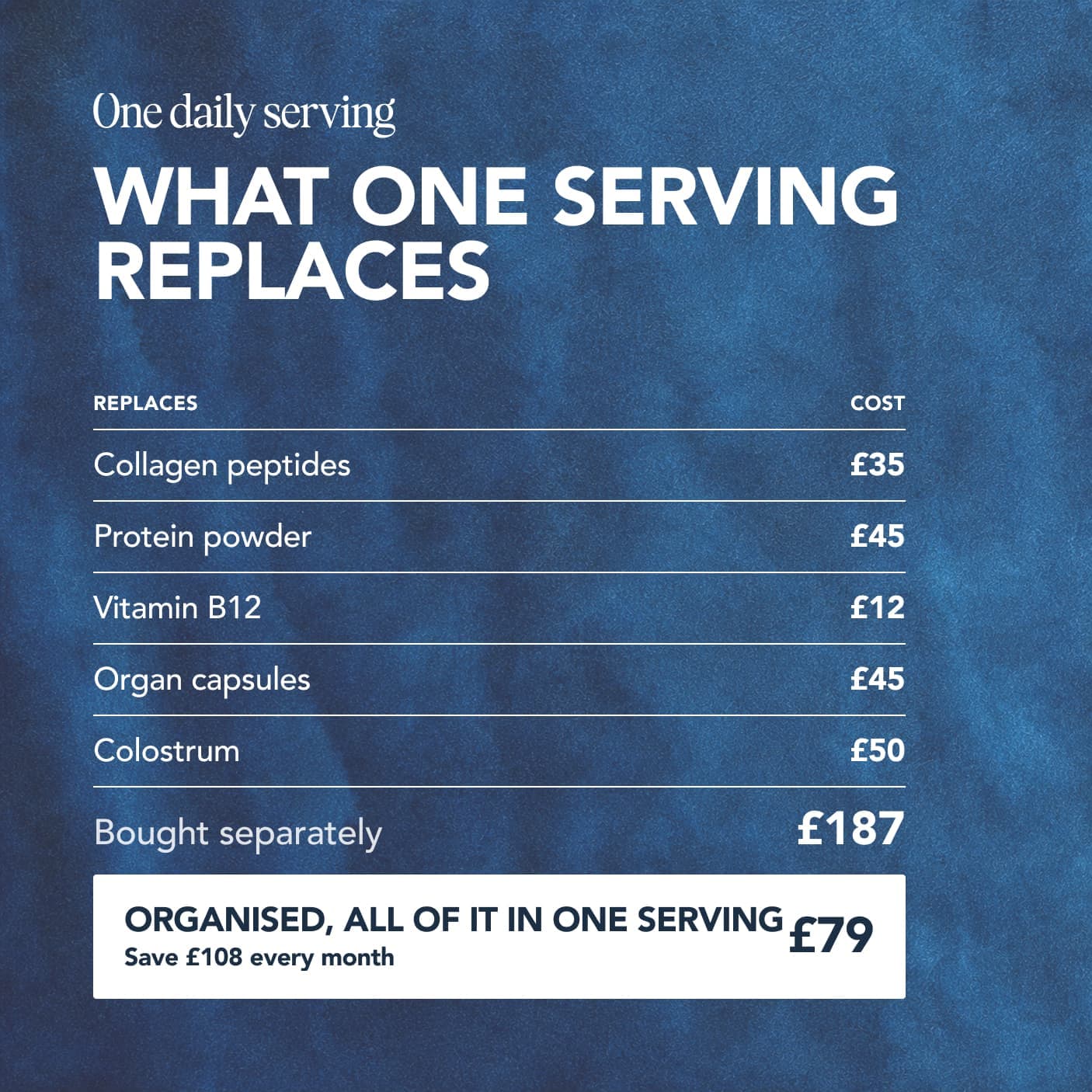
Free with your first order, worth £38. Plus £10 off the pouch with a subscription.
Free UK shipping · Made in England · 100 day money back guarantee on your first pouch · Skip, pause or cancel anytime
The cost of being specific about sourcing
This level of specificity costs. It costs us time, testing, and sometimes lost supply when a farm doesn't meet our standard in a given season. It costs the farms money to participate in this kind of transparency and testing. It costs the customer money at the till.
We could reduce costs dramatically by sourcing commoditised grass-fed organ powder from a distributor with no traceability. We'd lose maybe 30-50% of our costs. We'd lose the ability to tell you where it came from. We'd lose the confidence that the animals were actually well-fed and well-treated.
We've chosen not to do this, even though it would make us more profitable and grow faster. This is a genuine constraint we've accepted. Every choice to stay small and specific is a choice to leave money on the table.
Traceability and transparency are luxuries. Not every brand is willing to pay for them. We are.
Why regenerative is worth the investment
Some farms produce acceptable food cheaply. Some farms produce excellent food expensively. Regenerative farms do both: they produce excellent food whilst simultaneously improving the land asset they depend on. This is unusual enough to be worth paying for.
Most food production extracts: it takes from the land and returns nothing. Regenerative production invests: it takes from the land but leaves it better than it found it. Over time, this compounds. A regenerative farm improves year by year. A conventional farm depletes year by year.
For us, this matters because we believe the future of food depends on land improvement, not land depletion. Partnering with regenerative farms is not just sourcing. It is betting on a future where food comes from healthy land, not degraded land.
We partner with regenerative farms because they are building something that lasts. That matters more than margins.
The bottom line
Our farm partnerships aren't a marketing story. They're the foundation of the product. We chose regenerative farms because they produce better animals. Better animals produce better organs. Better organs are worth taking.
If you want to know more about where your pouch comes from, ask. We like the question.
References
Every source below was checked on 27 August 2026. Each PubMed, PMC and DOI identifier was resolved against NCBI or Crossref, and what it opens is printed under the citation, so you can see the link goes where the citation says without leaving the page. Where a citation and its identifier disagreed, the citation was corrected to the record or the reference was deleted along with the sentence marker that pointed at it, and where the resolved paper turned out not to support the sentence, the sentence was cut back to what it does support. Borrowed authority is worse than none, because it looks like rigour.
- Daley CA, Abbott A, Doyle PS, Nader GA, Larson S. A review of fatty acid profiles and antioxidant content in grass-fed and grain-fed beef. Nutrition Journal. 2010;9:10. https://pmc.ncbi.nlm.nih.gov/articles/PMC2846864/Checked 27 August 2026: PMC2846864 opens Daley CA, Abbott A, Doyle PS et al, A review of fatty acid profiles and antioxidant content in grass-fed and grain-fed beef. Nutr J 2010;9:10. PubMed indexes it as: Review.
- Teague WR, Apfelbaum S, Lal R, et al. The role of ruminants in reducing agriculture's carbon footprint in North America. Journal of Soil and Water Conservation. 2016;71(2):156-164. https://www.jswconline.org/content/71/2/156
Who wrote and reviewed this guide
Niall Kiddle
Author · Founder, Organised
Niall is the founder of Organised. He started the company in 2024 after fixing his own health the slow way: in 2022 he swapped a cupboard of synthetic supplements for real food, raw milk, organ meats, bone broth and honey, and felt the difference within months.
Areas of expertise: Ancestral nutrition, Organ meats, Whole-food supplementation, Gut health, Regenerative sourcing
Read Niall's full profile
Pedro Rodrigues
Reviewer · Agronomist (farming and sourcing only)
Pedro is the agronomist Organised works with on farming and sourcing. His job on the guides is to keep the science honest: he reviews what we publish about soil health, regenerative agriculture, grazing and the way food is actually produced.
Areas of expertise: Regenerative agriculture, Agronomy, Soil health, Grass-fed farming, Food sourcing
Reviewed this guide on
Read Pedro's full profileMore on regenerative farming
View allBrowse the guides library
All guidesKeep reading
Farming
How Organised Is Made: From Farm to Pouch
See how Organised is made, from farm to pouch. We walk through sourcing, freezing, testing, and freeze-drying so you know exactly what you are eating.
Farming
Where to Find Raw Milk: A Guide to Sourcing, Farms and Quality
Finding raw milk can feel like spotting a hidden door in the modern food system. Here is a practical guide to sourcing it, vetting farms and judging quality.
Farming
What Is Regenerative Agriculture? A Complete Guide
What is regenerative agriculture? Explore the five core principles, practices like cover crops and no-till, plus soil health and carbon, all explained simply.
Real food, made effortless
Shop the blendA few ways to use it
All recipes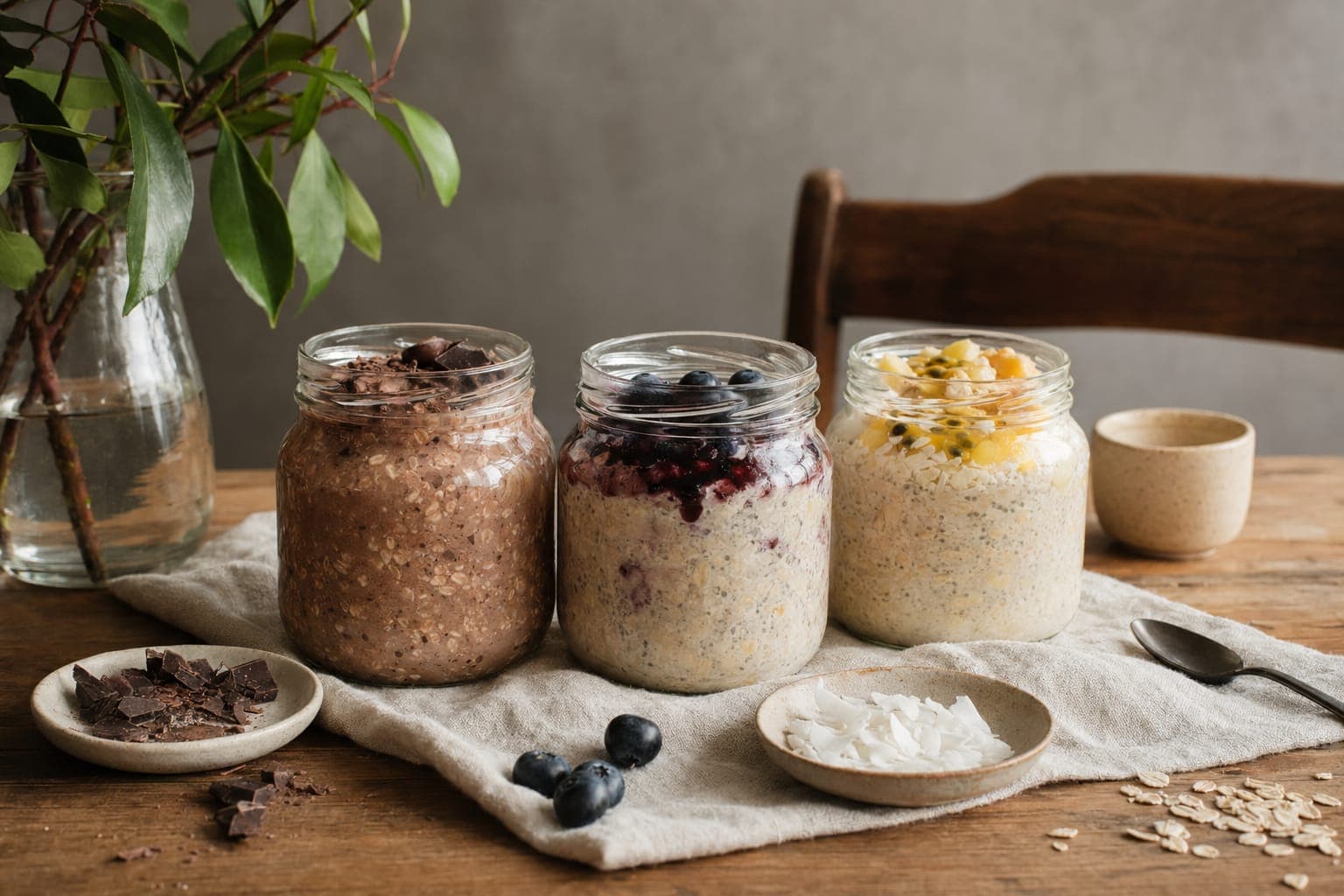
Organised Overnight Oats: 3 Variations
Three delicious overnight oats variations with Organised. Chocolate, berry, tropical flavours. Make them Sunday, eat them all week.
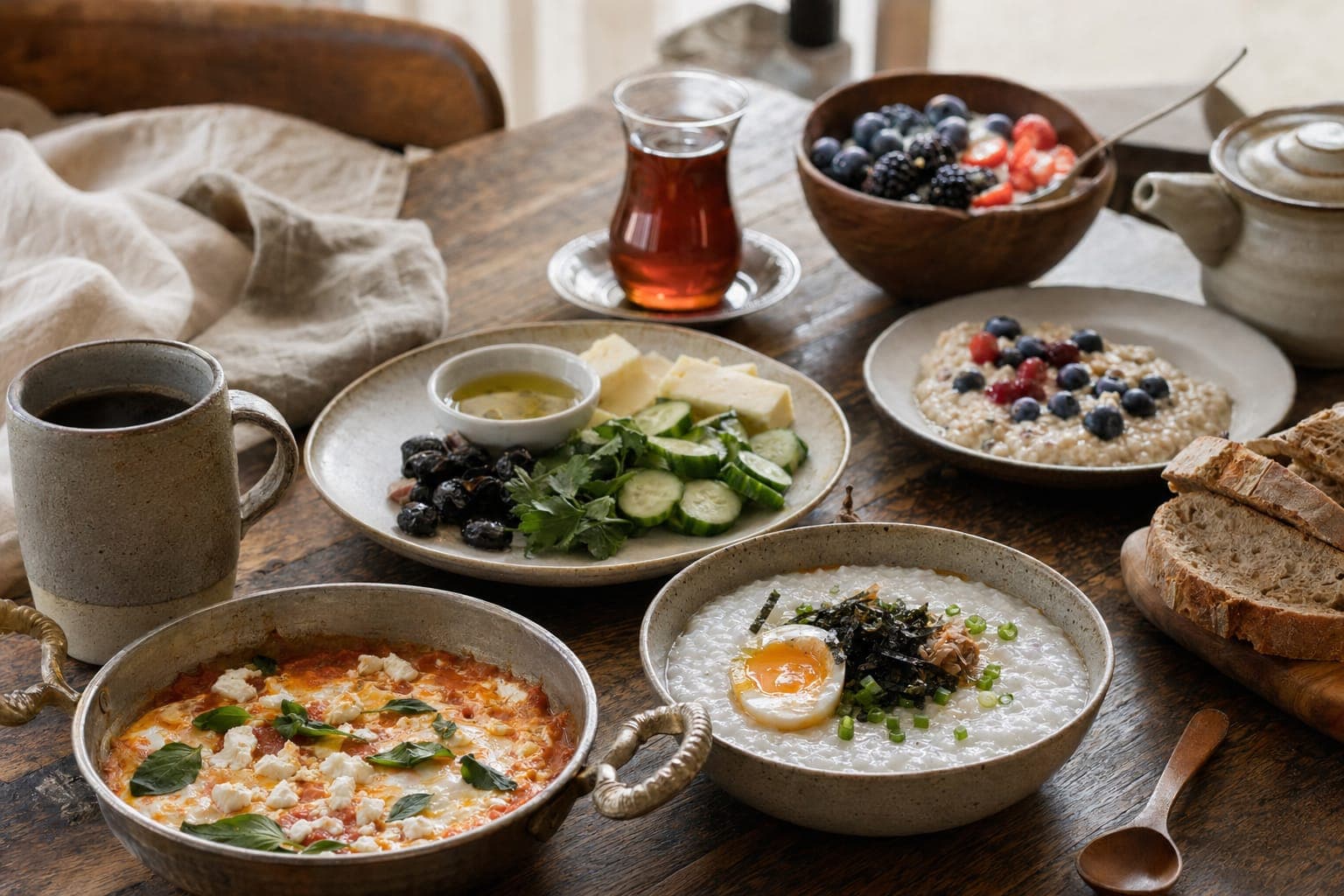
Ancestral Breakfast Ideas from Around the World
Traditional breakfast recipes from cultures that got nutrition right. Japanese, Turkish, Scottish, and more. Whole-food breakfast inspiration.
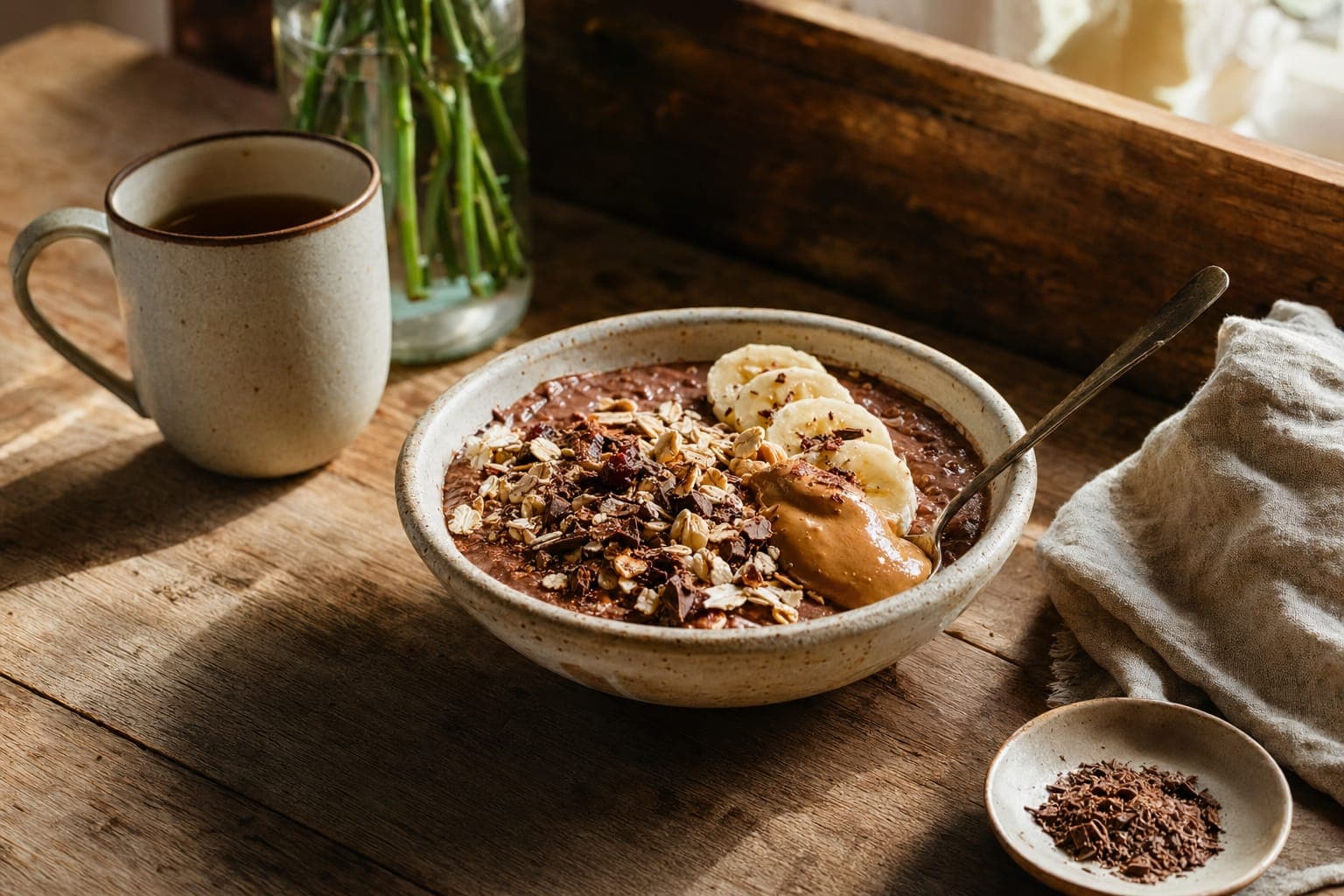
10 Ways to Use Organised That Aren't Just a Shake
Move beyond the basic shake. Discover 10 creative ways to use Organised in smoothie bowls, oats, yoghurt, baking, and more.


 Join over 100,000+ members
Build a better food system with us
The Organised community is thousands of people choosing real food and backing the farmers who grow it, all of us trying to leave the world a little better than we found it. If that is what you care about too, you belong here.