Why Nutrient Density Should Replace Calorie Counting
A 100-calorie portion of almonds and a 100-calorie portion of gummy bears contain exactly the same energy. But your body has no idea they're equivalent. One nourishes. One depletes. Treating them as interchangeable is the reason calorie counting fails.

By Niall Kiddle, Founder, Organised

Reviewed by Pedro Rodrigues, Agronomist (farming and sourcing only) ·
6 min read · Published · Updated · 3 cited sources
Makers of the Organised Daily blend, a grass-fed beef organ supplement from regenerative UK farms

For decades, nutrition science treated calories as the central variable. The logic was straightforward: if energy in minus energy out equals weight change, then managing calories should be the primary focus. Calories in, calories out. That's the rule.
But the human body isn't a simple calorie-burning machine. It's a complex biological system that responds not just to quantity but to quality. The shift from calorie-counting to nutrient-density thinking might be the single most important change in how people approach nutrition.

The calorie-counting assumption
The calorie-counting model assumes that all calories affect the body similarly. Whether you get 2000 calories from bread, olive oil, meat, vegetables, or donuts shouldn't matter metabolically, as long as the total is the same.
This assumption has driven nutrition policy for decades. Eat less, move more. It doesn't matter what you eat, as long as the calories balance. This logic led to low-fat diets that replace nutritious whole foods with processed alternatives. It led to portion control becoming the primary strategy for weight loss. It led to people counting macros obsessively while eating food-like substances with zero nutritional value.
And by almost every metric, it's failed. Obesity rates have skyrocketed despite people being more obsessed with calorie counting than ever. Metabolic disease is epidemic. People eat "healthily" by calorie standards and still feel tired, hungry, and metabolically damaged.
The problem isn't the logic. It's the assumption that all calories are metabolically equivalent.
Why calories aren't calories
This requires understanding how your body actually processes different foods.
When you eat processed carbohydrates with no fibre, your blood sugar spikes. Insulin surges. Leptin signalling becomes impaired. Your body stores excess energy as fat and continues to feel hungry despite having consumed calories. The 300 calories from a slice of white bread behaves completely differently metabolically than 300 calories from sweet potato with adequate fibre and nutrient density.
Protein has a higher thermic effect of food than carbohydrates or fat (roughly 20–30% of protein energy is used in digestion and processing) and is the most satiating macronutrient gram for gram in randomised trials.1
Different foods trigger different hormonal cascades. Different nutrient profiles activate different metabolic pathways. The micronutrients present or absent in food change how your body processes that food. Saying "a calorie is a calorie" ignores all of this biological reality.
Your body doesn't count calories. It responds to nutrient signals. When you give it real food, it knows what to do. When you give it processed food, it gets confused.
What nutrient density actually measures
Nutrient density is the amount of micronutrients, vitamins, minerals, phytonutrients, etc., per calorie of food.
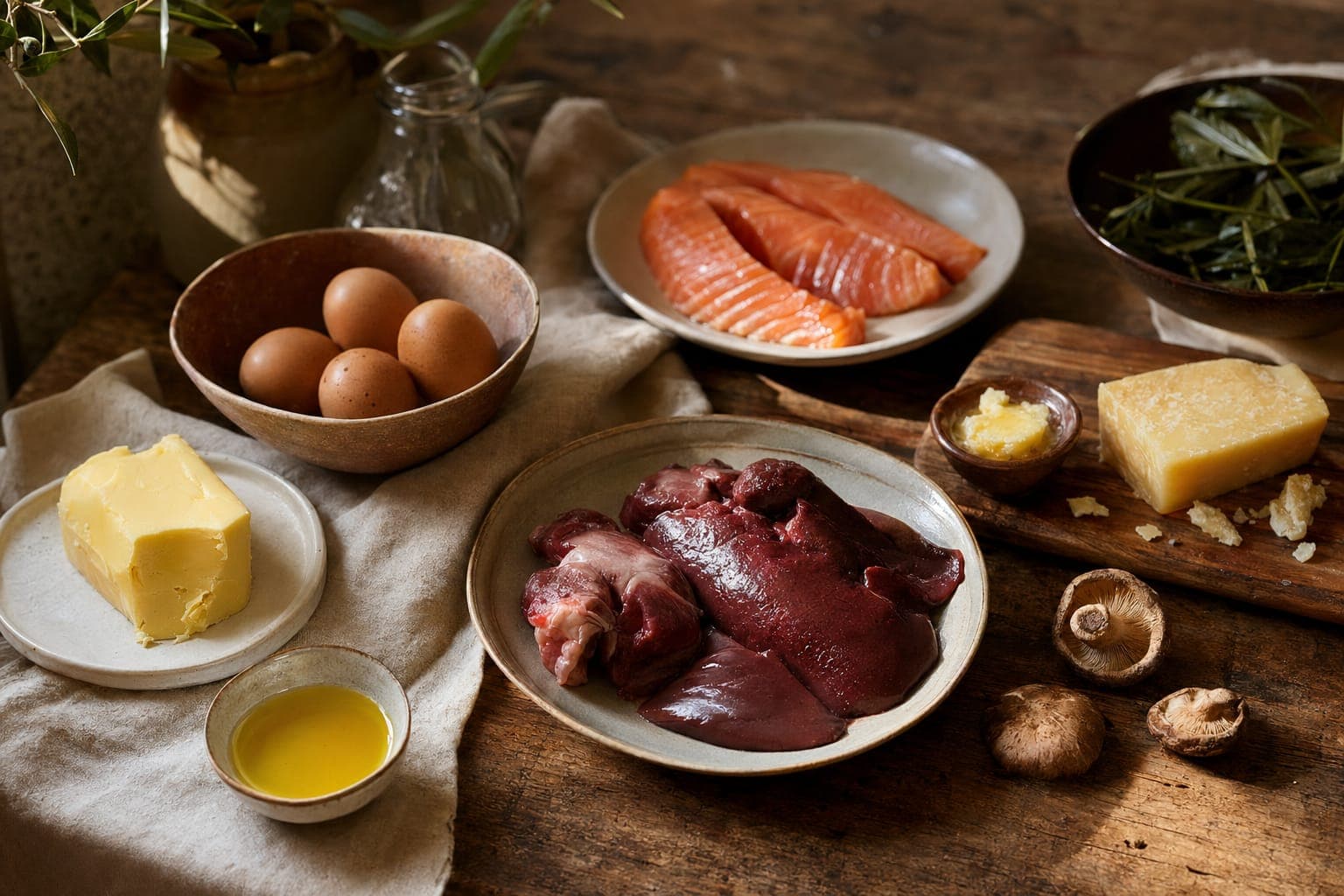
Beef liver is one of the most nutrient-dense foods per calorie, providing exceptional amounts of vitamin A, B12, folate, riboflavin, iron, copper and choline.3
A serving of broccoli contains fibre, vitamin C, sulforaphane, minerals, and phytonutrients in maybe 30 calories. Nutrient density: very high.
A croissant contains mostly refined carbohydrates, seed oil, and sugar, in maybe 300 calories. It contains negligible vitamins and minerals. Nutrient density: extremely low.
Nutrient density captures something calories don't: whether a food actually nourishes or merely fills. Whether it supports your metabolic systems or depletes them. Whether your body can extract what it needs or whether it leaves you depleted and still hungry.
Nutrient density and satiety
Here's the practical consequence. When you prioritise nutrient density, satiety follows naturally.
If you're eating nutrient-dense whole foods, you're getting adequate micronutrients. Leptin signals properly. Your brain receives accurate hunger signals. You feel satisfied after reasonable portions and don't feel compelled to keep eating.
If you're eating nutrient-poor processed foods, you're micronutrient-starved despite consuming calories. Your body keeps sending hunger signals because it hasn't actually been nourished. You eat more and more looking for the nutrients you need, but the foods you're eating can't provide them. Satiety never arrives. Overeating becomes nearly inevitable.
This is why someone eating 2000 calories of nutrient-dense whole foods often loses weight, while someone eating 1500 calories of processed food doesn't. The person eating real food is actually nourished and stops eating. The person eating processed food is still hungry because micronutrient needs are unmet.

How nutrient density affects body composition
A 2019 inpatient randomised crossover trial by Hall and colleagues found that adults consumed roughly 500 calories more per day on an ultra-processed diet compared with a calorie- and macronutrient-matched whole-food diet, and gained weight on the ultra-processed diet despite not being told to eat more.2
Why? Because nutrient density and satiety create an automatic calorie deficit. Not through restriction, but through genuinely feeling satisfied on less food.
Additionally, nutrient density supports metabolic health. The micronutrients in whole foods are cofactors for enzymatic systems that regulate metabolism. The antioxidants and anti-inflammatory compounds support the metabolic machinery. The whole-food matrix supports gut health and microbiome diversity, which influences metabolism itself.
Someone eating nutrient-dense foods is supporting their metabolic rate. Someone restricting calories while eating processed food is actually damaging their metabolic rate, they're underfed nutritionally even if they're adequate calorically.
Get the science, plainly, free
Two short reads a week on what the research actually says about nutrition.
By signing up you agree to receive emails from us. No spam, unsubscribe anytime.
Why the body responds to food quality
Your body evolved to process real foods. The enzymes in your digestive system, the nutrient sensors in your cells, the hormone-signalling systems, all of this developed over millions of years in response to whole foods from the natural world.
When you eat foods that match that evolutionary diet, meat, organs, fish, eggs, vegetables, fruit, tubers, nuts, seeds, your body's systems function optimally. Nutrient absorption works properly. Satiety signals fire correctly. Hormones balance naturally.
When you eat processed food-like substances, refined grains, seed oils, added sugars, artificial ingredients, your body's systems get confused. The nutrient sensors don't recognise the food. The hormone signals misfire. The gut bacteria that evolved on real food can't digest the processing byproducts.
This isn't about willpower or discipline. It's about biology. Your body literally functions differently when given different inputs.


1 of 9
Daily blend
100,000+ thriving families4.9 on Trustpilot
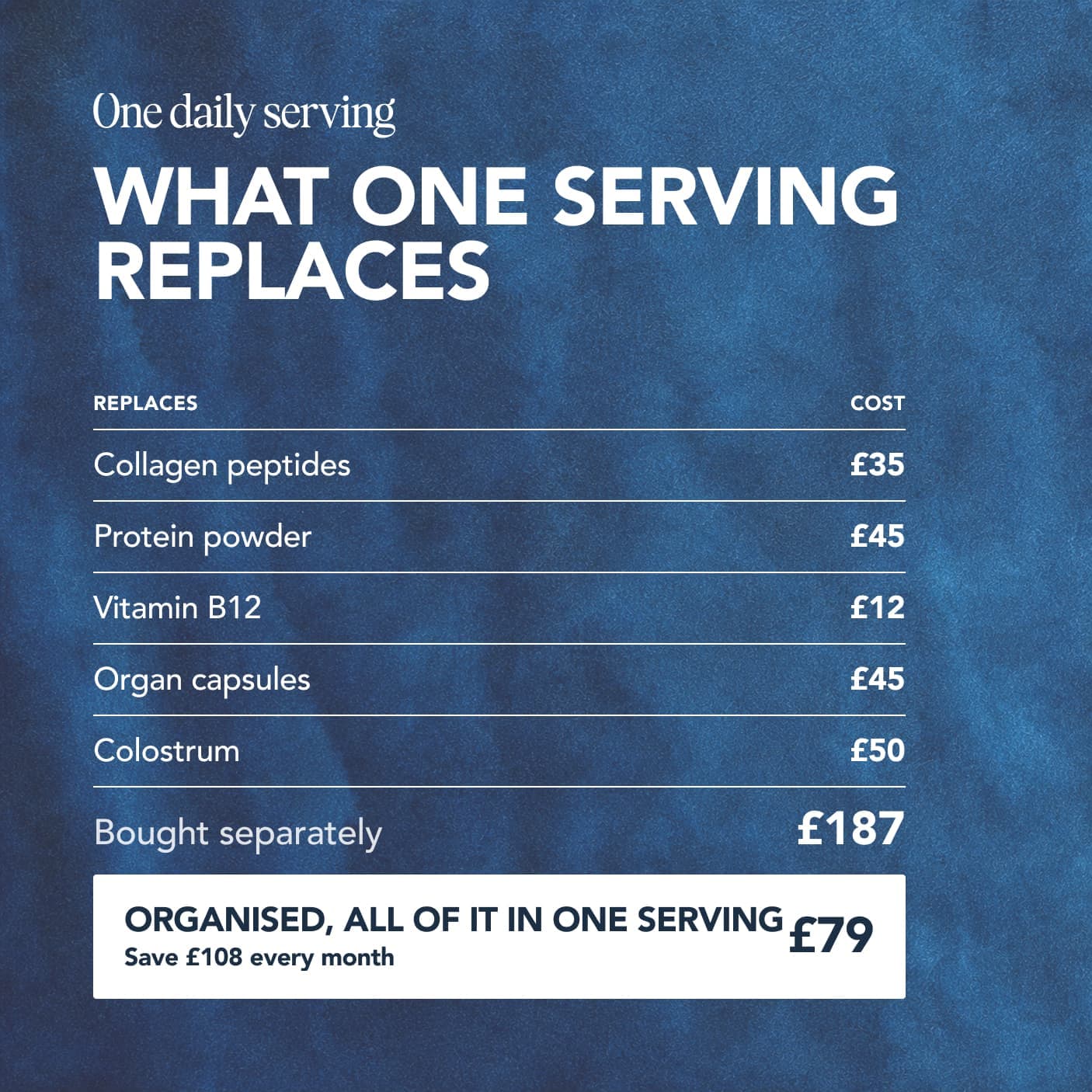
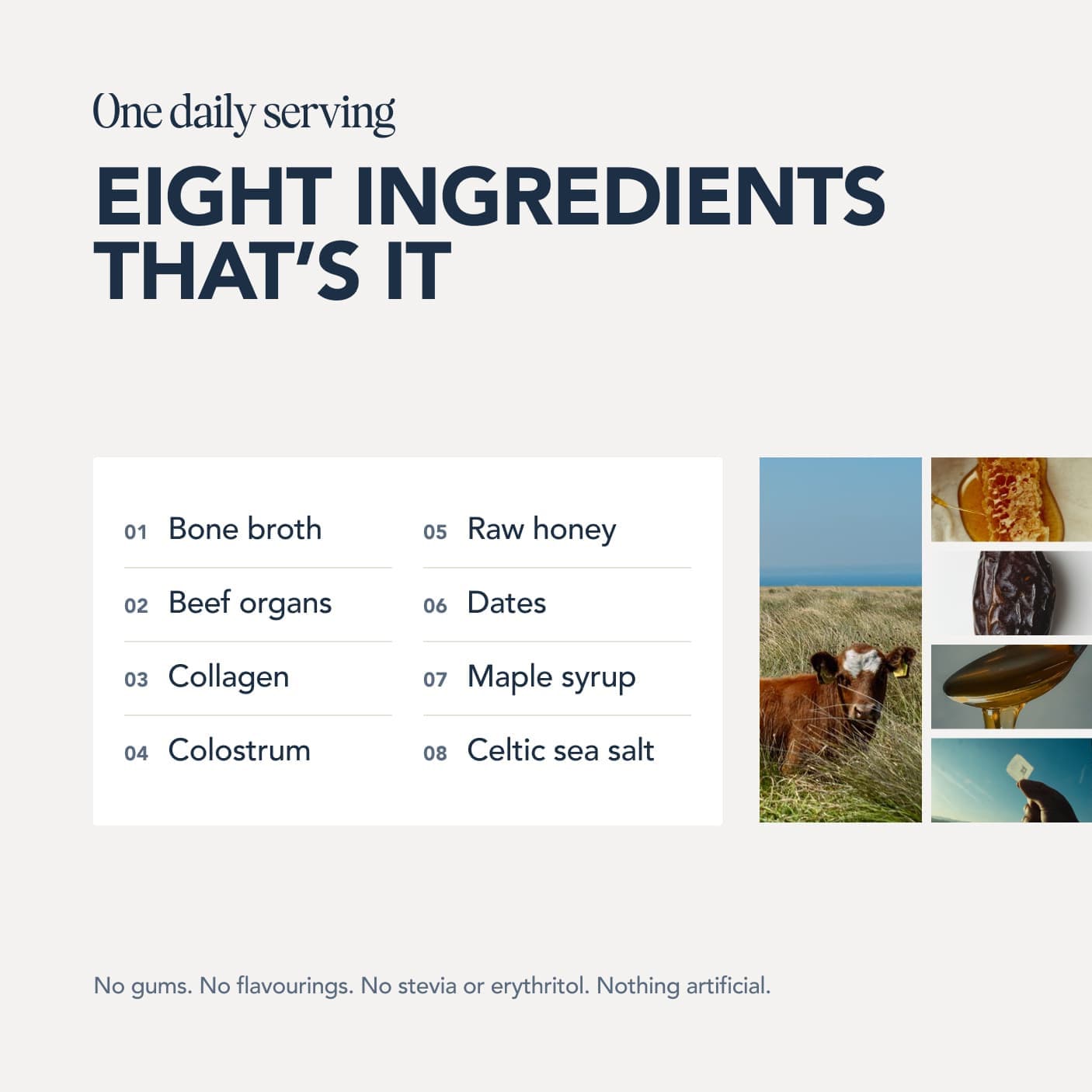
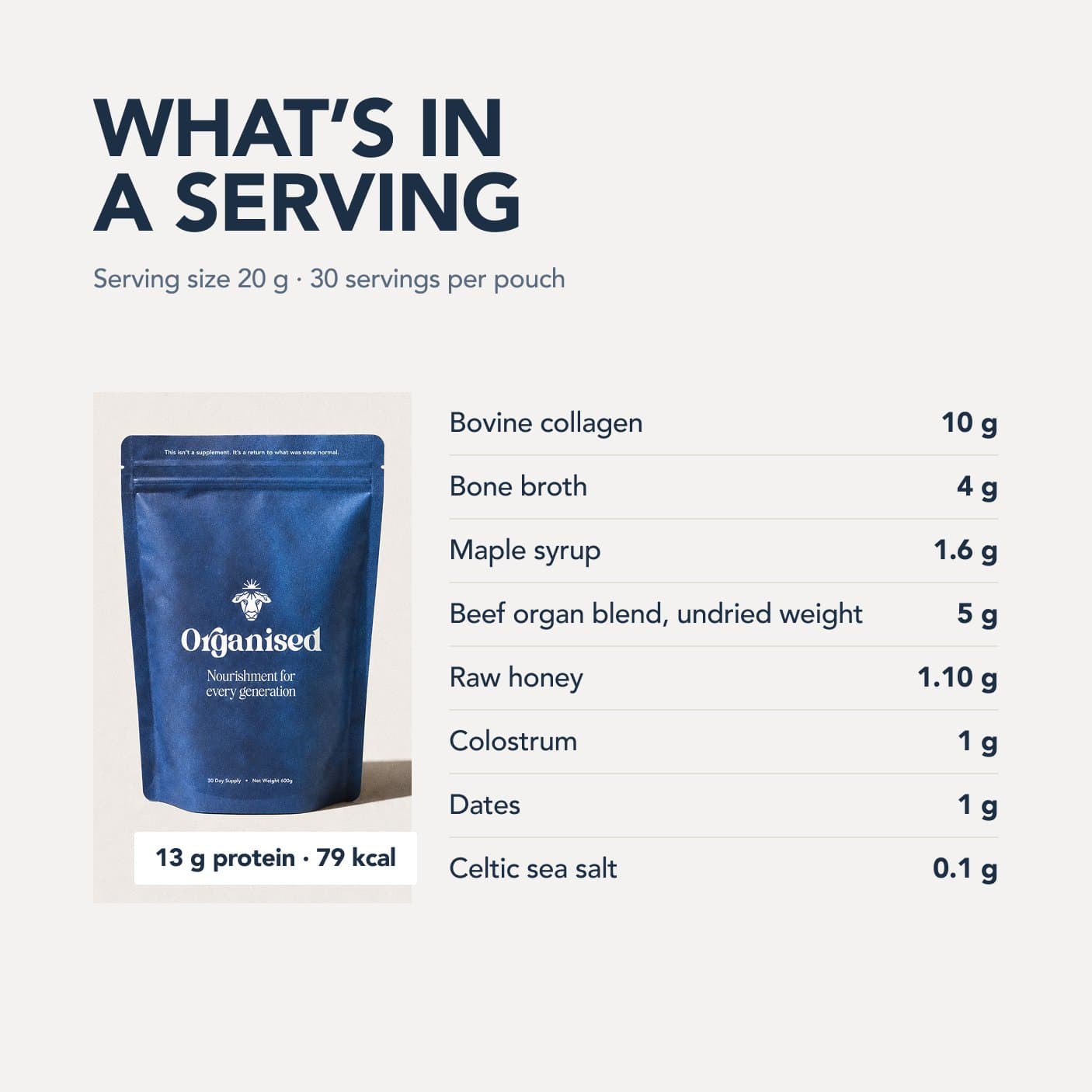
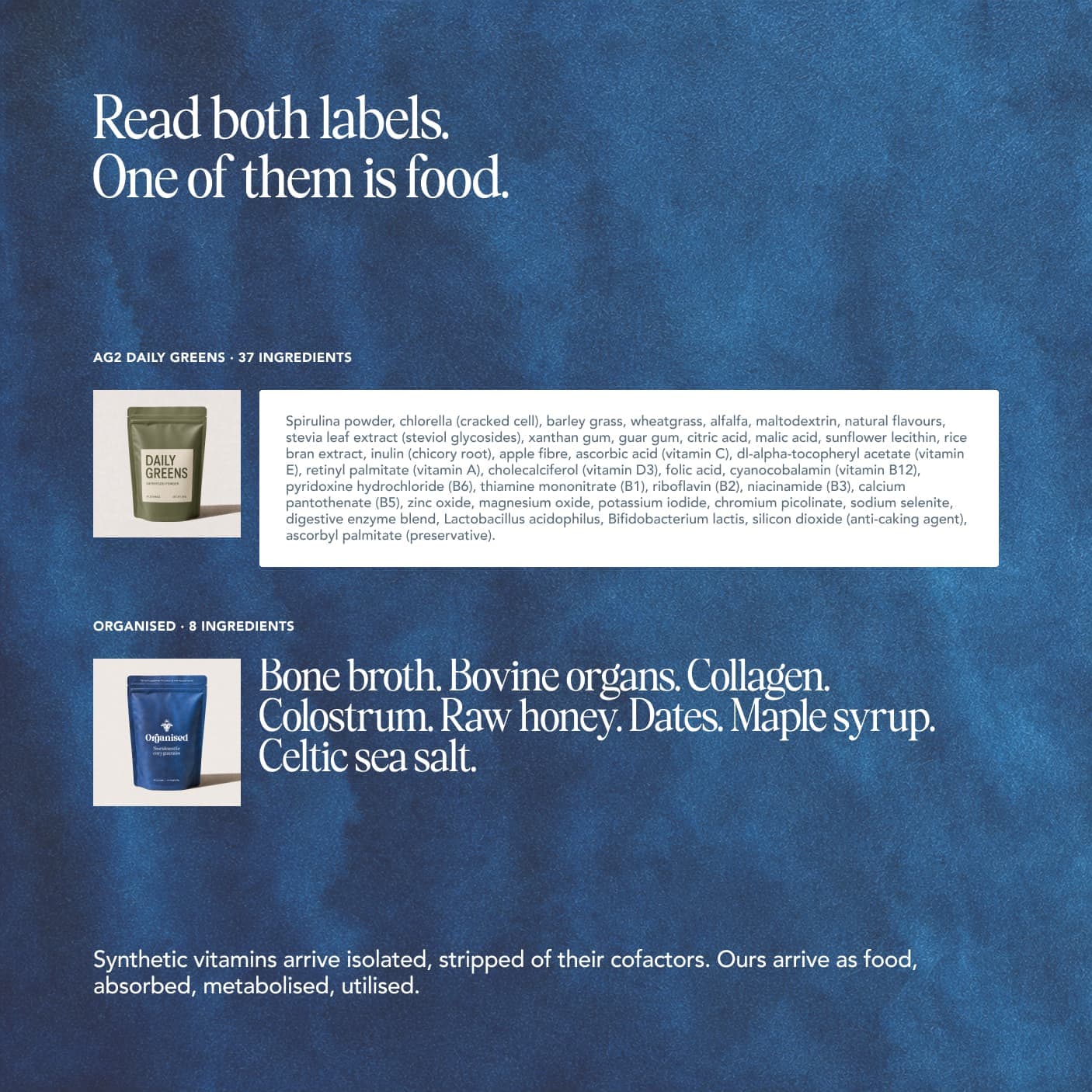
Eight real ingredients built around grass-fed beef organs, collagen and colostrum. Nothing synthetic added.
Free with your first order, worth £38. Plus £10 off the pouch with a subscription.



Free UK shipping · Made in England · 100 day money back guarantee on your first pouch · Skip, pause or cancel anytime
Practical nutrient density
How do you actually apply nutrient density thinking?
Stop counting calories. Start noticing how different foods make you feel. Do you feel satisfied after a small portion of nutrient-dense food? That's a sign your body is actually nourished. Do you feel hungry again an hour after eating processed carbohydrates? That's a sign your body is still nutritionally starved.
Build meals around nutrient-dense whole foods: beef or organ meat, fish, eggs, vegetables, fruit, whole grains, bone broth, good fats. These foods are self-limiting. You eat until you're satisfied, and satiety actually comes.
Avoid foods that don't nourish. Seed oils, refined grains, added sugars, ultra-processed items. These foods are designed to override satiety signals and keep you eating more than you need.
If you're concerned about portions, use satiety as your guide, not calorie counting. Are you satisfied? Good. Are you still hungry after a normal portion? That means the food isn't adequately nourishing, and you should change what you're eating, not restrict how much you eat.

Nutrient density also naturally favours whole foods. Meat, organ meat, fish, eggs, vegetables, and fruit are all nutrient-dense. Processed foods and refined carbohydrates are all low in nutrient density. So if you're prioritising nutrient density, you're automatically eating better foods. The framework does the work.
Calorie counting makes you obsess about the wrong variable. Nutrient density makes you naturally do the right thing.
The bottom line
The shift from calorie counting to nutrient density is a shift from a broken metric to a useful one. Calories tell you nothing about whether food nourishes. Nutrient density tells you everything that matters.
You don't have to count macros, track calories, or restrict portions obsessively. You have to eat nutrient-dense whole foods and trust your body's satiety signals. That's the entire framework. And it works far better than decades of calorie-obsessed approaches ever did.
The organs, beef liver, heart, kidney, are the most nutrient-dense foods available. A small serving provides more micronutrients than an entire meal of conventional foods. This is why ancestral peoples prized organs. They understood, intuitively, what modern nutrition science is finally catching up to: nutrient density is the variable that matters.
References
Every source below was checked on 27 August 2026. Each PubMed, PMC and DOI identifier was resolved against NCBI or Crossref, and what it opens is printed under the citation, so you can see the link goes where the citation says without leaving the page. Where a citation and its identifier disagreed, the citation was corrected to the record or the reference was deleted along with the sentence marker that pointed at it, and where the resolved paper turned out not to support the sentence, the sentence was cut back to what it does support. Borrowed authority is worse than none, because it looks like rigour.
- Westerterp KR. Diet induced thermogenesis. Nutrition & Metabolism. 2004. https://pmc.ncbi.nlm.nih.gov/articles/PMC524030/Checked 27 August 2026: PMC524030 opens Westerterp KR, Diet induced thermogenesis. Nutr Metab (Lond) 2004;1(1):5.
- Hall KD, et al. Ultra-Processed Diets Cause Excess Calorie Intake and Weight Gain: An Inpatient Randomized Controlled Trial of Ad Libitum Food Intake. Cell Metabolism. 2019. https://pmc.ncbi.nlm.nih.gov/articles/PMC7946062/Checked 27 August 2026: PMC7946062 opens Hall KD, Ayuketah A, Brychta R et al, Ultra-Processed Diets Cause Excess Calorie Intake and Weight Gain: An Inpatient Randomized Controlled Trial of Ad Libitum Food Intake. Cell Metab 2019;30(1):67-77.e3. PubMed indexes it as: Randomized Controlled Trial.The authors' own declaration, from the record: Declaration of Interests. CG Forde has received reimbursement for speaking at conferences sponsored by companies selling nutritional products, serves on the scientific advisory council for Kerry Taste and Nutrition, and is part of an academic consortium that has received research funding from Abbott Nutrition, Nestec, and Danone. The other authors have no conflicts of interest.
- U.S. Department of Agriculture, FoodData Central. Beef, variety meats and by-products, liver, raw. https://fdc.nal.usda.gov/food-search/
Who wrote and reviewed this guide
Niall Kiddle
Author · Founder, Organised
Niall is the founder of Organised. He started the company in 2024 after fixing his own health the slow way: in 2022 he swapped a cupboard of synthetic supplements for real food, raw milk, organ meats, bone broth and honey, and felt the difference within months.
Areas of expertise: Ancestral nutrition, Organ meats, Whole-food supplementation, Gut health, Regenerative sourcing
Read Niall's full profile
Pedro Rodrigues
Reviewer · Agronomist (farming and sourcing only)
Pedro is the agronomist Organised works with on farming and sourcing. His job on the guides is to keep the science honest: he reviews what we publish about soil health, regenerative agriculture, grazing and the way food is actually produced.
Areas of expertise: Regenerative agriculture, Agronomy, Soil health, Grass-fed farming, Food sourcing
Reviewed this guide on
Read Pedro's full profileMore on nutritional science
View all- 6 Mineral Deficiencies You Probably Have Without Realising
- Glutathione: Your Body's Master Antioxidant
- Methylation: What It Is and Why It Matters
- The Difference Between Heme and Non-Heme Iron (And Why It Matters)
- The Micronutrient Gap: Why Even 'Healthy' Diets Fall Short
- The Role of Fat-Soluble Vitamins: A, D, E and K
- Understanding Your Blood Work: A Nutritional Perspective
- What Is Oxidative Stress and How Does Nutrition Help?
Browse the guides library
All guidesKeep reading
Science
The Role of Fat-Soluble Vitamins: A, D, E and K
A clear guide to fat-soluble vitamins A, D, E and K2, how they work together, the best food sources and why organ meats are the richest source of them all.

Science
Collagen and Hair Density: Breaking Down the Reilly et al. Study
What the Reilly et al. research really shows about collagen and hair density. Why the 27% increase matters, and what to realistically expect.

Science
The Protein Leverage Hypothesis: Why We Overeat
The protein leverage hypothesis from Simpson and Raubenheimer explains how appetite chases a protein target and drives overeating of low-protein foods.
Real food, made effortless
See the blendA few ways to use it
All recipes
Whole Food Snacks for Busy Days
Practical whole food snacks that travel well and sustain energy. No refined carbs, no seed oils. Real food options for when you're busy.

Collagen-Rich Beef Stew: Slow-Cooked Nourishment
Beef stew that delivers collagen from connective tissue and bone broth. Winter comfort food that actually nourishes. Simple slow cooker recipe.

Gut-Healing Marshmallows with Collagen and Raw Honey
Learn to make gut-healing marshmallows with collagen and raw honey. A shareable treat that sneaks nutrition into every bite. Easy recipe with video tips.


 Join over 100,000+ members
Build a better food system with us
The Organised community is thousands of people choosing real food and backing the farmers who grow it, all of us trying to leave the world a little better than we found it. If that is what you care about too, you belong here.