Collagen Supplements on Reddit: Do They Actually Work?
Search 'does collagen work reddit' and you get thousands of opinions, half of them convinced it changed their skin and half convinced it is an expensive placebo. Here is what the threads actually agree on, where they get it wrong, and what the research says once you cut through the noise.

By Niall Kiddle, Founder, Organised

Reviewed by Pedro Rodrigues, Agronomist (farming and sourcing only) ·
5 min read · Published
Makers of the Organised Daily blend, a grass-fed beef organ supplement from regenerative UK farms
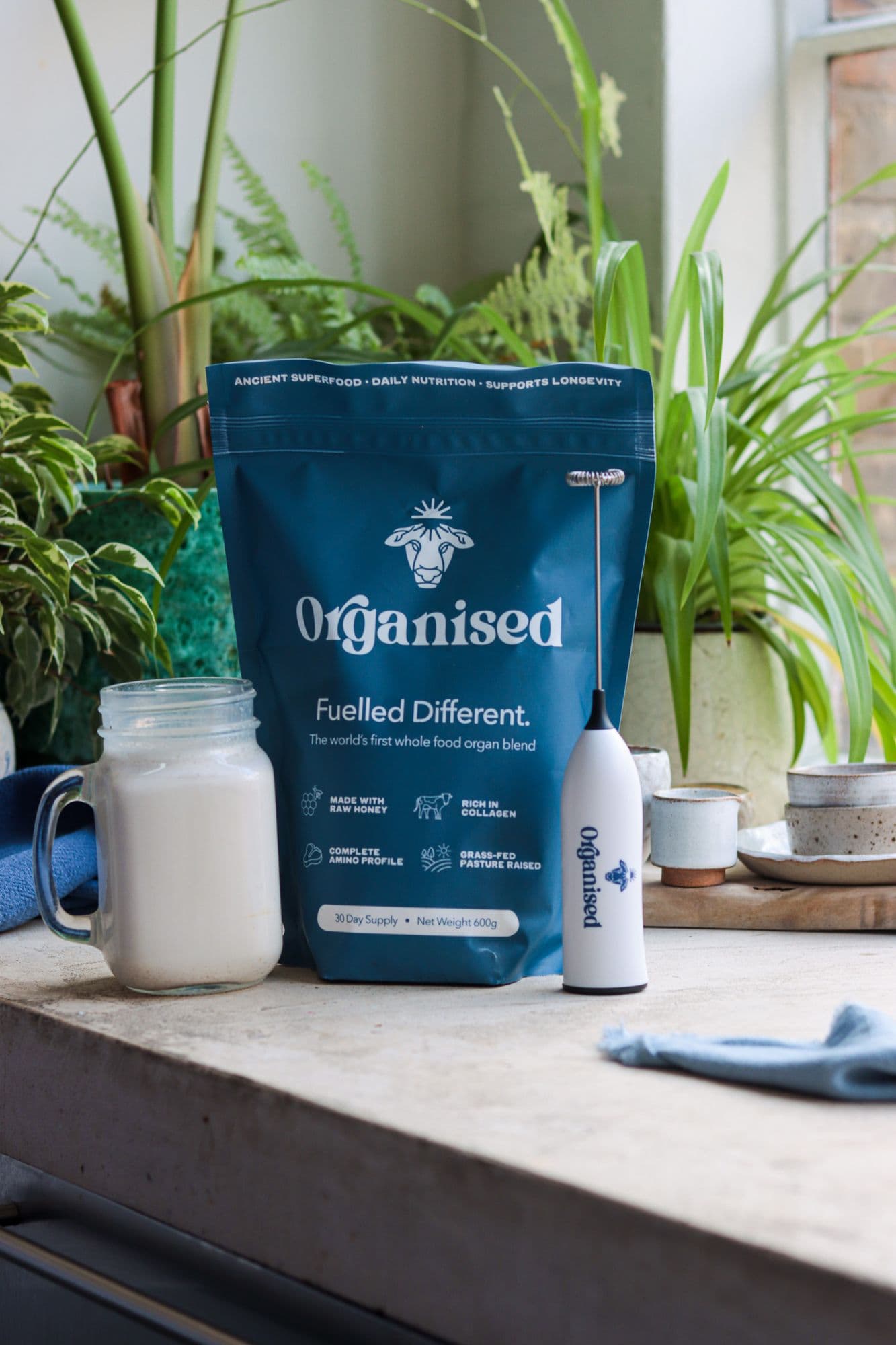
Collagen is one of the most argued-about supplements on the platform. It shows up constantly in r/Supplements, r/SkincareAddiction, r/xxfitness and r/Nutrition, usually as some version of the same question: is this worth the money, or am I just paying for expensive protein powder?
What people actually ask about collagen on Reddit
The recurring threads cluster into a few honest questions. People want to know whether collagen does anything for skin and joints, whether the type of collagen matters, which brands are worth it, and whether they could just eat protein and get the same result. Underneath all of it is the real anxiety: nobody wants to be the person who fell for a marketing trend.
The most upvoted replies tend to be cautious. The consensus is rarely 'miracle' and rarely 'total scam'. It usually lands on 'seems to help some things, at a real dose, over months, if you are consistent'. That is actually close to what the studies show, which is unusual for a supplement this hyped.
What Reddit tends to get right
A few points come up again and again, and the crowd is broadly correct on them.
- Dose and consistency matter more than brand. Threads repeatedly point out that people who saw nothing were often taking a token amount for two weeks. The studies that show a skin or joint effect use meaningful daily doses over eight to twelve weeks or longer.
- Hydrolysed collagen peptides are the sensible form. Redditors correctly note that the peptide (hydrolysed) form is what almost every trial uses, because it is broken down for absorption. Gelatin works too but is less convenient.
- Vitamin C helps. The more knowledgeable comments mention that your body needs vitamin C to build collagen, so pairing them is reasonable. This is genuinely how collagen synthesis works. Vitamin C is not the only cofactor either: your body also uses minerals like copper and zinc to build and cross-link collagen, which is why traditional diets paired gelatin-rich cuts with organ meats and shellfish. The easiest whole-food source of the vitamin C itself is ripe fruit, so a little citrus or a handful of berries alongside your protein covers it.
- It is not a complete protein, and that is rather the point. The fitness subs are right that collagen is low in some essential amino acids, so it should not replace your main protein source if muscle is the goal. What they miss is that its glycine is doing a job of its own, balancing the methionine and tryptophan concentrated in muscle meat, which most people eating boneless cuts get too little of.
The honest Reddit consensus on collagen is not 'miracle' or 'scam'. It is 'a real dose, taken consistently for a couple of months, seems to help skin and joints for a lot of people'.
Get ingredient guides like this, free
Two short reads a week on the ingredients that matter and how to actually use them.
By signing up you agree to receive emails from us. No spam, unsubscribe anytime.
Where the threads go wrong
The comment sections also carry some confident nonsense worth flagging.
"Your stomach just breaks it into amino acids, so it can't do anything specific." This is the most repeated takedown, and it is only half right. Collagen is digested into peptides and amino acids, but research has detected specific collagen-derived peptides in the blood after ingestion, and the leading theory is that these peptides act as signals that nudge your own cells to produce more collagen. So the mechanism is more interesting than 'it is just protein'.
"Marine collagen is far superior." Marine collagen is absorbed well and is a fine choice, especially for anyone avoiding beef, but the claim that it dramatically outperforms bovine collagen for skin is not well supported. Both are used successfully in trials. Sourcing quality matters more than the animal, so look for grass-fed, well-raised bovine or wild-caught marine rather than a vague label.
"Bone broth is the same thing, cheaper." Bone broth is genuinely good food, but the amount of collagen you get from a bowl is variable and usually far below a measured supplement dose. They are complementary, not identical.
1 of 9
Daily blend
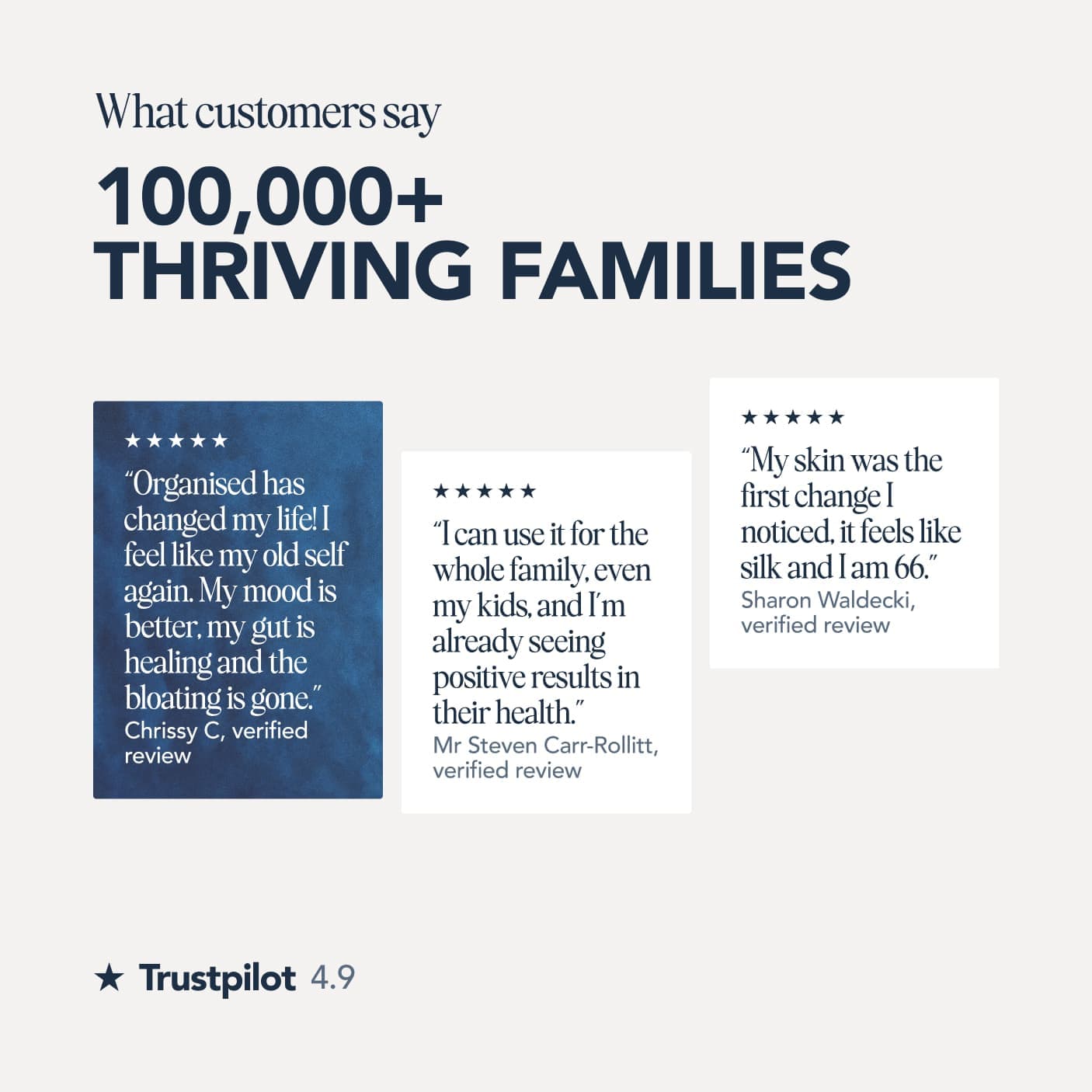
100,000+ thriving families4.9 on Trustpilot
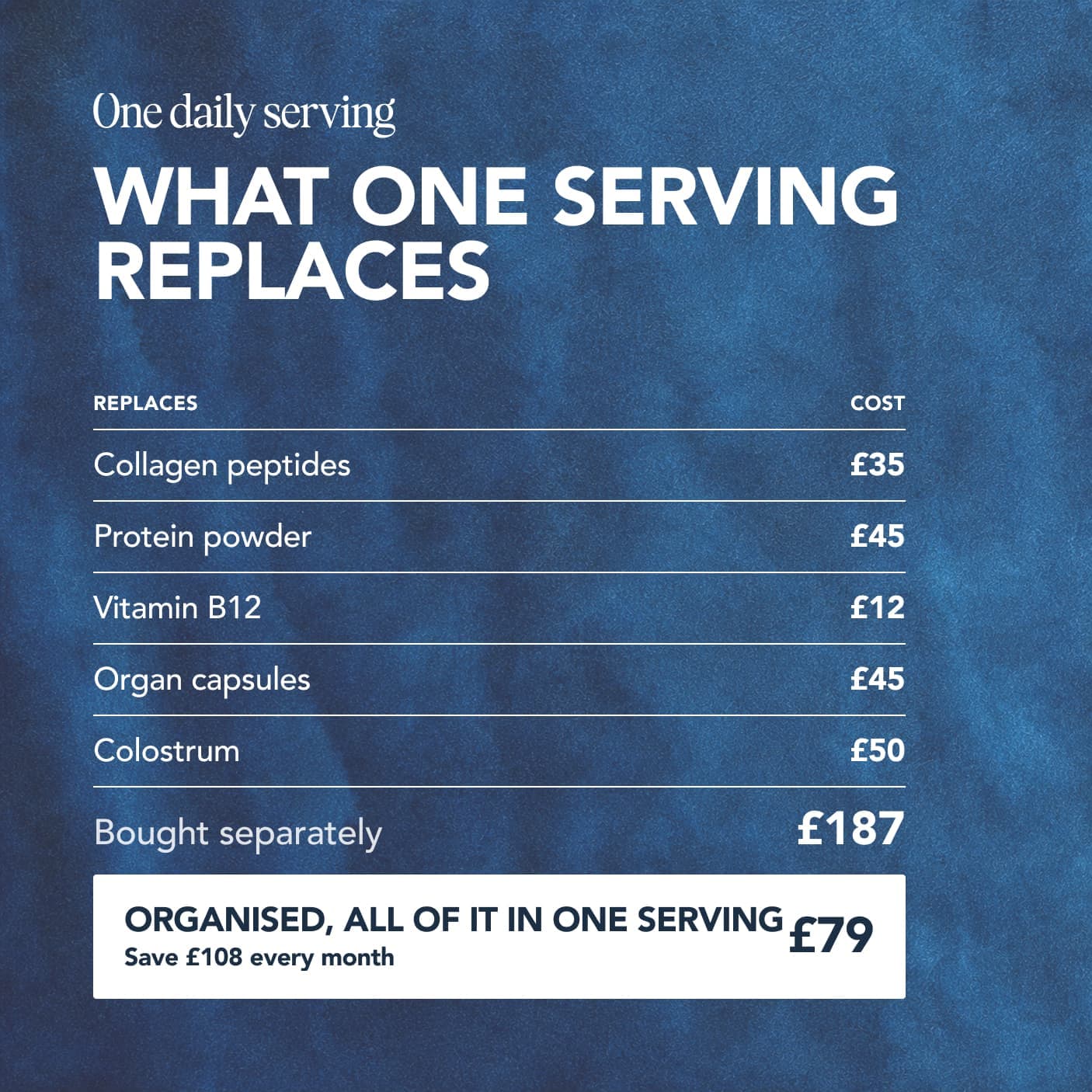
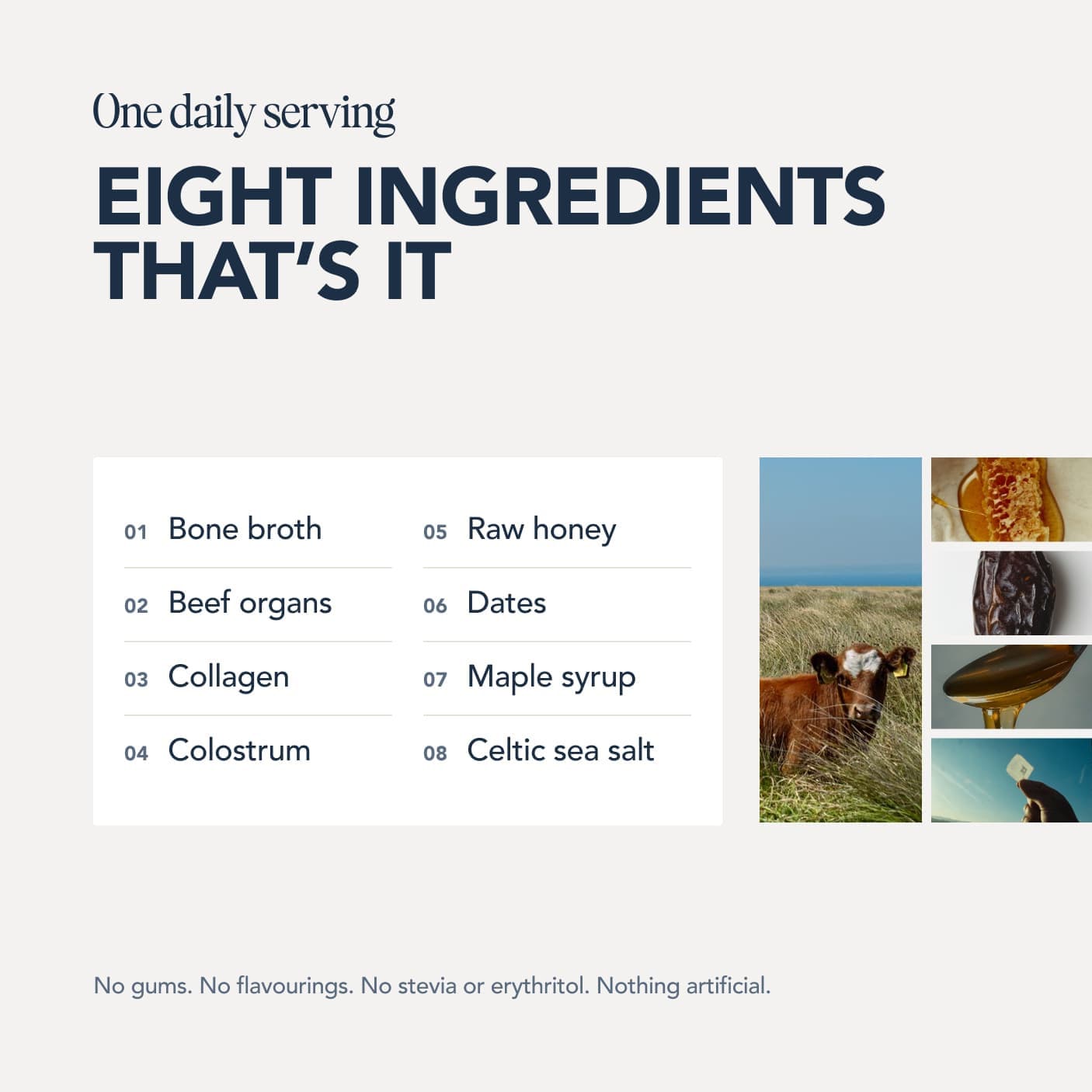
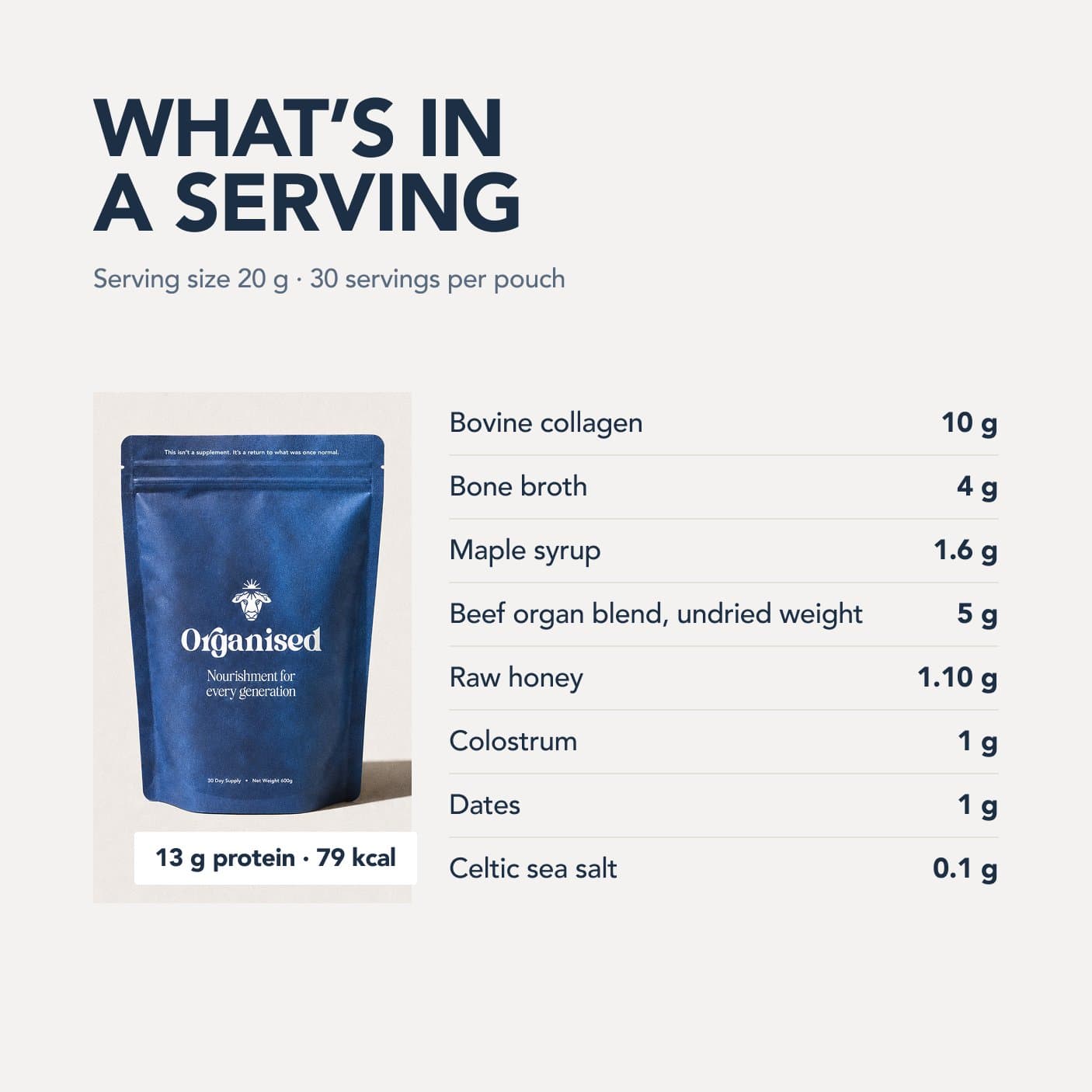
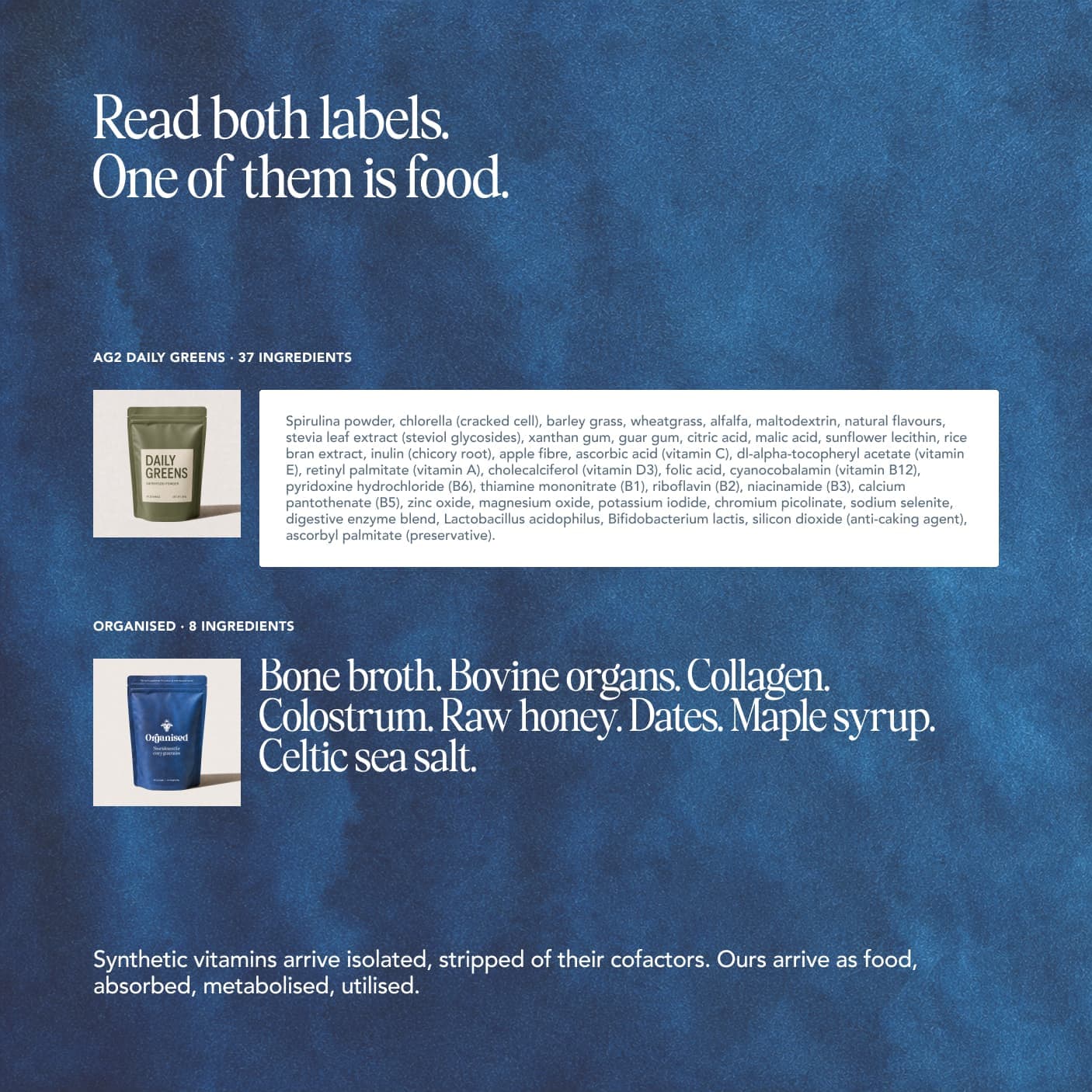
Eight real ingredients built around grass-fed beef organs, collagen and colostrum. Nothing synthetic added.
Free with your first order, worth £38. Plus £10 off the pouch with a subscription.

Free UK shipping · Made in England · 100 day money back guarantee on your first pouch · Skip, pause or cancel anytime
What the evidence says
Stripping out the hype, this is where the research actually sits. For skin, multiple randomised trials report modest improvements in elasticity and hydration after roughly eight to twelve weeks of daily supplementation. The effect is real but incremental, not a filter. For joints, there is reasonable evidence for reduced activity-related joint pain, which is why it is popular in the running and lifting communities. Glycine, the amino acid collagen is richest in, is also mildly calming and anti-inflammatory, part of why gelatin-rich foods have such a settled, traditional reputation. For a fuller, referenced breakdown of collagen types, sourcing and dosing, our complete guide to collagen peptides covers the mechanisms in depth.
The practical takeaways line up with the better Reddit comments: use a hydrolysed peptide, take a proper daily dose, give it two to three months, pair it with vitamin C and enough total protein, and treat it as a supporting player rather than the main event. Better still, build the base from whole animal foods that are naturally rich in collagen, like slow-cooked bone-in cuts, skin and connective tissue, and treat the peptide powder as a convenient concentrate on top.
Common questions
Does collagen actually work for skin according to Reddit?
The prevailing view is yes, modestly, for hydration and elasticity, but only with a real daily dose taken consistently for two to three months. People expecting overnight changes are the ones who report nothing.
What is the best collagen on Reddit?
Threads rarely crown one brand. The advice that gets upvoted is to ignore branding and choose a plain hydrolysed collagen peptide with a transparent dose per serving and third-party testing, rather than a flavoured blend padded with fillers.
Is marine or bovine collagen better?
Both are well absorbed and both appear in successful studies. Marine suits pescatarians and anyone avoiding beef, bovine is usually cheaper. Sourcing and dose matter more than the source animal.
Can I just eat protein instead?
Total protein supports collagen synthesis, but collagen supplements deliver a specific amino acid and peptide profile that ordinary protein does not. If joints or skin are your target, they are not interchangeable.
The bottom line
Reddit's collective verdict on collagen is more sensible than its reputation suggests: not magic, not a scam, but a genuinely useful supplement for skin and joints when you take a real dose for long enough. The people who are disappointed almost always under-dosed or quit early. Buy a plain peptide, be consistent for a couple of months, and judge it then.
Who wrote and reviewed this guide
Niall Kiddle
Author · Founder, Organised
Niall is the founder of Organised. He started the company in 2024 after fixing his own health the slow way: in 2022 he swapped a cupboard of synthetic supplements for real food, raw milk, organ meats, bone broth and honey, and felt the difference within months.
Areas of expertise: Ancestral nutrition, Organ meats, Whole-food supplementation, Gut health, Regenerative sourcing
Read Niall's full profile
Pedro Rodrigues
Reviewer · Agronomist (farming and sourcing only)
Pedro is the agronomist Organised works with on farming and sourcing. His job on the guides is to keep the science honest: he reviews what we publish about soil health, regenerative agriculture, grazing and the way food is actually produced.
Areas of expertise: Regenerative agriculture, Agronomy, Soil health, Grass-fed farming, Food sourcing
Reviewed this guide on
Read Pedro's full profileMore on collagen
View all- Collagen Peptides: A Complete Guide to Types, Sources and Benefits
- Can You Get Enough Collagen from Food Alone?
- Collagen and Hair Growth: Separating Fact from Hype
- Collagen for Gut Health: Rebuilding Your Intestinal Lining
- Collagen for Joint Pain: What Does the Evidence Say?
- Does Collagen Actually Work for Skin? What the Research Says
- The Amino Acids in Collagen and Why They Matter
- What Happens When You Take Collagen Every Day for 90 Days?
- When Does Your Body Start Losing Collagen? (And What to Do About It)
Browse the guides library
All guidesKeep reading
Ingredients
Collagen Peptides: A Complete Guide to Types, Sources and Benefits
Complete guide to collagen peptides. What they are, why type I and III matter, grass-fed vs marine, and the research behind them.
Ingredients
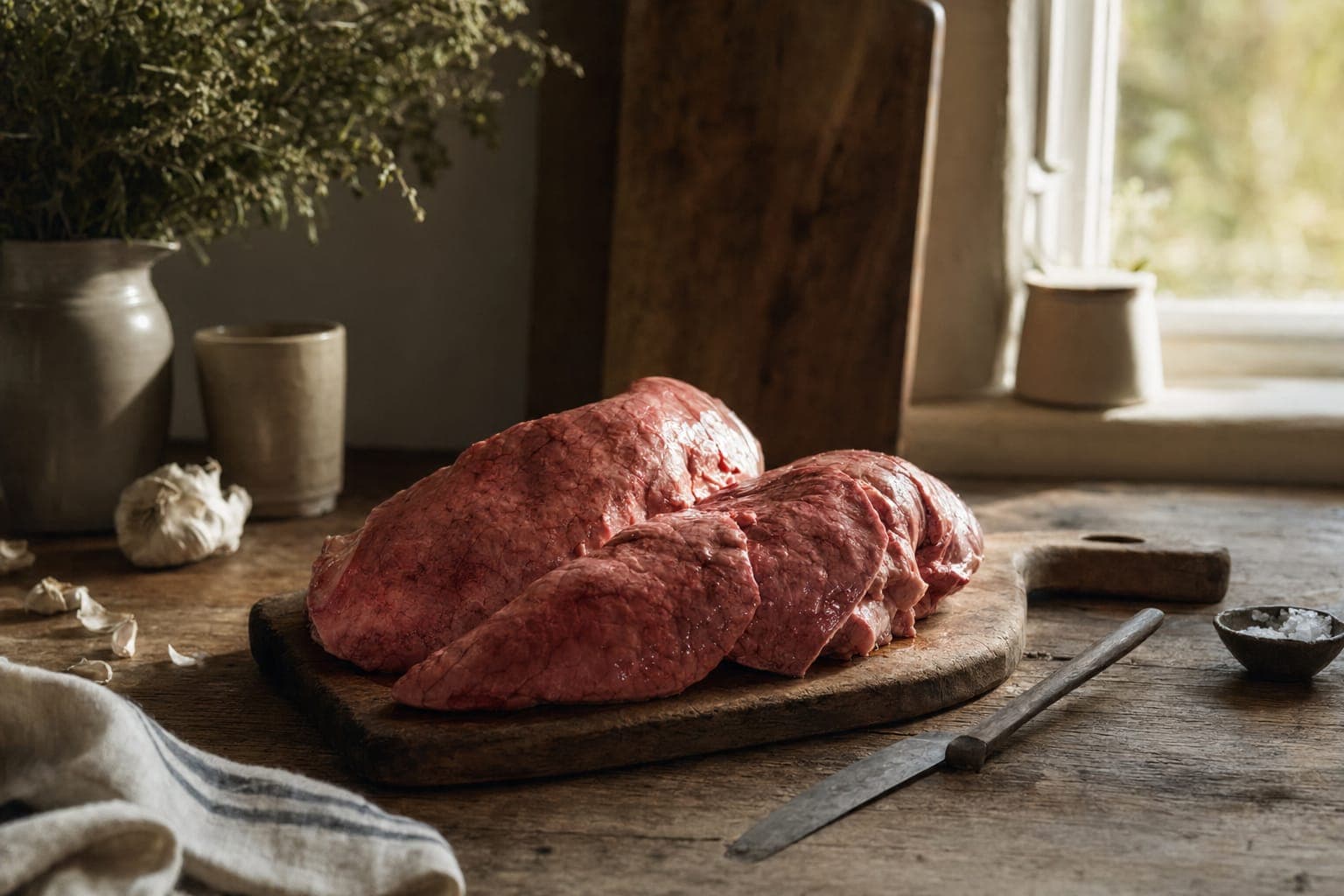
Beef Lung: What It Contains and Why It Matters
Beef lung is a lean source of elastin and protein. See why this nose-to-tail organ supplement earns a place in ancestral, whole food eating.
Ingredients
Colostrum vs Probiotics: Do You Need Both?
Understanding the difference between colostrum and probiotics. Learn whether you need both and how to use them together.
Real food, made effortless
Try the organ blendA few ways to use it
All recipes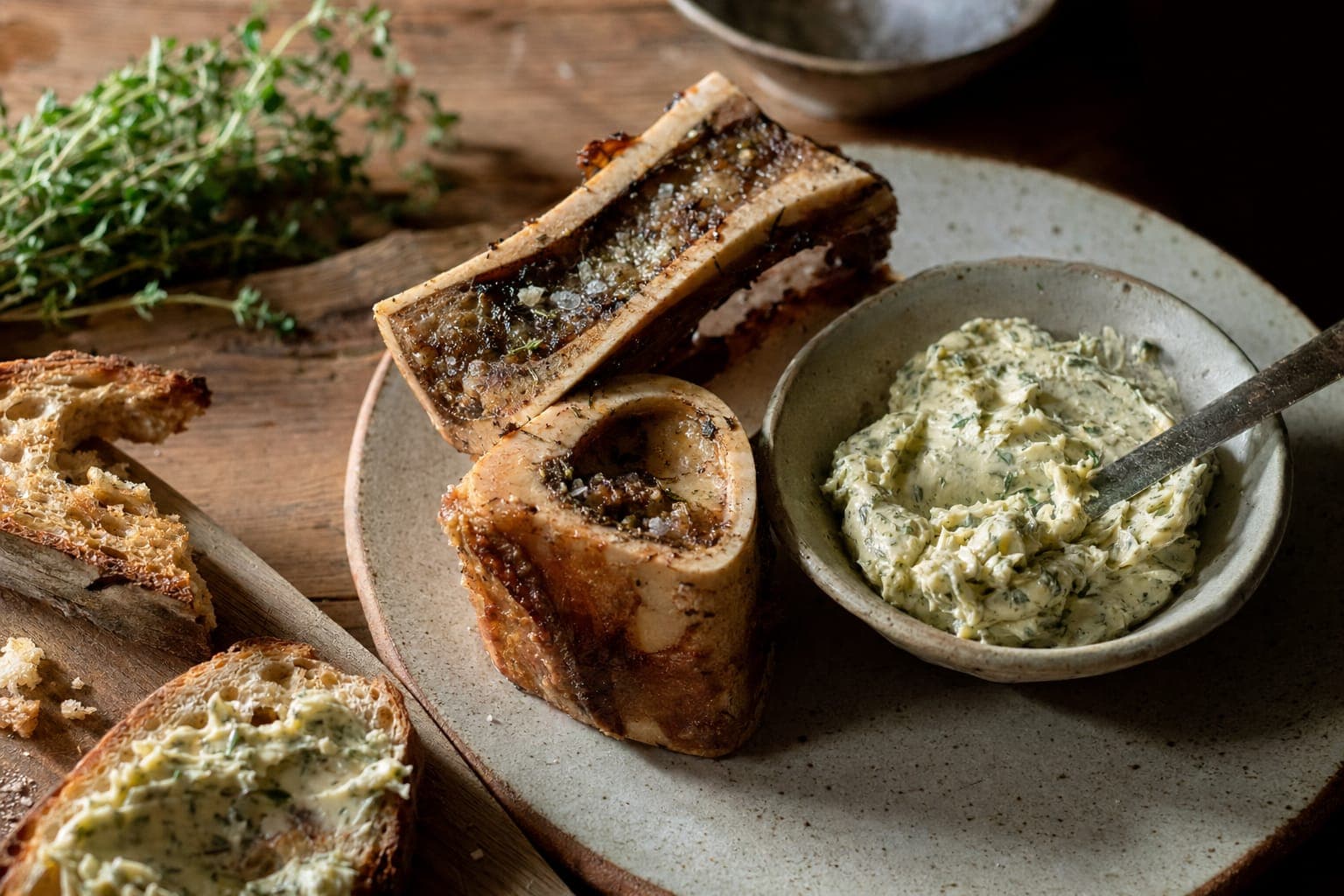
How to Make Bone Marrow Butter
Roast grass-fed marrow bones, scoop the marrow, and mix with butter and herbs. A nutrient-dense spread with fat-soluble vitamins.
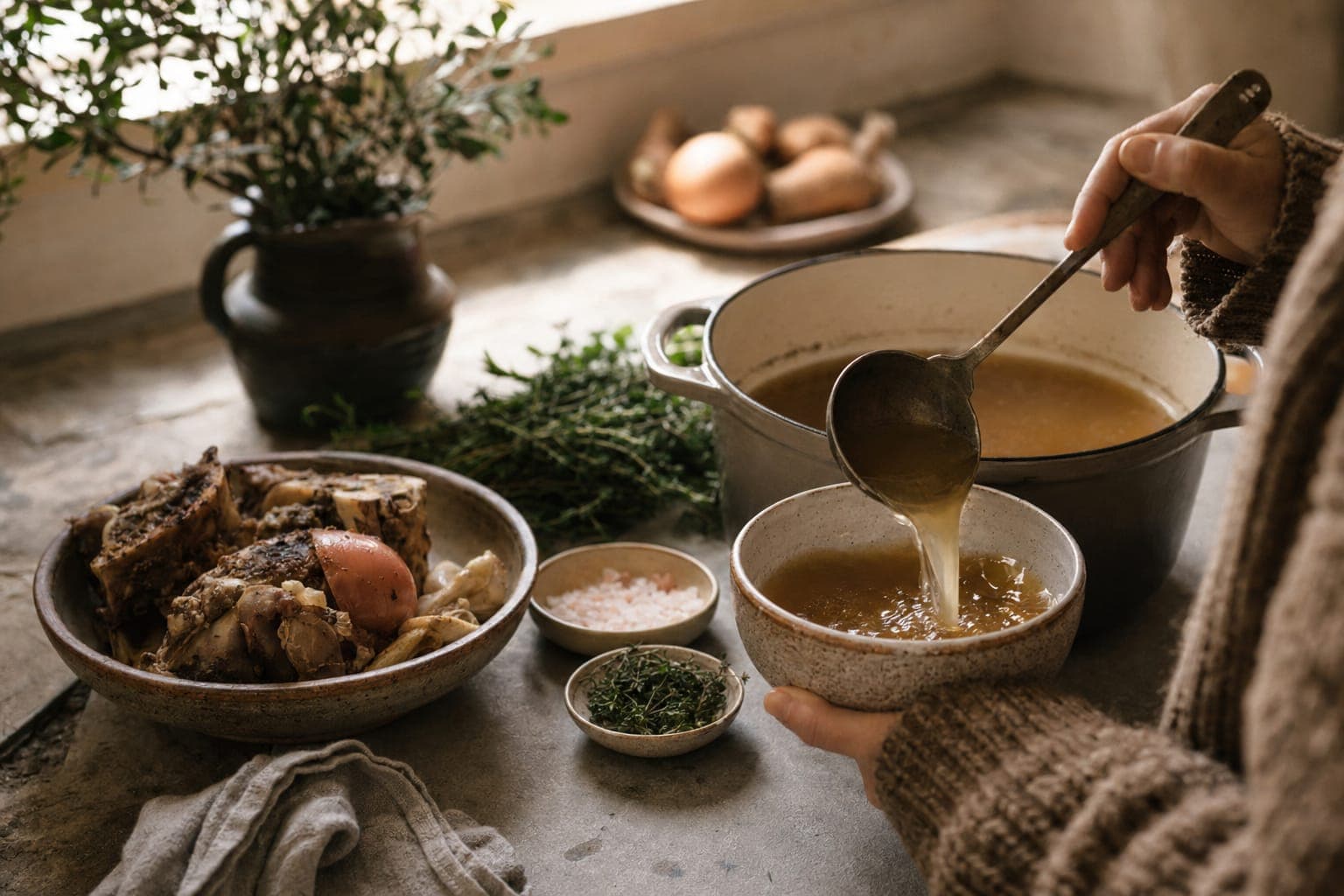
Bone Broth from Scratch: A Step-by-Step Guide
Step-by-step guide to making bone broth at home. Stovetop, slow cooker, and Instant Pot methods. Rich in collagen and gut-healing minerals.
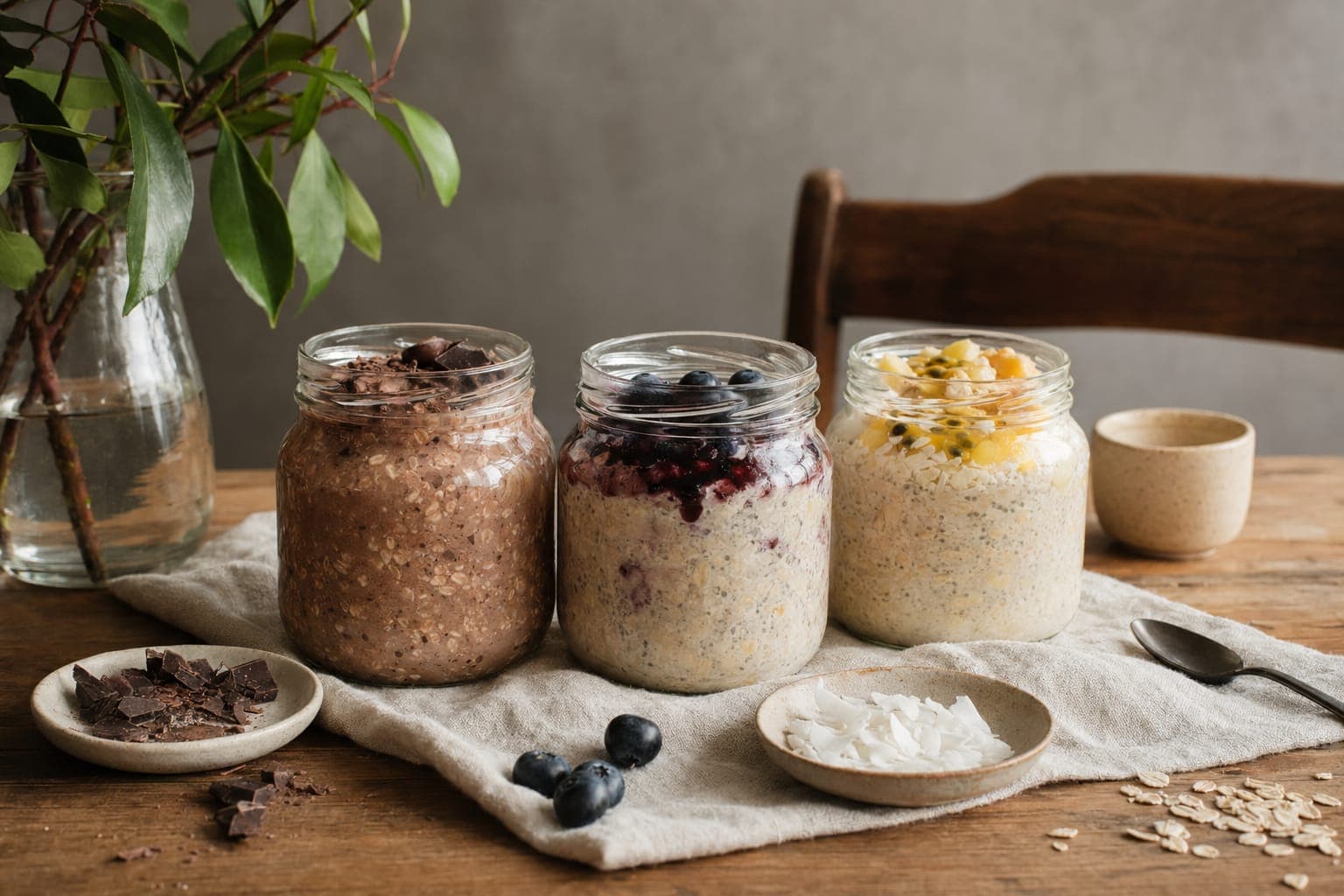
Organised Overnight Oats: 3 Variations
Three delicious overnight oats variations with Organised. Chocolate, berry, tropical flavours. Make them Sunday, eat them all week.


 Join over 100,000+ members
Build a better food system with us
The Organised community is thousands of people choosing real food and backing the farmers who grow it, all of us trying to leave the world a little better than we found it. If that is what you care about too, you belong here.